The Seven Dials Mystery by Agatha Christie: Free EPUB, AZW3 & KEPUB Download
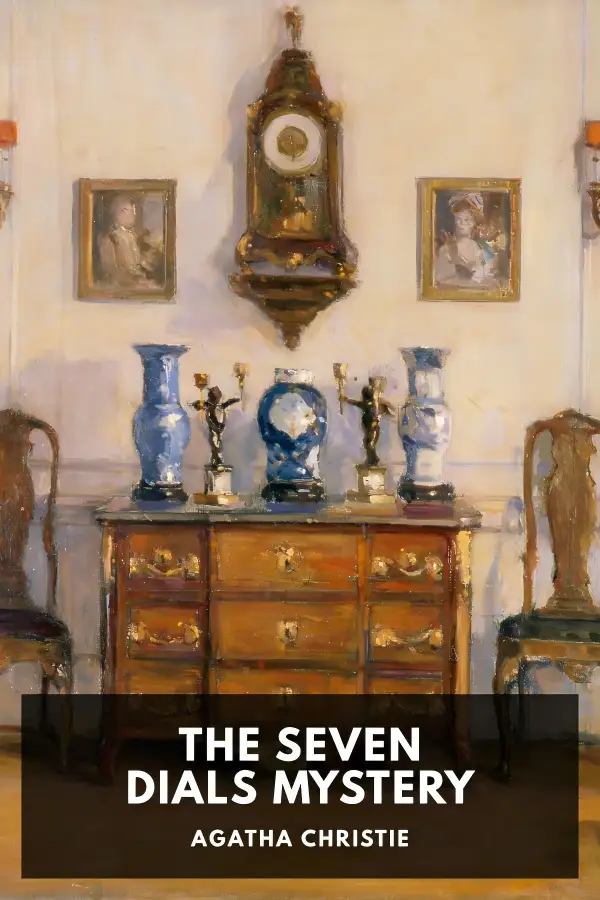
The Seven Dials Mystery
📖 Click to Read the Opening Pages Online Preview
Chapter I, On Early Rising: the first minutes at Chimneys
That amiable youth, Jimmy Thesiger, came racing down the big staircase at Chimneys two steps at a time. So precipitate was his descent that he collided with Tredwell, the stately butler, just as the latter was crossing the hall bearing a fresh supply of hot coffee. Owing to the marvellous presence of mind and masterly agility of Tredwell, no casualty occurred.
“Sorry,” apologized Jimmy. “I say, Tredwell, am I the last down?”
“No, sir, Mr. Wade has not come down yet.”
The preview stops a few lines into Chapter I. The complete text is in the free download below.
Download Full EPUB1929 — a house party, eight alarum clocks and a society that meets behind a shuttered door
~65,000 words (estimated)
Approx. 3.6 hours
Superintendent Battle, book 2
London and the Chilterns, 1920s
34 chapters in 12 groups
EPUB · AZW3 · KEPUB
0.30 MB (EPUB) · 0.41 MB (AZW3) · 0.34 MB (KEPUB)
Public domain in the United States
Project Gutenberg #75288
The Seven Dials Mystery is Agatha Christie’s 1929 country-house puzzle with a secret society at its centre. A weekend party at Chimneys buys eight alarum clocks and plants them beside the bed of the guest who is always last down, a practical joke that is still unfunny when the door is opened and he is found dead. Christie keeps the tone light and the machinery exact: a shooting party, a stolen formula, a masked club behind a shuttered door, and a young woman, Bundle Brent, who refuses to be frightened off. It is the second outing for Superintendent Battle, and it shows how much Christie could do with a house, a clock and a lie told politely.
What still works is the fairness of it. Every clue is set out in the open, the servants matter as much as the guests, and the joke about early rising turns into a question about who was awake at three in the morning. The book is lighter than The Murder of Roger Ackroyd and more cheerful than The Mystery of the Blue Train, but the plotting is just as disciplined, and the last chapter explains everything without cheating. It is also a comedy, and a good deal of the pleasure is in the talk. The text is available via Project Gutenberg #75288.
The Seven Dials Mystery by Agatha Christie: Summary, Characters & Themes
This summary and analysis follows The Seven Dials Mystery from its first morning at Chimneys to the unmasking in a club room off a London square, and it stops short of naming the killer. Agatha Christie published the book in 1929, four years after The Secret of Chimneys, and she brought back two of that novel’s characters: Lady Eileen Brent, known to everyone as Bundle, and Superintendent Battle of Scotland Yard. The result is a detective story that behaves like a comedy of manners until the moment it does not. It was written at the end of a decade in which Christie had published eight novels, and it carries some of that experience: the mechanism is simple, the suspects are numerous, and the reader is trusted. By 1929 she had already written The Murder of Roger Ackroyd, the book that made her famous, and the plotting here is just as careful, though the mood is far lighter and the jokes come faster.
The opening is a joke. Gerry Wade is the guest who is always last down, a champion sleeper whom his friends have long since given up expecting at breakfast. They drive into Market Basing and buy eight alarum clocks, and after dinner they creep into his room and set them to go off one after another from half past six. The clocks perform exactly as advertised, and nothing else happens; the house sleeps through the racket. By noon his door is still shut, and when it is opened Gerry Wade is found dead, with seven clocks ranged on the mantelpiece and the eighth thrown out on to the lawn. The doctor speaks of chloral, and the inquest settles on misadventure, which is the polite word for a young man who did not wake up. Nobody behaved badly: the servants were asleep, the guests were in their rooms, and the eight clocks were the only witnesses. The house had done nothing to help him.
Christie then hands the case to Bundle, who is twenty-one, rich, bored and entirely without fear. A letter from Gerry, half finished and full of apology, sends her looking for a man called Jimmy Thesiger; a dying man on a dark road gasps the words Seven Dials at her; and a visit to Scotland Yard produces the information that there is no such place any more, because the district was pulled down years ago. None of this stops her. She questions servants, follows a footman to a nightclub, hides in a cupboard during a meeting of masked men and comes out with a story nobody in authority wants to hear. She is helped, reluctantly, by Bill Eversleigh, who loves her, and by Jimmy Thesiger, who is more frightened than he admits. Her father, Lord Caterham, who would rather be at a sale than in a crisis, supplies the running commentary of a man who has been through it all before.
The second half moves the action to Wyvern Abbey, where George Lomax is entertaining an Air Minister, a visiting inventor and a good deal of self-importance. A formula disappears, a shot is fired in the dark, and the case turns on the difference between a left hand and a right one. Christie is scrupulous here: the clues are the sort a reader can hold in the hand, and the solution depends on a physical detail that has been visible since the first hundred pages. The house itself is a character: state rooms, a terrace, a library with a window opening on to ivy. The suspects are not master criminals but weekend guests with golf handicaps and too much money, which is exactly where Christie liked to put a murderer. The mechanics matter: a glove that fits the wrong hand, a revolver with no fingerprints, a bullet in a tree, a set of footprints measured in wet grass. Christie builds her solution out of objects rather than confessions.
The book is a useful hinge. It has the country-house machinery of the earlier novels, the political anxieties of the period, and a heroine who is allowed to be funny. It also shows the workshop: the timetable, the false alibi, the servant who saw something, the clue planted in plain sight. The complete text runs to roughly 65,000 words and is in the public domain in the United States, which is why a clean transcription is available from Project Gutenberg. Agatha Christie’s life and the shape of her career are set out on Wikipedia. Two natural companions on this site are The Murder of Roger Ackroyd, the book that made her reputation, and The Mystery of the Blue Train, written the year before this one. A third is The Big Four, the Poirot thriller she published in 1927. For the period’s taste for locked rooms and weekend parties, see our classic books by length and reading time index.
Historical Context
Britain in 1929 was between two worlds. The war was eleven years past, the General Strike three, and the slump was still ahead; the country still ran on coal, servants and trains, and the great houses were beginning to be let to men whose money came from steel rather than land. Christie registers the change without comment. Chimneys belongs to Lord Caterham, who cannot afford it and does not much like it, and it has been rented for the season by Sir Oswald Coote, a self-made manufacturer who talks about efficiency and punctuality. Christie had grown up in exactly this world of house parties and rented estates, and she describes its small humiliations with an insider’s accuracy. The house is a business now, and its servants know it.
The political background is the other half of the period. Sir Stanley Digby, the Air Minister at Wyvern Abbey, is negotiating over an invention that could change the balance of power in the air, and the guests talk about it the way people in 1929 did: as a matter of national survival and enormous profit. The book also carries the decade’s fear of secret organisation, of Bolshevism, of foreign agents in London clubs. Christie uses that fear as scenery, then quietly turns it around: the society with the masks is not what the reader has been told it is. In 1929 the aeroplane was still a novelty and a national secret worth killing for, which is why the formula at the Abbey is treated as a matter of state.
The novel also belongs to the moment when the detective story became a game with rules. Christie had published The Murder of Roger Ackroyd in 1926 and had been through the worst year of her life; by 1929 she was writing steadily, and the Detection Club, which would formalise the fair-play code, was founded within a year. Her detectives here work by observation and patience rather than by inspiration, and the book is careful to give the reader the same evidence they get. She was thirty-eight when it appeared, already famous, and writing at a speed that later critics found hard to forgive and readers have never minded. The fair-play rule she obeyed is the reason the book can be reread, and reread it has been.
Key Characters & Literary Archetypes
- Lady Eileen Brent: Called Bundle, twenty-one, daughter of Lord Caterham, and the engine of the plot. She drives her own Hispano, treats danger as an interruption, and has the useful habit of going where she is not wanted. She is not a detective and does not pretend to be one; she simply refuses to accept the official version, and her impertinence gets her further than other people’s good manners. Her father’s patience with her is one of the book’s running jokes.
- Jimmy Thesiger: A sociable young man of no fixed occupation, first met racing downstairs at Chimneys and colliding with the butler. He is charming, quick, and always short of money, and he becomes Bundle’s ally in the investigation. Christie uses him as a romantic lead and as a set of eyes, and gives him the most engaging scenes in the book, so that the reader likes him long before there is any reason to think about him at all.
- Superintendent Battle: The large, slow-spoken Scotland Yard officer with a wooden face and a reputation for political cases. He appears late, says little, and lets other people underestimate him, which is his method. Battle had already met Bundle at Chimneys four years earlier, and their mutual wariness is one of the book’s quiet pleasures. He is the professional against whom the amateurs are measured, and he is in no hurry to be proved right. He has a way of asking a question and then waiting, which nobody in the book can resist answering.
- Loraine Wade: Gerry Wade’s half-sister, brought up with him after her mother remarried, and now alone in the world. She is quiet, pretty and apparently helpless, and everyone in the book decides what to do with her. Christie gives her one long solo chapter of her own, in which she drives into a dark park at midnight and behaves with more courage than she is credited for. She is the book’s quietest figure and its most useful witness. Nobody asks her what she wants, and Christie makes that omission part of the mystery.
- Sir Oswald Coote: The steel manufacturer who has rented Chimneys, a man of enormous energy and no sense of humour. He holds forth on punctuality and the virtues of early rising, and expects the house to agree with him. His wealth and his certainties make him a natural suspect for a reader who has learned to distrust self-made men in detective fiction, and Christie lets that suspicion run for a long time. She gives him no charm at all, which is itself a kind of clue.
- Bill Eversleigh: A Foreign Office junior, old friend of Gerry Wade and Ronny Devereux, and hopelessly in love with Bundle. He is large, cheerful and not clever, and his function is to be sincere in a book full of people who are not. Christie gives him the best comic scenes and the last word on the marriage question, which is exactly where a character like Bill belongs. He is the only person in the novel who says what he means. He is also the only one never once suspected, which is its own kind of joke.
Core Literary Themes
- The country house as a closed world: Chimneys and Wyvern Abbey are both sealed systems: a fixed guest list, a servants’ hall with its own information network, and doors and windows that can be watched. Christie uses the form to limit the suspects and then to widen the crime, because in a house everyone is both a guest and a witness, and the person who brings you coffee at six in the morning knows more than the person who shares your dinner table. The servants’ hall is where the timetable is really kept. The house is also a timetable, and a timetable is what an alibi needs.
- The practical joke that turns serious: Eight alarum clocks, wound and hidden beside a sleeping man’s ear, are a prank about early rising. By noon the joke has produced a dead body, a missing clock and a question about who was awake. Christie’s theme is that a joke is a rehearsal for something else: the same ingenuity that hides clocks in a bedroom can arrange a death, and the same people who laugh at breakfast will lie to a policeman before lunch. The clocks, once they are found, are the only timetable anyone can trust.
- Amateurs against professionals: Bundle, Jimmy and Bill stumble about the case while Battle works quietly and refuses to share. Christie is careful not to make the police stupid: Battle is slow because he is thorough, and the amateurs succeed mainly by being rude, mobile and unafraid of embarrassment. The tension between the two modes of inquiry, gossip and procedure, is the book’s real subject, and it is settled in the last chapter in the professional’s favour. His patience is not stupidity, though the book enjoys letting the others think so. The reader is handed the same evidence and asked to be less polite about it. The amateurs get the excitement, the frights and the credit; the professional gets the arrest.
- Secret societies and the fear of conspiracy: The masked club with its numbered members and its absurd oaths is presented first as a criminal conspiracy, then as something else entirely. Christie is playing with the decade’s appetite for hidden organisation, the feeling that behind ordinary politics there must be a room with a locked door. The joke is that the society is real, disciplined and entirely respectable, and the crime is committed by someone standing outside it. The fear is real, the object of the fear is not what it seems, and the joke is on the reader who wanted a gang. The society’s secrecy is real; its criminality is not.
- Courtship, disguise and performance: Almost everyone in the book is playing a part: Bundle as a maid, the Countess as a fragile exile, George Lomax as a statesman, Jimmy as a fool. Christie links the marriage plot to the mystery by making both depend on seeing through a performance. The proposals, the misunderstandings and the final pairing are not decoration; they are the same test of character the detective applies to the evidence. The last proposal is a test of attention, and the right answer depends on having watched rather than listened. The romance is settled by the same evidence that settles the crime. The book’s last joke is that the proposal is a piece of evidence.
Why Download Our Custom E-Reader Edition of The Seven Dials Mystery?
This edition is built from the Project Gutenberg transcription of the 1929 text, cleaned and set for reading on a phone, a tablet or a dedicated e-reader. The chapter divisions are Christie’s own, the ellipses and the dropped punctuation are left as the printers set them, and nothing has been modernised, abridged or rewritten for a contemporary audience, and nothing in the text has been flagged or annotated. The text is the 1929 text, chapter for chapter, and short enough for a coat pocket.
The file is small, the markup is simple and the table of contents works on old Kindles as well as new ones. There are no footnotes to tap, no advertisements and no sample chapters; the book opens at Chapter I and ends at the last line, and the reading position is remembered by whatever device you use. If you read on a phone the type scales; if you read on e-ink the file is light enough to stay quick, even on a first-generation reader.
It is also free in the sense that matters: no account, no email address, no newsletter. The novel is in the public domain in the United States, the transcription has been proofread against the printed text, and the files can be copied, converted and kept for as long as you want them. You can put the book on a shelf of your own, lend it, print it, or delete it, and nothing about it will change. No account, no tracking, no reminder emails.
- Project Gutenberg transcription, via Project Gutenberg #75288, checked against the printing history and the chapter headings of the 1929 edition, so the page follows the book rather than a later editor’s idea of it.
- Complete thirty-four chapter text No abridgement and no invented titles: the thirty-four chapters as Christie divided them, with the original punctuation, the original names and the original ending intact.
- EPUB, AZW3 and KEPUB One download per format, so the book opens properly on Kindle, Kobo, Apple Books and every other reader without conversion, and the table of contents works on all of them.
- Free and DRM-free Public domain in the United States, with no sample chapter and no lock on the file; download it once and it is yours to keep, move between devices and reread.
- The Murder of Roger Ackroyd — free EPUB, AZW3 & KEPUB
- The Mystery of the Blue Train — free EPUB, AZW3 & KEPUB
- The Big Four — free EPUB, AZW3 & KEPUB
Chapter summaries
undefined
- Chapters I–III: Chimneys has been let for the shooting to Sir Oswald Coote, a steel man with strong views on punctuality, and the house party includes Jimmy Thesiger, Bill Eversleigh and a champion sleeper called Gerry Wade. The others buy eight alarum clocks in the village and set them going in Gerry’s bedroom from half past six. The clocks ring and nobody wakes; at noon Gerry is found dead in bed, the doctor speaks of chloral, and seven clocks stand on the mantelpiece where eight were left.
- Chapters IV–VI: Lord Caterham and Bundle come home to a house full of policemen and subdued guests. Bundle finds an unfinished letter from Gerry, written the night he died, which begs Loraine to forget the Seven Dials business and admits he is too sleepy to keep his eyes open. Driving to London, she nearly runs down a man in the road; he has been shot, not hit, and his last words are Seven Dials and the name Jimmy Thesiger. Bundle’s account of the dying man is received with official scepticism. Nobody in authority believes a word of it.
- Chapters VII–IX: The dead man is Ronald Devereux of the Albany, a Foreign Office clerk and an old friend of Bill and Gerry. Bundle telephones Bill, meets Loraine Wade at Jimmy’s flat, and discovers that Gerry had received a warning about Seven Dials and had intended to take it to Scotland Yard. The three of them make a plan: Bundle will question the servants at Chimneys, and Loraine will keep an eye on Jimmy, who is plainly frightened of something. Nobody tells the whole truth, and the three of them begin to mistrust each other. It fails at once.
- Chapters X–XII: At Scotland Yard, Superintendent Battle tells Bundle that Seven Dials no longer exists, the district having been pulled down, and that the name is now used by someone for something else. Bill, who knows more than he says, takes her to a nightclub behind a shuttered door where a former footman named Alfred stands guard. A visit to Chimneys produces a housekeeper with a grievance, a new servant and the first hint that the Countess Radzky is not what she appears. Battle’s manner is so mild that Bundle leaves believing she has learned nothing.
- Chapters XIII–XV: Bundle corners Alfred, who admits he was paid a hundred pounds to leave Chimneys and to recommend a replacement, and follows the trail to the club’s back room. Hidden in a cupboard, she watches masked men numbered by clock faces and hears a toast to Anna, the absent member. At the inquest on Ronny Devereux the official story is a shooting accident, and Bundle decides that the only way to learn anything is to stop asking politely. The members speak in numbers rather than names, and the empty seat is left empty on purpose.
- Chapters XVI–XVIII: The scene shifts to Wyvern Abbey, where George Lomax is entertaining Sir Stanley Digby, the Air Minister, an Irish adventurer named O’Rourke, the Cootes and a Hungarian countess. The talk is of a formula worth a fortune and of a house full of strangers. Jimmy, installed as a guest, begins a night watch of his own with a torch and a revolver, and hears a floorboard creak somewhere below him in the dark. The guests are more interested in the formula than in the dead man at Chimneys.
- Chapters XIX–XXI: Bundle climbs down the ivy at half past one and is marched back to her room by Battle, who is watching the terrace. Loraine drives to the Abbey at midnight and is handed a packet by a man coming down the ivy; shots are fired, and Jimmy appears in the library doorway with a wounded arm. The formula is recovered from Loraine’s coat, O’Rourke is found drugged in his room, and nobody can say how many men were in the garden. The house is full of people who were somewhere else when the shots were fired.
- Chapters XXII–XXIV: The Countess Radzky explains her faint with a story about a book and a torch, and Battle listens without believing a word. He lays out his exhibits: two bullets of different calibres, a burned glove too large for Jimmy, and a set of footprints that do not match the story he has been told. Bundle notices a mole on the Countess’s shoulder, and Jimmy’s account of the struggle begins to look like a performance. Every exhibit seems to point at a different man, and Battle is in no hurry to arrest anyone. Both of them are being watched.
- Chapters XXV–XXVII: Jimmy proposes to Loraine and is turned down until the business is finished. He talks his way into a weekend at Letherbury, where Coote is staying, and asks Bundle and Loraine to stage a breakdown outside the house to keep two of the guests occupied. At Letherbury the talk turns to left-handedness and card play, and Jimmy searches Coote’s study at night with a piece of wire, only to be caught in the hall by Bateman with a revolver. Jimmy’s excuse is weak, and Bateman’s politeness is worse. The visit succeeds and humiliates him in about equal measure.
- Chapters XXVIII–XXX: Bundle and Loraine arrive with a broken-down car and keep the house busy at clock golf while Jimmy nurses a small bottle of white powder and a story he will not tell. A glove, a golf club and a left-handed throw narrow the field to a man everyone has been trusting. In London, George Lomax asks Lord Caterham for Bundle’s hand, and Jimmy telephones with news of the biggest scoop of his life and an urgent request for help at the club. The evidence is now a matter of hands rather than alibis.
- Chapters XXXI–XXXII: At the Seven Dials Club the members gather in masks, and Bundle is offered the empty place at two o’clock. Number Seven arrives last, takes off his mask, and turns out to be Superintendent Battle. The society is not a gang: it is a group of amateurs who have been running their own intelligence service, and its numbered seats belong to a journalist, a diplomat, a Hungarian count, Bill Eversleigh and a dead man. The numbers are seats at a table, and one of them has been empty since the first chapter.
- Chapters XXXIII–XXXIV: Battle explains the case from the beginning: the clocks, the whisky and soda, the letter that was never finished, the glove torn by teeth, and the shot fired at a man’s own arm to make a story stand up. The arrest follows, and the last chapter belongs to Lord Caterham, who is asked for his blessing and gives it for the most practical of reasons. Bundle gets the ending she has been driving towards since the first morning, and nothing is left unexplained, including the clocks. Lord Caterham approves, mostly for reasons that have to do with golf.
The Seven Dials Mystery: Frequently Asked Questions
Is The Seven Dials Mystery a Tommy and Tuppence book?
Do I need to read The Secret of Chimneys first?
Who is Bundle Brent?
Is the Seven Dials club a real place?
How long does it take to read?
Is it suitable for younger readers?
How does it compare with Christie’s other 1920s novels?
Where can I read the full text online?
Part of: Authors · Classic Books by Length and Reading Time