Strange Case of Dr Jekyll and Mr Hyde by Robert Louis Stevenson – Free Download (EPUB, AZW3, KEPUB)
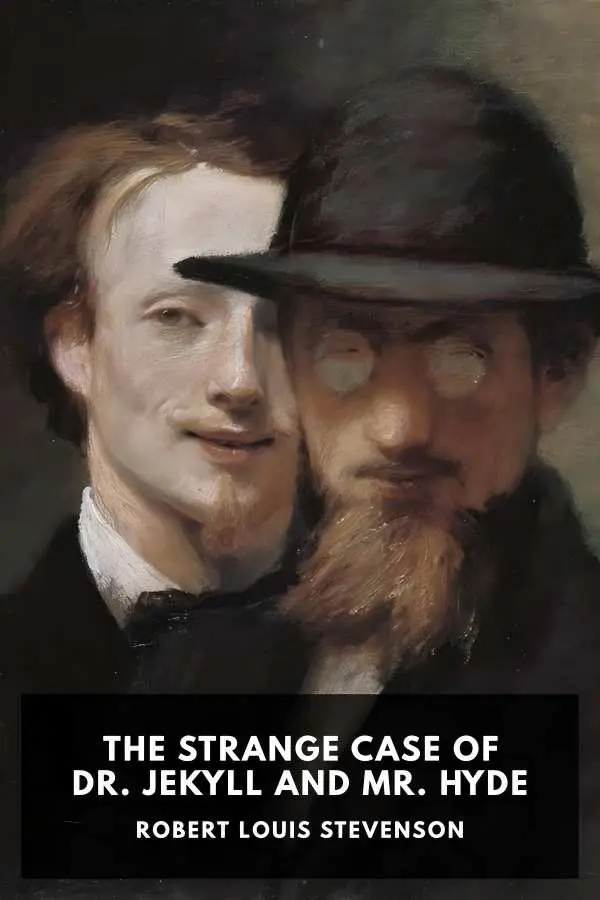
The Strange Case of Dr. Jekyll and Mr. Hyde
📖 Click to Read Chapter 1 Online Preview
Story of the Door
Mr. Utterson the lawyer was a man of a rugged countenance that was never lighted by a smile; cold, scanty and embarrassed in discourse; backward in sentiment; lean, long, dusty, dreary and yet somehow lovable. At friendly meetings, and when the wine was to his taste, something eminently human beaconed from his eye; something indeed which never found its way into his talk, but which spoke not only in these silent symbols of the after-dinner face, but more often and loudly in the acts of his life.
He was austere with himself; drank gin when he was alone, to mortify a taste for vintages; and though he enjoyed the theatre, had not crossed the doors of one for twenty years. But he had an approved tolerance for others; wondering almost with envy at the high pressure of spirits involved in their misdeeds; and in any extremity inclined to help rather than to reprove.
“I incline to Cain’s heresy,” he used to say quaintly: “I let my brother go to the devil in his own way.” In this character, it was frequently his fortune to be the last reputable acquaintance and the last good influence in the lives of downgoing men. And to such as these, so long as they came about his chambers, he never marked a shade of change in his demeanour.
Intrigued by the mysterious door in Soho? Download the complete, unabridged novella for your e-reader.
Download Full EPUBExplorations of Duality, Moral Decay & Forbidden Science
About The Strange Case of Dr. Jekyll and Mr. Hyde
First published in January 1886, The Strange Case of Dr. Jekyll and Mr. Hyde remains one of the defining masterpieces of Victorian literature and psychological horror. Written by Scottish novelist Robert Louis Stevenson in a feverish burst of creativity—reportedly completed in fewer than ten days following a terrifying nightmare—the novella caught the cultural anxieties of late-nineteenth-century Britain with pinpoint precision.
Set against the fog-drenched, gaslit streets of Victorian London, the narrative unfolds primarily through the perspective of Mr. Gabriel John Utterson, a rational, upright lawyer investigating the grotesque relationship between his mild-mannered, respected friend, Dr. Henry Jekyll, and the terrifying, violent outcast known as Edward Hyde. What begins as a mystery surrounding an unconscionable will quickly devolves into an existential descent into scientific hubris and psychological disintegration.
The phrase “Jekyll and Hyde” has long since penetrated the vernacular to describe someone of radically dual character, but Stevenson’s original prose possesses a sharp, analytical economy that modern pop-culture adaptations often flatten. It is not merely a tale of a good man fighting an externalized monster, but a profound examination of Victorian repression, the hypocrisy of bourgeois respectability, and the inescapable multiplicity of the human ego.
Historical & Cultural Context of The Strange Case of Dr. Jekyll and Mr. Hyde
The mid-1880s represented a period of immense psychological tension in Great Britain. The rapid ascendancy of evolutionary biology, pioneered by Charles Darwin’s On the Origin of Species (1859) and The Descent of Man (1871), prompted widespread anxiety regarding the fragility of human civilization. If humankind had evolved from lower animal orders, could humanity degenerate back into them?
Edward Hyde is explicitly characterized as smaller, ape-like, and radiating an intangible instinctual malice—a physical manifestation of Victorian evolutionary anxieties. He embodies the primitive drives unburdened by moral governance, moving through the nocturnal squalor of Soho while Dr. Jekyll inhabits the respectable, classical façades of Cavendish Square.
Simultaneously, the novella mirrors the emerging medical and psychiatric disciplines of the late 19th century. Preceding Sigmund Freud’s structural theory of the id, ego, and super-ego by decades, Stevenson anticipated the compartmentalization of consciousness. Jekyll’s tragic miscalculation lies not in his chemical concoction, but in his initial moral compromise: he did not seek to extinguish his darker urges, but merely to indulge them without compromising his upright reputation.
Key Characters in The Strange Case of Dr. Jekyll and Mr. Hyde
- Dr. Henry Jekyll: A prosperous, generous, and outwardly virtuous physician who harbors undisclosed private vices. Driven by a desire to split his disparate identities to indulge his appetites without shame, he brews a potent transformative tincture.
- Edward Hyde: Dr. Jekyll’s alter ego. Deformed, violent, remorseless, and utterly devoid of moral compunction, Hyde grows progressively stronger and harder to suppress the more frequently he is summoned.
- Mr. Gabriel John Utterson: The story’s central narrative vehicle. A taciturn, loyal, and scrupulously honest solicitor whose pursuit of the truth propels the plot forward amidst London’s conspiratorial silence.
- Dr. Hastie Lanyon: A fellow physician and stalwart traditionalist who rejects Jekyll’s experimental investigations as unscientific heresy, later suffering a fatal psychological collapse after witnessing the transformation firsthand.
Digital Edition & Typography Notes for The Strange Case of Dr. Jekyll and Mr. Hyde
Public domain texts of Victorian novellas frequently suffer from transcription errors, omitted hyphens, and sloppy OCR artifacts derived from centuries-old print impressions. This edition hosted on editions.ink has been digitally typeset to contemporary typographic benchmarks:
- Textual Integrity: Based on the Standard Ebooks transcription of the 1886 text (Project Gutenberg #43), cross-checked against HathiTrust Digital Library scans, including the canonical final confession, Henry Jekyll’s Full Statement of the Case.
- E-Reader Optimization: Formatted with clean reflowable CSS. It features custom-tuned typographic hierarchies, semantic paragraph indentations, non-breaking spaces before em-dashes, and verified internal hyperlinked chapter markers.
- DRM-Free Freedom: Open files provided strictly without encryption or vendor lock-in, ready to side-load onto Kindle Paperwhite, Kobo Clara/Libra, Onyx Boox, or open-source software like KOReader.