Gulliver’s Travels by Jonathan Swift: Free EPUB, AZW3 & KEPUB Download
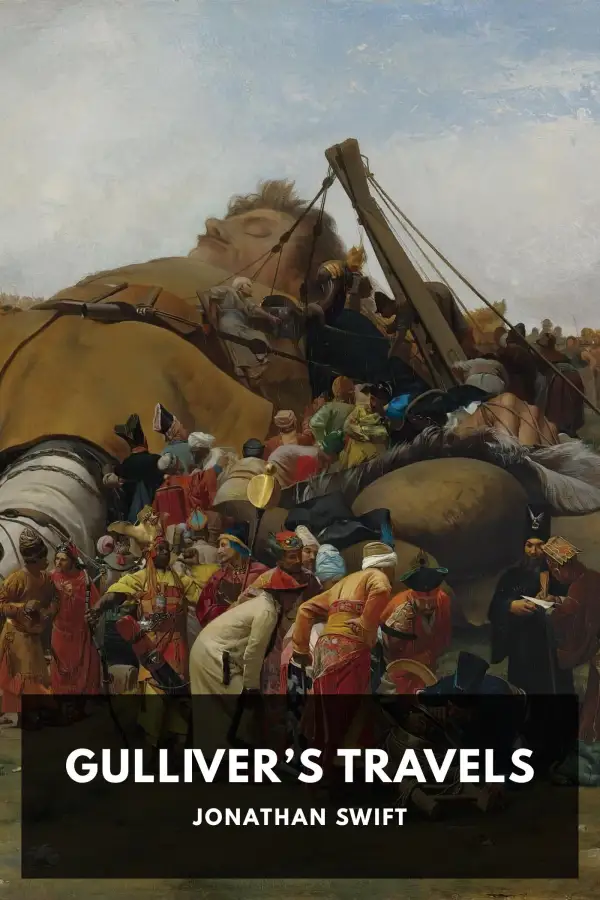
Gulliver’s Travels
📖 Click to Read Part I: A Voyage to Lilliput Online Preview
Part I: A Voyage to Lilliput — I
My father had a small estate in Nottinghamshire; I was the third of five sons. He sent me to Emanuel College in Cambridge, at fourteen years old, where I resided three years, and applied myself close to my studies; but the charge of maintaining me, being too great for a narrow fortune, I was bound apprentice to Mr. James Bates, an eminent surgeon in London, with whom I continued four years.
My good master, Mr. Bates, recommended me to the crew of the Antelope, Captain William Prichard, commander, with whom I made a voyage to the South Sea. We set sail from Bristol, May 4, 1699, and our voyage at first was very prosperous.
It would not be proper, for some reasons, to trouble the reader with the particulars of our adventures in those seas: let it suffice to inform him, that in our passage from thence to the East Indies, we were driven by a violent storm to the north-west of Van Diemen’s Land. By an observation, we found ourselves in the latitude of 30 degrees 2 minutes south. Twelve of our crew were dead by immoderate labour and ill food; the rest were in a very weak condition.
Follow Lemuel Gulliver across Lilliput, Brobdingnag, Laputa, and the land of the Houyhnhnms. Download the complete unabridged edition for your e-reader.
Download Full EPUBGulliver’s Travels is a 1727 satirical novel by Jonathan Swift, narrated by the ship’s surgeon Lemuel Gulliver as he voyages to four remote nations—Lilliput, Brobdingnag, Laputa, and the land of the Houyhnhnms. The novel uses these fantastical societies to satirize human nature, politics, and empire. This Standard Ebooks edition is based on Project Gutenberg eBook #829 and is in the public domain in the United States.
About Gulliver’s Travels: Summary, Characters & Themes
Published in 1727, Gulliver’s Travels (originally titled Travels into Several Remote Nations of the World) is Jonathan Swift’s enduring masterpiece. This summary and analysis covers its plot, key characters, and major themes. It stands as the supreme achievement of Menippean satire in world literature.
Disguised as a straightforward eighteenth-century sailor’s travelogue, the work systematically dissects European politics, philosophical vanity, scientific pedantry, and the moral corruption of human nature itself.
The journey follows Lemuel Gulliver, a practical English ship’s surgeon whose voyages carry him to four extraordinary remote nations. In Lilliput, he towers over a race of six-inch inhabitants, only to find their miniature kingdom consumed by trivial political rivalries and tyrannical ambition.
Inverting the scale, Gulliver next finds himself in Brobdingnag, a land of giants where he is treated as a curious domestic spectacle. When he proudly describes European warfare and court intrigue to the giant King, the monarch recoils in horror, condemning humanity as odious vermin.
His third voyage takes him to Laputa, a floating island of abstracted scientists and philosophers obsessed with useless theoretical speculations while their land lies in ruin, followed by the Academy of Lagado and the necromantic island of Glubbdubdrib.
In his final voyage, Gulliver reaches the land of the Houyhnhnms, a race of rational, noble horses who govern a society free of deception and greed. In contrast, he confronts the Yahoos—vicious, degraded humanoid brutes that mirror human physical form, driving Gulliver into incurable misanthropy upon his return home.
Key Characters & Literary Archetypes
The novel’s main characters are defined by the contrasting societies Gulliver encounters and the moral perspectives each embodies.
- Lemuel Gulliver is initially an honest, gullible ship surgeon who accepts European civilization unquestioningly. Traumatized by his encounters across the globe, his psychological trajectory traces the devastating collapse of human pride, ending in utter estrangement from his own family and kind.
- The Lilliputian Court and Emperor are miniature rulers who exhibit megalomaniacal political vanity, religious intolerance, and ungrateful malice. They embody the absurdity of European court politics and factional strife over petty distinctions.
- The King of Brobdingnag is a massive sovereign guided by common sense, justice, and practical human welfare. His famous rebuke of Gulliver’s imperial boasts serves as Swift’s devastating philosophical indictment of Western military aggression.
- The Projectors of Lagado are academics dedicated to absurd experiments, such as extracting sunbeams from cucumbers or softening marble for pillows. They satirize the detachment of pure intellectualism when severed from practical human benefit.
- The Houyhnhnms are wise, gentle, and utterly rational equine rulers whose language contains no word for “lying” or “evil.” They represent the stoic Enlightenment ideal of pure reason, though their detachment exposes the cold limitations of absolute rationality without emotion.
- The Yahoos are filthy, covetous, and chaotic creatures that physically mirror humanity. They serve as an unsparing reflection of human savagery stripped of societal manners, education, and moral control.
Core Literary Themes & Historical Significance
Three major themes structure the novel’s satirical and philosophical vision.
- The Illusion of Human Grandeur: By shifting physical scales between Lilliput and Brobdingnag, Swift demonstrates that human prestige, physical beauty, and military glory are entirely subjective, fragile, and absurd when viewed from altered perspectives.
- Critique of Politics and Theological Sectarianism: Through the war between Big-Endians and Little-Endians, Swift mocks how catastrophic wars and religious schisms are often fought over utterly trivial dogma and self-serving political factionalism.
- The Limits of Pure Reason vs. Raw Animalism: The stark contrast between the intellectual horses (Houyhnhnms) and the vile beasts (Yahoos) asks whether humanity can ever achieve harmony, or whether human beings are doomed to exist unhappily between beastly depravity and cold, unattainable logic.
Why Download Our Custom E-Reader Edition of Gulliver’s Travels?
Jonathan Swift’s Gulliver’s Travels is literature’s fiercest dissection of human vanity, partisan malice, and intellectual hubris—not a harmless children’s fable.
Mass-market automated conversions persistently distort Swift’s magnum opus: they expurgate the scandalous political allegories, outright excise the bizarre scientific parodies of Laputa or the misanthropic climax among the Houyhnhnms, and obliterate the parody maritime logbooks and letters that authenticate the narrative. Our custom digital release delivers the complete, uncompromising classic meticulously engineered for modern digital typography.
- Faithful Text Based on the 1727 Edition (via Project Gutenberg #829): Sourced from a Standard Ebooks transcription of the 1727 text, preserving Swift’s original satirical structure, the biting letter from “Capt. Gulliver to his Cousin Sympson,” and the uncensored court satire without modernization or editorial bowdlerization.
- Four-Part Structural Integrity & Parodic Formatting: Retains all four complete voyages in unabridged sequence (Lilliput, Brobdingnag, Laputa, and Houyhnhnmland), styling 18th-century nautical logs, pseudo-scholarly annotations, and foreign language phrases with clean CSS hierarchies that ensure flawless contrast on E-Ink screens.
- Hardware-Specific Dedicated Binaries: Clean reflowable EPUB with preserved drop caps and historical italics for Apple Books and Onyx Boox; native AZW3 calibrated for seamless paragraph flow and hyphenation on Kindle Paperwhite, Oasis, and Scribe; and pure KEPUB enabling granular chapter progress and live time-per-voyage analytics on Rakuten Kobo ereaders.
- Verified Public Domain Sources: The text is in the public domain in the United States and is based on Project Gutenberg eBook #829, with this edition produced by Standard Ebooks. Users outside the United States should check their local laws.