Germinal by Émile Zola: Free EPUB, AZW3 & KEPUB Download
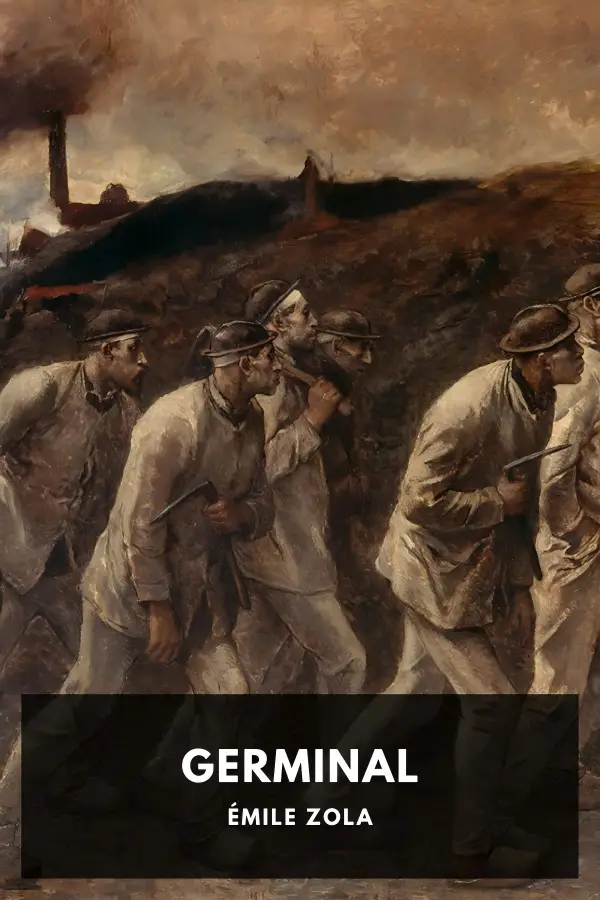
Germinal
📖 Click to Read Part I: Chapter I Online Preview
Part I — Chapter I
Over the open plain, beneath a starless sky as dark and thick as ink, a man walked alone along the highway from Marchiennes to Montsou, a straight paved road ten kilometres in length, intersecting the beetroot fields.
He could not even see the black soil before him, and only felt the immense flat horizon by the gusts of March wind, squalls as strong as on the sea, and frozen from sweeping leagues of marsh and naked earth. No tree could be seen against the sky, and the road unrolled as straight as a pier in the midst of the blinding spray of darkness.
The man had set out from Marchiennes about two o’clock. He walked with long strides, shivering beneath his worn cotton jacket and corduroy breeches. A small parcel tied in a check handkerchief troubled him much, and he pressed it against his side, sometimes with one elbow, sometimes with the other, so that he could slip to the bottom of his pockets both the benumbed hands that bled beneath the lashes of the wind.
Descend into the suffocating pit of the Voreux mine and witness humanity’s raw struggle for justice. Download the complete unabridged edition for your e-reader.
Download Full EPUBGerminal is an 1885 novel by Émile Zola, a naturalist epic set in the coal-mining district of northern France that follows Étienne Lantier, a young migrant worker whose involvement in a desperate miners’ strike exposes the brutal exploitation, starvation, and class warfare of the Industrial Revolution. This Standard Ebooks edition, translated by Havelock Ellis (1894), is based on Project Gutenberg eBook #56528 and is in the public domain in the United States; readers outside the US should check their local laws. The text is available via Standard Ebooks.

Germinal by Émile Zola: Summary, Characters & Themes
Published in 1885 as the thirteenth novel in the epic twenty-volume Les Rougon-Macquart cycle, Germinal is Émile Zola’s crowning masterpiece, here in the 1894 English translation by Havelock Ellis. This summary and analysis follows the supreme monument of French naturalist literature, an unflinching depiction of working-class exploitation and industrial revolt that contrasts sharply with the bourgeois media satire in Maupassant’s Bel-Ami.
The story follows Étienne Lantier, an unemployed, literate railway worker who arrives at the bleak northern coal-mining settlement of Montsou in search of labor. Securing a brutal job as a cart-pusher deep underground in the Voreux pit, Étienne witnesses first-hand the dehumanizing squalor, starvation wages, and physical degradation endured by generations of mining families.
Lodging with the Maheu family, Étienne falls deeply in love with Catherine Maheu, an exhausted young trammer who is subjugated by the abusive miner Chaval. Reading revolutionary socialist literature and corresponding with radical labor organizers, Étienne becomes the intellectual spearhead of the local mining collective.
When the mining company slashes wages under the guise of an economic downturn, Étienne organizes a mass walkout that paralyzes the entire district. As weeks of bitter winter cold stretch on, starvation breaks the miners’ patience, transforming a peaceful strike into a ferocious riot of rioting mobs, smashed machinery, and desperate violence against bourgeois company owners.
The imperial army is summoned to guard the pits, resulting in a tragic confrontation where soldiers fire upon unarmed workers, killing Maheu and several children. Despairing of peaceful victory, the Russian anarchist Souvarine covertly sabotages the Voreux shaft, flooding the subterranean tunnels and trapping Étienne, Catherine, and Chaval deep underground. The text is based on Project Gutenberg eBook #56528 and the Standard Ebooks edition.
After days in pitch-black subterranean agony—during which Étienne kills Chaval and Catherine dies in his arms moments before rescue—Étienne is hauled to the surface, pale and permanently altered. Walking away toward Paris under the warm April sun, he hears the distant pickaxes beneath his feet, confident that a black army of workers is germinating in the soil, destined to sprout and overturn the old world.
Historical Context: The Great Anzin Strike and Naturalism
Zola composed Germinal with scientific rigor, spending months in February 1884 living alongside striking miners during the historic Anzin Coal Strike in northern France. He descended into the dark tunnels of the pit, observed the miners’ diseases, and interviewed union organizers to capture the reality of the Industrial Revolution.
The title Germinal derives from the seventh month of the French Revolutionary calendar (spanning March and April), signifying the season of budding and seed germination. Zola employs the metaphor of seeds buried beneath winter snow to represent the dormant political awakening of the working class, destined to shatter the crust of capitalism in a future socialist spring.
Key Characters & Literary Archetypes
- Étienne Lantier (The Revolutionary Dreamer & Awakener): Intelligent, hot-tempered, and carrying hereditary violent instincts. He introduces Marxist and socialist theory to an illiterate proletariat, yet struggles when the elemental fury of the crowd escapes his intellectual control.
- Toussaint Maheu (The Noble Worker & Moral Anchor): The patriarch of the Maheu household, a veteran miner endowed with common sense, quiet dignity, and immense endurance. His tragic murder by military gunfire marks the extinguishing of the strike’s moral core.
- La Maheude (The Earth Mother & Fierce Matriarch): Maheu’s wife, who battles daily against starvation to feed seven children. Initially skeptical of the strike, she becomes its most unbending, ferocious voice after witnessing her family’s slow starvation.
- Catherine Maheu (The Sacrificial Victim & Gentle Heart): Hardworking and resigned to her fate, she endures brutal subterranean labor and the sexual violence of Chaval. Her tender, unconsummated love for Étienne represents the tragic collateral damage of industrial misery.
- Souvarine (The Nihilistic Destroyer & Anarchist Spectre): An exiled Russian machine operator who despises political reform and collective voting, believing that total annihilation of the existing civilization is the only path to universal purification.
- The Voreux Pit (The Mechanical Leviathan & Monster): Personified by Zola as a predatory, fire-breathing beast that swallows human flesh each morning, digests workers in its subterranean belly, and regurgitates broken bodies at twilight.
Core Literary Themes
- Naturalism and Hereditary Determinism: Zola portrays human beings not as entirely free moral agents, but as biological organisms shaped by hereditary traits, physiological hunger, and brutal environmental pressures.
- Capital as an Inhuman Entity: The ultimate enemy in Germinal is not individual managers like Hennebeau, but the invisible, absentee shareholders and corporate trusts that sacrifice human lives to balance balance sheets.
- The Inevitable Spring of Revolution: Despite the catastrophic failure of the strike, Zola concludes with profound revolutionary optimism, viewing suffering as fertile soil preparing an irresistible upheaval of social justice.
Why Download Our Custom E-Reader Edition of Germinal?
First published in 1885 as the thirteenth installment of Émile Zola’s monumental twenty-volume Les Rougon-Macquart cycle, Germinal stands as the undisputed masterpiece of French naturalism and the definitive literary portrait of modern industrial class war.
Grounded in months of undercover research in the coal basins of Anzin, Zola tracks the arrival of migrant engine-mechanic Étienne Lantier at the monstrous, beast-like Voreux pit, tracing how grinding physical exploitation, wage cuts, and starvation ignite a desperate, catastrophic miners’ strike.
Raw depictions of sub-surface peril, subterranean starvation, and violent mob justice are routinely undermined in cheap automated web dumps: mining technical jargon is botched, regional patois is scrambled, and vital narrative sections are merged into exhausting, unbroken blocks of text. Our bespoke digital edition delivers an archival, unabridged reading experience calibrated precisely for modern E-ink screens.
- Based on the Havelock Ellis Translation (1894), via Project Gutenberg #56528: Sourced directly from the landmark English translation by Havelock Ellis, first published in 1894. Unlike sanitized late-Victorian commercial versions that excised Zola’s raw anatomical realism, visceral biological frankness, and fierce political rhetoric, this edition presents the full, unabridged seven parts exactly as intended. Based on a transcription produced for Project Gutenberg #56528 and digital scans from the HathiTrust Digital Library.
- Granular 7-Part Architectural NCX/Nav Structural Navigation: Effortlessly navigate the sprawling labyrinth of the Montsou coal seams and worker settlements through our multi-tiered table of contents. Instantly access iconic set pieces—from the suffocating morning descent into the Voreux shaft and the moonlit forest assembly in the Plan-des-Dames, to the mob’s terrifying assault on the bourgeois groceries, Souvarine’s ruthless sabotage, and Lantier’s harrowing survival trapped in the flooded deep levels.
- Calibrated Typographical Layout for Epic Industrial Drama: Zola’s sweeping collective crowd scenes, coal-cutting technical terminology, and explosive ideological debates between Marxist socialism and nihilist anarchism require rigorous typographical composition. Our edition applies calibrated paragraph indents, distinct styling for corporate proclamations and miner songs, and zero-glare contrast across Kindle Paperwhite (AZW3), Kobo Libra/Clara (KEPUB), and open EPUB readers, ensuring smooth rendering without page clipping or battery-draining redraws.
- Verified Public Domain Sources: The source text is in the United States public domain; users outside the United States should check their local laws. Sourced from Project Gutenberg eBook #56528 and the Standard Ebooks edition.