The Hunchback of Notre-Dame by Victor Hugo: Free EPUB, AZW3 & KEPUB Download
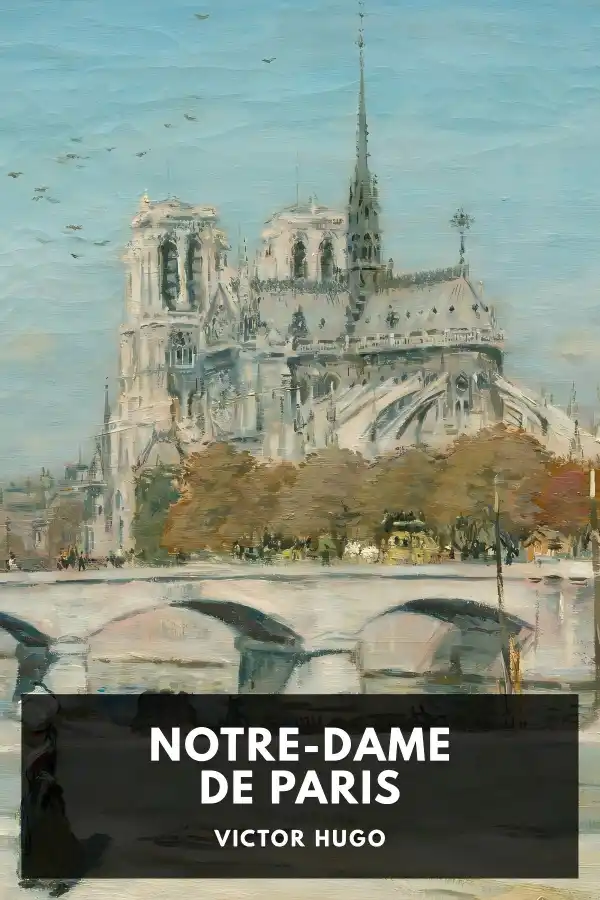
The Hunchback of Notre-Dame
📖 Click to Read Book I: Chapter I Online Preview
Book I — Chapter I: The Grand Hall
Three hundred and forty-eight years, six months, and nineteen days ago today, the Parisians awoke to the sound of all the bells in the triple circuit of the city, the university, and the town ringing a full peal.
The sixth of January, 1482, is not, however, a day of which history has preserved the memory. There was nothing notable in the event which thus set the bells and the bourgeois of Paris in a ferment from early morning.
It was neither an assault by the Picards nor the Burgundians, nor a hunt led along in procession, nor a revolt of scholars in the town of Laas, nor an entry of “our much dread lord, monsieur the king,” nor even a pretty hanging of male and female thieves by the courts of Paris. It was the double solemnity, united from time immemorial, of the Epiphany and the Feast of Fools.
Step onto the medieval cobblestones of Paris and climb the gothic towers of Notre-Dame. Download the complete unabridged edition for your e-reader.
Download Full EPUBThe Hunchback of Notre-Dame is an 1831 novel by Victor Hugo, a romantic gothic epic set in 1482 Paris that follows Quasimodo, the deformed bell-ringer of Notre-Dame Cathedral, and Esmeralda, a Romani street dancer, whose fates are destroyed by the obsessive lust of Archdeacon Claude Frollo, exploring themes of fate, the grotesque and the sublime, and institutional injustice. This Standard Ebooks edition, translated by Isabel F. Hapgood (1888), is based on Project Gutenberg eBook #2610 and is in the public domain in the United States; readers outside the US should check their local laws. The text is available via Standard Ebooks.
The Hunchback of Notre-Dame by Victor Hugo: Summary, Characters & Themes
Published in 1831 under its authentic French title Notre-Dame de Paris, The Hunchback of Notre-Dame is Victor Hugo‘s towering romantic masterwork, here in the 1888 English translation by Isabel F. Hapgood. This summary and analysis examines the novel’s reimagining of late-medieval France with unmatched architectural majesty and emotional ferocity, rivaling the tragic moral scope of Thomas Hardy’s Tess of the d’Urbervilles.
Set in 1482 during the reign of King Louis XI, the narrative revolves around the majestic gothic cathedral of Notre-Dame, towering over a labyrinthine Paris. Abandoned as a severely deformed infant on the cathedral steps, Quasimodo is raised by the austere archdeacon Claude Frollo to serve as the cathedral’s bell-ringer, growing up deaf, isolated, and feared by the superstitious public.
During the boisterous Feast of Fools, Quasimodo is crowned “Pope of the Fools” before being subjected to public pillory and torment. His torment is interrupted by Esmeralda, a compassionate, radiantly beautiful young Romani street dancer, who offers him water on the scaffold, awakening in the monstrous hunchback an eternal, selfless devotion.
Esmeralda becomes the focal point of three destructive masculine obsessions: the shallow vanity of the dashing military captain Phoebus de Châteaupers, the sublime devotion of Quasimodo, and the dark, repressed lust of Archdeacon Claude Frollo. Consumed by forbidden desire that shatters his theological sanity, Frollo stalks Esmeralda, stabs Phoebus in a fit of jealousy, and frames the innocent dancer for murder and sorcery.
When Esmeralda is condemned to the gallows at the Place de Grève, Quasimodo performs a breathtaking rescue from the towers of the cathedral, carrying her into the sanctuary of Notre-Dame while roaring his legendary defiance: “Sanctuary!” Sheltered among the gargoyles, Quasimodo shields Esmeralda with tender reverence, even repelling a ferocious midnight assault by the Parisian underworld’s Court of Miracles. The text is based on Project Gutenberg eBook #2610 and the Standard Ebooks edition.
However, royal troops storm the cathedral after King Louis XI revokes the right of sanctuary. Frollo offers Esmeralda a final ultimatum between the gallows or his bed; her proud refusal sends her to the scaffold. As Frollo laughs demonically from the heights of Notre-Dame watching Esmeralda hang, Quasimodo hurls his adopted master to his death on the pavement below, subsequently disappearing into the charnel vault of Montfaucon to embrace Esmeralda’s body in eternal, skeletal reunion.
Architectural Setting: The Cathedral as Living Protagonist
Victor Hugo famously stated that the true central character of the novel is Notre-Dame Cathedral itself. In the famous theoretical chapter “This Will Kill That” (Ceci tuera cela), Hugo explores how the invention of the printing press was destined to kill gothic architecture as humanity’s primary medium of permanent collective expression.
Written when Notre-Dame was in severe structural ruin, neglected by city authorities, and threatened with demolition, the novel ignited a passionate public preservation movement. Hugo’s vivid romantic prose directly compelled the French government to commission master architect Eugène Viollet-le-Duc in 1844 to undertake the complete historical restoration of the monument.
Key Characters & Literary Archetypes
- Quasimodo (The Sublime Monstrosity & Pure Soul): Deformed, half-blind, and deafened by the bells he loves. His grotesque exterior conceals an angelic capacity for loyalty and sacrifice.
- Esmeralda / Agnès (The Incorruptible Grace & Sacrificial Lamb): Sincere, free-spirited, and accompanied by her clever goat Djali. Her innocence makes her a fatal magnet for institutional, sexual, and religious persecution.
- Archdeacon Claude Frollo (The Tormented Scholar & Faustian Damned): A brilliant priest, alchemist, and philosopher trapped in the icy vows of celibacy. His suppressed sexual passion mutates into psychotic sadism.
- Captain Phoebus de Châteaupers (The Hollow Narcissist): Handsome, aristocratic, and callous. He treats Esmeralda as a casual sexual conquest, cowardly abandoning her to the scaffold.
- Pierre Gringoire (The Practical Dramatist & Comic Philosopher): An impoverished, vain playwright who marries Esmeralda according to Romani custom to escape hanging. He personifies pragmatic self-preservation over dangerous passion.
- King Louis XI (The Calculating Sovereign): The cold, paranoid monarch who hoards gold in the Bastille, embodying the shift from feudal chivalry toward autocratic administrative power.
Core Literary Themes
- The Greek Concept of ANÁΓKH (Fatal Destiny): Hugo claimed the inspiration for the book came from the Greek word for “Fate” carved into a secluded wall of Notre-Dame, demonstrating how human beings are trapped in the merciless machinery of social and theological destiny.
- The Grotesque vs. The Sublime: Hugo’s radical aesthetic manifesto finds its definitive narrative fulfillment in the contrast between Quasimodo’s hideous shell and his radiant, heroic love.
- Institutional Injustice and Social Cruelty: The novel indicts the judicial apparatus of medieval France, revealing that the supposedly civilized society is far more barbaric than the underworld it condemns.
Why Download Our Custom E-Reader Edition of The Hunchback of Notre-Dame?
First published in Paris in 1831 as Notre-Dame de Paris, Victor Hugo’s monumental romantic gothic epic was conceived not merely as a tragic romance, but as a passionate preservation manifesto to save crumbling medieval Gothic architecture from Renaissance neglect and neoclassical demolition.
Set against the vibrant, tumultuous backdrop of 1482 Paris, the narrative intertwines the doomed fates of the deformed bell-ringer Quasimodo, the radiant Romani dancer Esmeralda, the tormented archdeacon Claude Frollo, and the shallow captain Phoebus de Châteaupers, all presided over by the cathedral’s looming gargoyles and the inescapable Greek curse of Fate (Ananke).
Standard public domain web transcriptions notoriously ruin Hugo’s grand vision: stripping his crucial architectural essays (“A Bird’s-Eye View of Paris” and “This Will Kill That”), censoring Frollo’s tortured alchemical and sexual obsessions, and mangling Latin inscriptions and medieval French street nomenclature. Our bespoke digital edition restores an archival, unabridged reading experience calibrated precisely for modern E-ink displays.
- 1888 Isabel F. Hapgood Definitive Unabridged Translation, via Project Gutenberg #2610: Sourced directly from the celebrated translation by Isabel F. Hapgood, published in New York by Thomas Y. Crowell in 1888, and based on a transcription produced for Project Gutenberg #2610 and digital scans from Google Books. Unlike earlier Victorian translations that censored Hugo’s grotesque naturalism, anti-clerical critiques, and raw passion, Hapgood’s version faithfully preserves Hugo’s philosophical vigor, poetic register, and comprehensive architectural treatises intact across all eleven books.
- Granular 11-Book Architectural NCX/Nav Structural Navigation: Navigate the sprawling labyrinth of medieval Paris effortlessly using our multi-tiered table of contents. Instantly jump between Hugo’s greatest dramatic milestones—from the bawdy Feast of Fools and Pierre Gringoire’s initiation into the Cour des Miracles, to Esmeralda’s dramatic sanctuary rescue, Quasimodo’s defense of the cathedral battlements with molten lead, and the heartbreaking ossuary finale in the vault of Montfaucon.
- Calibrated Typographical Layout for Gothic Grandeur: Hugo’s sweeping prose shifts effortlessly between dramatic theatrical dialogue, philosophical digressions on printing presses and stone architecture, and medieval street songs. Our edition implements calibrated paragraph indents, distinct styling for French epigraphs and Latin texts, and zero-glare contrast across Kindle Paperwhite (AZW3), Kobo Libra/Clara (KEPUB), and open EPUB readers, ensuring rapid rendering without layout breaks or screen flashes.
- Verified Public Domain Sources: The source text is in the United States public domain; users outside the United States should check their local laws. Sourced from Project Gutenberg eBook #2610 and the Standard Ebooks edition.