The Prince and the Pauper by Mark Twain: Free EPUB, AZW3 & KEPUB Download
The Prince and the Pauper
📖 Click to Read the Opening Pages Online Preview
Offal Court and Tom Canty’s childhood in Chapter 2
Let us skip a number of years.
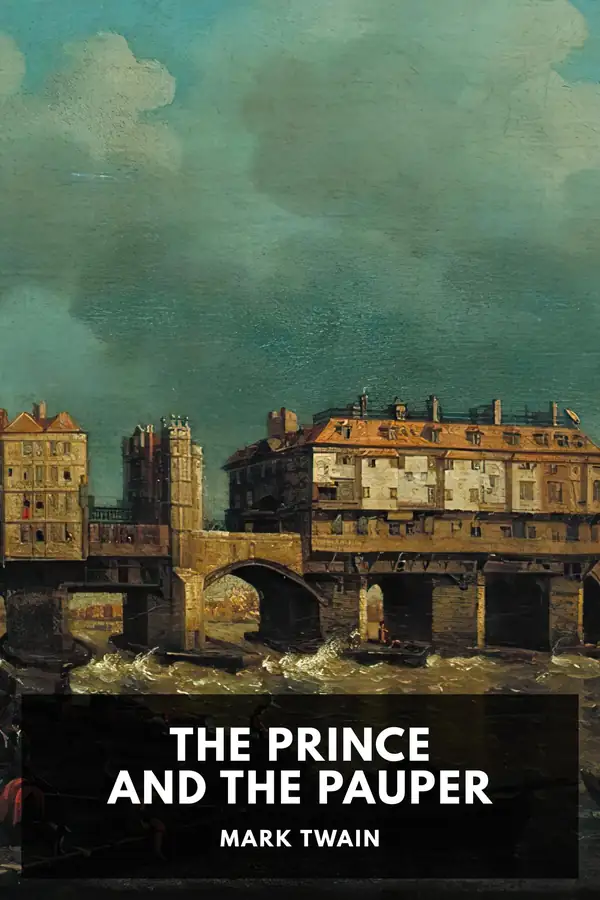
London was fifteen hundred years old, and was a great town—for that day. It had a hundred thousand inhabitants—some think double as many. The streets were very narrow, and crooked, and dirty, especially in the part where Tom Canty lived, which was not far from London Bridge. The houses were of wood, with the second story projecting over the first, and the third sticking its elbows out beyond the second. The higher the houses grew, the broader they grew. They were skeletons of strong crisscross beams, with solid material between, coated with plaster. The beams were painted red or blue or black, according to the owner’s taste, and this gave the houses a very picturesque look. The windows were small, glazed with little diamond-shaped panes, and they opened outward, on hinges, like doors.
The house which Tom’s father lived in was up a foul little pocket called Offal Court, out of Pudding Lane. It was small, decayed, and rickety, but it was packed full of wretchedly poor families. Canty’s tribe occupied a room on the third floor. The mother and father had a sort of bedstead in the corner; but Tom, his grandmother, and his two sisters, Bet and Nan, were not restricted—they had all the floor to themselves, and might sleep where they chose. There were the remains of a blanket or two, and some bundles of ancient and dirty straw, but these could not rightly be called beds, for they were not organized; they were kicked into a general pile, mornings, and selections made from the mass at night, for service.
The preview stops inside Chapter 2. All thirty-three chapters are in the free download below.
Download Full EPUB1881
~66,000 words (estimated)
Approx. 3.6 hours
Standalone
London and Westminster in 1547
33 chapters
EPUB · AZW3 · KEPUB
0.65 MB (EPUB) · 0.69 MB (AZW3) · 0.67 MB (KEPUB)
Public domain in the United States
Project Gutenberg #1837 · Standard Ebooks
The Prince and the Pauper is Mark Twain’s 1881 novel about two boys born in London on the same autumn day: Tom Canty, a beggar’s son from Offal Court, and Edward Tudor, the Prince of Wales. A guard drives Tom from the palace gate, the prince takes him indoors, and the two exchange clothes for a jest. A mirror shows them identical, and the mistake begins at once: the guard takes Edward for the beggar and throws him into the street, while the court holds Tom for a prince gone mad. Twain follows both boys through palace, jail and vagabond camp until a coronation settles which of them is king.
Twain wrote the book in 1881, set it in 1547, and built it on the plainest of plots: a boy who is treated as a prince learns nothing, and a prince who is treated as a boy learns everything. Edward’s weeks among thieves and prisoners are the engine of the story, and Miles Hendon, the ruined soldier who guards him without believing a word of his claim, gives it warmth. Tom governs gently and finds that mercy comes easier from a throne than from a doorway. Read Wikipedia’s article on The Prince and the Pauper for the composition and the reception. The text is available via Project Gutenberg #1837 and Standard Ebooks.
The Prince and the Pauper by Mark Twain: Summary, Characters & Themes
This page is a summary and analysis of The Prince and the Pauper, the 1881 novel in which Mark Twain sent a prince into the London slums and a slum boy onto the throne. Twain was in his mid-forties and already famous for The Adventures of Tom Sawyer and A Tramp Abroad when he wrote it, and he reached back three centuries, to the last weeks of Henry VIII and the first of Edward VI. The idea of two identical boys trading places had been on his mind for years, and he worked it up with historical reading and a great deal of invention. Twain’s life — the Hannibal boyhood, the printing offices, the river — is visible in the book’s sympathy for boys who are prized for what they can be made to do rather than for what they are.
The plot is a single hinge. Tom Canty, raised in Offal Court off Pudding Lane by a violent father and a beggar grandmother, has taught himself to read and has filled his head with Father Andrew’s tales of princes. Edward Tudor, born on the same day, is bored inside his father’s palace. When the two meet at the gate, Edward envies Tom’s freedom and Tom envies Edward’s dinner, and the swap of clothes is a game until the guard mistakes the prince for the beggar and drives him into the street. From that moment neither boy can prove who he is, because each is wearing the other’s life, and neither can take it off again.
Twain runs the two stories side by side and lets each comment on the other. Tom learns to be king by doing what the crown requires: he sits through councils, receives ambassadors, and discovers that a word from him can hang a man or save one. Edward learns what the crown costs by being beaten, starved and hunted, and by meeting the people his laws have been grinding down. The novel is a comedy for long stretches, but its subject is serious: rank is a costume, and the man inside it is the same as the man outside. The court scenes and the vagabond scenes are written to rhyme with one another, down to the servants who surround a boy and the thieves who surround a boy.
Twain had already made a career of boys on the loose, and this book belongs with the novels that follow the same instinct. The Adventures of Tom Sawyer keeps its boy in a small Missouri town and lets him imagine a prince’s life; Adventures of Huckleberry Finn sends a boy downriver through a society that has decided in advance what he is worth; and A Connecticut Yankee in King Arthur’s Court reverses the trick entirely, dropping a modern American into a medieval court. Read together, they show Twain testing one question in four keys: what a child sees that an adult has learned to ignore, and what a society does to keep its arrangements looking natural.
The novel has been read as a children’s book, a satire on monarchy and a plea for the poor, and it survives all three readings. Its best scenes — the prince in the stocks, the mad hermit, the ragged claimant walking up the aisle of the abbey — are staged with the timing of a man who had spent twenty years on lecture platforms. Twain closes the book with a short afterword on the English penal code that is angrier than anything in the story, and the anger is the point. This edition follows the Project Gutenberg #1837 transcription and the Standard Ebooks text, which supplies the chapter divisions used in the summaries below; both are faithful to the 1881 printing, and neither modernises the prose.
Historical Context
Twain set the novel in 1547 for a reason. Henry VIII died in January of that year, leaving the throne to a nine-year-old boy, and the country was run by a Regency council of noblemen who had spent their lives in the shadow of a tyrant. The old king’s last months had been a season of executions: the Duke of Norfolk was condemned by attainder, and only the king’s death stayed the warrant. A boy on the throne, a court split into factions and a capital crowded with the poor — these were the conditions Twain needed. He took the frame seriously enough to date the action and to put real councillors in the room, then filled the gaps with fable.
The London of the novel is the London of the 1540s: a walled city of about a hundred thousand people, its streets narrow and crooked, its houses timber, its river the main road. Westminster stood outside the walls, joined to the city by the Strand and by the water. The gap between the two worlds was not a metaphor. Beggary was a crime, and the laws against it grew harsher as the century went on; vagabonds could be branded, enslaved or hanged, and Twain’s afterword notes that English law of the period made more than two hundred offences capital. Edward’s walk through his own kingdom is a tour of that machinery.
Twain’s history is not a historian’s history. He keeps the names and the dates and invents the rest, including the whipping-boy, which he admitted in a note, and the hermit, who has no basis in any chronicle. The coronation is staged with real topography — the stone of Scone, the Archbishop of Canterbury, the peers in their robes — but the Great Seal does not behave as it does here. What the novel gets right is the texture: the ceremonial, the barges, the guilds, the taste of a public dinner, the fear of a boy who is told he is a god. Edward VI died in 1553, a boy of fifteen, and the mercy Twain praises had barely six years to work.
Key Characters & Literary Archetypes
- Tom Canty: A beggar’s son from Offal Court, quick to learn and quicker to dream. Father Andrew taught him letters and a little Latin, and the tales of princes he heard at the priest’s knee are what drive him to the palace gate. He is clever, gentle and frightened, and the novel’s quiet joke is that he makes a better king than the boy born to it, because he has been on the receiving end of the law. He keeps his mother in his memory even when the court would rather he forgot her.
- Edward Tudor: The Prince of Wales, born on the same day as Tom and bored by a life of ceremony. He has been raised to believe that his word is law, and the weeks he spends as a beggar teach him what that belief costs other people. He is proud, brave and slow to doubt himself, and Twain lets his dignity survive every humiliation, which is both his comic value and his moral education. He becomes king at the end, and the last chapter measures what he learned in the street.
- Miles Hendon: A soldier of fortune back from the wars, cheated of his inheritance by a brother who has taken his name. He finds the prince in the street, decides the boy is mad, and protects him anyway, out of an instinct he cannot explain. He sleeps across the door of their room, buys the boy clothes on London Bridge, and takes a flogging and the stocks rather than abandon him. He is the novel’s warmest figure, and his loyalty is what makes the prince’s claim bearable to read.
- John Canty: Tom’s father, a thief and a bully who beats his son and drags the prince home by the collar when the boy claims to be king. He is violent, greedy and entirely without imagination, which makes him more frightening than a villain with a plan. Twain uses him to show what poverty does to a family: the father is not a monster from outside the system but a product of it. He disappears from the story near the end, and the novel refuses to say what became of him.
- Hugh Hendon: Miles’s younger brother, who has taken the estate, the title and, in effect, Miles’s wife Edith. He wears a disguise when he first meets the prince, and at Hendon Hall he denies his brother to his face with the calm of a man who has already won. His confession at the end reveals that he threatened Edith into silence, and his death abroad closes the account without settling it. He is the novel’s real villain, and a petty one, which is the point.
- Humphrey Marlow: The prince’s whipping-boy, whose office is to take the beatings that the prince has earned by bad Latin. He appears at Tom’s bedside asking to be recognised, and Tom, who has never heard of such a post, improvises an answer and later makes it hereditary. His function in the book is comic and quietly savage: a child whose whole career is to be punished in another child’s place. Twain invented him, and noted that James I and Charles II had boys like him.
Core Literary Themes
- Rank is a costume: The novel turns on a change of clothes. Edward in Tom’s rags cannot prove he is a prince, and Tom in Edward’s silks is accepted as one within the hour. Twain takes the oldest joke about dress and makes it a moral argument: the deference people offer is addressed to the garment, not the person, and the same crowd that cheers a king will cuff a beggar at the gate. The coronation is the final demonstration, because the crown goes to whichever boy is standing in the right place. Identity, here, is what other people agree to see.
- Justice and mercy: The prince’s education is a tour of English law. He meets a man branded and sold as a slave, a lawyer ruined by a fine, women burned at the stake, a boy condemned for stealing a hawk. Each case is a sentence he cannot commute because nobody believes he is the king. When he does take the throne his first acts are pardons, and Twain presents them not as sentiment but as the repayment of a debt. The argument is that a ruler who has not been punished by his own laws does not know what they do.
- Suffering as education: Tom and Edward are taught by opposite means. Tom learns from books and dreams, and his reign is gentle because he has never been taught to think of the poor as a category. Edward learns by being cold, hungry, beaten and hunted, and the knowledge changes what he wants from power. Twain does not pretend that suffering makes anyone noble: the thieves are thieves, the mob is a mob, and some of the people Edward meets are simply cruel. What suffering gives him is evidence, and the novel trusts evidence more than virtue.
- The double and the mirror: The two boys are not twins but reflections, and the mirror in the prince’s cabinet is the book’s central image. Twain keeps finding doubles: Hugh Hendon in Miles’s place, the false prince and the true, the hermit who plays the saint and turns out to be a murderer. The mirror scene gives the novel its premise and its anxiety, because a society that identifies people by their clothes can be fooled by a looking-glass. The coronation resolves the plot by finding an object, the Great Seal, that only one body can remember hiding.
- Innocence and the child’s eye: Twain’s children see what adults have agreed not to notice. Tom notices that the king’s servants go hungry while the king’s dinner is wasted; Edward notices that the law is a machine for punishing the poor. The novel’s comedy comes from a child’s literal mind applied to ceremony — Tom asking for the napkin to be taken away, Tom using the Great Seal to crack nuts. Its pathos comes from the same source, because the child who sees clearly is also the one nobody will believe.
Why Download Our Custom E-Reader Edition of The Prince and the Pauper?
This edition is built for reading. The text is the Standard Ebooks edition of Twain’s 1881 novel, with all thirty-three chapters in their original order and the chapter titles as the edition gives them. There are no footnotes in the middle of the page, no modernised spelling and no abridgement. What you download is the novel as Twain wrote it, set cleanly, with a table of contents that works on an e-reader and not only in a browser.
The novel has been reprinted continuously since 1881, and cheap editions differ in small ways: a sentence restored, a chapter title dropped, an American spelling quietly substituted. This one follows the Standard Ebooks text, established against the early printing, and the chapter list below uses the same divisions. If you want to check a passage against the original transcription, Project Gutenberg #1837 is the obvious place to start, and the two texts agree chapter for chapter.
Three formats are offered, one download each: EPUB for most readers, AZW3 for Kindle, KEPUB for Kobo. All three carry the same text and the same navigation, and none of them is locked. There is no account to create, no sample chapter standing in for the book, and no expiry date on the file. Download it once, keep it on your device, and move it to another reader without asking anyone’s permission.
- Based on the Standard Ebooks Edition, via Standard Ebooks, whose editors prepared this text from the Project Gutenberg transcription and checked it against the early printing; their chapter divisions are the ones used in the summaries below, so what you see on this page matches the file you download, chapter for chapter, with nothing cut and nothing rewritten.
- Complete thirty-three-chapter text Every chapter is here, from the birth of the two boys to the last page of the conclusion, with the preface, the afterword on the Blue Laws and Twain’s own notes kept where the edition puts them. Nothing is summarised in place of the text and no scene is shortened for modern taste, so the book reads as it did in 1881.
- EPUB, AZW3 and KEPUB One file per format, so the novel opens on Kindle, Kobo, Apple Books and most other readers without conversion, with a working table of contents, proper chapter breaks and a cover that survives being sent to a device. The files stay small enough for an old reader and complete enough for a new one.
- Free and DRM-free Public domain in the United States, with no account, no subscription and no lock on the file; download it once and it is yours to keep, to copy between devices and to reread. There is nothing hidden in the file and nothing to install before it opens.
- The Adventures of Tom Sawyer — free EPUB, AZW3 & KEPUB
- Adventures of Huckleberry Finn — free EPUB, AZW3 & KEPUB
- A Connecticut Yankee in King Arthur’s Court — free EPUB, AZW3 & KEPUB
Chapter summaries
Thirty-three chapters, from the birth of the two boys to the last page of the conclusion. These twelve summaries follow the Standard Ebooks text in order, grouping the short chapters where the action runs straight on.
- Chapters 1–3 — Two boys born on the same autumn day: Twain opens with two births on one day: Tom Canty into a poor family that does not want him, Edward Tudor into a palace and a kingdom that has prayed for him. Chapter 2 stays with Tom in Offal Court, where his father steals, his grandmother begs, and Father Andrew secretly teaches him Latin and letters. In Chapter 3 Tom walks to Westminster, sees the prince through the gate, and is cuffed away by a guard; the prince invites him in.
- Chapters 4–6 — The guard, the mirror and the swap: Edward takes Tom into the palace, feeds him, and hears about Offal Court and the sisters he has left behind. For a jest the boys exchange clothes, and the mirror shows them so alike that neither can tell the difference. Edward, in rags, runs out to scold the guard who hurt Tom’s hand, and is thrown into the street as a beggar. Tom is left alone in the prince’s cabinet, and the court begins to treat him as a prince who has lost his wits.
- Chapters 7–9 — Dinner at court and a dying king: Tom is dressed, fed and watched by a household of servants whose titles he cannot follow, and he eats with his fingers because nobody has told him not to. The court is told that the prince is ill and must be humoured, and every mistake Tom makes is folded into the story of his madness. In the same palace Henry VIII is dying, and his councillors hurry a condemned duke toward the block. Twain cuts between the boy playing king and the king losing his life.
- Chapters 10–12 — Offal Court, the Guildhall and a dead king: John Canty finds the prince in the street, takes him for his son and drags him home, where the grandmother and the neighbours mock his claim. A single man speaks for him and is struck down with a cudgel. Meanwhile Tom is carried by barge to the Guildhall, attended by princesses and greeted by the Lord Mayor. Then the news arrives that Henry VIII is dead, and the city shouts for Edward VI, while the real Edward is learning what a London mob is.
- Chapters 13–15 — Miles Hendon’s bed and the whipping-boy: Miles Hendon, a soldier cheated of his estate, takes the prince under his protection, gives him the bed and sleeps across the door with his sword. He does not believe the boy is a king, and protects him anyway. In the palace Tom wakes and calls for Nan and Bet, and a boy answers out of the dark: Humphrey Marlow, the prince’s whipping-boy, who takes the beatings for the prince’s bad Latin. Tom keeps the office, and makes it hereditary.
- Chapters 16–18 — The king among the vagabonds: Tom dines in public under the eye of the court, and the ceremony is played for comedy. Edward, separated from Miles, is led away from Southwark by a youth, followed by a man with a slinged arm and a green patch over one eye. He falls in with a troop of beggars and thieves, is renamed Foo-Foo the First, and is put in the charge of Hugo, who is ordered not to be too rough with him. The farmhouse they rob is his first lesson in other people’s hunger.
- Chapters 19–21 — The barn, the hermit and the knife: Edward wakes in a barn with a rat inside his coat and is found by two little girls who feed him and hide him from their mother. He flees into a wood and comes to a hut where an old hermit prays before a shrine, with a skull and an open book beside him. The hermit turns out to be mad, and worse than the thieves: he binds the boy, whets a knife and prepares to send him to God. The chapter ends with Edward bound and the blade ready.
- Chapters 22–24 — Hugo’s cudgel and a false arrest: Edward is rescued and returned to the vagabond troop, where Hugo torments him and the king fells him with a cudgel. Set to fight with singlesticks, he wins, and the rabble crowns him King of the Gamecocks. The troop cannot make him beg or steal, so Hugo arranges for him to be caught. Miles finds him, calls him prince, and is arrested with him for the disturbance; the two end up before a constable, and Miles calls himself Sir Miles to keep the boy out of jail.
- Chapters 25–27 — Hendon Hall and the false brother: Miles and the prince ride east on borrowed horses, and Miles buys the boy a secondhand suit on London Bridge. They come at last to Hendon Hall, where Miles’s brother Hugh has taken the estate, the title and Miles’s wife Edith. Hugh denies him, and Edith, white-faced, denies him too. Miles and the king are thrown into a crowded jail, where visitors come to stare at the impostor and the king learns how little his word is worth inside a cell.
- Chapters 28–30 — The stocks and the whipping-boy mine: Miles is tried as a sturdy vagabond, sentenced to two hours in the stocks and pelted with an egg, while the king rages at the crowd and nearly gives himself away. Released, Miles decides to petition the young king he has heard about, and remembers Sir Humphrey Marlow, his father’s old friend. In the palace Tom has grown into his role: he sends for the princesses, doubles his guard, and works the whipping-boy mine for all it is worth.
- Chapters 31–32 — Coronation eve and the Great Seal: The recognition procession goes from the Tower through the city, with cannon, guilds and Tom on a war-steed. On coronation day the abbey fills before dawn, and the Archbishop of Canterbury lifts the crown over Tom’s head. A ragged boy walks up the aisle and forbids it. Tom recognises him. The Lord Protector demands the Great Seal, which Edward cannot remember hiding; Tom, who has been using it to crack nuts, describes the morning of the swap until Edward remembers the arm-piece of the Milanese armour.
- Chapters 33 — Edward as king: Edward takes the crown, pardons Tom, and rebukes the Lord Protector for wanting him punished. Tom is made the king’s Ward, with the chief place among the governors of Christ’s Hospital and a dress no one else may copy, and he runs home to his mother and sisters. The conclusion settles the rest: Hugh Hendon’s confession and death, Miles’s marriage to Edith, the king’s pardons, and the short reign that Twain calls merciful in harsh times. Edward dies young; Tom lives to be an old man.
The Prince and the Pauper: Frequently Asked Questions
What is The Prince and the Pauper about?
Is this the complete novel?
Do I need to read Tom Sawyer first?
What is the Great Seal and why does it matter?
Is the history accurate?
Is it suitable for children?
Does the novel have a sad ending?
Where can I download the free EPUB, AZW3 and KEPUB?
Part of: Children’s Classics · Victorian Literature