The Return of the Native by Thomas Hardy: Free EPUB, AZW3 & KEPUB Download
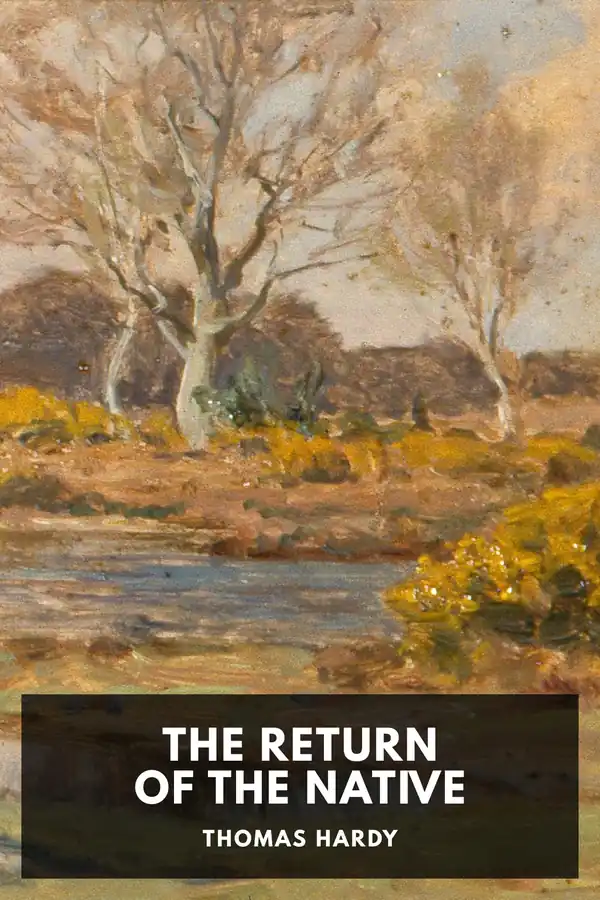
The Return of the Native
📖 Click to Read the Opening Pages Online Preview
A face on which time makes but little impression: the opening of Book I
A Saturday afternoon in November was approaching the time of twilight, and the vast tract of unenclosed wild known as Egdon Heath embrowned itself moment by moment. Overhead the hollow stretch of whitish cloud shutting out the sky was as a tent which had the whole heath for its floor.
The heaven being spread with this pallid screen and the earth with the darkest vegetation, their meeting-line at the horizon was clearly marked. In such contrast the heath wore the appearance of an instalment of night which had taken up its place before its astronomical hour was come: darkness had to a great extent arrived hereon, while day stood distinct in the sky. Looking upwards, a furze-cutter would have been inclined to continue work; looking down, he would have decided to finish his faggot and go home. The distant rims of the world and of the firmament seemed to be a division in time no less than a division in matter. The face of the heath by its mere complexion added half an hour to evening; it could in like manner retard the dawn, sadden noon, anticipate the frowning of storms scarcely generated, and intensify the opacity of a moonless midnight to a cause of shaking and dread.
In fact, precisely at this transitional point of its nightly roll into darkness the great and particular glory of the Egdon waste began, and nobody could be said to understand the heath who had not been there at such a time. It could best be felt when it could not clearly be seen, its complete effect and explanation lying in this and the succeeding hours before the next dawn: then, and only then, did it tell its true tale. The spot was, indeed, a near relation of night, and when night showed itself an apparent tendency to gravitate together could be perceived in its shades and the scene. The sombre stretch of rounds and hollows seemed to rise and meet the evening gloom in pure sympathy, the heath exhaling darkness as rapidly as the heavens precipitated it. And so the obscurity in the air and the obscurity in the land closed together in a black fraternization towards which each advanced halfway.
The preview stops after the opening of Book I. All forty-eight chapters are in the free download below.
Download Full EPUB1878
~143,000 words (estimated)
Approx. 7.9 hours
Standalone
Egdon Heath in Wessex, in the 1840s
48 chapters in six books
EPUB · AZW3 · KEPUB
1.14 MB (EPUB) · 1.08 MB (AZW3) · 1.19 MB (KEPUB)
Public domain in the United States
Project Gutenberg #122 · Standard Ebooks
The Return of the Native opens on Egdon Heath on a November afternoon, with the heath folk stacking furze for the bonfires of the fifth of November. Among them is Diggory Venn, the reddleman, who is carrying Thomasin Yeobright home from a wedding at Anglebury that never took place, because the licence had been made out for another town. Her cousin Clym is coming back from Paris, where he has been a diamond merchant, and Eustacia Vye, who lives at Mistover with her grandfather, has decided that he is her way off the heath. What follows is a marriage, a quarrel, a mother shut out of a door, and a night at Shadwater Weir.
Hardy published the novel in 1878, after Far from the Madding Crowd had made his name, and it is the book in which Wessex stops being local colour and becomes a country of the imagination. It is a story about a place as much as about people: the heath is older than anyone in it, indifferent to their plans, and it outlasts every passion the plot sets loose. Wikipedia’s article on The Return of the Native covers the serialisation in Belgravia, the three-volume printing of 1878 and the novel’s difficult first reception. The text is available via Project Gutenberg #122 and Standard Ebooks.
The Return of the Native by Thomas Hardy: Summary, Characters & Themes
This page is a summary and analysis of The Return of the Native, Thomas Hardy’s sixth published novel and the book in which he made Wessex a country of the imagination rather than a set of disguised place names. It appeared in 1878, when Hardy was thirty-eight, after Far from the Madding Crowd had brought him a readership and before The Mayor of Casterbridge began the run of novels that secured his reputation. The action is placed in the 1840s, a generation before he wrote, on Egdon Heath, a tract of furze and gravel and dark sky that he had known since childhood. Thomas Hardy’s life — the architect’s training, the Dorset childhood, the slow climb into London letters — is present in the book’s patience with labour and weather.
Clym Yeobright comes home from Paris to keep Christmas with his mother at Blooms-End, and the heath takes his return personally. He is tired of the diamond trade and wants to open a school, and Eustacia Vye, marooned at Mistover with her grandfather, decides that this prodigal is her escape from a place she hates. Around them Hardy arranges a second couple: Thomasin, Clym’s cousin, who has been half married to the innkeeper Damon Wildeve and is rescued from the scandal by Diggory Venn, the reddleman who loves her without saying so. The four lives are pulled tight by gossip, by a rumour of an inheritance, and by Mrs Yeobright’s conviction that her son is throwing himself away.
The heath is not scenery but a character with a longer memory than anyone in the book. Hardy opens with a chapter in which no person appears, and the description of Egdon at dusk sets the terms of the tragedy: human beings are small, their passions are brief, and the land is what remains. Eustacia wants Paris, Clym wants a school, Wildeve wants to be amused, and the heath absorbs all of it. Hardy’s narrator is fond of these people and does not spare them. The famous scenes — the bonfire, the mummers’ play, the reddleman’s van, the walk across the heath in August heat — are staged so that the landscape is always the largest thing in the frame.
Contemporary readers found the book difficult. Hardy’s heath was not the picturesque Wessex of guidebooks but a harsh, archaic place, and his heroine was neither gentle nor penitent. The novel sold steadily rather than spectacularly, and Hardy revised it more than once in later editions, adjusting the dialect and the punctuation. Its reputation rose in the twentieth century, when critics began to read it as the first of his tragic novels and the clearest statement of his fatalism. The book belongs with the other Wessex fiction of the same decade, and readers who finish it often go on to Tess of the d’Urbervilles, where the same indifference of nature is turned against a woman, or to The Mayor of Casterbridge, where a man’s past returns with the persistence of weather.
This edition follows the Standard Ebooks text, prepared from Project Gutenberg #122 and checked against scans of the early printing. The six books and forty-eight chapters are kept in Hardy’s order, and the chapter titles in the summaries below are the ones he gave them. The novel is public domain in the United States. Nothing has been modernised, and the spellings and place names are Hardy’s own. The moorland book it most resembles is Wuthering Heights, another novel in which love is a form of exposure, and the heath does something of the work that Emily Brontë’s moor does: it makes the human drama look brief. The Standard Ebooks edition supplies the text used here.
Historical Context
The novel is set in the 1840s, a decade Hardy chose so that his heath could still be reached by cart and on foot rather than by railway. Egdon is a remnant of the old commons, land that had never been enclosed, and its economy is furze, turf, honey and rabbits. The people who cut furze on it are labourers on the edge of poverty, and Hardy gives their work and their talk a seriousness that Victorian fiction usually reserved for drawing rooms. This is a world in which a man may walk six miles to look for work and a woman may be ruined by a wedding that did not happen.
Marriage in the 1840s was a legal transaction as well as a sacrament, and the plot turns on its paperwork. A licence was issued for a particular parish, and Wildeve’s was made out for Budmouth; when the couple went to Anglebury instead, the parson refused to marry them, and Thomasin came home disgraced in the eyes of the heath. Hardy knew the mechanism and used it to show how narrow the margin was between respectability and shame. The same margin governs Eustacia’s choices: with no money and no profession, marriage is the only career open to her, and the heath offers very few candidates.
Hardy wrote the book in 1877 and 1878, while the Wessex novels were becoming a series, and he was conscious of writing for a London audience about a country it did not know. Reviews complained of coarseness and gloom, and the book sold less well than its predecessor. Its pessimism belongs to the decade’s argument about Darwin and determinism, but Hardy’s version is older than Darwin: the heath is indifferent rather than hostile, and the old gods have gone away for good. He never argues the case in public. The preaching that ends the novel is the sound of a man making terms with that silence.
Key Characters & Literary Archetypes
- Clym Yeobright: The native of the title, a diamond merchant in Paris who comes home to Egdon Heath at Christmas, tired of the trade and determined to keep a school for the labourers. He is in his early thirties, handsome, and stubborn in a quiet way. His return sets the tragedy going, and his honesty is the quality that makes it worse: he cannot see what his mother sees, and he cannot stop loving a woman who wants a world he has deliberately left behind.
- Eustacia Vye: Captain Vye’s granddaughter, who lives at Mistover and hates the heath with an intensity that makes her its most vivid inhabitant. She is passionate, theatrical and intelligent, with no outlet for any of it, and she has loved Wildeve before the novel begins. She sees Clym as a way back to Paris, and her disappointment when he chooses furze-cutting over ambition is the engine of the second half of the book.
- Diggory Venn: The reddleman, a travelling dealer in the red ochre used to mark sheep, whose trade stains him from head to foot and keeps him on the edges of respectable society. He loves Thomasin in silence and works for her happiness through other people, negotiating, watching and occasionally gambling. He is the novel’s most resourceful figure and its moral centre, and his reward at the end is quiet rather than triumphant.
- Thomasin Yeobright: Clym’s cousin, a gentle, practical young woman who has been living at Blooms-End with her aunt. Her wedding to Wildeve fails on the way home, and the scandal nearly destroys her; she marries him properly later and tries to make the marriage work. She is the character Hardy treats most tenderly, and her steadiness is the measure by which the book judges everyone else’s restlessness.
- Damon Wildeve: The innkeeper of the Quiet Woman, an engineer by training who has sunk into a comfortable, idle life and cannot resist a woman who is bad for him. He married Thomasin after loving Eustacia, and he keeps returning to Eustacia out of vanity and habit. He is not a villain so much as a man of sentiment without a purpose, and the novel punishes him for it at the weir.
- Mrs Yeobright: Clym’s mother, a widow of firm opinions and considerable courage, who runs Blooms-End and believes she knows what is best for her son. She opposes the marriage to Eustacia, relents too late, and dies on the heath after a last walk to Alderworth. Her pride and her love are tangled together, and the scene at Clym’s door is the novel’s cruellest turn.
Core Literary Themes
- Egdon Heath and the indifference of nature: The heath is the novel’s largest presence and its final judge. Hardy describes it before he describes a single character, gives it a geological history, and keeps returning to it when the plot becomes unbearable. It is not cruel, and it does not notice anyone in particular. The people on it read their passions into its weather and its barrows, and the book quietly shows that the heath will outlast every one of them. This is the source of the novel’s gloom and also of its grandeur.
- The return that fails: Clym comes home expecting to belong, and discovers that the place has no room for the man he has become. The novel is full of returns: Wildeve returns to Eustacia, Eustacia dreams of returning to Budmouth and Paris, Mrs Yeobright returns to a son who has changed. Hardy’s point is that a native who has been away is a native no longer, and that the heath is unforgiving about it. The title is ironic before the first chapter is over, and by the last page it is a verdict.
- Desire, boredom and the rebel woman: Eustacia is the novel’s great study of wasted force. Her intelligence and appetite have nothing to work on in Mistover, so they turn into theatrical longing and a taste for other people’s misery. Hardy does not condemn her, and he does not excuse her either; he shows how a woman with no legal or economic room to move becomes dangerous to herself and to everyone near her. Her death is the logical end of a life lived entirely in anticipation, and Hardy grants her no consolation at the weir.
- Marriage, licence and reputation: The plot is driven by paperwork: a licence made out for the wrong town, a wedding that does not happen, a second wedding that does. Around that mechanism Hardy arranges the whole question of reputation, in which a woman’s worth depends on a certificate and a man’s on very little. Thomasin is nearly ruined by a technicality, and Eustacia is trapped by the only respectable future available to her. Marriage in the novel is a contract that nobody enters freely, and the paperwork decides who is respectable.
- Work, education and class: Clym’s plan to teach the labourers is treated by nearly everyone as a betrayal of his position. Hardy takes the idea seriously and shows why it fails: the heath’s economy has no place for a schoolmaster, and Clym’s own eyes give out before his scheme can be tested. The furze-cutting chapters are among the book’s best, because they measure a man by what he can do with his hands. Class in the novel is not a matter of money alone; it is a matter of what a person is allowed to want.
Why Download Our Custom E-Reader Edition of The Return of the Native?
This edition is built for reading rather than for a shelf. The text is the full novel, six books and forty-eight chapters in Hardy’s order, with his chapter titles and his dialect left as he wrote it. The type is set for an e-reader screen, the paragraphs are not broken by editorial notes, and the table of contents opens at the chapter rather than at the part. What you download is the novel as Hardy published it.
The text follows the Standard Ebooks edition, prepared from Project Gutenberg #122 and checked against scans of the early printing, so a passage you remember can be found and compared. Chapter divisions match the summaries below, which means the page and the file tell the same story in the same order. If you want to test a sentence against the public transcription, the Gutenberg file is the obvious place to look.
Three formats are offered, one download each: EPUB for most readers, AZW3 for Kindle, and KEPUB for Kobo. All three carry the same complete text and the same working navigation, and there is no account to create, no sample chapter standing in for the book and no expiry date. Download it once and it stays on your device, and you can move it to another reader or a phone without asking anyone’s permission.
- Based on the Standard Ebooks Edition, via Standard Ebooks, whose editors prepared this text from the Project Gutenberg transcription and checked it against scans of the early printing; the six books and forty-eight chapters are numbered as Hardy numbered them, so the summaries on this page and the file you download agree.
- Complete forty-eight-chapter text All six books are here entire, from the bonfires on Rainbarrow to the preaching at the end, with Hardy’s chapter titles, his dialect and his long landscape passages left as they stand. Nothing is abridged, no chapter is merged into another and no editorial note interrupts the page.
- EPUB, AZW3 and KEPUB One file per format, so the novel opens on Kindle, Kobo, Apple Books and most other readers without conversion, with a working table of contents, a cover that survives being sent to a device, and files small enough for an old reader or a phone.
- Free and DRM-free Public domain in the United States, with no account, no subscription and no lock on the file; download it once and it is yours to keep, to copy between devices and to reread, with nothing to renew and nothing that expires.
- Tess of the d’Urbervilles — free EPUB, AZW3 & KEPUB
- The Mayor of Casterbridge — free EPUB, AZW3 & KEPUB
- Wuthering Heights — free EPUB, AZW3 & KEPUB
Chapter summaries
Forty-eight chapters in six books, from the November bonfires on Rainbarrow to Clym’s preaching at the end. These twelve summaries follow the Standard Ebooks text in order, grouping the shorter chapters where the action runs straight on.
- Book I, chapters 1–4 — The heath and the bonfire: The novel opens on a November afternoon with the heath itself, described before any person appears, and by dusk the labourers are carrying furze to the top of Rainbarrow for the fifth of November bonfire. Captain Vye walks the white road; Mrs Yeobright and little Olly come down to it; and Diggory Venn’s van stands in the dark. The talk at the fire is all about Thomasin’s wedding that day, and when Venn drives the bride home it is already clear that something has gone wrong.
- Book I, chapters 5–8 — The failed wedding and the woman on the barrow: The wedding failed because Wildeve’s licence was made out for Budmouth and the couple went to Anglebury, where the parson would not marry them. Mrs Yeobright goes to the Quiet Woman to force the matter, and Wildeve promises nothing. That night Eustacia waits on Rainbarrow, and Wildeve comes to her; she begs him to take her away, and he half agrees. Hardy then gives his heroine a chapter of her own, and Venn questions the boy Johnny about the woman he saw on the barrow.
- Book I, chapters 9–11 and Book II, chapter 1 — The reddleman’s campaign and tidings of the comer: Venn decides to fight for Thomasin by removing her rival. He visits Eustacia at Mistover and asks her to give Wildeve up, offering to help her leave the heath; she refuses and mocks him. Mrs Yeobright meanwhile corners Wildeve and learns, in passing, that Clym is coming home from Paris for Christmas. Book II opens with the heath in its winter quiet and with the little white house at Blooms-End being swept and garnished for a son who has been away for years.
- Book II, chapters 2–5 — Christmas, the mummers and the moonlight: Christmas preparations fill Blooms-End, and Eustacia, unable to stay away, overhears the household talking about the returning man. She borrows Charley’s mumming costume and joins the players as the Turkish knight, so that she can see Clym without being seen. The mummers perform, Eustacia swoons in the heat of the part, and the evening ends in dancing at the Quiet Woman. There, in the moonlight outside, she and Clym meet face to face for the first time.
- Book II, chapters 6–8 and Book III, chapter 1 — The dance and the schoolmaster’s plan: At the dance Wildeve watches Eustacia and Clym together and cannot hide his jealousy; Eustacia learns from him that Thomasin is now his wife, and the knowledge turns her triumph sour. The next morning Captain Vye questions her, and Venn, in his best clothes, tries once more to settle Thomasin’s future with Mrs Yeobright. Thomasin is married to Wildeve in church, with Venn looking on. Book III begins with Clym’s face and his announcement that he will give up Paris and keep a school on the heath.
- Book III, chapters 2–5 — Clym at home and the first act of the drama: Clym’s plan disappoints everyone. His mother wanted him to return to the diamond trade, the heath folk think a schoolmaster’s life beneath him, and only Eustacia sees the scheme as a way of keeping him near her. He calls at Mistover to help with a bucket in the well and falls in love with her in an afternoon. Their engagement is secret for a while, then Mrs Yeobright hears of it from Captain Vye, and the quarrel between mother and son becomes a breach that neither can mend.
- Book III, chapters 6–8 and Book IV, chapter 1 — The breach and the rencounter by the pool: Clym leaves Blooms-End for a lonely cottage at Alderworth, and Mrs Yeobright stays behind with her grief. Thomasin’s wedding day arrives without her aunt; Wildeve, stung by the Yeobrights’ contempt, gambles with Christian Cantle and wins the guineas Mrs Yeobright had sent as a peace offering. Venn sits down at the table and wins them back. In the summer Eustacia meets Mrs Yeobright by a pool, and the older woman tells her plainly what she thinks of the marriage.
- Book IV, chapters 2–5 — The furze-cutter and the mother’s journey: Clym’s eyesight fails under the strain of reading, and he takes work as a furze-cutter on the heath, singing at his labour while Eustacia sinks into boredom and despair. He asks her to visit his mother and make peace; she refuses, and he cannot understand why. Mrs Yeobright, hearing that her son is ill, decides to walk to Alderworth herself on the last day of August. The chapter follows her across the heath in the heat, with the furze and the apples and the wasps, and ends at her son’s door.
- Book IV, chapters 6–8 and Book V, chapter 1 — The shut door and the adder: Mrs Yeobright looks through the window and sees Eustacia sitting with Wildeve, and turns away without knocking. Clym is asleep inside and knows nothing. He wakes, goes out, and finds his mother collapsed on the heath, bitten by an adder; she dies before help can be brought, and Clym’s grief becomes an illness. Eustacia hears the news from Wildeve and understands what her silence has cost. Book V opens with Clym recovering, Thomasin with a baby, and the whole heath waiting to see what he will do.
- Book V, chapters 2–5 — The revelation and the flight planned: Clym learns the truth in pieces: his mother had come to the door, Eustacia had been inside and had not opened it, and the man his mother saw was Wildeve. The discovery destroys the marriage. Clym confronts Eustacia with what he knows, and she leaves Alderworth for her grandfather’s house, where Charley waits on her and she plans an escape. She signals to Wildeve from Rainbarrow, and he agrees to bring a carriage on the night of the sixth of November. The plan is made in secret and in bad weather.
- Book V, chapters 6–9 and Book VI, chapter 1 — The sixth of November and the weir: Clym, urged by Thomasin, writes to Eustacia asking her to come back, but the letter arrives too late. On the sixth of November the heath is swept by rain; Susan Nunsuch melts a wax figure of Eustacia over a fire; Thomasin and Venn search the roads for Wildeve. At Shadwater Weir Eustacia falls into the pool, Wildeve leaps in after her, and both drown. The last chapter of the book gathers the survivors, and Venn finds Thomasin’s glove in the grass and keeps it.
- Book VI, chapters 2–4 — Thomasin, Venn and Clym’s vocation: Spring comes, and Thomasin slowly recovers for her child’s sake. Venn, who has given up reddle and become a dairyman, meets her by the Roman road, and the courtship that has run under the whole novel finally surfaces. Clym urges his cousin to marry him, and she does, on a morning when the whole heath gathers at Fairway’s. Clym, half blind and done with schemes, takes up preaching, and the novel ends with a man who has lost almost everything finding a use for his voice.
The Return of the Native: Frequently Asked Questions
When is The Return of the Native set?
Where is Egdon Heath?
Is Clym the native of the title?
Why did Thomasin’s first wedding fail?
How does Mrs Yeobright die?
What happens at Shadwater Weir?
What is a reddleman?
Where can I download the free EPUB, AZW3 and KEPUB?
Part of: Classic Fiction · Victorian Literature