The Black Arrow by Robert Louis Stevenson: Free EPUB, AZW3 & KEPUB Download
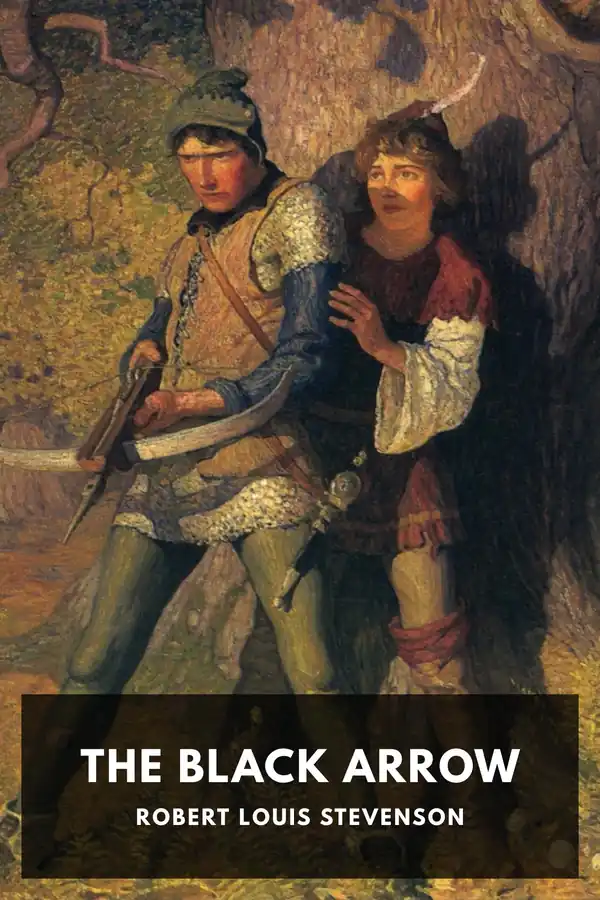
The Black Arrow
📖 Click to Read the Opening Pages Online Preview
Two in the morning at the sign of the Sun in Kettley
Sir Daniel and his men lay in and about Kettley that night, warmly quartered and well patrolled. But the Knight of Tunstall was one who never rested from money-getting; and even now, when he was on the brink of an adventure which should make or mar him, he was up an hour after midnight to squeeze poor neighbours. He was one who trafficked greatly in disputed inheritances; it was his way to buy out the most unlikely claimant, and then, by the favour he curried with great lords about the king, procure unjust decisions in his favour; or, if that was too roundabout, to seize the disputed manor by force of arms, and rely on his influence and Sir Oliver’s cunning in the law to hold what he had snatched. Kettley was one such place; it had come very lately into his clutches; he still met with opposition from the tenants; and it was to overawe discontent that he had led his troops that way.
By two in the morning, Sir Daniel sat in the inn room, close by the fireside, for it was cold at that hour among the fens of Kettley. By his elbow stood a pottle of spiced ale. He had taken off his visored headpiece, and sat with his bald head and thin, dark visage resting on one hand, wrapped warmly in a sanguine-coloured cloak. At the lower end of the room about a dozen of his men stood sentry over the door or lay asleep on benches; and somewhat nearer hand, a young lad, apparently of twelve or thirteen, was stretched in a mantle on the floor. The host of the Sun stood before the great man.
“Now, mark me, mine host,” Sir Daniel said, “follow but mine orders, and I shall be your good lord ever. I must have good men for head boroughs, and I will have Adam-a-More high constable; see to it narrowly. If other men be chosen, it shall avail you nothing; rather it shall be found to your sore cost. For those that have paid rent to Walsingham I shall take good measure—you among the rest, mine host.”
The preview stops inside the opening chapter. All thirty-two chapters are in the free download below.
Download Full EPUB1888
~74,000 words (estimated)
Approx. 4.1 hours
Standalone
England during the Wars of the Roses, in the 1460s
32 chapters in five books
EPUB · AZW3 · KEPUB
0.66 MB (EPUB) · 0.71 MB (AZW3) · 0.69 MB (KEPUB)
Public domain in the United States
Project Gutenberg #848 · Standard Ebooks
The Black Arrow opens in a divided England, where Richard Shelton, not yet eighteen, is riding home when a clothyard shaft kills an old archer in a cabbage patch. The paper wrapped round the arrow names four men and promises a shaft for each, and one of the four is Sir Daniel Brackley, Dick’s guardian. Before the week is out Dick has carried his guardian’s letters, put a drowning horse out of its misery in the fen, met a runaway boy called John Matcham, and heard a band of outlaws say that Sir Daniel murdered his father. What follows is disguise, a stolen ship, a sacked town and a wedding that almost happens.
Stevenson wrote the book in the early 1880s for the boys’ magazine Young Folks and published it with Cassell in 1888, between Treasure Island and Kidnapped. Lancaster and York give the story its weather rather than its argument: the real subject is a boy’s education in loyalty, and the people who profit from it. There is a warm fire in the book, but the murders are murders and the ending is careful rather than tidy. Read Wikipedia’s article on The Black Arrow for the serial and the novel’s later history. The text is available via Project Gutenberg #848 and Standard Ebooks.
The Black Arrow by Robert Louis Stevenson: Summary, Characters & Themes
This page is a summary and analysis of The Black Arrow, the historical adventure Robert Louis Stevenson published in 1888, between the two books that made him famous. Stevenson was born in Edinburgh in 1850, trained as an engineer and then as a lawyer, and came to fiction late, by way of essays, travel writing and a long apprenticeship in short stories. His life was restless — France, California, the South Seas — and the journeys show in prose that is quick, visual and fond of a road. He had already published Treasure Island and Kidnapped when he turned to the fifteenth century. This one he wrote for boys’ magazines, in the voice of a man telling a story around a fire, and the result is a book that knows it is entertainment and quietly refuses to be only that.
The story is set in the England of Henry VI, among the fens and forests of Suffolk, and it begins with a murder that has already happened. Richard Shelton, not yet eighteen, is the ward of Sir Daniel Brackley, a knight who has grown rich by changing sides and who may have killed the boy’s father. The first black arrow takes an old archer in a cabbage patch, and the paper round its shaft names four men and promises a shaft for each. From there the novel moves through a night ride, a fen, a ferry, a ruined house in the greenwood, a castle with a secret passage, a stolen ship, a sacked town and a wedding that almost becomes a funeral. Stevenson keeps the five books moving, and he lets his hero be wrong, frightened and slow to understand what the reader has already guessed.
The people around him are drawn with a satirist’s eye. Sir Daniel is merry, generous with other people’s property and entirely without scruple; his piety is a matter of convenience and his oaths are worth what they cost him. Sir Oliver Oates, the priest, is the book’s study in weakness — a man who has done evil for good reasons and cannot live with the memory. Bennet Hatch is brutal and sentimental at once, and the outlaw Ellis Duckworth carries a grievance so old that it has become a religion. Against them Stevenson sets plain people, the ferryman, the shipman Arblaster, the old rogue Lawless, whose loyalty is small in scale and steady. The novel’s moral centre is not a code of chivalry but the habit of keeping faith with the person in front of you.
The prose is deliberately old-fashioned in its dialogue and modern in its pacing. Stevenson had read the chronicles and the ballads, and he gives his fifteenth-century men a broad, warm, invented English — “ye”, “go to”, “by the rood” — which is less an imitation than a convention the reader agrees to. The same instinct for the story rather than the archive drives Treasure Island, where the map and the mutiny matter more than the geography, and Kidnapped, which turns a Highland crossing into a moral test between two men who are tied to each other. What is new here is the mood. The wood is cold, the men are hungry, and the jokes are usually at the expense of somebody who is about to be hanged.
The novel has never had the fame of those two island books, and it is often treated as a boys’ story with a dark middle. That is fair, and it undersells the machine. The inheritance plot, the hidden letters, the woman with two names and the hearing in the abbey church are the furniture of the sensation novel, and the same machinery drives Wilkie Collins’s The Woman in White. Stevenson uses it to ask who owns a child, a house and a marriage, and the answer he gives is not comfortable. The text on this page follows Project Gutenberg #848 and the Standard Ebooks edition, which keeps the prologue, the five books and the thirty-two chapters, with the chapter titles as their editors print them.
Historical Context
Stevenson sets his story in the 1460s, in the long civil war between the houses of Lancaster and York that later historians named the Wars of the Roses. The crown changed hands more than once, and the great families changed with it; a knight like Sir Daniel could go to bed Lancaster and get up York, as a countryman says in the prologue, and every change might bring him another manor. England had no standing army and no effective police, so order rested on the goodwill and the private armies of men like him. Villages paid for their lords’ quarrels in burned barns and hanged tenants. Stevenson did not have to invent the disorder. He had only to put a boy inside it, with a guardian who profited from every shift of the wind.
The legal machinery of the book is historical too. Wardship allowed a lord to hold an heir’s lands and arrange the heir’s marriage, and an heiress was a piece of property with a face. Sir Daniel’s guardianship of Dick and his cheerful willingness to sell a marriage are not Gothic invention; they were ordinary business among fifteenth-century families, and the same trade in heirs appears in manor rolls and in the Paston letters. Stevenson turns that economy into plot. Joanna Sedley’s value is her land, and everyone from Sir Daniel to Lord Shoreby wants to control the wedding. The romance of the book is that Dick and Joan choose each other anyway. The realism is that they can do it only after the men who owned them are dead or beaten.
The book also belongs to the 1880s rather than the 1460s. Stevenson wrote it for Young Folks, a weekly that serialised adventure stories for young readers, and the shape of the magazine is visible in the short chapters and the repeated cliff-hangers. Boys’ fiction of the period was expected to be improving as well as exciting, with courage, loyalty and fair play as the stock virtues and bullies in armour as the stock villains. Stevenson meets the expectation and then bends it. His hero swears, loses his temper, is deceived, and is saved more than once by other people’s mercy; the last chapter rewards a shipman and an outlaw rather than a duke. It is a boys’ adventure written by a man with a sceptical eye, and it is better for the doubt.
Key Characters & Literary Archetypes
- Richard Shelton: The hero, not yet eighteen and Sir Daniel’s ward. He is loyal, quick to anger and quicker to shame, and the book is the story of his education: he begins by defending the guardian who murdered his father, and ends by serving a duke he does not much like and marrying the girl he was once tricked into meeting. Stevenson lets him be wrong for a long time, which is why the change of sides feels earned. Gloucester knights him before the last chapter, and the title sits lightly on him.
- Sir Daniel Brackley: Dick’s guardian and the novel’s villain, though never merely a villain. He is merry, hospitable, generous with other men’s goods and completely unscrupulous; he changes sides with the weather and kills when the ledger demands it. His religion is a performance and his oaths are instruments. What makes him frightening is his plausibility: he can weep, laugh, swear brotherhood and order a murder in one afternoon, and he half believes his own excuses. He dies as he lived, by an arrow out of a thicket while dressed as a pilgrim.
- Joanna Sedley: The heiress Sir Daniel means to sell in marriage, and the boy called John Matcham for the first third of the book. She is sharp-tongued, practical and braver than her situation requires; disguised in boy’s clothes she teases Dick about the wife he does not want, and the joke is on both of them. Her disguise is a flight for her life rather than a game, and when she drops it she becomes the book’s moral test: who will keep faith with a girl whose only property is herself?
- Ellis Duckworth: The outlaw captain who signs himself John Amend-All, and the book’s avenging angel. Ruined and wronged by Sir Daniel’s household, he runs the Black Arrow fellowship in Tunstall Forest and sends his arrows as warrants. He is generous to Dick, ruthless to his enemies and superstitious about his own oath of revenge. His last shot settles the plot without giving the hero the killing, and his admission afterwards, that he took the worse part while Dick took the better, is the quiet moral of the book.
- Lord Foxham: Joanna’s guardian and a Lancastrian knight, wounded and taken prisoner in the fight on the beach at Shoreby. He is honourable in a tired, practical way: he listens to Dick’s story, agrees that the boy has been wronged, and promises Joanna’s hand if the outlaws can win her back. He stands for the decent old order, better than Sir Daniel and less useful than Duckworth, and he is glad to hand a difficult ward to a young man who has earned her.
- Lawless: The renegade friar who becomes Dick’s lieutenant and the book’s comic engine. He is huge, drunken, cheerful and reliable when it matters: he can handle a boat, a horse and a bottle, and he talks his way into Sir Daniel’s house disguised as an old monk. His drinking nearly ruins the rescue and his seamanship nearly drowns the crew of the Good Hope. Stevenson likes him without trusting him, and the friendship between the boy and the old rogue is one of the novel’s quiet pleasures.
Core Literary Themes
- Inheritance, wardship and the marriage market: The engine of the plot is property in persons. Dick is a ward whose lands and marriage belong to his guardian, and Joanna is an heiress whose value is counted in manors; Sir Daniel’s trade is to hold both and sell the wedding to the highest bidder. Stevenson makes the marriage plot literal — a wedding is a contract, a bride is a title deed, and the villain’s best weapon is a lawyer. The happy ending is not a restoration of the old order but a small break in it, since the couple escape the market only by leaving the world that runs it.
- Loyalty and the changing of sides: Every important character has to decide whom to be true to, and most of them are true to the wrong person for a while. Sir Daniel changes sides with the seasons and calls it wisdom; Sir Oliver breaks a great oath and is destroyed by the memory of it; Bennet Hatch serves a bad master with a good heart; Dick begins by defending his father’s murderer and ends by taking up arms against his guardian’s party. Stevenson’s point is that loyalty is a virtue only when its object is worth the name, and that the moment of change is always a betrayal of somebody.
- Disguise and the borrowed name: The plot turns on clothes. Joanna lives for a third of the book as a boy, Sir Daniel walks the forest as a leper, Dick and Lawless enter a house as monks, and Sir Daniel ends as a pilgrim. Nobody can be identified by appearance, and the black arrow itself is a signature without a name. Disguise is played for comedy and for terror at once: a leper’s bell is funny only until it turns towards you. Underneath is a plainer idea. A society that values names and titles cannot tell who anybody really is.
- Vengeance and its disappointments: The Black Arrow fellowship exists to avenge four men, and the novel watches what revenge does to the people who carry it. Duckworth’s arrows are more just than Sir Daniel’s law, but they are still arrows; the killing at the end comes out of a thicket rather than from the hero’s hand, and it leaves a bad taste in everyone’s mouth. Dick’s own threat to his guardian is written down in a letter, and when the chance to kill arrives he offers mercy instead. Stevenson is not squeamish about violence, but he is honest about its aftermath. Revenge can be deserved and still leave a debt.
- The greenwood and the fellowship of outlaws: The forest in this book is both a refuge and a rough court. The outlaws take their name from a rhyme, share their venison, punish the lords who ruined them and keep an order of their own. Stevenson inherited that greenwood from the ballads and from Scott, and he uses it as a moral contrast to the walled house: the Moat House is full of spies and trapdoors, while the cave in the woods has friends in it. The last chapter sends the hero back to the forest with his wife, which is a strange ending for a book about inheritance and exactly the right one for a book about freedom.
Why Download Our Custom E-Reader Edition of The Black Arrow?
This edition is the whole book rather than an extract. The text is the Standard Ebooks edition of Stevenson’s 1888 novel, with the prologue, the five books and the thirty-two chapters in their published order and the chapter titles as the editors give them. Nothing is modernised, shortened or softened. The hanging in the first chapter is still a hanging, the oaths are still oaths, and the old-fashioned dialogue is kept because the story depends on it. The file is built for an e-reader, with a working table of contents and clean chapter breaks.
Reprints of this novel differ more than they should. Some split the books into numbered chapters, some drop the prologue, some cut the rhyme of the four arrows, and most tidy the spelling. This edition keeps the five-book arrangement, and the twelve groupings below follow it, so the chapter you read about on this page is the chapter you find in the file. If you want to compare a passage with the public transcription, Project Gutenberg #848 is the obvious place to start, and the two agree chapter for chapter.
Three files are offered, one per format: EPUB for most readers, AZW3 for Kindle, KEPUB for Kobo. They carry the same text and the same navigation, and none of them is locked to a device or an account. There is no subscription and no sample chapter standing in for the book, and the file does not expire. Download it once and it stays yours. You can move it between a phone, a tablet and a dedicated reader, and the book opens where you left off.
- Based on the Standard Ebooks Edition, via Standard Ebooks, whose editors prepared this text from the Project Gutenberg transcription and checked it against the early printed edition, keeping the prologue, the five books and the thirty-two chapters in order and supplying the chapter titles used in the summaries below.
- Complete thirty-two-chapter text Every chapter is here, from the arrow in Appleyard’s back to the pensioners in Tunstall hamlet, with the ballads, the letters, the rhyme of the four arrows and the long set-piece fights left as Stevenson wrote them. Nothing is summarised in place of the original, and the divisions between the five books are kept, so a reader can follow the printed structure rather than a modern abridgement.
- EPUB, AZW3 and KEPUB One download per format, so the novel opens on Kindle, Kobo, Apple Books and most other readers without conversion, with a working table of contents, proper chapter breaks and a cover that survives being sent to a device. The files are small enough for an old reader and complete enough for a new one.
- Free and DRM-free Public domain in the United States, with no account, no subscription and no lock on the file; download it once and it is yours to keep, to copy between devices and to reread, with nothing to renew and nothing that expires. There is nothing hidden in the file and nothing to install before it opens.
- Treasure Island — free EPUB, AZW3 & KEPUB
- Kidnapped — free EPUB, AZW3 & KEPUB
- The Woman in White — free EPUB, AZW3 & KEPUB
Chapter summaries
Thirty-two chapters in five books, from the first arrow in the cabbage patch to the wedding at Holywood. These twelve summaries follow the Standard Ebooks text in order, grouping the short chapters where the action runs straight on.
- Book I, chapters 1–3 — At the sign of the Sun in Kettley: Sir Daniel is at the inn by two in the morning, hanging one tenant and squeezing a bond out of another, when Dick arrives with letters from the Moat House. The war has reached Risingham and the knight must march, so he sends his ward home with a packet. Dick crosses the fen, puts a quarrel through a drowning grey horse, and finds the boy who calls himself John Matcham. The two take Hugh Ferryman’s boat over the Till and land in Tunstall Forest.
- Book I, chapters 4–6 — A Greenwood Company, and the flight through the forest: Beyond the ferry the lads see a spy in a fir and hide in a ruined house where the Black Arrow fellowship is eating a stolen deer. Dick hears Ellis Duckworth swear to avenge three men, one of them Harry Shelton, and hears the rhyme of the four arrows. Selden’s crossbowmen walk into the ambush; Dick tries to warn them, Selden is shot down, and Duckworth saves Dick’s life by naming him Harry’s son. The boys run until dark and sleep in a pit.
- Book I, chapter 7 to Book II, chapter 2 — The hooded face, and the two oaths: Morning brings a blind leper who chases the boys, catches Matcham, and turns out to be Sir Daniel, skulking home from the rout at Risingham. At the Moat House the garrison is terrified of the black arrows and Selden’s body is carried in. Sir Daniel swears on his honour that he had no part in Harry Shelton’s death. The oath is barely spoken when an arrow crashes through the stained-glass window and sticks in the table with one word on it. Earthed.
- Book II, chapters 3–5 — The room over the chapel, and how Dick changed sides: Dick is given the fine chamber above the chapel, and in the night a man comes up through the floor with a knife. The alarm saves him, and Matcham at the door is revealed as Joanna Sedley. Together they open the trap and crawl through the passages over the chapel roof, where they overhear Sir Oliver at prayer and Bennet Hatch, who shows them the hidden spring. They escape by Throgmorton’s rope, and Dick writes a letter that ends the old loyalty.
- Book III, chapters 1–3 — The house by the shore, and the meeting at St. Bride’s Cross: Months later Shoreby-on-the-Till is full of Lancastrian lords, Sir Daniel keeps Joanna in a house by the shore, and Dick is living with the outlaws at the Goat and Bagpipes. A night attack on the house becomes a brawl with Lord Shoreby’s men and a retreat through the surf. At St. Bride’s Cross in the morning Dick bargains with his prisoner, Lord Foxham, Joanna’s guardian, who promises that if the outlaws win her back she shall marry Dick.
- Book III, chapters 4–6 — The Good Hope, and the wreck on the sands: With Duckworth away, Dick takes command. Lawless talks his way aboard the Good Hope, a Dartmouth ship lying off Shoreby, and forty men take her in the dark. The landing on the pier goes wrong, the frightened crew put to sea, and a winter gale drives the ship until she breaks. Lord Foxham is carried ashore wounded, the outlaws lose their plunder, and Book IV opens with Dick and Lawless trudging through snow towards the outlaws’ den.
- Book IV, chapters 1–3 — The Den, and the dead spy: In the woods Lawless leads Dick to the Den and shows him a black arrow of his own. Sir Daniel’s house in Shoreby is full of wedding guests, and the two enter it disguised as monks; Dick finds Joanna upstairs and Lawless gets drunk. A spy called Rutter carries off a tassel from Dick’s girdle, and in a dark passage Dick kills him. In the man’s wallet is Lord Shoreby’s sealed letter to Lord Wensleydale, which proves the bridegroom is trading with the Yorkists.
- Book IV, chapters 4–6 — Sanctuary in the abbey church, and Arblaster again: Dick takes sanctuary in Shoreby Abbey, where Rutter’s body is waked and Sir Oliver confesses that he lured Harry Shelton to his death. Earl Risingham hears the case and takes Dick and Lawless prisoner, then lets them slip away. In the town they meet Arblaster, who has lost his ship, his wine and his man Tom, and who is now the book’s most wronged and comic figure. Dick hides in a doorway until the patrols have passed.
- Book V, chapters 1–3 — The shrill trumpet, and the battle in the streets of Shoreby: Before dawn Dick goes to the Den for Lord Foxham’s papers and finds a fight at St. Bride’s Cross, where a slight boy with a shrill trumpet is holding off horsemen. The boy is the young Duke of Gloucester, and Dick fights for him. Gloucester’s small party enters Shoreby, the Lancastrians are unprepared, and by noon the market place is a battle. Dick’s hundred are cut down to seventy, and the earl who held him prisoner is left dead on the field.
- Book V, chapters 4–5 — The sack of Shoreby, and a ride through the snow: Shoreby is taken and sacked. Dick forces his way into Sir Daniel’s house and finds the chamber on the third floor wrecked and empty, with the knight already ridden out by the garden gate. He climbs the church tower to read the country, then finds Alicia Risingham in the snow beside her dead horse and carries her with him. She proposes marriage during the pursuit; he refuses, and keeps faith with Joanna.
- Book V, chapters 6–7 — The camp in the woods, and Dick’s revenge: Dick’s night attack on the outpost where Joanna is held goes wrong, and Sir Daniel’s riders drive his men back; Bennet Hatch is killed in the fighting. Dick gets away with Joan, still in her boy’s clothes, and the three young people walk to Holywood in the moonlight. In the morning Sir Daniel comes to the abbey as a pilgrim, and Dick spares him, forbids him the church and offers a fair fight. An arrow from a thicket kills the knight as he turns away.
- Book V, chapter 8 — The wedding at Holywood: Gloucester looks at Joanna, tells her she is fair and dowered, and offers her a great marriage; she answers that she asks no more of Heaven than to die Sir Richard’s wife. The duke takes it well, marries Alicia Risingham to Lord Foxham’s kinsman Hamley and rides off to his own history. Dick and Joan are married in the abbey church, then live quietly in the green forest, while two old men draw pensions in Tunstall hamlet.
The Black Arrow: Frequently Asked Questions
Who is Richard Shelton?
Who killed Dick’s father?
Is John Matcham really a boy?
What does the black arrow mean?
What happens on the Good Hope?
How does Dick change sides?
Is the Duke of Gloucester the Richard III of history?
Where can I download the free EPUB, AZW3 and KEPUB?
Part of: Adventure & Sea Stories · Victorian Literature