Typee by Herman Melville: Free EPUB, AZW3 & KEPUB Download
Typee
📖 Click to Read the Opening Pages Online Preview
Six months at sea, and a ship bound for the Marquesas
Six months at sea! Yes, reader, as I live, six months out of sight of land; cruising after the sperm-whale beneath the scorching sun of the Line, and tossed on the billows of the wide-rolling Pacific—the sky above, the sea around, and nothing else! Weeks and weeks ago our fresh provisions were all exhausted. There is not a sweet potato left; not a single yam. Those glorious bunches of bananas, which once decorated our stern and quarterdeck, have, alas, disappeared! and the delicious oranges which hung suspended from our tops and stays—they, too, are gone! Yes, they are all departed, and there is nothing left us but salt-horse and sea-biscuit. Oh! ye stateroom sailors, who make so much ado about a fourteen-days’ passage across the Atlantic; who so pathetically relate the privations and hardships of the sea, where, after a day of breakfasting, lunching, dining off five courses, chatting, playing whist, and drinking champagne-punch, it was your hard lot to be shut up in little cabinets of mahogany and maple, and sleep for ten hours, with nothing to disturb you but “those good-for-nothing tars, shouting and tramping overhead,”—what would ye say to our six months out of sight of land?
Oh! for a refreshing glimpse of one blade of grass—for a snuff at the fragrance of a handful of the loamy earth! Is there nothing fresh around us? Is there no green thing to be seen? Yes, the inside of our bulwarks is painted green; but what a vile and sickly hue it is, as if nothing bearing even the semblance of verdure could flourish this weary way from land. Even the bark that once clung to the wood we use for fuel has been gnawed off and devoured by the captain’s pig; and so long ago, too, that the pig himself has in turn been devoured.
There is but one solitary tenant in the chicken-coop, once a gay and dapper young cock, bearing him so bravely among the coy hens.
The preview stops inside Chapter 1. All thirty-four chapters are in the free download below.
Download Full EPUB1846
~101,000 words (estimated)
Approx. 5.6 hours
Standalone
Nuku Hiva in the Marquesas Islands, in the 1840s
34 chapters
EPUB · AZW3 · KEPUB
0.79 MB (EPUB) · 0.90 MB (AZW3) · 0.82 MB (KEPUB)
Public domain in the United States
Project Gutenberg #1900 · Standard Ebooks
Typee is Herman Melville’s first book, published in 1846, and it opens with a whaler six months out of sight of land. The narrator, a sailor who calls himself Tommo, runs away from the ship at Nukuheva in the Marquesas with a shipmate named Toby, climbs into the mountains, and comes down into a valley held by the Typee, a people with a cannibal reputation. They do not kill him. They feed him, carry him when his leg swells, and refuse to let him go, and he spends months among them, learning the language, admiring Fayaway, and watching the sea for a sail.
Melville had been at sea himself. In 1842 he deserted the whaler Acushnet in the Marquesas, and the valley, the damaged leg, the girl and the tattooed chiefs all come out of that stay. Read Wikipedia’s article on Typee for the book’s reception, its quarrel with the missionaries and the long argument over whether Toby existed. Typee made his name, and it remains the sharpest account of a Polynesian valley before the French and the missionaries had finished with it. The text is available via Project Gutenberg #1900 and Standard Ebooks.
Typee by Herman Melville: Summary, Characters & Themes
This page is a summary and analysis of Typee, Herman Melville’s first book, published in London in 1846. The narrator, a sailor who calls himself Tommo, is six months out of sight of land on a whaler; he and a shipmate named Toby slip ashore at Nukuheva, climb into the mountains, and come down into a valley held by the Typee, a people with a cannibal reputation and no intention of letting a white man walk out again. What follows is not an escape story but a long captivity among people he comes to like, ending with an English whaleboat, a false report and a run through the surf. It is the book that made Moby-Dick possible, and it is still the best account of a Polynesian valley written by someone who had to live in one.
Melville knew what he was describing because he had done it. He signed the articles of the whaler Acushnet at New Bedford on 1 January 1841, spent eighteen months in the Pacific, and deserted at Nukuheva in the summer of 1842; the introduction printed with the 1892 edition calls the ship of this book “the Dolly, otherwise the Acushnet.” He was in his early twenties, with no literary reputation to protect, and what he wrote out of those months is closer to reportage than to fiction. Herman Melville’s life — the years before the mast, the family’s money troubles, the later work in the New York customs house — explains the book’s appetite for detail and its suspicion of anyone who explains the Pacific from a desk.
Structurally the book is a travel journal with arguments. Each of the thirty-four chapters opens with a short list of its contents — the sea, the longings for shore, the feast of calabashes, the tattoo artist — and then proceeds by digression, anecdote and complaint. There is a plot, but it is thin: the narrator cannot leave, and then he does. The interest is in the middle, in the ordinary arrangements of a valley without locks or written law, and in the narrator’s growing inability to say whether he is a guest or a prisoner. Robinson Crusoe had taught readers to see an island as property to be improved; Melville’s valley is the reverse, a place that improves the visitor’s manners while keeping him.
The style is worth a warning. Melville writes in the loud, confidential manner of a young man who has read travel books and despises most of them, and he will stop the story for pages at a time over breadfruit, tattooing or the beauties of the Typee complexion. Those digressions are the book. They carry its comedy, from the French admiral’s horse to the priest dandling an idol, and its anger, most of it aimed at published missionary accounts of the islands. The text used here is the Standard Ebooks edition, prepared from the Project Gutenberg transcription, which was itself made from an early printing and checked against scans of the book.
The reception was immediate. John Murray accepted the manuscript, the book appeared in 1846 and was dedicated to Chief Justice Lemuel Shaw, and an American edition followed at once. Omoo, the sequel, came out in 1847, and the introduction printed with the 1892 edition calls the next book, Mardi, a splendid failure. Toby turned out to be a real man, Richard T. Greene, who recognised himself in print and wrote to the author, and the epilogue here is his own account of what happened after he left the valley. The Standard Ebooks edition keeps the thirty-four chapters, the arguments and that epilogue, and for a reader coming from Treasure Island it is a reminder that the sea story began as reportage.
Historical Context
A whaler in the 1840s was a factory under sail, and her crew signed on for the voyage; the 1892 introduction calls it an eighteen months’ cruise. The Acushnet sailed from New Bedford on 1 January 1841 for the sperm fishery; fresh provisions were eaten in the first weeks, then came salt-horse and sea-biscuit, and the captain’s word was law. Men ran away when a ship touched land, and the Marquesas were a provisioning stop. In the summer of 1842 the French under Rear Admiral Du Petit Thouars had taken possession of the group. The narrator arrives to find a French squadron in the bay, a horse from Valparaiso that the islanders take for a great hog, and a king in a plumed hat with a strip of tattooing across his face.
The Typee valley already had a reputation in the ports. Its people were at war with the Happar, who were at peace with Nukuheva, and sailors were warned that a white man who went inland would be killed and eaten. The book takes that warning seriously and then spends its length qualifying it. The Typee deny the practice; no European in the narrative has seen it; the evidence is a smoked head, a feast the narrator is shut out of and the word of other islanders. The chapter on the Feast of Calabashes goes after the published missionary accounts directly, and asks how much of what Europe believed about the islands rested on secondhand testimony.
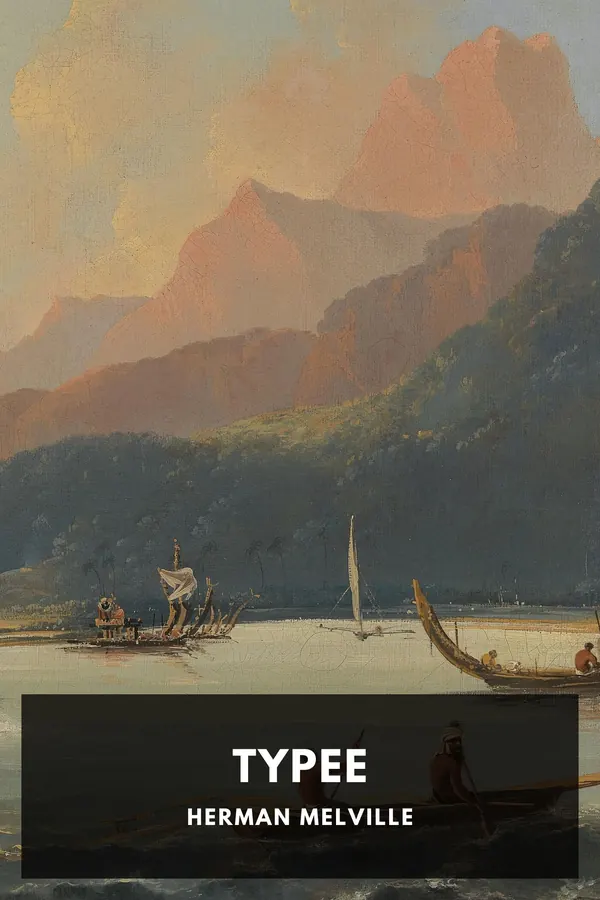
Typee appeared in 1846, when its author was twenty-six and the Pacific was still a place European readers knew mostly from voyage narratives and sermons. John Murray published it in London, an American edition followed at once, and the book was successful enough to make a sequel worth writing. The text here comes from the Standard Ebooks edition, produced by Duncan McFarland from the Project Gutenberg transcription made by Dianne Bean, David Widger and Distributed Proofreaders, with the cover adapted from William Hodges’s view of Matavai Bay. The epilogue, in which Toby tells his own story, was added as a sequel, and the 1892 introduction vouches for him as an authentic personage.
Key Characters & Literary Archetypes
- Tommo: The narrator, an American sailor six months out of sight of land and desperate for grass under his feet. He gives his name as Tom, which the chief cannot pronounce, and becomes Tommo for the whole of his stay. He is curious, quick to take offence and quicker to be ashamed of it, and the leg that swells and will not heal keeps him dependent on people he cannot leave. Almost everything in the book is seen through his temper, including the people who are kindest to him.
- Toby: The shipmate who agrees to run with him. He is about the narrator’s age, active, ready and obliging, of dauntless courage, and he refuses to tell anyone his real name. He is wounded in the head during an expedition into the Happar mountains and nursed by Tinor, and when boats are reported he goes down to the beach, promises to return in three days and disappears from the narrative. The epilogue prints his own account, and the 1892 introduction names him as Richard T. Greene.
- Fayaway: The young Typee woman who becomes the narrator’s favourite. Her free, pliant figure, her olive complexion and her soft hands are described at length, and she is almost, though not quite, free of tattooing. She sits with him when he is in pain, weeps when he suffers, and in the lake she stands in a canoe and spreads her tappa robe for a sail. Her devotion is one of the reasons the valley is hard to leave, and one of the reasons he cannot quite trust his own account of it.
- Kory-Kory: The narrator’s body servant and the son of Marheyo. He carries him on his back to the stream, feeds him like an infant, and translates the valley for him with patience and a good deal of noise. His face is marked with three broad stripes of tattooing. He is devoted, fussy and occasionally a traitor to his master’s wishes, as when he urges him to submit to Karky’s needle; he is also the person who finally carries him down to the beach and the whaleboat.
- Mehevi: The chief, whom the narrator calls king. He receives the strangers with ceremony, sends food to Marheyo’s house, presides over the Ti and the feasts, and carries a musket in one hand and a captured javelin in the other. He is dignified, curious about the white man’s world and capable of sudden coldness: when the narrator asks to be released, the friendship cools at once. He wants Tommo tattooed, and his displeasure is one of the things that makes the valley feel like a prison.
- Marheyo: The aged warrior in whose house the narrator lives, and the father of Kory-Kory. He has retired from the affairs of the valley, leaves the household to Tinor, and is eccentric, warm-hearted and given to sudden enthusiasms. He piles his guest’s mat with delicacies, hides his weapons under the eaves and then resumes his cooking as if nothing had happened. He learns two English words, Home and Mother, and uses them when he at last lets the narrator go.
Core Literary Themes
- The cannibal question: Cannibalism is the promise of the title and the fear of every sailor in the book, and Melville keeps the question open to the last page. The Typee deny it, no European in the narrative witnesses it, and the evidence comes down to a smoked head and a feast the narrator is excluded from. The reader is given the smoke, the drums and the narrator’s fear, and nothing that settles the question. The joke, and the argument, is that the reputed cannibals treat him better than the civilised captain of the Dolly did. What the book finally questions is not the Typee appetite but the European appetite for stories about it.
- Hospitality as captivity: The valley’s kindness and its refusal are the same institution. The narrator is fed, carried, nursed and never left alone, and the word for the arrangement is taboo. The word covers the sacred trees and the rules that keep a guest inside the valley, and the narrator learns to hear it as both at once. Mehevi’s hospitality is real, and so is his decision that his guest will not leave; the two things do not cancel each other. Melville finds the ambiguity interesting rather than shocking, and he keeps it in view to the last chapter, where Marheyo’s two English words do more for the narrator than any argument about rights.
- The marked body: The leg that swells, the tattoo that is almost inflicted, the shark’s tooth on the artist’s stick, Fayaway’s nearly unmarked skin and the smoked heads in Marheyo’s rafters: the body is where this book argues about savagery and civilisation. Illness makes the narrator dependent, and the tattoo would make him permanently other. He can refuse the needle, but he cannot refuse the illness. His skin is the last thing he can refuse, and the chapters about Karky are the most frightened writing in the book.
- The unfinished record: The book presents itself as notes rather than a novel. The preface is written three years after the events by a man who admits he lost count of the days of the week; the chapters digress; the epilogue hands the story to Toby, who contradicts nothing and explains little. It is a record with gaps, and it knows it. That untidiness is not a failure of craft. It is how Typee asks to be read, as testimony gathered by an unreliable witness who is honest about the limits of what he saw.
- Civilisation and the missionary: The chapter on the Feast of Calabashes is a direct attack on published missionary accounts of the islands, and the book’s picture of a valley without locks or written law was read as an argument against the civilising mission. Melville is not consistent about this. He admires the French admiral, despises the captain at Tior, and jokes about his own countrymen as readily as about the Typee. The inconsistency is the point: the book refuses the choice between a savage valley and a virtuous Europe.
Why Download Our Custom E-Reader Edition of Typee?
This is the whole book, not a selection. Thirty-four chapters in their order, each with the short argument Melville set above the prose, the epilogue in which Toby tells his own story, and the introduction from the 1892 edition. Nothing is abridged, nothing is modernised, and the chapter numerals are the ones in the text rather than titles invented for a website. The typesetting is clean and the chapters break where Melville broke them. If you have only met Typee in an anthology, this is the version to read.
The text follows the edition used for this page, prepared from the Project Gutenberg transcription of the book. That transcription is the easiest place to check a passage, and Project Gutenberg #1900 will show you the same chapters in plain text. It is the same text this page describes, chapter for chapter. If a sentence looks wrong, compare it there before blaming the typesetter.
Three formats, one download each. EPUB opens in most readers, AZW3 in Kindle, KEPUB on a Kobo, and all three carry the same text, the same chapter breaks and a working table of contents. There is no account to create and no lock on the file; download it once and it stays on your device, ready for a train or a winter evening.
- Based on the Standard Ebooks Edition, via Standard Ebooks, whose editors prepared this text from the Project Gutenberg transcription and checked it against scans of the printed book. Their chapter divisions are the ones used in the summaries below, so the thirty-four numerals on this page match the file you download. The text is complete and unabridged, with the arguments and the epilogue left where Melville and his editors put them.
- Complete thirty-four-chapter text The download carries the whole book: thirty-four chapters, the epilogue in which Toby gives his own account of the valley and the beach, and the introduction added to the 1892 edition. Nothing is summarised in place of the original and no chapter is folded into another, so the page and the file agree from the first page to the last.
- EPUB, AZW3 and KEPUB One file per format, so the book opens on Kindle, Kobo, Apple Books and most other readers without conversion. Each file has a working table of contents, chapter breaks where the book has them and a cover that survives being sent to a device; the text is the same in all three, and none of them needs an account to open.
- Free and DRM-free Public domain in the United States, with no subscription, no sample chapter standing in for the book and no lock on the file. Download it once and it is yours to keep, copy between devices and reread, with nothing to renew and nothing that expires. Check the law where you live before downloading, as the edition itself advises.
- Moby-Dick; or, The Whale — free EPUB, AZW3 & KEPUB
- Robinson Crusoe — free EPUB, AZW3 & KEPUB
- Treasure Island — free EPUB, AZW3 & KEPUB
Chapter summaries
Thirty-four numbered chapters, with no titles beyond the numerals and a short argument above each one. These twelve summaries follow the book from the whaler to the last page of the valley.
- Chapters 1–3 — The whaler and the longing for shore: Six months out of sight of land, and the ship is down to salt-horse and sea-biscuit. The narrator longs for grass, for earth, for anything that is not the green paint on the bulwarks, and the talk turns to the Marquesas, where the voyage is bound. At Nukuheva a French squadron lies at anchor, canoes come out with fruit and swimmers, and the sailors hear about the Typee valley and its cannibals. The three chapters set the tone for the book, which is about wanting to get ashore.
- Chapters 4–6 — The Dolly, the plan to run, and the mountains: The ship’s larder is empty, her cruises are long, and the captain answers complaint with the butt of a handspike. The narrator makes up his mind to run, and Toby, a fellow sailor of his own age, agrees to go with him. The captain gives the starboard watch a holiday and warns them about the tattooed cannibals inland; the two men take what biscuit they can carry and slip away up the mountain, with the valley somewhere below the clouds.
- Chapters 7–9 — Hunger on the ridge, and the question of Typee or Happar: There is no easy pass. From the top they see ridges and more ridges, no descending valley, and their food runs out. Toby believes the valley below belongs to the Happar, who are at peace with Nukuheva; the narrator is certain it is the Typee, their enemies. Four days pass, with bark chewed for hunger and a waterfall blocking the gorge, before they find a way down through the ferns.
- Chapters 10–12 — The name Tommo, and the house of Marheyo: Fruit, then two natives, then a house full of faces. The chief cannot pronounce Tom and settles on Tommo, the name the narrator keeps for the rest of his stay. He wakes in terror, is visited by young women in their best ornaments, and is given Kory-Kory as a body servant. Mehevi receives them, the taboo groves and the Ti are explained, and Kory-Kory carries him on his back to the stream.
- Chapters 13–15 — Cannibals in repute, and Toby’s wounded head: A week passes and the valley begins to make sense. Toby comes back from an expedition into the Happar mountains with a wound in his head, nursed by Tinor, and reports that their hosts are cannibals; the narrator answers that a more humane set of epicures does not exist in the Pacific. The leg that will trouble him for months begins to swell, the valley telegraph carries news from ridge to ridge, and Marheyo piles his guest’s mat with delicacies.
- Chapters 16–18 — Toby disappears, and a stranger arrives: Toby had run ahead to meet the boats and promised to return in three days; three days pass, then more, and he does not come. A later report of boats sends the valley into motion again, and Mehevi will not let the narrator go down to the beach. The leg improves, the narrator bathes in the lake with Fayaway and the other girls, and a stranger called Marnoo arrives, eloquent, handsome and clearly used to being admired.
- Chapters 19–21 — Refusals, a day in the valley, and the spring of Arva Wai: Marnoo leaves and the valley closes again. The narrator asks to be released and finds that the request itself is an offence; Mehevi, who had been all kindness, turns cold at the suggestion. The book settles into the ordinary: a day in Typee Valley from morning to the dances of the girls, the making of tappa, and a walk to the mineral spring of Arva Wai, where the water oozes out of mossy rock into a stone basin.
- Chapters 22–24 — The Feast of Calabashes and the gods: The valley prepares a festival. Calabashes are stacked into a monument, the girls wear gala dress, drums sound all day, and the whole population gathers in the taboo groves. The narrator meets Kolory, the priest, and the little idol Moa Artua, carried about and dandled like an infant. The chapter turns into an argument with published missionary accounts of the islands, and the narrator asks how much of what Europe believes about the Typee rests on secondhand testimony.
- Chapters 25–27 — Beauty, King Mehevi, and a country without locks: At the festival the narrator gathers his notes on the beauty of the Typees, their complexions and their ointments, and compares them with the islanders other travellers had described. Mehevi is presented as a king who is also a companion, and Marheyo’s household as a place of small eccentricities. The central observation is political: there is no law, no padlock, and property is safe. The narrator keeps turning the comparison round on his own country.
- Chapters 28–30 — Fishing, natural history, and the tattoo artist: Fishing parties go out at night, the catch is divided by rule, and a midnight banquet follows. The narrator turns naturalist and describes lizards, tame birds, mosquitoes, dogs and a solitary cat, the climate, and the coconut trees with their difficult climbing. Then Karky the tattoo artist appears, with a stick pointed with a shark’s tooth and a small hammer, and the pressure begins for the narrator to have his face, or at least both arms, covered.
- Chapters 31–32 — Chants, three months, and the feast of bones: The islanders chant, and the narrator’s own singing wins him a new dignity with the king; the valley has its instruments and its boxing matches. Months have passed, and the pressure to be tattooed has become persecution. A second Happar alarm brings a skirmish and prisoners, and the narrator glimpses smoked heads hanging in Marheyo’s house, one of them the head of a white man, before a feast from which he is excluded.
- Chapters 33–34 — Marnoo’s counsel, the whaleboat, and the run through the surf: Marnoo returns and tells him to wait for a night when the valley sleeps and then come to Pueearka; the attempt fails, and the word for it is taboo. Then Mow-Mow announces that Toby has arrived, the Typee carry him towards the beach, and the report turns out to be false. Marheyo says the two English words he has learned, Home and Mother, and the crowd divides. An English whaleboat waits beyond the surf, and Karakoee calls his name.
Typee: Frequently Asked Questions
What is Typee about?
Is Typee a true story?
Who is Tommo?
Who are the Typee?
Is Typee difficult to read?
How many chapters does Typee have?
Why was Typee controversial?
Where can I download the free EPUB, AZW3 and KEPUB?
Part of: Adventure & Sea Stories · Victorian Literature