Walden by Henry David Thoreau: Free EPUB, AZW3 & KEPUB Download
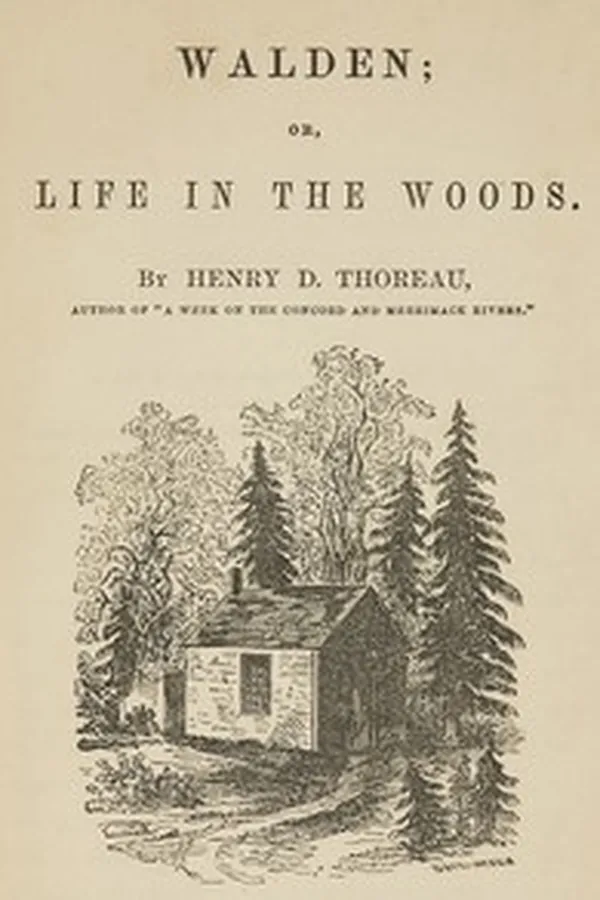
Walden
📖 Click to Read the Opening Pages Online Preview
Read a preview
When I wrote the following pages, or rather the bulk of them, I lived alone, in the woods, a mile from any neighbor, in a house which I had built myself, on the shore of Walden Pond, in Concord, Massachusetts, and earned my living by the labor of my hands only. I lived there two years and two months. At present I am a sojourner in civilized life again.
I should not obtrude my affairs so much on the notice of my readers if very particular inquiries had not been made by my townsmen concerning my mode of life, which some would call impertinent, though they do not appear to me at all impertinent, but, considering the circumstances, very natural and pertinent. Some have asked what I got to eat; if I did not feel lonesome; if I was not afraid; and the like. Others have been curious to learn what portion of my income I devoted to charitable purposes; and some, who have large families, how many poor children I maintained. I will therefore ask those of my readers who feel no particular interest in me to pardon me if I undertake to answer some of these questions in this book. In most books, the I , or first person, is omitted; in this it will be retained; that, in respect to egotism, is the main difference. We commonly do not remember that it is, after all, always the first person that is speaking. I should not talk so much about myself if there were anybody else whom I knew as well. Unfortunately, I am confined to this theme by the narrowness of my experience. Moreover, I, on my side, require of every writer, first or last, a simple and sincere account of his own life, and not merely what he has heard of other men’s lives; some such account as he would send to his kindred from a distant land; for if he has lived sincerely, it must have been in a distant land to me. Perhaps these pages are more particularly addressed to poor students. As for the rest of my readers, they will accept such portions as apply to them. I trust that none will stretch the seams in putting on the coat, for it may do good service to him whom it fits.
I would fain say something, not so much concerning the Chinese and Sandwich Islanders as you who read these pages, who are said to live in New England; something about your condition, especially your outward condition or circumstances in this world, in this town, what it is, whether it is necessary that it be as bad as it is, whether it cannot be improved as well as not. I have travelled a good deal in Concord; and everywhere, in shops, and offices, and fields, the inhabitants have appeared to me to be doing penance in a thousand remarkable ways. What I have heard of Brahmins sitting exposed to four fires and looking in the face of the sun; or hanging suspended, with their heads downward, over flames; or looking at the heavens over their shoulders “until it becomes impossible for them to resume their natural position, while from the twist of the neck nothing but liquids can pass into the stomach;” or dwelling, chained for life, at the foot of a tree; or measuring with their bodies, like caterpillars, the breadth of vast empires; or standing on one leg on the tops of pillars,—even these forms of conscious penance are hardly more incredible and astonishing than the scenes which I daily witness. The twelve labors of Hercules were trifling in comparison with those which my neighbors have undertaken; for they were only twelve, and had an end; but I could never see that these men slew or captured any monster or finished any labor. They have no friend Iolas to burn with a hot iron the root of the hydra’s head, but as soon as one head is crushed, two spring up.
1854
~106,000 words (estimated)
Approx. 5.9 hours
Standalone
Walden Pond, Concord, Massachusetts, 1845-1847
Chapter summaries
EPUB · AZW3 · KEPUB
670 KB (EPUB) · 822 KB (AZW3) · 700 KB (KEPUB)
Public domain in the United States
Project Gutenberg #205
Walden is Henry David Thoreau’s account of two years and two months in a cabin he built himself on the shore of Walden Pond, a mile from Concord, Massachusetts, between 1845 and 1847. It is not a diary: the year is compressed into a single arc from summer to spring, and the chores, building, hoeing beans, plastering, cutting ice, keeping accounts, are turned into arguments about what a life costs and what it is for. “I went to the woods because I wished to live deliberately,” he writes, and the book is the report of that experiment, with its ledgers, its visitors and its long winter. The complete text is on Project Gutenberg.
Published in 1854, Walden sold slowly and was often read as the eccentricity of a man who disliked his neighbours; its reputation grew only after Thoreau’s death, and it is now the founding text of American nature writing and one of the few books people use as a manual for living rather than as a story. This page gives the complete text as a free EPUB, AZW3 and KEPUB, together with chapter summaries, the characters and themes, and the history of the pond and of the book that made it famous.
Walden by Henry David Thoreau: Summary, Characters & Themes
Thoreau wrote Walden over nine years, from the journal he kept at the pond in 1845-47 to the final revision of 1854, and the manuscript was cut and sharpened through several drafts. His first book, A Week on the Concord and Merrimack Rivers, had appeared in 1849 and failed badly, leaving him in debt to his publisher. Walden was published on 9 August 1854 by Ticknor and Fields of Boston, in a printing of two thousand copies, with the subtitle “or, Life in the Woods”. Thoreau corrected the proofs himself and was unhappy about the price and the paper, and later editions print “On the Duty of Civil Disobedience” beside the eighteen chapters of the pond. The edition on this page is built from the Project Gutenberg text.
On 4 July 1845 Thoreau moved into a ten-by-fifteen-foot house he had built for under thirty dollars on Emerson’s woodlot at the edge of Walden Pond, and he lived there until 6 September 1847. He was not a castaway. Concord was a mile and a half away, he walked in for dinner and gossip, and he received visitors at the hut. He hoed two and a half acres of beans, surveyed the pond, cut and sold ice, and kept accounts of everything. His purpose was an experiment in the literal sense, to find out what the necessaries of life cost and whether a man could live deliberately rather than by inherited habit.
Walden belongs to Transcendentalism, the movement gathered around Ralph Waldo Emerson that trusted intuition over custom and Nature over scripture. Emerson’s essay Nature (1836) supplied much of the vocabulary; the Dial, the club that met in Concord and Boston, and the utopian community at Brook Farm supplied the company and the arguments. Thoreau lived in Emerson’s house, edited the Dial in 1843, and inherited both his friend’s confidence in the private life and the woodlot where the cabin stood. But the book is Emersonian mainly in its premises: where Emerson generalised, Thoreau counted, measured and hoed, and found his god in a thawing bank rather than in a lecture. The Wikipedia entry on Thoreau covers the biography in more detail.
The first reception was mixed enough to be discouraging. Some reviewers admired the prose and the natural observation; others found the narrator egotistical, impertinent and affected, a man boasting about the beans he ate. The two thousand copies sold slowly over several years, and the book did not make Thoreau famous or solvent. He published essays and a travel book, worked as a surveyor, and died of tuberculosis in 1862 at forty-four, known in Concord and among a small circle of readers rather than to the country. The first reviewers who called the book merely eccentric set a tone that lasted for two generations.
What changed was the twentieth century. Walden was canonised as the central text of American nature writing, taught in schools, reprinted in scholarly editions, and used as a model by conservationists, back-to-the-land writers and anyone arguing that a simpler life is a choice rather than a defeat. The word “Walden” became a name for deliberate retreat, and the pond a place of pilgrimage. Its influence is odd for a book so local, a survey of one pond in one town in one year, and yet it has outlasted most of the novels published in the same decade. The Wikipedia article on Walden traces its slow rise to classic status.
Historical Context of Walden
Thoreau went to the pond in July 1845 into an America that was being rebuilt under him. The railroad reached Concord in 1844, the telegraph was spreading along the same corridors, and New England farms were being pulled into a national market in which crops, shoes and clocks were made for sale rather than use. Walden records the noise of that change from a hundred yards off: the locomotive that cuts through his bean field, the ice cut on the pond for the Boston trade, the farmers who mortgage their land for a better barn. He wrote much of the book while the Mexican-American War (1846-48) was being fought and while the argument over extending slavery westward was splitting the churches and the parties; the Fugitive Slave Act of 1850 made the north complicit, and Thoreau’s refusal to pay a poll tax in 1846, and the night he spent in the Concord jail, belong to the same year as the bean crop.
Concord in the 1840s was a small town with an unusual concentration of reformers. Emerson had published Nature in 1836 and gathered the Transcendentalist club around him; Margaret Fuller edited the Dial, to which Thoreau contributed; Bronson Alcott’s experimental school had failed and Brook Farm, the Fourierist community, was running at the other end of the county from 1841 to 1847. Abolitionism, temperance, vegetarianism, dress reform and schemes for communal living were all in the air, and Walden is one of the few of those experiments to have been carried out privately, cheaply and without a committee. Thoreau’s originality was to test the ideas at his own expense and in his own name, rather than to pronounce on them.
The book also belongs to the business of publishing in 1854, which explains its odd shape. Magazines such as Putnam’s and Harper’s wanted sketches and serial fiction; Thoreau offered a mixed form, part autobiography, part natural history, part account book, part sermon, with no plot and a narrator who addresses the reader directly and sometimes scolds him. His first book, A Week on the Concord and Merrimack Rivers (1849), had sold badly and left him in debt, and he supported himself by surveying, by making pencils in the family business and by lecturing. Walden was published by Ticknor and Fields in August 1854 in an edition of two thousand copies, and it found its readers slowly, in the next century rather than in its own.
Key Characters & Literary Archetypes
- Henry David Thoreau: the narrator, a Concord surveyor, pencil-maker and lecturer who leaves the village to live alone at Walden Pond for two years and two months, and who turns every chore, from plastering a wall to hoeing beans, into an argument about how a life should be spent.
- Ralph Waldo Emerson: Thoreau’s friend, neighbour and literary father in Concord, whose essay Nature supplied the vocabulary of the book and whose woodlot at Walden Pond made the experiment possible; he is never named in the text, but his confidence in the private life runs through every chapter.
- John Field: the Irish labourer and tenant farmer at Baker Farm, worn out and in debt, who is offered a simpler and cheaper life by a visitor with a string of fish and cannot take it, because he is, in Thoreau’s phrase, living “without arithmetic”, and has already bought into the habits of his neighbours.
- The Canadian woodchopper: the unnamed French-Canadian lumberman and post-maker who visits the hut, a man of few wants and great physical strength, whom Thoreau calls “a true Homeric or Paphlagonian man” and admires more than the talkers of the village, though he notes that the man’s contentment is not thought.
- The poet: the second voice in the Hermit and Poet dialogue of Brute Neighbors, generally taken to be Thoreau’s friend William Ellery Channing, who answers the Hermit’s complaint about the emptiness of the woods with jokes about fishing, dinner and the world’s business, and whose cheerful irreverence keeps the chapter from becoming a sermon.
- The loon: the bird that leads Thoreau on a long and undignified chase across Walden in Brute Neighbors, diving when the boat comes near and surfacing far off to laugh at him, and which escapes every time, a small comedy about the limits of a naturalist’s patience and of human cleverness.
- The ant armies: the black and red ants whose battle on a woodpile Thoreau reports as a war between “the red republicans” and “the black imperialists”, describing their fury, their wounded and their dead in the language of human history, and measuring the difference between men’s wars and insects’ by the ground fought over.
- Walden Pond: not scenery but a presence in the book, “earth’s eye” into which the beholder looks to measure the depth of his own nature, whose depth, temperature, ice and spring thaw Thoreau records and argues about, and which gives the two years their calendar and their scale.
Core Literary Themes
- Simplicity: the argument is quantitative before it is moral. Thoreau claims that most of what people own, wear and owe is inherited clutter, and that once food, shelter, clothing and fuel are secured, further acquisition is a tax on life; “Simplicity, simplicity, simplicity!” is the slogan of a man who has done the sums and found how little is necessary.
- Deliberate living: going to the woods is described as an experiment rather than a retreat, with a stated question, a method and a report; Thoreau wants to discover what a life actually costs and what it is for, and he keeps ledgers, measures depths and plants beans in order to answer the question in figures rather than in rhetoric.
- Nature as company and measure: the pond, the seasons and the animals are not a backdrop for human feeling but the standard against which human arrangements are judged; owls, loons, ants and thawing banks are described with the same care as the village, and they are usually found to be the more sensible party.
- Time and the seasons: the book’s calendar runs from one summer through a long winter to the spring thaw, and the structure carries the argument that renewal is a physical fact before it is a hope; the ice going out of the pond in the last chapters is offered as evidence about how a life might change.
- Work and the cost of things: Thoreau’s accounts, a house for under thirty dollars, a bean crop and a profit of eight dollars and seventy-one cents, are a moral instrument rather than a budget, since the true cost of anything is the amount of life exchanged for it, and most people never do that subtraction.
- Solitude and society: the book defends being alone, since “Society is commonly too cheap”, and still keeps three chairs for visitors, walks into Concord for gossip and misses his friends; the point is not to choose the hermit’s life over the neighbour’s but to stop confusing company with contact and noise with news.
Why Download Our Custom E-Reader Edition
It is a book about money that actually does the arithmetic. Thoreau prices a house, a coat, a bean crop and a railway journey, and then asks what each cost in days of his life, which is a question almost no economic writing since has put so plainly. In an age of subscriptions, mortgages and invisible monthly charges, the ledger in Economy reads less like a nineteenth-century eccentricity and more like a tool: it shows how much of a working life is spent paying for things that were never chosen. The alternative it proposes is small and unglamorous, and that is what makes it credible. Background on the book makes the argument easier to follow.
The prose is exact in a way that nature writing has been imitating ever since. Thoreau describes the sound of a train, the colour of ice, the way a thawing bank flows, the look of a fox on snow, and he does it with a surveyor’s patience for measurement and a poet’s ear for the phrase. He resists the two temptations of the genre, vague rapture and moral instruction, and keeps the object in front of the reader. Sentences such as “the sun is but a morning star” have survived because they are the end of an argument, not a decoration attached to one.
It offers a usable test rather than a doctrine. Walden does not tell the reader to move to a pond; it reports an experiment with its costs, boredom and failures included, and leaves the conclusion open. That is why it has been read by people with almost nothing else in common: abolitionists, conservationists, civil-rights campaigners, back-to-the-land families, and readers who simply want one hour a day that is not scheduled. The book’s claim is modest and still radical, that a life can be examined, costed and changed, and that most of what looks necessary is only customary.
- A ledger, not a sermon
- Prose that keeps the object in view
- An experiment you can repeat
- On Liberty — free EPUB, AZW3 & KEPUB
- Meditations — free EPUB, AZW3 & KEPUB
Chapter summaries
The chapters of Walden in the order Thoreau arranged them in 1854 — each one a walk, a season, or an argument about how a life should be lived.
- Economy: The longest chapter, and the book’s argument about money. Thoreau explains that he lived alone in the woods for “two years and two months”, then asks what a house, clothes, food and fuel really cost in a man’s life. He reports his own accounts, a tight shingled house built for under thirty dollars, and argues that most people are poor because they have inherited expensive ideas of shelter: “the mass of men lead lives of quiet desperation”. Farms, furniture and fashionable clothing are debts dressed up as necessities, and the railroad beside his bean field is laid on sleepers that were men, an Irishman or a Yankee, over whom the cars now run smoothly. His remedy is arithmetic rather than asceticism, and his definition of value is the chapter’s real thesis: “the cost of a thing is the amount of what I will call life which is required to be exchanged for it.”
- Where I Lived, and What I Lived For: Thoreau chooses his site by imagining that he has bought every farm within a dozen miles, tasting wild apples and pricing pastures, until he decides that he holds “the refusal of several” and needs no deed to enjoy them. He describes building the house, the view from the hill above the pond, and the economy of living where one can leave. Then comes the book’s declaration of method: “I went to the woods because I wished to live deliberately, to front only the essential facts of life, and see if I could not learn what it had to teach, and not, when I came to die, discover that I had not lived.” From that follows the chant, “Simplicity, simplicity, simplicity!”, and the mockery of the morning news. He praises dawn and the waking of the senses, and ends by arguing that a man is rich in proportion to what he can afford to let alone.
- Reading: A defence of reading as a discipline rather than a pastime. Thoreau complains that his townsmen learn to read “only as far as Easy Reading”, the primers, newspapers and story books, and never attempt the classics in their own language, still less in Greek or Latin, which he thinks any New Englander could acquire for the price of a few tools. “Books are the treasured wealth of the world and the fit inheritance of generations and nations,” he writes, and they must be read as deliberately as they were written, in the morning, with the head clear. He has Homer on his table and a village that buys libraries without readers, and the reproach falls on himself as much as on Concord: he too has been reading only the easy books.
- Sounds: Having argued for silence, Thoreau gives a chapter to noise. He puts aside his book and listens: the locomotive whistle, “sounding like the scream of a hawk sailing over some farmer’s yard”, the rattle of the cars carrying merchants to market, the village bells, a cow, a dog, the hooting of owls, and in summer “the whippoorwills chanted their vespers” on the stump by his door. The railroad, built during his stay, is the great event of the two years, and he watches it with the composure of a man who need not board. He reflects that “the echo is, to some extent, an original sound, and therein is the magic and charm of it”, and prefers the local music to any news the trains bring.
- Solitude: An evening chapter written against the fear of being alone. Thoreau reports that he was never oppressed by solitude, except once, for an hour, a few weeks after he came; the pond, the rain and the wood give him company enough, and he finds a “sweet and beneficent society in Nature”. He describes sitting behind his door through a long northeast rain, and the strange doubleness by which a man can be a spectator of his own life. Then comes the sharp observation that “Society is commonly too cheap”: we meet at very short intervals without having acquired any new value for each other, and gossip three times a day is not conversation. Distance, he suggests, is what makes meeting worth anything.
- Visitors: The social chapter. Thoreau had “three chairs in my house; one for solitude, two for friendship, three for society”, and when more visitors arrived they sat on the floor. He sorts them by kind: children, fugitive slaves going north, and above all “a Canadian, a woodchopper and post-maker, who can hole fifty posts in a day”, a man so contented and so free of fuss that Thoreau calls him “a true Homeric or Paphlagonian man” and regrets that he cannot print his name. Their talk is of wood, weather and the price of things, and Thoreau finds more of Homer in it than in the village. The chapter defends a one-room house and the company that fits it.
- The Bean-Field: Hoeing, and what a cash crop is worth. Thoreau plants two and a half acres of beans on sandy ground near the pond, hoes the rows daily, hears the small army of the field, and keeps the accounts like a farmer. At the end he reports a pecuniary profit of eight dollars and seventy-one and a half cents, then subtracts the day-labour he might have done instead, so that the money nearly vanishes. “I came to love my rows, my beans,” he admits, though he could not eat them all and the woodchuck and the weeds took their share. The bean field is his emblem of work that can be measured, and of a market price that leaves the man’s life out of the sum.
- The Village: The reverse of the pond. Thoreau walks to Concord every day or two to hear the gossip, watches the shops and the courthouse, and comes home through the woods in the dark. He is no hermit by principle, and the village amuses him, but he notes that he was once “seized and put into jail” for refusing to pay a tax, and he treats the opinion of the town as something to be weighed rather than obeyed. Walking home he observes that even in our most trivial walks we are “constantly, though unconsciously, steering like pilots by certain well-known beacons”, and that a man must be lost before he can find himself. The chapter is short, and quieter politically than the essay it points to.
- The Ponds: The longest scenic chapter, and the most beautiful. Thoreau surveys Walden and its neighbours, Flint’s, White, Goose and Fair Haven, giving depths, colours, shores and fish, and tells the legend that the pond takes its name from “one old squaw, named Walden”, the only survivor of a hill that shook and sank. He floats on the water through a summer forenoon, fishes at night, hears the frogs, and complains that “the woodcutters, and the railroad, and I myself have profaned Walden”. His praise is exact rather than rhapsodic: “A lake is the landscape’s most beautiful and expressive feature. It is earth’s eye; looking into which the beholder measures the depth of his own nature.”
- Baker Farm: A walk in the rain to a poor farm. Thoreau shelters with John Field, an Irish labourer with a wife and several children, and preaches at him: one might fish, gather, go barefoot and drink water, and so work less. Field listens politely and cannot do it, “living, John Field, alas! without arithmetic, and failing so”, because he has taken on a mortgage, coffee, tea and the habits of his neighbours. Thoreau leaves in the rain, catches a fine string of fish, and is uneasy about his own sermon: the chapter examines the condescension of the reformer as much as the poverty of the farmer, and it does not settle the question in the reformer’s favour.
- Higher Laws: The most uncomfortable chapter, on appetite. Coming home at dusk with a string of fish, Thoreau meets a woodchuck crossing his path and feels “a strange thrill of savage delight”, a temptation to seize and devour it raw; he reads this as evidence of “the wild” in himself and refuses to call it simply base. He describes giving up meat, tea, coffee and spirits as experiments, finds animal food unclean and hard to justify, and argues for chastity, temperance and self-denial as the higher laws of the title. But he keeps fishing, and admits the pull of the senses. The chapter is a dialogue between the ascetic and the animal in one man, and Thoreau does not pretend that the argument closes.
- Brute Neighbors: A comic chapter, and the best proof that attention to animals is not sentimentality. It opens with a dialogue between a Hermit and a Poet, “I wonder what the world is doing now”, and then reports the battle of the ants on a woodpile: “the red republicans on the one hand, and the black imperialists on the other”, fighting with human fury over a few inches of ground. A loon leads Thoreau a long chase across the pond, diving and surfacing to laugh at him, and escapes; partridges, a woodchuck and a cat pass through the chapter. Thoreau measures men against animals and finds the animals, on the whole, the better company.
- House-Warming: Autumn, and the business of keeping warm. Thoreau goes “a-graping to the river meadows” and comes home loaded with clusters, builds a chimney, plasters the walls, and calculates that a fireplace costs less than a stove and gives better heat and light. He lays in wood, comparing pine, hickory and swamp timber, and welcomes the first frost as a test of the house he built himself with his own hands. He contrasts his cheap shelter with the costly houses of the town, and argues that shelter should be as plain as the need for it, since most houses are built for opinion rather than for warmth. The chapter ends as the pond begins to freeze and the cold season announces itself by sound.
- Former Inhabitants; and Winter Visitors: Winter, and the pond as a place with a history. Thoreau rehearses the people who lived in these woods before him: Cato Ingraham, “slave of Duncan Ingraham”, and Brister Freeman, the freedman whose apple orchard and cellar hole still mark the ground, with their lilac and their well. Then come the winter visitors who still climb the hill, a farmer, a poet, the Homeric woodchopper, and the long evenings of talk by the fire. He watches an owl he calls “winged brother of the cat”, half asleep on a bough, and notes that “I weathered some merry snow storms”. The chapter is the book’s quietest meditation on time, settlement and what outlasts a house.
- Winter Animals: The woods in deep winter, handed over to the animals. Thoreau follows fox tracks across the snow, hears the foxes bark “raggedly and demoniacally like forest dogs”, watches one carry off a hen and balance it “like a tiger with a buffalo”, and sees the hounds run a fox while the hunters close in and a shot ends it. Partridges come out of the woods morning and evening to feed at his wood-pile, red squirrels scold him from the trees, and small animals keep their runs under the snow. He walks out at dusk and finds the frozen ponds as strange and wide as “Baffin’s Bay”. The chapter is a naturalist’s notebook kept by a man with a hunter’s eye and no gun.
- The Pond in Winter: Ice, depth and measurement. Thoreau wakes before daylight and writes that “I awoke to an answered question, to Nature and daylight”; then he bores through the ice, sounds the pond, and reports that “the greatest depth was exactly one hundred and two feet”, correcting for the five feet the water has risen since his survey. He takes the temperature at different depths and maps the shape of the bottom. The ice-cutters arrive and tell him they can cut “a thousand tons” in a good day for the Boston trade, stacking it under hay to be sold as Walden water. The chapter is the most factual in the book and the most symbolic: to measure the pond is also to take the measure of the man measuring it.
- Spring: The thaw, and the book’s climax. Thoreau watches the ice go out of the pond and the sand and clay flow down the railroad cut, and says he felt as if he “stood in the laboratory of the Artist who made the world and me”, the bank below him a “creation of an hour”. He connects the melting of the earth with the thawing of his own winter, reports the first birds and frogs, and sees the geese circle over the pond, “twenty-nine of them”, before they steer north. It is a resurrection scene written by a surveyor: the physical facts of spring are made to carry the argument that renewal is a law of the world and not merely a consolation for it.
- Conclusion: Thoreau leaves the woods “for as good a reason as I went there”: the experiment is finished, not abandoned. The last chapter refuses to let the reader reduce the book to a pond. “Thank Heaven, here is not all the world”, the wild goose travels further than any of us, and “the universe is wider than our views of it”. He tells the story of the artist of Kouroo, who refused to be hurried and made a perfect staff, and insists that “if one advances confidently in the direction of his dreams” he will meet with unexpected success. He ends with the thawing of a new day: “the sun is but a morning star.”
Walden: Frequently Asked Questions
How long is Walden, and how many words?
How many chapters does Walden have?
Where should I start reading Walden?
Is Walden philosophy or nature writing?
How was Walden received in 1854?
What is the best free edition of Walden?
Why does the bean field matter in Walden?
How long does it take to read Walden?
Part of: The complete catalogue of free editions · Philosophy classics