Far from the Madding Crowd by Thomas Hardy: Free EPUB, AZW3 & KEPUB Download
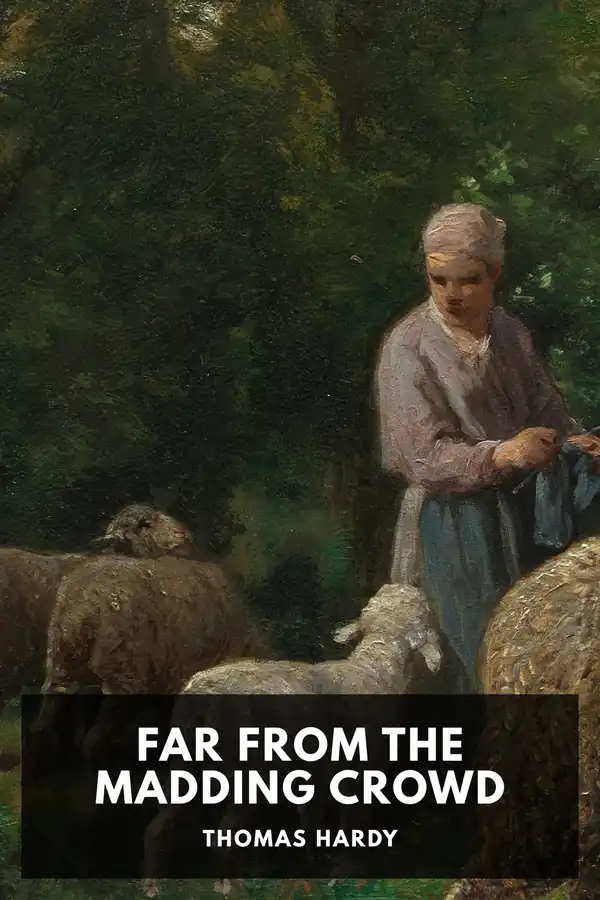
Far from the Madding Crowd
📖 Click to Read the Opening Pages Online Preview
Chapter 1 on Norcombe Hill, where a shepherd looks over a hedge
When Farmer Oak smiled, the corners of his mouth spread till they were within an unimportant distance of his ears, his eyes were reduced to chinks, and diverging wrinkles appeared round them, extending upon his countenance like the rays in a rudimentary sketch of the rising sun.
His Christian name was Gabriel, and on working days he was a young man of sound judgment, easy motions, proper dress, and general good character. On Sundays he was a man of misty views, rather given to postponing, and hampered by his best clothes and umbrella: upon the whole, one who felt himself to occupy morally that vast middle space of Laodicean neutrality which lay between the Communion people of the parish and the drunken section—that is, he went to church, but yawned privately by the time the congregation reached the Nicene creed, and thought of what there would be for dinner when he meant to be listening to the sermon. Or, to state his character as it stood in the scale of public opinion, when his friends and critics were in tantrums, he was considered rather a bad man; when they were pleased, he was rather a good man; when they were neither, he was a man whose moral colour was a kind of pepper-and-salt mixture.
Since he lived six times as many working-days as Sundays, Oak’s appearance in his old clothes was most peculiarly his own—the mental picture formed by his neighbours in imagining him being always dressed in that way. He wore a low-crowned felt hat, spread out at the base by tight jamming upon the head for security in high winds, and a coat like Dr. Johnson’s; his lower extremities being encased in ordinary leather leggings and boots emphatically large, affording to each foot a roomy apartment so constructed that any wearer might stand in a river all day long and know nothing of damp—their maker being a conscientious man who endeavoured to compensate for any weakness in his cut by unstinted dimension and solidity.
The preview stops inside Chapter 1. All fifty-seven chapters are in the free download below.
Download Full EPUB1874
~136,000 words (estimated)
Approx. 7.6 hours
Standalone
Weatherbury and the Wessex countryside, in the 1870s
57 chapters
EPUB · AZW3 · KEPUB
0.98 MB (EPUB) · 1.08 MB (AZW3) · 1.03 MB (KEPUB)
Public domain in the United States
Project Gutenberg #107 · Standard Ebooks
Far from the Madding Crowd opens on a chalk down above Norcombe Hill, where Gabriel Oak keeps two hundred sheep and falls in love with a girl riding past in a yellow wagon. Bathsheba Everdene is vain, quick and not yet a farmer; by the time she takes on her uncle’s Weatherbury farm, Oak has lost his flock and his lease, and comes to her door for work. Three men gather round her: Oak, steady and silent; William Boldwood, the neighbouring farmer she teases with a valentine; and Sergeant Frank Troy, whose sword drill and flattery turn her head. Hardy’s fourth novel is a story of weather, work and the harm done when a mood is mistaken for a promise.
The novel appeared in 1874, first in the Cornhill Magazine and then in two volumes from Smith, Elder, and it gave Hardy the name he would use for the rest of his career: Wessex. Read Wikipedia’s article on Far from the Madding Crowd for the serial, the revisions and the films. What has kept the book alive is not the machinery of a valentine and a misplaced wedding but the farm itself, the sheep-washing, the shearing, the rick-cloths going up before rain and the labourers at the maltster’s fire. The text is available via Project Gutenberg #107 and Standard Ebooks.
Far from the Madding Crowd by Thomas Hardy: Summary, Characters & Themes
This page is a summary and analysis of Far from the Madding Crowd, the 1874 novel in which Thomas Hardy first named Wessex and put a woman farmer at the centre of an English pastoral. Hardy was thirty-four, trained as an architect, and had published three novels in three years. He had grown up in the countryside he describes, the son of a builder in a village near Dorchester, and he knew the wages, the weather and the small politics of a farm from the inside. Hardy’s life — the church restoration, the Dorset walks, the habit of watching the sky — is in every page. He wanted agricultural work treated with the care other novelists gave to drawing rooms, and he made the farm itself the subject of a serious book.
The story turns on four people and a farm. Bathsheba Everdene takes on the Weatherbury holding her uncle left her, dismisses the bailiff and runs the place herself, which in 1874 is an act of quiet defiance in a parish of men. Gabriel Oak, who loved her when she had nothing, loses his own flock and becomes her shepherd. William Boldwood, the neighbouring farmer and a settled bachelor who has never been looked at twice, receives an anonymous valentine from her and is changed by it past recovery. Sergeant Frank Troy arrives with a red coat, a swordsman’s ease and no scruple at all, and the careful arrangements of farm life give way to something faster and less kind.
Hardy builds the book out of work. Sheep are washed and shorn, corn is cut and stacked, ricks are thatched, a swarm of bees is hived, a flock is bled to save it from clover. Weather is not scenery but an opponent with a schedule, and the great storm works because the reader has already learned what a stack of wheat is worth. The same attention to rural labour shapes Tess of the d’Urbervilles, written seventeen years later, where a dairyman’s daughter is destroyed by the narrow society that here only gossips. In both novels the land is beautiful and indifferent, and the people who work it are watched by neighbours with nothing else to do.
What makes the novel more than a pastoral is its interest in self-deception. Bathsheba is not a passive beauty; she is proud, impulsive and amused by her own power, and the valentine is a small cruelty that grows into a catastrophe. Boldwood’s love is obsession dressed as propriety, Troy’s charm is a performance with nobody behind it, and Fanny Robin, the girl nobody notices, pays the highest price for the smallest mistake. Hardy returns to that study of a proud man undone by his own fixity in The Mayor of Casterbridge, and to the pull of a place and its people in The Return of the Native. His characters are rarely wicked; they are certain too early.
The book sold well in 1874 and has never gone out of print. Victorian readers enjoyed the pastoral and were shaken by the violence of the last chapters; later criticism treats it as Hardy’s first full Wessex novel and as the rehearsal for the tragedies that followed. Its images have outlived their period: the yellow wagon, the chalk pit, the sword flashing around a woman in a fern hollow, the coffin lid chalked with two names. This page follows the text at Project Gutenberg #107 and the Standard Ebooks edition, which was prepared from that transcription and keeps Hardy’s chapter divisions. The summaries below are keyed to that text and to its fifty-seven chapters.
Historical Context
Hardy wrote the novel in 1873 and 1874, at thirty-four, while working for a London architect and publishing fiction at a rate that alarmed his employers. It ran as a serial in the Cornhill Magazine through 1874 and appeared in two volumes from Smith, Elder in the same year. The timing was pointed. Britain was the richest country in Europe and its countryside was in the early years of a long agricultural depression; wheat prices had begun to fall, rents were being renegotiated, and the confident farmer of the 1860s was becoming a careful one. Hardy set his story in that moment of squeeze rather than in a golden past.
The farm in the novel is a business with hired hands, account books and markets. Casterbridge hiring fairs, where labourers stood in the street waiting to be taken on for a year, were still part of the working year, and Hardy uses one to bring Oak and Bathsheba together. Wages were low, hours long and security thin, which is why Joseph Poorgrass and Coggan talk so much about weather and so little about ambition. Agricultural trade unionism had begun in 1872 with Joseph Arch’s National Agricultural Labourers’ Union, and the men in the malthouse are exactly the audience for it, though Hardy keeps politics off the page.
Literary fashion favoured the pastoral, but Hardy wanted something harder. George Eliot had made provincial life serious in Middlemarch, published in 1871 and 1872, and Hardy admired her; what he added was a district with a map. He had been collecting Dorset names since boyhood, and here he began translating them into the counties of Wessex, a device that let him write about real places while claiming the freedom of fiction. He went on revising the book for later editions, and the Wessex edition of 1912 fixed the text most readers know. The result reads as both a local chronicle and a national myth.
Key Characters & Literary Archetypes
- Bathsheba Everdene: The mistress of Weatherbury Upper Farm, young, dark-haired and used to admiration. She inherits the farm from her uncle, dismisses the bailiff, keeps the account book herself and refuses to be lectured by any man. Her vanity is real but so is her courage, and the two pull against each other: she sends a valentine as a joke, marries on impulse, and spends the rest of the book learning what cleverness costs. Hardy gives her the best lines and the worst mistakes, and never lets her be merely a victim.
- Gabriel Oak: A shepherd who becomes a farmer and then a shepherd again. He is steady, patient and quietly humorous, the novel’s moral centre and its most reliable pair of eyes. He proposes early and is refused, loses his flock to his own dog, and takes work under the woman he loves without complaint or display. He saves the ricks in the storm, bleeds the poisoned sheep and becomes bailiff of two farms. Hardy rewards him late and carefully, because his virtue is competence rather than charm.
- William Boldwood: The tenant of Little Weatherbury Farm and the most respected man in the parish. He is a bachelor of settled habits who has arranged his life into routines that leave no room for anyone else, until an anonymous valentine makes him believe he has been loved for years. His courtesy turns into insistence, his insistence into obsession, and the man who waited becomes the man who shoots. Hardy makes him pitiable before he is dangerous, which is what makes the last chapters so hard to read.
- Sergeant Frank Troy: A sergeant in the Dragoon Guards, back in Weatherbury where his father was a doctor. He is handsome, athletic and entirely present-tense, a man who lives by performance and cannot imagine a consequence. He drills Bathsheba among the ferns with a sword, flatters her into a secret marriage, gambles away her money on horses and destroys her peace with the news of Fanny. Hardy gives him no inner life on purpose: he is a surface, brilliantly lit, and the novel is about what happens when someone marries a surface.
- Fanny Robin: A servant girl from Weatherbury who loves Troy and believes he will marry her. She is timid, thin, poor and completely without protection, and the book follows her through a failed wedding, a walk through snow to a barracks and a long road to the Casterbridge Union, where she dies in childbirth the day she arrives. Her coffin and the chalked words on its lid carry the novel’s hardest revelation. She is the person the whole plot forgets, and Hardy makes sure the reader cannot.
- Liddy Smallbury: Bathsheba’s maid and companion, the one person who sees most of her mistress’s moods and understands about half of them. She is small, warm, easily frightened and unexpectedly shrewd, and she is the audience for Bathsheba’s confidences, her rages and her regrets. Hardy uses her for comedy and for the practical business of a household, and she is the only woman in the book whose life is not decided by a man. Her loyalty survives every quarrel her mistress picks.
Core Literary Themes
- Work, weather and the farming year: The novel is organised by the agricultural calendar rather than by the marriage plot. Sheep-washing, shearing, the clover crisis, the harvest and the rick-building each arrive in their season, and the crises grow out of the work itself: a flock that breaks into the wrong field, a storm that comes with the corn still open to the sky. Hardy makes labour legible, so that the reader knows what a ruined stack means before anyone loses one. Weather is the antagonist no character can argue with, and competence, not birth, is the quality the book most admires.
- The valentine, chance and self-deception: A joke sent on a February afternoon sets the plot in motion. Bathsheba does not mean anything by the valentine, and Boldwood reads it as a declaration; both are deceived, and neither can take the letter back. Hardy builds the book out of such small misreadings, a note read by the wrong person, a wedding waited at the wrong church, a face seen at the wrong window. His people are not the playthings of fate so much as the authors of their own misreading. The result is a novel in which character and accident are hard to separate, which is exactly how Hardy sees a life.
- Love, vanity and the marriage market: Bathsheba has three suitors and treats each of them badly in a different way. She refuses Oak because he is too plain, encourages Boldwood because she likes the power, and marries Troy because he is exciting. Hardy shows the marriage market as a market, with farms, incomes and prospects weighed alongside feeling, and he lets his heroine want both independence and adoration without quite seeing that the two are in conflict. The book is unsentimental about romance. It is generous about love, which it treats as something that has to be earned by patience.
- Property, class and the hired hand: Weatherbury is a small economy in which everyone is someone’s tenant, servant or employer. Bathsheba owns; Boldwood rents; Oak is hired, dismissed and hired again; Fanny is dismissed without a reference. Hardy is precise about money, wages, rick values and the shame of dependence, and the plot turns on a woman who can command labour and cannot command respect. The novel’s quiet argument is that a society which measures people by their holdings will always misjudge the ones who hold nothing, and that the best man on the farm may be the one with the least.
- Reputation and the girl nobody notices: Fanny Robin is the novel’s test case. She is seduced, abandoned, pregnant and destitute, and the respectable world of Weatherbury has no category for her except disgrace. Hardy gives her almost no voice and a great deal of pathos, and he makes her death the hinge of the plot: it exposes Troy, destroys Bathsheba’s marriage and shames the parish that ignored her. The book is unusually clear-eyed about the double standard, and about the way a small community protects itself by deciding who is not worth protecting. Her grave is where the survivors have to stand.
Why Download Our Custom E-Reader Edition of Far from the Madding Crowd?
This edition is built for reading. The text is the Standard Ebooks edition of Hardy’s 1874 novel, prepared from the Project Gutenberg transcription, with all fifty-seven chapters in their original order and the chapter numerals left as Hardy wrote them. There is no abridgement and no editor talking over the story. What you download is the novel, set cleanly, with a table of contents that works on an e-reader rather than only in a browser.
Editions of a Victorian novel differ in small ways, a sentence restored, a comma moved, a chapter division decided by an editor. This one follows the Standard Ebooks text, which its editors established from the Project Gutenberg transcription. If you want to compare a passage with the source transcription, Project Gutenberg #107 is the obvious place to look, and the two texts agree chapter for chapter.
Three formats are offered, one download each: EPUB for most readers, AZW3 for Kindle, KEPUB for Kobo. All three carry the same text and the same navigation, and none of them is locked. There is no account to create, no sample chapter standing in for the book, and no expiry date on the file. Download it once and it stays on your device, and you can move it to another reader, a phone or a tablet without asking anyone’s permission.
- Based on the Standard Ebooks Edition, via Standard Ebooks, whose editors prepared this text from the Project Gutenberg transcription, keeping the 1874 chapter divisions, so the summaries below and the download match.
- Complete fifty-seven-chapter text Every chapter is here, from Oak on Norcombe Hill to the foggy wedding morning, with the sword drill, the sheep-shearing, the storm and the coffin lid left as Hardy wrote them and nothing cut for length or modern taste. The chapter numerals run straight through without a gap, and no scene is folded into another.
- EPUB, AZW3 and KEPUB One file per format, so the novel opens on Kindle, Kobo, Apple Books and most other readers without conversion, with a working table of contents, proper chapter breaks and a cover that survives being sent to a device. The files stay small enough for an old reader and complete enough for a new one.
- Free and DRM-free Public domain in the United States, with no account, no subscription and no lock on the file; download it once and it is yours to keep, to copy between devices and to reread, with nothing to renew and nothing that expires. There is nothing hidden in the file and nothing to install before it opens.
- Tess of the d’Urbervilles — free EPUB, AZW3 & KEPUB
- The Mayor of Casterbridge — free EPUB, AZW3 & KEPUB
- The Return of the Native — free EPUB, AZW3 & KEPUB
Chapter summaries
Fifty-seven chapters, grouped into twelve spans that follow the Standard Ebooks text in order. Hardy numbered these chapters and gave them no titles, so each label below names the events inside it.
- Chapters 1–4 — Oak on Norcombe Hill; Bathsheba and the mirror: The novel opens with Gabriel Oak smiling, a sheep-farmer on Norcombe Hill with two hundred ewes and a lease he has worked years to get. In the yellow spring-wagon Bathsheba Everdene unwraps a small looking-glass and studies her own face. Oak meets her on the road and by the fourth chapter has walked to her aunt’s cottage to propose. She refuses him with a joke about being a bride at a wedding, then regrets her own cleverness. Nothing in the scene looks like the beginning of a tragedy.
- Chapters 5–8 — the chalk pit; sheep lost; a fire in the rick-yard; hired by the new mistress: Bathsheba leaves to take on her uncle’s farm at Weatherbury, and Oak’s luck turns with her going. His young dog chases the flock over the brow of the chalk pit, and two hundred ewes lie dead at the foot. Ruined, he looks for a place as bailiff at the Casterbridge hiring fair. On the road he helps put out a rick-yard fire; the farm turns out to be Bathsheba’s, and she hires him as shepherd without admitting that she remembers him.
- Chapters 9–12 — the mistress takes the time-book; snow outside the barracks; a farmer’s rule and its exception: Weatherbury gets its new mistress. Bathsheba inspects the homestead, dismisses the bailiff and takes the time-book herself, to the men’s astonishment and the neighbourhood’s disapproval. In the snow outside a barracks town many miles away, a girl counts windows and whispers to a sergeant through a wall — Fanny Robin, waiting on a promise. In Casterbridge the farmers agree that a woman cannot manage a farm, and Bathsheba sets out to prove that the rule has an exception.
- Chapters 13–17 — a valentine and a key; Boldwood wakes; a wedding that does not happen: On a February Sunday, with Liddy’s help and a Bible and key, Bathsheba sends an anonymous valentine to William Boldwood as a joke. Boldwood is a bachelor of settled habits, and the letter goes off like a charge in a quiet room. A flashback shows Fanny waiting at the wrong church, All Souls’ instead of All Saints’, while Troy stands at the altar for a bride who never comes. In Casterbridge market Boldwood sees Bathsheba and begins to fall in love.
- Chapters 18–22 — sheep-washing; the offer of marriage; clover in the fold; the shearing barn: Boldwood, tenant of Little Weatherbury Farm, works out that he wants to marry, and at the sheep-washing he proposes outright. Bathsheba is startled and refuses him, but the refusal is softer than a no. Oak quarrels with her over the encouragement she gives, and she tells him to keep his opinions. When the flock breaks into a field of clover and begins to swell, only Oak knows how to bleed the sheep and save them, and she has to send for him.
- Chapters 23–27 — the shearing supper; a meeting in the fir plantation; bees in the garden: At the shearing supper Boldwood declares himself a second time, and Bathsheba, half flattered and half afraid, asks Oak to change seats so Boldwood can sit beside her. That night she walks to the fir plantation and meets a man in the dark — Sergeant Troy, who steadies her and will not let her go. Troy drills the hay-mead like a parade ground, calls her the Queen of the Corn-market, and hives the swarm of bees that settles in her garden.
- Chapters 28–32 — swords in the fern; a warning refused; a quiet marriage in Bath: In the hollow amid the ferns Troy gives a display of sword drill, cutting the air around Bathsheba until she is dizzy, and kisses her. Oak, watching her drift, tells her plainly what Troy is, and she refuses the warning and his offer to stay on as bailiff. Then she slips away to Bath and marries Troy quietly at St Ambrose’s. The news reaches Weatherbury in a newspaper, and Boldwood, who has been waiting, hears it as a sentence.
- Chapters 33–37 — rumours from Bath; a husband at the farm; the harvest dance; the storm and the ricks: The parish gossips about the mistress and her soldier, and Boldwood learns that the marriage is real. Troy comes home, spends money and talks of pulling down the old farm buildings; Oak’s position becomes impossible and he gives notice. At the harvest revel Troy drinks and dances while the sky darkens, and Oak goes out alone to cover the ricks with waterproof cloths. The storm breaks; two hundred pounds of grain are saved, then the third stack.
- Chapters 38–42 — a morning of rain; the road from Casterbridge; Fanny sent for; the coffin at Buck’s Head: Oak finishes the ricks at dawn, soaked through, and meets Boldwood on the road. Driving home from market, Troy walks beside the gig and admits he has lost more than a hundred pounds at the autumn races; a woman faints by the milestone and he sends her away. She is Fanny Robin, walking to Casterbridge. She reaches the Union-house in the morning and dies there in the evening. Joseph Poorgrass brings her coffin home by way of Buck’s Head, and the lid is chalked with two names.
- Chapters 43–47 — the coffin opened; a night in the plantation; the gurgoyle; Lulwind Cove: Bathsheba goes to the room where Fanny lies and sees the dead girl with her child. Troy comes in, kisses the corpse and tells his wife that she is nothing to him. Bathsheba flees into the plantation and spends the night under a tree. Troy orders a headstone, plants flowers on the grave and drifts away. A gargoyle on the church tower pours rainwater into the new grave, and Troy goes bathing at Lulwind Cove, where his clothes are found and he is thought drowned.
- Chapters 48–52 — word of a drowning; Oak made bailiff; the sheep fair; a promise deferred to Christmas: A coastguardsman brings word that Troy drowned at Lulwind Cove, and Bathsheba, who has learned to stop expecting him, receives the news quietly. Oak is made bailiff of the Upper Farm and then of Boldwood’s as well, and Boldwood begins to hope again, though Bathsheba puts him off until Christmas. At Greenhill sheep fair a bearded stranger takes her hand. It is Troy, alive, back from a travelling show and a long spell abroad, come home just as Boldwood prepares to ask for her.
- Chapters 53–57 — the Christmas party; a shot; the assizes; a foggy wedding morning: At Boldwood’s Christmas party a stranger is shown in, and Boldwood, not recognising Troy, presses him to drink. When Troy claims his wife, Boldwood takes a gun from the rack and shoots him. Boldwood walks to Casterbridge and gives himself up; at the assizes he pleads guilty, is sentenced to death and is reprieved to confinement. Bathsheba keeps to the house in black while Oak speaks of going away. On a foggy morning they are married privately, and the farm settles into quieter weather.
Far from the Madding Crowd: Frequently Asked Questions
Where does Far from the Madding Crowd begin?
How does Gabriel Oak lose his sheep?
Who is William Boldwood?
How does Bathsheba meet Sergeant Troy?
What happens to Fanny Robin?
Does Troy really drown at Lulwind Cove?
How does the novel end?
Where can I download the free EPUB, AZW3 and KEPUB?
Part of: Classic Fiction · Victorian Literature