The History of the Peloponnesian War by Thucydides: Free EPUB, AZW3 & KEPUB Download
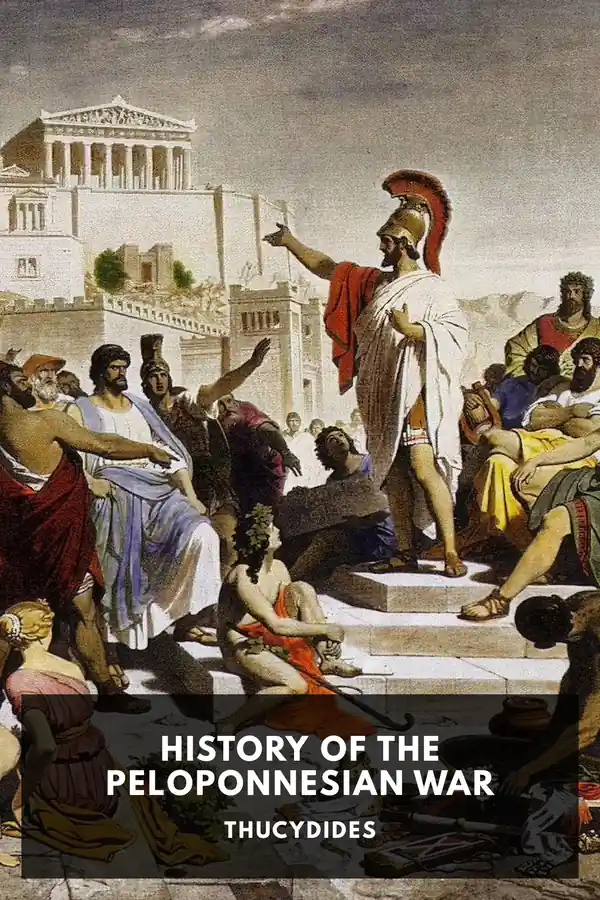
The History of the Peloponnesian War
📖 Click to Read the Opening Pages Online Preview
The opening of Book I: a possession for all time
Thucydides, an Athenian, wrote the history of the war between the Peloponnesians and the Athenians, beginning at the moment that it broke out, and believing that it would be a great war and more worthy of relation than any that had preceded it. This belief was not without its grounds. The preparations of both the combatants were in every department in the last state of perfection; and he could see the rest of the Hellenic race taking sides in the quarrel; those who delayed doing so at once having it in contemplation. Indeed this was the greatest movement yet known in history, not only of the Hellenes, but of a large part of the barbarian world—I had almost said of mankind. For though the events of remote antiquity, and even those that more immediately preceded the war, could not from lapse of time be clearly ascertained, yet the evidences which an inquiry carried as far back as was practicable leads me to trust, all point to the conclusion that there was nothing on a great scale, either in war or in other matters.
For instance, it is evident that the country now called Hellas had in ancient times no settled population; on the contrary, migrations were of frequent occurrence, the several tribes readily abandoning their homes under the pressure of superior numbers. Without commerce, without freedom of communication either by land or sea, cultivating no more of their territory than the exigencies of life required, destitute of capital, never planting their land (for they could not tell when an invader might not come and take it all away, and when he did come they had no walls to stop him), thinking that the necessities of daily sustenance could be supplied at one place as well as another, they cared little for shifting their habitation, and consequently neither built large cities nor attained to any other form of greatness. The richest soils were always most subject to this change of masters; such as the district now called Thessaly, Boeotia, most of the Peloponnese, Arcadia excepted, and the most fertile parts of the rest of Hellas. The goodness of the land favoured the aggrandizement of particular individuals, and thus created faction which proved a fertile source of ruin. It also invited invasion. Accordingly Attica, from the poverty of its soil enjoying from a very remote period freedom from faction, never changed its inhabitants. And here is no inconsiderable exemplification of my assertion that the migrations were the cause of there being no correspondent growth in other parts. The most powerful victims of war or faction from the rest of Hellas took refuge with the Athenians as a safe retreat; and at an early period, becoming naturalized, swelled the already large population of the city to such a height that Attica became at last too small to hold them, and they had to send out colonies to Ionia.
There is also another circumstance that contributes not a little to my conviction of the weakness of ancient times. Before the Trojan war there is no indication of any common action in Hellas, nor indeed of the universal prevalence of the name; on the contrary, before the time of Hellen, son of Deucalion, no such appellation existed, but the country went by the names of the different tribes, in particular of the Pelasgian. It was not till Hellen and his sons grew strong in Phthiotis, and were invited as allies into the other cities, that one by one they gradually acquired from the connection the name of Hellenes; though a long time elapsed before that name could fasten itself upon all. The best proof of this is furnished by Homer. Born long after the Trojan War, he nowhere calls all of them by that name, nor indeed any of them except the followers of Achilles from Phthiotis, who were the original Hellenes: in his poems they are called Danaans, Argives, and Achaeans. He does not even use the term barbarian, probably because the Hellenes had not yet been marked off from the rest of the world by one distinctive appellation. It appears therefore that the several Hellenic communities, comprising not only those who first acquired the name, city by city, as they came to understand each other, but also those who assumed it afterwards as the name of the whole people, were before the Trojan war prevented by their want of strength and the absence of mutual intercourse from displaying any collective action.
The preview stops inside Book I, and all eight books are in the free download below.
Download Full EPUBc. 431–404 BC
~250,000 words (estimated)
Approx. 13.9 hours
Standalone
Greece, 431–411 BC
Eight books, 26 chapters
EPUB · AZW3 · KEPUB
2.49 MB (EPUB) · 1.66 MB (AZW3) · 2.52 MB (KEPUB)
Public domain in the United States
Project Gutenberg #7142 · Standard Ebooks
The History of the Peloponnesian War opens with a claim: that the war between Athens and Sparta was the greatest disturbance in Greek history, and that it can be explained. Thucydides was an Athenian general who wrote as a participant and a survivor, and he clears away myth before he starts. The first book traces how Athens grew from the leader of an alliance against Persia into an empire, and how Sparta came to fear it. Then the fighting itself: Plataea, the plague, the funeral speech, Mytilene, Corcyra, Pylos, Amphipolis, Mantinea, Melos, and the enormous gamble in Sicily. The narrative breaks off in 411 BC, unfinished.
Read in order, the eight books are one argument about power: what it does to the people who hold it, what it does to the language they speak, and how a confident democracy can lose a fleet and an army in a single harbour. The speeches are Thucydides’ own reconstructions, as he admits, and they are where the book’s thinking happens. Melos, Corcyra and the plague are the passages later writers quote. Read Wikipedia’s article on the History of the Peloponnesian War for the manuscript tradition and the long argument over the speeches. The text is available via Project Gutenberg #7142 and Standard Ebooks.
The History of the Peloponnesian War by Thucydides: Summary, Characters & Themes
This page is a summary and analysis of The History of the Peloponnesian War, the account of the war between Athens and Sparta written by an Athenian who fought in it, lost a command, and was exiled for the loss. Thucydides began work at the outbreak because he expected the war to be greater than anything before it, and he was still writing when the text breaks off. Thucydides’ life is known mostly from his own pages: a family rich enough to work the gold mines of Thrace, a general’s command in 424 BC, twenty years of exile, and an interest, unusual for his century, in how states actually behave rather than how their gods reward them. Richard Crawley’s translation appeared in 1874 and has carried the book into English ever since.
The first book is preparation rather than war. Thucydides surveys the earliest Greeks, argues that this war dwarfed even the Persian wars, and then compresses fifty years into a few dense pages: how Athens took over the alliance against Persia, moved its treasury, taxed its allies and built a navy that made the Aegean an Athenian lake. He names two orders of cause. The complaints of Corinth, Megara and Aegina were the immediate ones; the truest was the growth of Athenian power and the fear it produced in Sparta. From the second book the narrative becomes chronological, summer and winter, campaign and campaign, with the confidence of a writer who thinks a war can be understood by anyone who pays attention to what was decided and why.
The famous passages are the ones where the war becomes an argument. Pericles’ funeral oration turns a public burial into a definition of the city, and within a year the plague has emptied the same streets and Thucydides has described it with clinical exactness and no consolation. The Mytilenean debate sets Cleon’s anger against Diodotus’ calculation and lets the assembly reverse itself in a single day. The revolution at Corcyra produces the book’s most disturbing sentence, that words had to change their ordinary meaning and take that which was now given them. In each case a political order is shown thinking out loud, and then shown paying for the decision it reached.
The last third belongs to Sicily. Athens sends a vast fleet to conquer an island the size of Greece, commanded by a cautious older general and an ambitious young one, and loses the fleet, the army and the war’s remaining margin in a harbour. Before that comes Melos, where the Athenians tell the islanders that the strong do what they can and the weak suffer what they must, and then kill the men and sell everyone else. The world of this book is the world of The Iliad, where honour is a currency and a quarrel can kill a generation, and of The Odyssey, where the sea is a road to islands full of strangers. It is also the world Plato answered in The Republic, when he asked what justice would look like if it were not simply the interest of the stronger.
Read now, the analysis still startles: coalitions that cannot agree, a democracy that votes for a war it cannot pay for, generals who cannot disobey an assembly, and a plague that makes every plan provisional. Thucydides refuses consolation. He does not say that Athens deserved what happened, and he does not pretend that Sparta was better; he shows how the decisions were made and what followed, and leaves the judgement to a reader who has been given the speeches of both sides, never quite saying which city he would have chosen himself. This edition follows the text transcribed at Project Gutenberg and prepared for Standard Ebooks, so the chapter divisions here match the file you download.
Historical Context
Thucydides names two kinds of cause. The immediate ones were quarrels among allies: Epidamnus, a colony on the Adriatic, asked Corinth for help against Corcyra, and Athens, bound to Corcyra by a defensive alliance, was drawn in; Potidaea, a Corinthian colony that paid tribute to Athens, revolted. The deeper cause, in the sentence everyone remembers, was the growth of Athenian power and the alarm it inspired in Lacedaemon. Between the Persian wars and 431 BC, Athens had turned the Delian League into an empire, moved the treasury to the Acropolis and used allied ships and money to run a navy no single state could match. Sparta, a land power with a league of its own, could not ignore that.
The two cities were different kinds of machine. Athens was a democracy, its assembly open to any citizen, its strength in ships, tribute and trade, its weakness in the fact that an assembly can change its mind. Sparta was an oligarchy of warriors, its citizens trained from childhood, its army the best in Greece, its society resting on the labour of helots it feared. Pericles told the Athenians that they could win by staying behind their walls and using the fleet, and for a while they did. Sparta’s strategy was simpler: invade Attica each summer, burn the crops and hope the Athenians came out to fight. The war became a contest between those two logics.
Thucydides served as general in 424 BC and was sent to relieve Amphipolis, which the Spartan Brasidas took before he could arrive. For that failure the Athenians exiled him, and he spent the next twenty years, as he says, watching the war from the outside and talking to men on both sides. Exile gave him access and detachment; it also gave him a subject. He did not finish. The narrative stops in the twenty-first year of the war, 411 BC, with a bracketed note about the coming winter, and the last seven years, down to the surrender of Athens in 404 BC, are simply not there.
Key Characters & Literary Archetypes
- Pericles: Athenian statesman and general, the first citizen of the democracy in the years before the war. Thucydides gives him three great set pieces: the speech that persuades Athens to refuse Sparta’s ultimatum, the funeral oration over the first year’s dead, and the defence of his strategy when the plague and the invasion have made him unpopular. The city makes him responsible for the whole of the public suffering, then re-elects him. Thucydides judges that while he led, the multitude was led rather than leading, and that his successors could not manage the same trick.
- Alcibiades: The brilliant, unscrupulous aristocrat who dominates the last five books. He advocates the Sicilian expedition and shares its command with Nicias and Lamachus, is recalled to face charges over the mutilation of the Hermae, defects to Sparta, and advises the enemy to fortify Decelea and send help to Syracuse. Later he intrigues with the Persian satrap Tissaphernes, is recalled by the fleet at Samos, and wins at Cynossema. Thucydides notes his ambition, his usefulness and how much of Athens’ fate depended on a man the city could not trust.
- Nicias: Athenian general, pious, cautious and rich, who argues against the Sicilian expedition and is then appointed to command it. His delays define the campaign: he will not move quickly, will not withdraw while withdrawal is possible, and after the lunar eclipse refuses to let the army sail until the thrice nine days demanded by divination have passed. The narrator calls him somewhat over-addicted to divination; the heading before his defeat speaks of his folly and obstinancy. He is killed after surrender, and Thucydides says that of all the Hellenes he least deserved such a fate.
- Brasidas: Spartan commander, fast, daring and politically shrewd, the one Spartan who consistently beats the Athenians on land. He saves Megara, wins over the cities of Chalcidice by promising freedom and moderation, and takes Amphipolis by a combination of speed and terms generous enough to make the city open its gates. Thucydides, whose own command was there, gives him a full portrait and a speech. He dies at Amphipolis in the fighting that also kills Cleon, and peace follows, since the two principal opponents of peace on either side were now dead.
- Cleon: The tanner and demagogue who becomes the most powerful man in Athens after Pericles. Thucydides calls him the most violent man at Athens and gives him the worst of the Mytilenean debate, where he proposes to kill the whole adult male population of Mitylene and is answered by Diodotus, whose argument that anger is a bad counsellor wins by a narrow margin. Cleon then taunts Nicias over Pylos, is given the command, and takes Sphacteria within the twenty days he promised. He dies at Amphipolis beside Brasidas.
- Hermocrates: Syracusan statesman and general, the most influential man in his city and the most effective opponent Athens meets in Sicily. He argues at the congress of Gela that the Greeks of Sicily should settle their own quarrels before Athens exploits them, and he debates Euphemus at Camarina. When the expedition arrives he organises the defence of Syracuse, refuses to despair after early defeats, and with Gylippus turns the siege into a trap. Thucydides gives him long speeches and a plain judgement: a man who understood the situation and could say what he thought.
Core Literary Themes
- Power and justice: The book’s most famous sentence about justice is spoken by Athenians to Melians, and it is offered not as a boast but as a description of how the world works: right is in question only between equals in power, while the strong do what they can. Thucydides tests the proposition everywhere. Corinth and Corcyra argue about treaties, Sparta and Athens argue about oaths, Plataea appeals to a treaty and is destroyed anyway. What the book shows is not that justice is absent but that it is weak in proportion to the interests at stake, and that states invoke it most loudly when they are frightened.
- The plague and stasis: The plague at Athens and the revolution at Corcyra are the two great scenes of social dissolution. The plague kills without regard to virtue, empties the temples of their suppliants and makes men reckless, since they expect to die. At Corcyra, Thucydides describes a civil war in which faction becomes a trade and words had to change their ordinary meaning and take that which was now given them. The two passages are usually read together because they make one point: a city’s institutions and its language can break before its walls do.
- Speeches as evidence: Thucydides states his method plainly. He did not write down what was said; he reconstructed each speech as the situation seemed to demand, keeping as close as he could to the sense of what was actually spoken. That admission has kept scholars arguing for four centuries, and it is also why the book reads as it does. The speeches are where the arguments are made, where motive is examined and where the reader is invited to judge. They are not transcripts and they are not fiction; they are analysis in the form of debate between men who had to decide.
- Empire and fear: The archaeology of the first book makes a hard case: every power that grows will be feared, and every state that is feared will eventually be attacked. Athens did not plan an empire, on this account; it acquired one through allies who needed protection and tribute that became habitual. Sparta did not want a war; it was pushed by allies and by alarm. The bleakest suggestion in the book is that both cities were trapped by their own success, and that the causes of the war lay less in wickedness than in the structure of the situation each had inherited.
- The Melian Dialogue: The dialogue on Melos is the shortest and most quoted episode in the work. The Athenians offer the islanders a choice between submission and destruction, refuse to debate justice, and state the rule that the strong do what they can while the weak suffer what they must. The Melians answer with hope, with the gods and with Sparta, and are besieged, betrayed from inside and destroyed: the men killed, the women and children sold. The episode is often taken as the book’s thesis in miniature, though Thucydides puts the argument in the mouths of Athenians and lets the outcome, rather than the narrator, pass judgement.
Why Download Our Custom E-Reader Edition of The History of the Peloponnesian War?
This edition is built for reading. The text is Richard Crawley’s 1874 translation, complete in eight books and twenty-six chapters, with the book divisions, the chapter numbers and the spelling of the names left as Standard Ebooks prepared them. Nothing is modernised, abridged or explained in the middle of the page. If you have never read Thucydides, the first book is the hardest, and the fifty pages before the war begins are the hardest part of it; once the fighting starts the narrative runs and the speeches carry you. The transcription used here is the one at Project Gutenberg.
The file itself is plain: a working table of contents, clean chapter headings and a text that reflows on a phone, a tablet or a dedicated e-reader without footnotes dropping into the middle of a sentence. EPUB, AZW3 and KEPUB are generated from the same source, so the book you read on a Kindle and the book you read on a Kobo have the same divisions and the same eight books. There is no DRM, no login and no app to install.
The page around it is a reading guide. Twelve summaries follow the text in order, from the archaeology of the first book to the unfinished twenty-first year, and each one names the events its chapters contain, so you can find your place or decide whether to read a section now and come back to it. The character notes and the theme notes are there for the same reason: to keep hundreds of names straight, and to show why a book that stops in the middle is still the founding work of history as a discipline.
- Based on the Standard Ebooks Edition, via Standard Ebooks, whose editors prepared this text from the Project Gutenberg transcription and proofed it against a printed copy of Crawley’s translation; their eight books and twenty-six chapters are the divisions used in the summaries below, so the labels on this page match the file you download.
- Free EPUB, AZW3 and KEPUB files Three formats, one text. Download the one your reader wants, or all three; there is no email address to give and no newsletter to unsubscribe from.
- Book-by-book summaries and a reading guide Twelve summaries, six character notes and five theme notes, arranged to follow the text rather than replace it, so you can read straight through or find the passage you came for.
- No sign-up, no paywall The files are served directly from this site. Nothing sits behind an account, nothing expires, and the text itself is in the public domain in the United States.
- The Iliad — free EPUB, AZW3 & KEPUB
- The Odyssey — free EPUB, AZW3 & KEPUB
- The Republic — free EPUB, AZW3 & KEPUB
Chapter summaries
Eight books and twenty-six chapters, from the archaeology of the first book to the unfinished twenty-first year. These twelve summaries follow the Standard Ebooks text in order, grouping the chapters where the action runs straight on.
- Book I, chapters 1–2 — The quarrel over Epidamnus: Thucydides opens by claiming that this was the greatest war ever fought, then clears the ground: the poor, scattered Greece of the past, the migrations, the rise of sea power, and the argument that only a rich and settled city could have mounted a war of this size. He ends the first chapter with the sentence about the growth of Athenian power and the alarm it inspired in Lacedaemon. The second chapter turns to the immediate quarrel. Epidamnus is besieged, Corinth helps it, Corcyra resents it, and Athens takes the side that has the navy.
- Book I, chapters 3–4 — The congress at Lacedaemon: The Corinthians come to Sparta and describe Athens as a city that will not stay still. The Spartans, cautious and slow, hear from their king Archidamus and from the ephor Sthenelaidas, who puts the question in a single sentence and lets the assembly shout; war is voted. The fourth chapter steps back from the conference and traces the fifty years between the Persian and Peloponnesian wars, when Athens converted an alliance into an empire and the fear described at the end of chapter one became a fact that no speech could undo.
- Book I, chapter 5 — Pausanias, Themistocles and the last speeches: A second congress at Sparta, more embassies, and a long double digression on the two men who did most to save Greece and how each of them ended: Pausanias, taken dying from the temple where he had taken refuge, and Themistocles, driven to the Persian court and dying there as the king’s governor of Magnesia. The book closes with Pericles telling the Athenians that they hold their empire like a tyranny, which it may seem unjust to take up and dangerous to let go, and with the assembly’s flat refusal to do anything on compulsion.
- Book II, chapters 6–8 — The funeral oration, the plague and Plataea: The war begins with Thebes attacking Plataea and with the first Spartan invasion of Attica. Pericles gives the funeral speech over that year’s dead, the most famous statement of Athenian freedom, with its sentence about the city being the school of Hellas and its line that heroes have the whole earth for their tomb. The next summer brings the plague, described with clinical exactness and followed by the collapse of law and hope. The eighth chapter moves north: Plataea is invested, Phormio wins two sea battles with a small fleet, and Sitalces brings a Thracian army into Macedonia.
- Book III, chapters 9–11 — Mytilene, Plataea and the Corcyraean revolution: Mitylene revolts, the Athenians besiege it, and after its fall the assembly votes in anger to kill its men and sell its women and children; the next day the decree is reversed, and Diodotus’ argument that anger is a bad counsellor carries by a narrow majority. Plataea, starving behind its walls, surrenders, and the Spartans kill the survivors. In Corcyra the stasis begins, with the description of a faction that makes words mean what it wants them to mean. Three disasters in three chapters: the book that begins with a revolt ends with a language breaking down.
- Book IV, chapters 12–14 — Pylos, Sphacteria and the fall of Amphipolis: Demosthenes occupies Pylos, and a Spartan army is cut off on the island of Sphacteria. Cleon, taunted by Nicias, promises to bring the Spartans back within twenty days or kill them, is given the command and does it, and the most famous surrender of the war humiliates the one city that never surrendered. The scene then moves west and north: Demosthenes’ campaigns in Aetolia and Acarnania, the peace of Gela in Sicily, the capture of Nisaea, and finally the swift campaign in which Brasidas takes Amphipolis and with it Thucydides’ command.
- Book V, chapters 15–17 — The peace of Nicias and the fate of Melos: Cleon and Brasidas die at Amphipolis, and the two principal opponents of peace on either side are gone; the Peace of Nicias is signed, and it holds badly. Sparta drifts, the Argive league forms, Mantinea is fought and the league breaks up, and Alcibiades seizes suspected oligarchs at Argos while Athens begins to plan something larger. The book ends on Melos, where a conference between Athenians and Melians becomes the most compressed argument in the work, and where refusal is answered with the deaths of all grown men and the sale of everything else.
- Book VI, chapters 18–20 — The Sicilian expedition and the Hermae: Sicily is voted: sixty ships, three generals and an island the size of Greece to be added to the empire. Nicias argues against the plan and loses; Alcibiades speaks for it and wins. Before the fleet sails, the Hermae are mutilated in the night, and the hunt for the guilty becomes a political weapon. Alcibiades is recalled, escapes and goes over to Sparta. The Athenians reach Syracuse, win the first engagement, and the campaign’s first year ends with an army in camp, waiting, while its most capable commander is on the other side.
- Book VII, chapters 21–22 — Gylippus at Syracuse and Epipolae: Gylippus reaches Syracuse and turns a besieged city into a besieging one; the Spartans fortify Decelea in Attica, and the war acquires a second front. Nicias writes home that he needs to be relieved or recalled, and Athens sends Demosthenes with a second fleet. He arrives, sees the position and attempts a night attack on Epipolae, and is beaten. The heading of the next chapter names the reason the campaign is lost: the folly and obstinancy of Nicias, who will not take the army home while there is still time to go.
- Book VII, chapter 23 — The annihilation in the Great Harbour: The Athenians attempt a last sea battle in the Great Harbour, watched from the shore by their own army, and are beaten after a long and desperate fight. Retreat by land follows, with the Syracusan horse harrying the column; the moon is eclipsed, and Nicias, over-addicted to divination, refuses to move for the thrice nine days. Demosthenes is surrounded and taken; Nicias surrenders to Gylippus and is put to death. Few out of many return, and Thucydides calls the disaster the greatest Hellenic achievement of the war.
- Book VIII, chapters 24–25 — Ionia revolts and Athens turns oligarch: The war moves to the Aegean and the coast of Asia. Chios, Miletus and the cities of Ionia revolt, Sparta sends a fleet, and the Persian satrap Tissaphernes begins to pay for the war; Alcibiades, having quarrelled with Sparta, intrigues with him and with the fleet at Samos. The subsidies shrink, the Peloponnesian fleet decays, and Athens, exhausted, is talked into an oligarchic coup. The Four Hundred take power, the army at Samos refuses them, and Thucydides shows how quickly a city can change its own constitution when the alternative looks like defeat.
- Book VIII, chapter 26 — Cynossema and the end of the text: Alcibiades is recalled to Samos, where the soldiers promise him restoration, and the Four Hundred in Athens are on the defensive. Euboea revolts, the news breaks the oligarchy, and at Cynossema the Athenian fleet wins a battle off the Hellespont. The chapter closes with a bracketed note about the winter that would complete the twenty-first year of the war, and there the text stops, in 411 BC, seven years short of the surrender of Athens. What survives is a fragment of a much larger plan, and it is still the founding work of history.
The History of the Peloponnesian War: Frequently Asked Questions
Who was Thucydides?
Does the History cover the whole war?
What is the Funeral Oration?
What is the Melian Dialogue?
How does Thucydides handle the plague at Athens?
Are the speeches in the History word for word?
Which translation is this?
Where can I get the free e-reader edition?
Part of: Classic Fiction · Ancient Greece