The History of the Decline and Fall of the Roman Empire by Edward Gibbon: Free EPUB, AZW3 & KEPUB Download
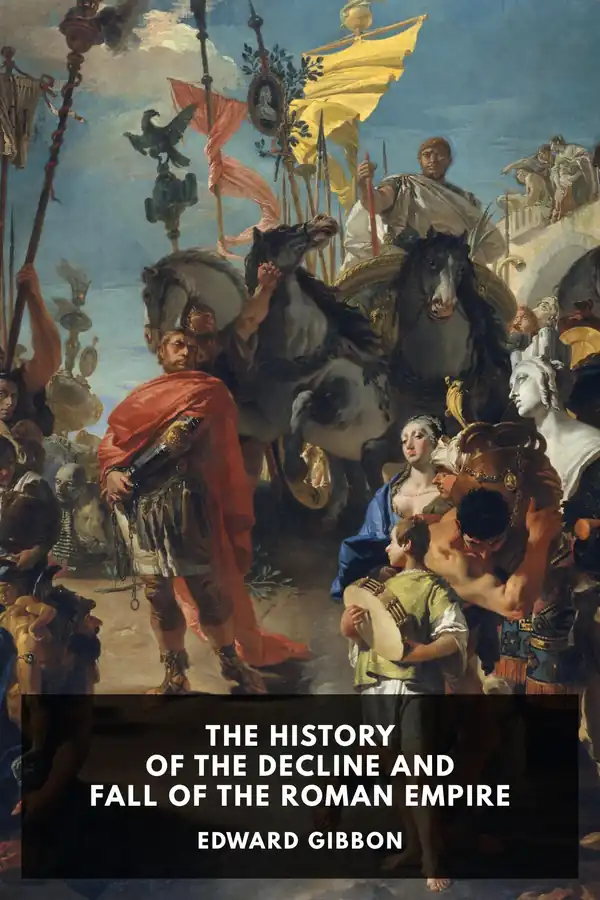
The History of the Decline and Fall of the Roman Empire
📖 Click to Read the Opening Pages Online Preview
The opening of Chapter 1
In the second century of the Christian Era, the empire of Rome comprehended the fairest part of the earth, and the most civilized portion of mankind. The frontiers of that extensive monarchy were guarded by ancient renown and disciplined valor. The gentle but powerful influence of laws and manners had gradually cemented the union of the provinces. Their peaceful inhabitants enjoyed and abused the advantages of wealth and luxury. The image of a free constitution was preserved with decent reverence: the Roman senate appeared to possess the sovereign authority, and devolved on the emperors all the executive powers of government. During a happy period of more than fourscore years, the public administration was conducted by the virtue and abilities of Nerva, Trajan, Hadrian, and the two Antonines. It is the design of this, and of the two succeeding chapters, to describe the prosperous condition of their empire; and afterwards, from the death of Marcus Antoninus, to deduce the most important circumstances of its decline and fall: a revolution which will ever be remembered, and is still felt by the nations of the earth.
The principal conquests of the Romans were achieved under the republic; and the emperors, for the most part, were satisfied with preserving those dominions which had been acquired by the policy of the senate, the active emulations of the consuls, and the martial enthusiasm of the people. The seven first centuries were filled with a rapid succession of triumphs; but it was reserved for Augustus to relinquish the ambitious design of subduing the whole earth, and to introduce a spirit of moderation into the public councils. Inclined to peace by his temper and situation, it was easy for him to discover that Rome, in her present exalted situation, had much less to hope than to fear from the chance of arms; and that, in the prosecution of remote wars, the undertaking became every day more difficult, the event more doubtful, and the possession more precarious and less beneficial. The experience of Augustus added weight to these salutary reflections, and effectually convinced him that, by the prudent vigor of his counsels, it would be easy to secure every concession which the safety or the dignity of Rome might require from the most formidable barbarians. Instead of exposing his person and his legions to the arrows of the Parthians, he obtained, by an honorable treaty, the restitution of the standards and prisoners which had been taken in the defeat of Crassus.38
His generals, in the early part of his reign, attempted the reduction of Ethiopia and Arabia Felix. They marched near a thousand miles to the south of the tropic; but the heat of the climate soon repelled the invaders and protected the unwarlike natives of those sequestered regions.39 The northern countries of Europe scarcely deserved the expense and labor of conquest. The forests and morasses of Germany were filled with a hardy race of barbarians, who despised life when it was separated from freedom; and though, on the first attack, they seemed to yield to the weight of the Roman power, they soon, by a signal act of despair, regained their independence, and reminded Augustus of the vicissitude of fortune.40 On the death of that emperor his testament was publicly read in the senate. He bequeathed, as a valuable legacy to his successors, the advice of confining the empire within those limits which nature seemed to have placed as its permanent bulwarks and boundaries; on the west the Atlantic Ocean; the Rhine and Danube on the north; the Euphrates on the east; and towards the south the sandy deserts of Arabia and Africa.41
The preview quotes the first three paragraphs of Chapter 1 from the Standard Ebooks text, which opens with the empire of Rome in the second century of the Christian era; the other seventy chapters are in the free download below.
Download Full EPUB1776–1788
~1,603,000 words (estimated)
Approx. 89.1 hours
Standalone
The Roman Empire and its successor states, from the second century AD to 1453
Seventy-one chapters in six volumes
EPUB · AZW3 · KEPUB
5.79 MB (EPUB) · 9.06 MB (AZW3) · 6.76 MB (KEPUB)
Public domain in the United States
Project Gutenberg #25717 · Standard Ebooks
The History of the Decline and Fall of the Roman Empire begins in the second century, when the empire of Rome comprehended the fairest part of the earth and the Antonines governed it by laws, roads and legions, and it ends in 1453, when the Turks took Constantinople. Between those dates Gibbon follows the barracks emperors and the recovery under Diocletian, the conversion of Constantine and the establishment of the church, the Huns and Goths and the extinction of the Western empire in 476, the reconquests of Justinian, the rise of Islam, the long contraction of Byzantium, the crusades and the ruin of the city on the Bosphorus. His subject is not one collapse but a process, and his tone is a mixture of erudition, irony and grief.
Gibbon published the first volume in February 1776 and the last three in May 1788, and the twelve years between them show in the book: the early chapters are a portrait of a settled world, the later ones a chronicle of fragmentation, with the empire of the East surviving as a Greek kingdom in a sea of Muslim and Latin powers. The six volumes run to about 1.6 million words, and the argument that holds them together is stated in a single epigram about the triumph of barbarism and religion. Read Wikipedia’s article on The History of the Decline and Fall of the Roman Empire for the publication history and the reception. The Standard Ebooks text used here is based on Project Gutenberg #25717. The text is available via Project Gutenberg #25717 and Standard Ebooks.
The History of the Decline and Fall of the Roman Empire by Edward Gibbon: Summary, Characters & Themes
This page is a summary and analysis of The History of the Decline and Fall of the Roman Empire, the six volumes Edward Gibbon published between 1776 and 1788, and of the world it describes: the empire of the Antonines at its height, the third-century crisis, the Christian revolution, the barbarian invasions, the survival of the Eastern empire, the coming of Islam, the crusades and the Ottoman conquest of Constantinople in 1453. Gibbon treats the fall as a revolution still felt by the nations of the earth, and he means to explain it rather than merely narrate it. The first volume appeared in February 1776, the second and third in 1781, and the last three in May 1788; the interval shows in the book, whose early chapters are a settled portrait of government and manners and whose later chapters are a chronicle of fragmentation.
The work is not arranged as a single chronological line. Gibbon groups his material by subject, so that a chapter on the German frontier, a chapter on the Roman law and a chapter on the Paulicians stand beside the narrative of reigns, and the reader is asked to hold the pattern in mind. The author’s preface divides the whole into three periods: from Trajan and the Antonines to the subversion of the Western empire; from Justinian to Charlemagne; and from the revival of the Western empire to the taking of Constantinople. Chapter 38 closes the second period with a set of General Observations on the Fall of the Roman Empire in the West, chapter 44 digests the civil law from Romulus to Justinian, and chapter 48 pauses to explain the plan of the last two volumes.
Edward Gibbon was born in 1737, was educated at Oxford, and converted to Rome there in 1753, a step that cost him his place and sent him to Lausanne, where he read widely in French and Latin and learned to work from the original authorities rather than from compendiums. He returned to England, served in the militia, published an essay on the study of literature, and travelled to Italy, where, as he says at the end of the last chapter, he first conceived the idea of the work among the ruins of the Capitol. Edward Gibbon wrote the first volume in Bentinck Street and dated its preface 1 February 1776; he finished the last at Lausanne on 27 June 1787 and dated the dedication from Downing Street on 1 May 1788.
Three books on this site make good companions. The History of the Peloponnesian War is the other great classical history in English, and Thucydides asks a narrower question about why a state loses a war it had the strength to win. Meditations is the emperor’s own notebook, written on the frontier that Gibbon describes in his first chapters, and it is the voice of the world he calls happy. The Odyssey is the oldest journey home in European literature, and it belongs to the Greek world whose fall to the Turks closes the history.
The text here follows the Standard Ebooks edition, which is based on the Project Gutenberg #25717 transcription and carries the introduction and notes of J. B. Bury, whose signature closes it. That apparatus matters in a book of this size: the seventy-one chapters run to about 1.6 million words, and the endnotes number some 9,364, several of them essays in their own right. The chapter divisions used in the summaries below are the edition’s, and every quotation on this page is checked against it. Nothing has been abridged or modernised inside the download.
Historical Context
Gibbon wrote as a man of the Enlightenment, and the Decline and Fall is the largest English example of what its age called philosophic history: a narrative that asks why institutions change and judges the past by the standards of reason and civility rather than by providence. He had read Montesquieu, Hume and Robertson, and he admired the French writers enough to imitate their manner of general reflection while distrusting their systems. Bury, in the introduction printed here, points to the paradox that the greatest history of modern times was written by a man in whom a distrust of enthusiasm was deeply rooted, and argues that the coolness is a method rather than a defect.
The book was made by travel as much as by libraries. Gibbon’s conversion at Oxford in 1753 sent him to Lausanne, where he spent five years under a Calvinist tutor, learned to think in French and acquired the habit of reading the sources themselves. His Grand Tour took him to Rome, and the sentence at the end of chapter 71, written at Lausanne on 27 June 1787, places the conception of the work among the ruins of the Capitol. He wrote the first volume in London, in the house in Bentinck Street, and the last volumes back beside the Lake of Lausanne, a country he says he has known and loved from his early youth.
The first volume was published in February 1776 and made its author famous and controversial in the same season. Chapters 15 and 16, on the progress of Christianity and on the conduct of the Roman government towards the Christians, were answered by a pamphlet war, and Bury records Dean Milman’s charge of a bold and disingenuous attack on Christianity while noting that such a charge can neither be proved nor disproved. Later scholarship corrected Gibbon on Byzantium and on the Slavs, and Bury’s introduction lists the work done since 1776; the chapter on the Roman law is still admired by lawyers. The book has never gone out of print, and its epigram about the triumph of barbarism and religion remains the shorthand for its argument.
Key Characters & Literary Archetypes
- Edward Gibbon, the narrator: The historian is the book’s most constant character. Bury says that he never lays aside his toga when he takes up his pen: the style is balanced, Latinised and deliberately cool, and the irony usually arrives in the last clause of a sentence. He tells the reader what he thinks of the Antonine golden age, of the monks, of the relics and of his own labour, and he ends among the ruins of the Capitol, delivering near twenty years of work to the curiosity and candour of the public.
- Constantine: Constantine is the hinge of the first half. Proclaimed at York, he defeats Maxentius at the Milvian bridge and Licinius in the East, and gives the church the establishment described in chapter 20, with the labarum and the words By this conquer. He founds Constantinople, presides over Nicaea, and delays baptism to his deathbed, a detail Gibbon turns into an argument about how slowly a Roman emperor could become a Christian.
- Julian: Julian is the book’s favourite apostate. Declared emperor by the legions of Gaul, he marches east, buries Constantius and tries to restore the old worship, to reform its priesthood and to rebuild the temple at Jerusalem. He is a philosopher who writes against the Christians and a soldier who leads an army down the Tigris to his death in the Persian desert. Gibbon calls him the philosophic warrior and gives him four chapters, more attention than most emperors receive.
- Theodosius: Theodosius receives the eastern empire from Gratian after the disaster at Adrianople, and his reign closes the old world. Chapter 27 gives his character, his penance at Milan after the massacre at Thessalonica, and his death; chapter 28 describes the final destruction of paganism; chapter 29 divides the empire between his sons, Arcadius and Honorius, a division from which Gibbon dates the last stage of the decline in the West.
- Belisarius: Belisarius is the last general the book allows to be great. He destroys the Vandal kingdom in Africa, brings its king to Constantinople in triumph, then fights the Goths for Italy, recovering Sicily, Naples and Rome and taking Ravenna. Gibbon ranks his character above the heroes of the ancient republics; chapter 43 follows his disgrace and death, and a note dismisses as an idle fable the story that he ended blind and begging at the Pincian gate.
- Mahomet: Muhammad enters the history in chapter 50, when the Roman and Persian war had exhausted both empires. Gibbon describes the peninsula, the caravan towns and the tribes, then the prophet who, with the sword in one hand and the Koran in the other, erected his throne on the ruins of Christianity and of Rome. The portrait is admiring and sceptical at once: the preaching at Mecca, the flight to Medina and the submission of Arabia are treated as history as well as revelation.
Core Literary Themes
- Decline and corruption: Gibbon’s subject is not a single defeat but a long corrosion. The praetorians sell the throne, the soldiers make and unmake emperors, taxes and confiscations eat the provinces, and the frontier is bought with subsidies and settled with allies who keep their own laws. He calls Severus the principal author of the decline, which is his way of saying that the third century had causes no later emperor could undo.
- Christianity: Chapters 15 and 16 are the most argued pages in the book. Gibbon explains the growth of the church by five secondary causes, and treats the establishment under Constantine, the destruction of paganism under Theodosius, the worship of relics and the monastic life with an irony his contemporaries found intolerable. Bury’s summary of the thesis, the triumph of barbarism and religion, is the phrase everyone remembers.
- The barbarian frontier: From the Germans of chapter 9 to the Huns of chapter 26 and the Alaric of chapters 30 and 31, the frontier is the book’s long weather. Gibbon is careful about the difference between raiders, allies and settlers, and he shows the empire converting its enemies into soldiers, feeding them, paying them and at last being governed by them. The sack of Rome in 410 is not the end; it is a stage in a negotiation that lasts another sixty years.
- The Eastern empire: Gibbon gives the Greek empire less space than it needs, and he knows it. Chapter 48 opens with a confession that the annals of each reign would repeat a tedious and uniform tale of weakness and misery, and settles for a rapid survey of sixty emperors in six hundred years. The result is brilliant and unfair: Bury spends much of his introduction correcting it, and the empire that guarded the West before 1204 emerges from these pages as a court of eunuchs and theologians.
- Irony and footnotes: The footnotes are not an appendix to the text but a second voice inside it. Gibbon cites the original authorities, corrects them, and drops his most dangerous remarks into a note, where the clergy could read them and the polite could pretend not to. The manner is inseparable from the argument: the balanced sentence that ends in a sneer is how he says that a council, a relic or a miracle is being described by a man who does not believe it, and Bury calls the affectation of the manner immortal.
Why Download Our Custom E-Reader Edition of The History of the Decline and Fall of the Roman Empire?
The six volumes are offered here as one clean file of about 1.6 million words, with the seventy-one chapters in order, the author’s prefaces, Bury’s introduction and the endnotes kept where they belong. There is a working table of contents, chapter breaks that fall where Gibbon put them, and no abridgement: the digressions on the law, on the Germans and on the Paulicians are all present, because without them the argument does not work.
The book is long, and the page is built to be read beside it. Fourteen summaries map the seventy-one chapters, the themes are set out beneath them, and the quotations on this page come from the Standard Ebooks text rather than from an OCR scan. Nothing here is inserted into the download; the edition is the book, and the commentary stays outside it, where a reader can ignore it entirely.
If you want to check a passage, Project Gutenberg #25717 is the transcription behind this edition, and the two agree chapter for chapter. Take the EPUB, the AZW3 or the KEPUB and the whole work is yours: six volumes, seventy-one chapters, and the last sentence written at Lausanne in June 1787.
- Based on the Standard Ebooks Edition, via Standard Ebooks, whose editors prepared the text from the Project Gutenberg transcription of #25717 and added Bury’s introduction and notes; the chapter divisions used in the summaries below are theirs, so the page and the file agree chapter for chapter.
- Free EPUB, AZW3 and KEPUB files One download per format, with a working table of contents and a cover that survives being sent to a device. EPUB for most readers, AZW3 for Kindle, KEPUB for Kobo, all three carrying the same complete text and none of them locked or tied to an account.
- Chapter summaries and a reading guide Fourteen summaries cover the six volumes from the Antonines to 1453, with notes on the historical context, the people who carry the narrative and the arguments that made the book famous, plus answers to the questions readers ask most often about its size, its accuracy and its quarrel with the church.
- No sign-up, no paywall No account, no subscription and no sample standing in for the book. The text is public domain in the United States, and the file is yours to keep, copy between devices and reread, with nothing that expires and nothing hidden inside it.
- The History of the Peloponnesian War — free EPUB, AZW3 & KEPUB
- Meditations — free EPUB, AZW3 & KEPUB
- The Republic — free EPUB, AZW3 & KEPUB
Chapter summaries
Seventy-one chapters, six volumes and about 1.6 million words. The summaries below follow the Standard Ebooks text and pick fourteen stations, from the survey of the empire under the Antonines to the ruins of Rome in the fifteenth century, so that a reader can see the shape of the whole before beginning, or find a way back into it afterwards.
- Chapter 1 — The extent and military force of the empire: Gibbon opens in the second century with the empire at its height: the advice of Augustus to keep within the Atlantic, the Rhine, the Danube and the Euphrates; the single addition of Britain; the wars of Trajan and the retreat of Hadrian; and a long survey of the legions, their camps, their marches and their discipline. The chapter ends by measuring the empire at above two thousand miles in breadth.
- Chapter 2 — Union and internal prosperity: Rome is held together by law, roads, colonies and citizenship rather than by conquest alone. Gibbon describes the provinces that submitted to a wise and simple government, the arts and agriculture that enriched them, the Latin language spreading with the legions, and the way a Greek or a Gaul could rise to the senate. The chapter is the most favourable portrait of the empire in the whole work.
- Chapter 5 — The empire sold by the Praetorian guards: The guards murder Pertinax and auction the purple to Didius Julianus, and three provincial armies answer at once. Septimius Severus marches on Rome, defeats Niger and Albinus, and establishes maxims of government that Gibbon thinks decisive: the army first, the senate last. The chapter ends with the judgement that Severus was the principal author of the decline of the Roman empire.
- Chapter 9 — The state of Germany: Before the invasions, Gibbon describes the country that produced them: its forests, its cold, its reindeer and its lack of cities. Following Tacitus, he sets out the German love of freedom, the assembly of warriors, the annual division of land and the contempt for a king who rules by command. His point is that such a people could be defeated in battle but never easily governed.
- Chapter 15 — The progress of the Christian religion: This is the most famous chapter in the book. Gibbon asks what secondary causes favoured the growth of the church and names five: the zeal of the Christians, the doctrine of a future life, the claim to miraculous powers, the austerity of their morals and the discipline of their republic. The tone is candid and cool, and the footnotes do much of the arguing.
- Chapter 20 — The conversion of Constantine: Gibbon begins with a difficulty: the date of the conversion cannot be fixed, since the emperor was baptised only on his deathbed. He follows the slow movement from the worship of the sun to the labarum and the words By this conquer, then describes the legal establishment of the church, the wealth of the bishops, the councils of Arles and Nicaea, and the constitution of a state within the state.
- Chapter 26 — The Huns and the Goths: The chapter opens with an earthquake and closes with a treaty. Gibbon describes the pastoral nations, the Huns riding from China to the Volga, and the Gothic flight across the Danube into a Roman province that could not feed them. The war ends at Adrianople, where the emperor Valens is killed and his army destroyed, and Gratian invests Theodosius with the East.
- Chapter 30 — Alaric and the defence of Italy: After the death of Theodosius the Goths revolt, and Alaric plunders Greece before turning west. Stilicho beats back two invasions of Italy, one led by Alaric and one by Radagaisus, while Germans overrun Gaul and a usurper is proclaimed in Britain. The chapter ends with the fall and execution of Stilicho, the general on whom the defence of Italy had depended.
- Chapter 38 — Clovis and the fall of the West: The conversion of Clovis and the establishment of the French monarchy in Gaul give Gibbon a vantage point on the new kingdoms, their laws and the state of the Romans who lived under them. The chapter closes with the General Observations on the Fall of the Roman Empire in the West, where he argues that the empire fell through its own weight and that civilisation has continued to advance.
- Chapter 41 — Belisarius in Africa and Italy: Justinian inherits the claim to the whole empire and sends Belisarius to enforce it. The Vandals of Africa are destroyed in a single campaign, and the general returns in triumph; then the Gothic war begins, and he recovers Sicily, Naples and Rome, holds the city through a long siege and takes Ravenna. Gibbon admires the man while doubting the wisdom of the conquest.
- Chapter 44 — The Roman law: In a single chapter Gibbon traces the jurisprudence of Rome from the kings and the Twelve Tables to the Code, the Pandects and the Institutes of Justinian. He explains the rights of persons and of things, the law of guardianship, injuries and crimes, and ends by arguing that the civilians made law a mystery and a trade. Lawyers have admired the chapter ever since.
- Chapter 50 — Muhammad and the Arabs: Gibbon turns east in the reign of Heraclius and describes the peninsula, its deserts, its caravans and its tribes before describing the prophet. The birth, character and doctrine of Muhammad, the preaching at Mecca, the flight to Medina and the propagation of the religion by the sword are set out with a mixture of admiration and irony that has never been quite forgiven.
- Chapter 60 — The fourth crusade: The schism of the Greek and Latin churches, the revolt of the Bulgarians and the deposition of Isaac Angelus lead to the bargain between the crusaders and the Venetian fleet. The Latin army twice besieges Constantinople, takes it in 1204, and plunders a city that had stood for nine centuries. Gibbon counts the statues melted for coin and the libraries lost in the fires.
- Chapter 71 — The ruins of Rome: The last chapter is a tour of the ruins with Poggio Bracciolini in 1430, followed by four causes of decay: time, barbarian plunder, the quarrels of the Romans themselves and the reuse of stone and metal. Gibbon ends with the whole history before him, confesses that the design came to him among the ruins of the Capitol, and dates the sentence at Lausanne, 27 June 1787.
The History of the Decline and Fall of the Roman Empire: Frequently Asked Questions
What is The History of the Decline and Fall of the Roman Empire about?
Do I have to read all six volumes?
Is Gibbon still reliable?
Why does Gibbon blame Christianity for the fall?
What are the General Observations at the end of chapter 38?
Why does the history continue to 1453?
Is the prose difficult, and what about the footnotes?
Where can I download the free EPUB, AZW3 and KEPUB?
Part of: Classic Fiction · Edward Gibbon