Aesop’s Fables by Aesop: Free EPUB, AZW3 & KEPUB Download
Aesop’s Fables
📖 Click to Read the Opening Pages Online Preview
The first fables
A hungry Fox saw some fine bunches of Grapes hanging from a vine that was trained along a high trellis, and did his best to reach them by jumping as high as he could into the air. But it was all in vain, for they were just out of reach: so he gave up trying, and walked away with an air of dignity and unconcern, remarking, “I thought those Grapes were ripe, but I see now they are quite sour.”
A Man and his Wife had the good fortune to possess a Goose which laid a Golden Egg every day. Lucky though they were, they soon began to think they were not getting rich fast enough, and, imagining the bird must be made of gold inside, they decided to kill it in order to secure the whole store of precious metal at once. But when they cut it open they found it was just like any other goose. Thus, they neither got rich all at once, as they had hoped, nor enjoyed any longer the daily addition to their wealth.
Much wants more and loses all.
The edition opens with the Fox and the Grapes, then the Goose That Laid the Golden Eggs:
Download Full EPUB1912
~40,000 words (estimated)
Approx. 2.2 hours
Standalone
The animal world of the Greek fables, and the courts and cities that retold them
284 fables, grouped into twelve movements by theme
EPUB · AZW3 · KEPUB
0.47 MB (EPUB) · 0.57 MB (AZW3) · 0.49 MB (KEPUB)
Public domain in the United States
Project Gutenberg #11339 · Standard Ebooks
Aesop’s Fables is the name for a collection of very short stories, most of them about animals, which the Greek world told for centuries before anyone wrote them down; this edition prints 284 of them. A fox decides that the grapes he cannot reach are sour, a wolf eats a lamb after inventing reasons, a tortoise beats a hare who sleeps, and the north wind loses an argument with the sun. Each fable is a scene and a sentence of advice, and together they make the oldest manual of practical sense in the language. This is V. S. Vernon Jones’s translation of 1912, with G. K. Chesterton’s introduction.
The fables were old before they were books. They were versified in Latin and in Greek, copied in monasteries, folded into the medieval beast epic of Reynard the Fox and rewritten by La Fontaine in French verse; the name of Aesop stood for the whole genre. Aesop’s Fables reached English readers in this translation in 1912, published in London by William Heinemann with illustrations by Arthur Rackham. The edition is complete, with all 284 fables and Chesterton’s introduction. The text is available via Project Gutenberg #11339 and Standard Ebooks.
Aesop’s Fables by Aesop: Summary, Characters & Themes
This is a summary and analysis of Aesop’s Fables, the collection of short animal stories that the Greek world attributed to a slave named Aesop. The book has no plot and no chapters. It has 284 separate fables, most of them a paragraph long, and each one is a single scene with a decision in it: a fox tries to reach grapes, a wolf accuses a lamb, a lion catches a mouse and lets him go. The story is told plainly and then a line draws the lesson out. Because the fables are short, the book can be read in an evening or kept for years, and it is one of the few classics in which the index of morals is nearly as long as the text. A single fable is over before a listener can ask what happened, and that brevity is the form, not a shortage of material.
What makes the collection cohere is not a story but a method. Chesterton, in the introduction printed here, says that for a fable all the persons must be impersonal, like pieces in chess: the lion must always be stronger than the wolf, the fox must move crooked, the sheep must march on. That is why the animals never surprise us and why the morals still land, since nothing is worked out about an individual and everything is said about a type. A fable is not a fairy tale, he adds, and the difference is human beings: there can be no good fable with people in it, and no good fairy tale without them. Read a dozen in a row and the pattern is plain: a situation, a choice, a consequence, a sentence. His argument is that the fable survives because it does not need to be believed, only recognised.
Aesop himself is harder to see than his animals. The tradition makes him a Phrygian slave of the sixth century BC, living in the time of Croesus of Lydia, ugly, sharp-tongued and finally thrown from a cliff at Delphi, and Chesterton remarks that his fame is all the more deserved because he never deserved it, since what is authentic in the fables belongs to everybody and what belongs to everybody is anonymous. The Greeks themselves treated the stories as old and common property. Orators quoted them in the assembly, children learned them at school, and the name of Aesop became a label for a kind of story rather than a claim about who wrote it. What remains is the voice of the stories themselves, which is flat, quick and certain of its judgments.
The fables travelled well. They were versified in Latin by Phaedrus and in Greek by Babrius, copied in monasteries, folded into the medieval beast epic of Reynard the Fox, and rewritten in French verse by La Fontaine in the seventeenth century; Chesterton names Reynard and La Fontaine as the two ends of that chain. Something of the same short, hard-shaped moral turns up in the German tales collected by the brothers Grimm, and the talking animals of Grimms’ Fairy Tales are the nearest thing on this site to Aesop’s menagerie; Kipling’s The Jungle Book shows what happens when those animals are given names, histories and a law. Readers who want the wider shelf can start from children’s classics. Each of those books can be read as a descendant of the Greek fable, and each was written for readers who already knew the animals.
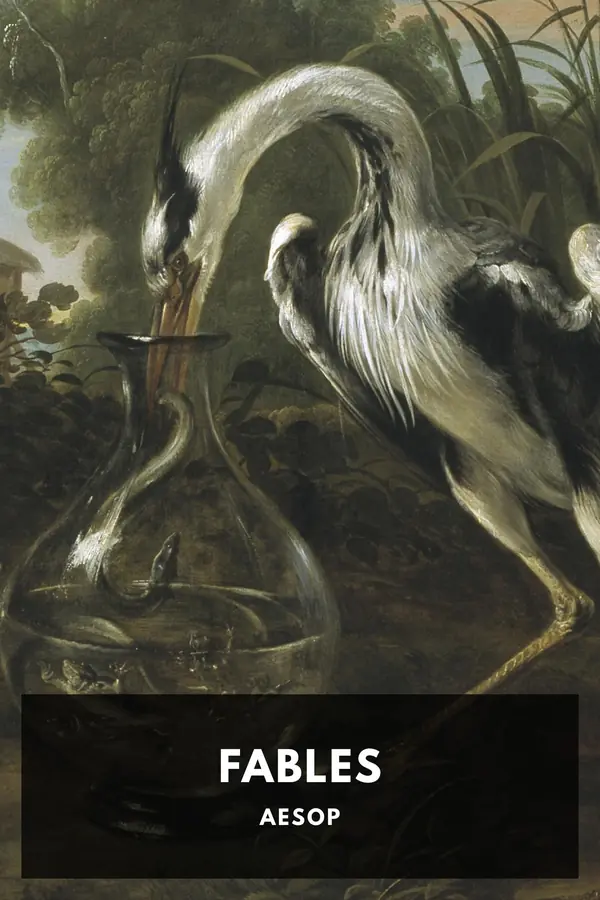
The text here is V. S. Vernon Jones’s translation, published in London by William Heinemann in 1912 with an introduction by G. K. Chesterton, and it is complete and unabridged. It follows the Standard Ebooks edition, which is based on a 2004 Project Gutenberg transcription by Suzanne Shell, Greg Chapman and Distributed Proofreaders and on scans from the Internet Archive; the same translation is at Project Gutenberg as ebook 11339. The Standard Ebooks cover is adapted from a painting by Frans Snyders, The Fox Visiting the Heron, made between 1630 and 1640, a reminder that these stories were a subject for painters long before they were a subject for children’s books. All 284 fables are here. Nothing has been added by the editors, and the order of the fables is the order of the 1912 volume.
Historical Context
The fables are older than any book that contains them. The Greeks told them in the sixth century BC and before, and the tradition that grew up around them put Aesop in that century, a slave from Phrygia in Asia Minor, at the court of Croesus of Lydia, and at Delphi, where he was said to have been thrown from the cliff. Chesterton, writing the introduction to this translation, treats the biography as a story the Greeks told about themselves. What is certain is that a slave could be remembered as a philosopher, and that the stories he was remembered for were about animals. In a world of masters and servants, a wolf and a lamb could say what a citizen could not say aloud: the fables are political without ever naming a politician.
Written down, the fables kept changing hands. Phaedrus turned them into Latin verse in the first century AD, Babrius into Greek verse, probably in the second, and from those collections and from prose paraphrases they passed into schoolbooks and sermons. Medieval Europe knew them through Latin compilations and through the beast epic of Reynard the Fox, where the animals carry the satire of courts and clergy. The Renaissance printed them in Greek, Latin and the vernaculars, and La Fontaine made them French poems in 1668. Each stage kept the short shape and the closing moral, which is why a line written for a Greek audience can still be understood by a child in English. The name of Aesop was used as a warrant for the whole genre, so that a later writer could put a new story under it and be read.
The translation printed here was made for a particular book: Aesop’s Fables, translated by V. S. Vernon Jones, with an introduction by G. K. Chesterton and illustrations by Arthur Rackham, published by William Heinemann in London in 1912. It was a gift book of the kind Edwardian publishers did well, and Rackham was then the most celebrated illustrator in England. Vernon Jones’s prose keeps the plainness of the Greek: short sentences, few adjectives, and dialogue that carries the point. Chesterton’s introduction is a defence of the fable as a form, arguing that its animals are abstractions and that this is exactly what makes the moral stick. The Standard Ebooks edition reproduces the translation and the introduction, and its cover carries a painting of a fox and a heron from the 1630s.
Key Characters & Literary Archetypes
- The Fox: The collection’s clever one: he flatters the crow out of her cheese, talks the goat into a well and out of it, and reads the footprints outside the sick lion’s cave. Chesterton says the fox must move crooked, as the knight in chess must move crooked. He is cunning as a method rather than a person, and when the trick fails, as with the grapes, the failure is the moral.
- The Lion: Power with a crown on. He is king of the beasts, generous when it costs him nothing and dangerous when hungry, and he is also, in one of the best fables, ashamed of being frightened by a cock until he meets an elephant who dreads a gnat. He is outwitted by the fox, freed by the mouse, and killed by quarrels he did not start.
- The Wolf: Appetite dressed as argument. He rarely attacks without a speech: he accuses the lamb of muddying his stream and of insulting him the year before, then eats him when the answers run out. He is the strong inventing reasons, and Chesterton’s line that the wolf will always be wolfish is the point of every fable he appears in.
- The Ass: Pretension and patience. He wears a lion’s skin and gives himself away with a bray, carries a sacred image and believes the bows are meant for him, and envies the lapdog until he is beaten for it. He is also the beast of burden who knows the road, and the fables are gentle with him when he is only tired.
- The Crow: Voice and vanity. The crow is flattered out of her cheese by the fox, and the moral is aimed at her rather than at him, because she believed a compliment about her singing. Elsewhere she is clever, dropping pebbles into a pitcher to raise the water, and when the birds compete for importance she is taught her place.
- The Mouse: The small ally. A mouse gnaws through the net that holds a lion and is thanked for it; the mice in council agree that a bell would warn them of the cat and then cannot find a volunteer to hang it. The mouse stands for the weak who can still do what the strong cannot, and for the distance between deciding and doing.
Core Literary Themes
- Cunning against force: Half the collection is a contest between the quick and the strong, and the fables refuse to give either side a permanent victory. The fox’s flattery wins the crow’s cheese, but the same fox cannot reach the grapes and calls them sour; the ass in the lion’s skin frightens the wood until he opens his mouth; the wolf needs no argument at all, only an appetite and a lamb. Chesterton’s rule, that the lion is always stronger than the wolf and the fox always moves crooked, means the outcome depends on which kind of power the situation rewards. Cunning is a tool, not a virtue. Read the fox fables in sequence and the lesson sharpens: the same cleverness that wins the cheese loses the grapes, and the fables never let either result stand as a rule.
- The moral as a tool of instruction: Every fable arrives at a sentence: slow and steady wins the race, necessity is the mother of invention, look before you leap, do not count your chickens before they are hatched. These are not decorations. They are the reason the stories were told, copied and taught for two thousand years, and many of them have passed into English as proverbs. The book is also explicit about the use of fables: in the story of Demades, an Athenian orator facing an inattentive assembly begins to tell one of Aesop’s tales, and the crowd falls silent at once, a joke about the very habit the collection is built on. The moral is the product: the story exists to deliver it, and the best of them are remembered as proverbs rather than as plots.
- The small against the great: The collection’s most radical claim is that size is not the same as strength. A mouse frees a lion, a gnat torments him, a beetle takes revenge on an eagle by rolling its eggs out of the nest, and the mouse who faces a bull is told that the battle is not always to the strong. The fables do not pretend that the weak usually win: the frog who tries to swell to the size of an ox bursts, and the mice who want to bell the cat find no volunteer. What they insist on is that the small have weapons of their own, which are patience, numbers, timing and the ability to wait. The lesson is not that the weak win, but that the strong are never as safe as they think.
- Ingratitude: Again and again the fables notice that help is forgotten. Travellers rest under a plane tree and complain that it bears no fruit, and the tree answers that they are enjoying its shade while abusing it; the stag eats the vine that hid him and is shot for it; the farmer nurses a viper and is bitten; the bees sting the beekeeper while the thief who robbed the hives walks away. Ingratitude is treated as a fact of nature rather than a surprise, and the lesson is less indignation than instruction: know whom you are helping, and remember what you owe. The fables are hard on both parties: the helper is warned to be careful, and the helped are shown how quickly they forget.
- The idiom of 1912: Vernon Jones’s prose is plain to the point of bareness, and that is its virtue: short sentences, little description, dialogue carrying the weight, and morals that often take the shape of an English proverb. Once bitten, twice shy; out of the frying pan into the fire; one swallow does not make a summer. The translation is also of its period, and a few fables carry assumptions about servants, foreigners and punishment that a modern reader will notice; they are printed as they stood in 1912. Chesterton’s introduction, written for the same volume, supplies the argument the stories do not make for themselves, and its English is the same period English at greater length.
Why Download Our Custom E-Reader Edition of Aesop’s Fables?
Because the whole book can be read in an evening and then kept for a lifetime. The fables are short enough to finish between two stops on a train, and each one leaves something behind: a phrase, a picture, a rule for dealing with people who are stronger or smoother than you are. Vernon Jones’s 1912 English is clear and unsentimental, and the Project Gutenberg #11339 transcription is there if you want to compare the text; the files here are built from the Standard Ebooks edition, complete and unabridged, with all 284 fables and Chesterton’s introduction. It is a book that rewards rereading, because each fable is a whole argument in a paragraph and the argument does not wear out.
The files are made for reading rather than for display. The fables come with a working table of contents rather than a wall of text, each one begins at the top of a screen, and the type reflows to whatever size your reader is already set to, so a fable that fits a phone also fits a page. There are no plates to scroll past and no scenery between you and the story. Download once and the book stays on the device, which matters when the train enters a tunnel or the wifi drops: nothing here needs a connection to open.
Read it beside this page. The twelve groups above are an editorial map rather than Aesop’s own arrangement, and they are useful the way an index is useful: the fox fables in one place, the wolf’s harsh arithmetic in another, the last fables about luck and the gods at the end. If you want a single story for a child at bedtime, the Fox and the Grapes and the Goose are the two the edition itself prints first. If you want the argument rather than the stories, Chesterton’s introduction is there to be read and disagreed with.
- Based on the Standard Ebooks Edition, via Standard Ebooks, whose text is based on a 2004 Project Gutenberg transcription by Suzanne Shell, Greg Chapman and Distributed Proofreaders, checked against scans from the Internet Archive.
- The complete 1912 translation All 284 fables, from the Fox and the Grapes to the Traveller and Fortune, with Chesterton’s introduction, without abridgement, modernised spelling or rewritten morals.
- EPUB, AZW3 and KEPUB One download per format, so the book opens on a Kindle, a Kobo, an iPad or an older e-reader without conversion, with navigation that works on old devices as well as new ones.
- Free and DRM-free Public domain in the United States, with no account, no sample chapter and no lock on the file: download it once and it stays yours to move between readers and read again.
- Grimms’ Fairy Tales — free EPUB, AZW3 & KEPUB
- The Jungle Book — free EPUB, AZW3 & KEPUB
- Children’s Classics — free EPUB, AZW3 & KEPUB
Chapter summaries
The collection has no chapters. It has 284 fables, each a title, a story and usually a one-line moral, and the only order in the book is the order of the edition. The twelve movements below group the fables by the kind of animal and the kind of lesson, and they are a convenience rather than Aesop’s structure: they are meant to help you find your way in, not to replace the pleasure of opening the book at random.
- The fox and the grapes, and the fox fables: Where the collection begins, and the fox’s book within the book. He cannot reach the grapes and calls them sour; he flatters the crow until she drops her cheese; he talks the goat into a well and climbs out over her back; he catches at a bramble and is scratched for it. The morals are about self-deception and flattery, and about a cleverness that works often enough to be dangerous.
- The lion and the lion fables: The lion is the collection’s king and its test of strength. He is caught in a net and freed by a mouse, pretends to be ill so that the animals come to his cave, falls in love and lets his claws be pared, and is ashamed of fearing a cock until an elephant admits to fearing a gnat. The morals turn on power that is real but not unlimited.
- The wolf and the lamb, and the wolf fables: The wolf’s fables are the harshest in the book. He accuses the lamb of insults and trespasses that never happened, then eats him because he is hungry; he dresses as a shepherd and is killed for the mutton; he promises a crane a reward and pays her with the news that her head is safely out of his mouth. Violence needs no excuse, only an appetite.
- The ass in the lion’s skin, and the ass fables: The ass is the book’s comedian and its burden-bearer. He puts on a lion’s skin and terrifies the wood until he brays; he carries a sacred image and takes the bows for himself; he envies the lapdog’s place by the fire and is beaten for it. The morals are about pretension, and the difference between what you carry and what you are.
- The town mouse and the country mouse: Fables about where to live and what safety costs. The country mouse offers roots and corn, the town mouse a larder of figs and honey broken up by the door and the dog, and the country mouse goes home to plain food and peace. The tortoise who carries his house and the crab who leaves the sea for a meadow learn the same lesson in different keys.
- The goose that laid the golden eggs: The book’s plainest morals about money. The goose is killed by owners who want the whole treasure at once and find only an ordinary bird inside; the miser buries his gold and is told to put a brick in the hole and look at it; the milkmaid counts her chickens and spills the pail; the dog drops his meat for its reflection. Much wants more and loses all.
- The tortoise and the hare, and the slow and steady: The hare sleeps and the tortoise plods past him, with the fox to set the course and judge; the tortoise who wants to fly is dashed on a rock; the lark feeds her young by outwitting a farmer who waits for his neighbours to help; the hound learns that running for dinner is not running for your life. The morals are about patience and self-help.
- The north wind and the sun: The north wind and the sun argue over a traveller’s cloak, and the sun wins by warmth; the oak that will not bend is uprooted while the reeds survive; the crow raises the water in the pitcher pebble by pebble; the wagoner who prays to Hercules is told to put his shoulder to the wheel. The morals are about persuasion, yielding and the patient use of what you have.
- The mice in council: The mice agree that a bell would warn them of the cat and then discover that nobody will hang it; a gnat humbles a lion; a mouse tells a bull that the battle is not always to the strong; a beetle wrecks an eagle’s eggs; a frog bursts trying to look as big as an ox. The morals are about how far the weak can reach, and what pretension costs.
- The shepherd’s boy and the wolf: The shepherd’s boy calls wolf twice for fun and is not believed when the wolf comes; the jackdaw dresses in borrowed feathers and is stripped by the other birds; the crow tries to pass for a raven and is ignored; the monkey who is made king is found out. The morals are about lying, borrowed credit and the reputation that cannot be borrowed.
- The belly and the members: The belly is accused by the hands and feet of doing nothing, and the whole body weakens when they refuse to feed it; a father shows his sons that a bundle of sticks cannot be broken; a lion eats three bulls one by one after setting them against each other. The morals are about union, and how easily a strong group is divided.
- The traveller and fortune, and the last fables: The old man who calls on Death and then asks to be helped up with his bundle; the traveller asleep at the edge of a well, warned by Fortune that the blame would be hers; the frogs who ask Jupiter for a king and get a stork; Mercury and the woodman, rewarded for honesty. The last fables are about the gods, luck and the limit of what can be blamed on anyone.
Aesop’s Fables: Frequently Asked Questions
What is Aesop’s Fables about?
Who was Aesop?
How many fables are in this edition?
What is the moral of the Fox and the Grapes?
Are these stories for children?
Who translated this edition?
What is the difference between a fable and a fairy tale?
Where can I read the full text for free?
Part of: Children’s Classics · Classic Fiction