Vanity Fair by William Makepeace Thackeray: Free EPUB, AZW3 & KEPUB Download
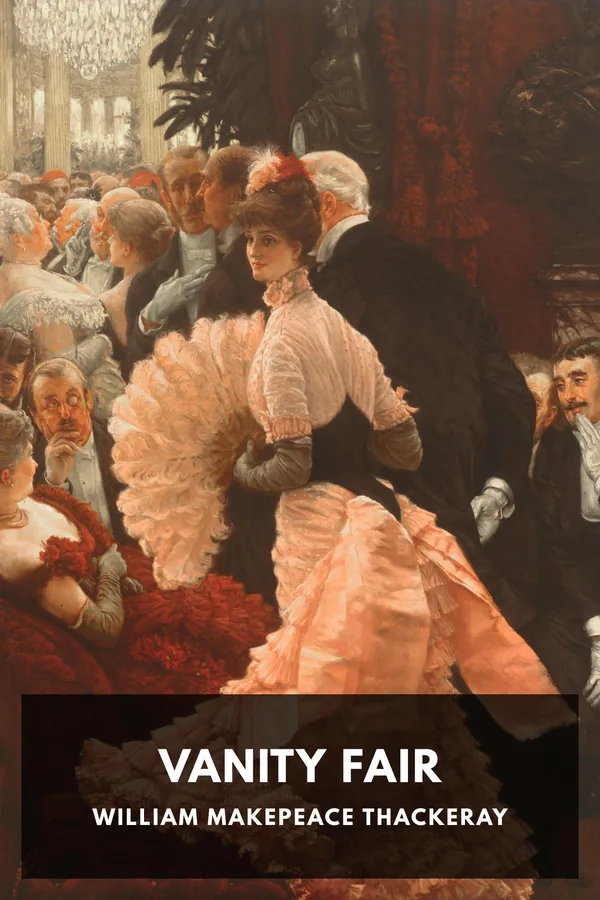
Vanity Fair
📖 Click to Read the Opening Pages Online Preview
The opening of Chapter 1
While the present century was in its teens, and on one sunshiny morning in June, there drove up to the great iron gate of Miss Pinkerton’s academy for young ladies, on Chiswick Mall, a large family coach, with two fat horses in blazing harness, driven by a fat coachman in a three-cornered hat and wig, at the rate of four miles an hour. A black servant, who reposed on the box beside the fat coachman, uncurled his bandy legs as soon as the equipage drew up opposite Miss Pinkerton’s shining brass plate, and as he pulled the bell at least a score of young heads were seen peering out of the narrow windows of the stately old brick house. Nay, the acute observer might have recognized the little red nose of good-natured Miss Jemima Pinkerton herself, rising over some geranium pots in the window of that lady’s own drawing-room.
“It is Mrs. Sedley’s coach, sister,” said Miss Jemima. “Sambo, the black servant, has just rung the bell; and the coachman has a new red waistcoat.”
“Have you completed all the necessary preparations incident to Miss Sedley’s departure, Miss Jemima?” asked Miss Pinkerton herself, that majestic lady; the Semiramis of Hammersmith, the friend of Doctor Johnson, the correspondent of Mrs. Chapone herself.
The excerpt below quotes the opening three paragraphs of Chapter 1, which end with Miss Pinkerton asking whether everything is ready for Miss Sedley to leave.
Download Full EPUB1848
~301,000 words (estimated)
Approx. 16.7 hours
Standalone
London, Brussels and the Continent, 1813–1830
Sixty-seven chapters grouped into thirteen movements
EPUB · AZW3 · KEPUB
1.18 MB (EPUB) · 1.53 MB (AZW3) · 1.28 MB (KEPUB)
Public domain in the United States
Project Gutenberg #599 · Standard Ebooks
Vanity Fair follows two schoolgirls out of Miss Pinkerton’s academy in 1811: Amelia Sedley, the soft-hearted daughter of a City merchant, and Becky Sharp, the penniless young woman with a French accent and no intention of staying poor. Across sixty-seven chapters Thackeray moves them through drawing rooms, debt, a secret marriage, the Brussels ball of June 1815 and the battle that follows, and then through the long peace in which fortunes are made and quietly unmade. There is no hero, only a narrator who keeps pulling the strings, and a fair where almost everybody is for sale.
Thackeray issued the novel in monthly parts through 1847 and 1848, drawing the illustrations himself, and the subtitle he gave it, A Novel without a Hero, was a warning as much as a joke. Its targets are the marriage market, the credit economy and the self-deception of respectable people. Vanity Fair has stayed in print because the satire still lands. The text is available via Project Gutenberg #599 and Standard Ebooks.
Vanity Fair by William Makepeace Thackeray: Summary, Characters & Themes
Vanity Fair is the story of two young women who leave the same school in the same coach and take opposite roads through the same world. Amelia Sedley is kind, pretty and sentimental, and she marries for love; Becky Sharp is clever, poor and entirely unsentimental, and she marries for money, or tries to. Around the pair Thackeray assembles merchants, baronets, officers, servants and creditors, and lets them bargain, borrow and betray one another for sixty-seven chapters. The action runs from 1811 into the early 1830s and touches London, Brighton, Brussels and half the Continent. This page gives a summary and analysis of the novel, with the chapters grouped into thirteen movements, notes on the people and the themes, and a free edition to read alongside them. It was published in 1848, and it has never quite stopped being read as a portrait of its own century and of ours.
William Makepeace Thackeray was born in Calcutta in 1811 and sent to England as a child; he was at Charterhouse, then Cambridge, then briefly in Paris and Weimar as a young man with an inheritance, and he lost most of that inheritance to gambling and to two failed newspapers. By the 1840s he was a working journalist and caricaturist, and Vanity Fair, issued in monthly parts from January 1847, made his name and his fortune. The full life is set out in the Wikipedia article on Thackeray, and the details matter here, because the City bankruptcy, the Anglo-Indian money and the club gossip are things he had seen at close range. He drew the illustrations himself, and the puppets of the prologue are his joke about his own trade.
The novel runs from 1811 to about 1830 and follows the British army to Belgium, but most of it happens indoors, in drawing rooms, lodgings and inns, where the real battles are fought over wills and marriage settlements. Thackeray’s narrator is present throughout, addressing the reader, offering opinions and occasionally withdrawing a scene because it would be improper to describe. The technique owes something to the eighteenth-century novel, and readers who want the earlier model should try Tom Jones, whose narrator talks to his reader in a similar voice. Vanity Fair keeps that intimacy and turns it into irony, so that the reader is flattered and mocked at the same time. The book’s own joke is that the fair it describes is the world the reader already lives in.
Money is the engine of the book. Becky counts what a man is worth before she counts his virtues; old Osborne disinherits his son over a marriage settlement and blots the name out of the family Bible; Rawdon lives by cards and by the credit of a shopkeeper who is ruined in the process. Thackeray shows how much of what passes for morality is arithmetic with better manners, and he is careful to show the women doing the same sums with fewer options. The French novel of the same decade made the point more brutally, and Father Goriot is the nearest cousin: a young man learning what a fortune costs and who pays for it. Both were serialised, both were read as scandal, and both are still read as social history.
Vanity Fair is long, and it is meant to be. The monthly parts gave Thackeray room to let a character change over years, and the book rewards a reader who stays past the first hundred pages. It is also very funny in a dry way, and unexpectedly tender about the people it exposes, which is why readers who expect satire alone are surprised by it. For the full text, use Project Gutenberg #599 or the Standard Ebooks edition from which this page’s chapter divisions are taken. Readers who want the comic marriage plot without the bitterness should begin with Pride and Prejudice, and then come back to this one.
Historical Context
Vanity Fair begins in 1811 and ends in the early 1830s, and the hinge of its public history is the Waterloo campaign of June 1815. Thackeray’s first readers knew that war as the founding victory of their century; his characters meet it first as rumour, then as a march, then as a list of casualties in the Gazette. The novel keeps the battle itself offstage and stays with the people who cannot fight: the panic in Brussels, the carriages hired at any price for Ghent, the wounded coming back into the town, and Amelia praying in a rented room while her husband lies dead on the field. Nobody in the book sees the battle whole, and that is the point of the way it is told.
The peace that followed made the kind of novel Thackeray wrote possible. Money was suddenly the measure of everything: City merchants were ruined by the fall of the funds, East India men came home with fortunes and liver complaints, younger sons lived on credit and on speculation, and a marriage settlement could decide whether a family rose or sank. Thackeray is exact about the machinery, the annuities, the bills at three months, the insurance policy, the entail that keeps a baronet’s estate in one piece while his tenants go unpaid, and the rotten borough that returns him to Parliament. Readers who know the period only from costume drama will be surprised by how much of the book is bookkeeping.
The novel appeared in 1847 and 1848, the year of revolutions in Europe and of Chartism and famine at home, and its first readers were the grandchildren of the world it describes. Thackeray had watched the railway boom and the crash that followed, and he wrote his novel of 1815 with those later failures in mind. The Victorian reviewers who praised it as a satire on the Regency were also, whether they liked it or not, reading a satire on themselves. It came out in monthly parts, each with its own illustrations and its own small cliffhanger, which is why the narrator keeps interrupting and why the plot is full of delays, false reports and letters that arrive too late. That double vision is why the book outlived its own occasion.
Key Characters & Literary Archetypes
- Becky Sharp: The governess who refuses to remain one. Daughter of a drunken painter and a French opera singer, she leaves Chiswick with a Parisian accent, a taste for the main chance and no illusions about the market in husbands. She marries Rawdon Crawley in secret, climbs into Lord Steyne’s circle, loses everything in an hour on a May evening, and spends her later years working the rooms of half the towns in Europe. She is the novel’s engine and its most entertaining liar.
- Amelia Sedley: The sentimental heroine the novel keeps testing. She leaves school engaged to George Osborne, marries him against his father’s will, is widowed within months and raises her son in poverty at Fulham. She worships a memory rather than a man, and it takes a letter in George’s own hand, shown to her by Becky, to clear her sight. Dobbin waits through all of it, and the novel is honest about how badly she treats him while she waits to be ready.
- Rawdon Crawley: A Life Guards officer with a talent for billiards and none for arithmetic. He adores Becky, believes her stories and is ruined by the bills he never reads. The discovery in his own drawing room makes him respectable in an instant; he takes the governorship of Coventry Island, sends for his son, and dies there of fever, still sending money home. His last letters are the only place in the book where Becky’s charm is measured by what it cost someone else.
- William Dobbin: The novel’s one good man, and the butt of its jokes. Awkward, lisping and large-footed, he buys Amelia’s piano at her father’s auction and never tells her, defends George at school and later at his father’s door, and loves her for eighteen years before she finally sends for him. He is not a hero in the ordinary sense; he is something rarer, an honest friend. The book allows him one moment of real anger, and it changes the whole last hundred pages.
- George Osborne: A dandy with a high opinion of himself and a low one of everybody else. He marries Amelia in defiance of his father, flirts with Becky in Brussels, and is killed at Waterloo before the bill for his vanity comes in. His father’s grief takes the form of erasing his name from the family Bible, and his widow spends years weeping over a man who was not worth it. The letter Becky keeps from the night of the ball is his real memorial.
- Joseph Sedley: Amelia’s brother, a collector of Boggley Wollah in the East India Company’s service, fat, vain, timid and devoted to curry. He nearly proposes to Becky at Vauxhall in 1811 and is still under her spell twenty years later in Pumpernickel. He dies at Aix-la-Chapelle in circumstances the insurance office finds suspicious, and Becky is named his administratrix. He is the novel’s clearest example of a man who mistakes being flattered for being loved.
Core Literary Themes
- The fair and the puppets: The novel opens with a Manager before the curtain, surveying a fair of jugglers, bullies and quacks, and naming his puppets: the Becky Puppet, the Amelia Doll, the Dobbin Figure and the richly dressed Wicked Nobleman. The image is not decoration. It tells the reader that the book is a show, that its author is running it, and that the same vanity operates on both sides of the curtain. The last page returns to the box and the puppets being packed away, and asks who in this world has his desire, or having it is satisfied. That question hangs over every chapter between.
- Marriage as a market: Getting married is the central business of the novel, and Thackeray describes it as a transaction with settlements, annuities and expectations. Becky prices Jos, then Rawdon, then any man who can keep her in carriages; old Osborne offers his son the West Indian heiress Rhoda Swartz and her fortune; Miss Crawley’s seventy thousand pounds keeps a whole family of nephews and nieces in attendance. Even the good marriages in the book are shaped by money, and the narrator never pretends otherwise. The comedy is in the haggling, and the cruelty is in what the haggling does to the people who lose.
- A novel without a hero: The subtitle is a promise the book keeps. Waterloo is fought by men we barely see, and the only soldier who behaves well there is dead by the end of the chapter. The nearest thing to a hero is Dobbin, who is mocked for his feet and his lisp, and whose virtue consists of patience, accounts kept straight and a love that lasts eighteen years. Thackeray admires Becky’s courage even while exposing her, and refuses to let either woman be simply a lesson. Heroism in this book is a small, unglamorous, daily thing, and most of the people who have it are servants.
- Respectability and its price: Society in the novel runs on appearances, and Becky’s sin is being found out. Lady Steyne, devout and unhappy, receives her husband’s mistress at dinner; Lady Jane, gentle and honest, finally refuses to have Becky under her roof; the great ladies who cut Becky at the opera were glad to borrow her cook’s recipes a season before. The argument is that respectability is a currency like any other, and that the people who hold it are no better than the woman who counterfeits it. The novel’s own narrator is careful never to claim otherwise, which is what makes the ending so uncomfortable.
- War and the home front: The Waterloo chapters are placed almost exactly in the middle of the novel, and they are written from the wrong side of the battlefield. Jos hides, Mrs. O’Dowd refuses to leave, the ball goes on, the cannon is heard from the Namur gate, and the news arrives in fragments. Thackeray uses the war to test his characters rather than to display his research, and what it reveals is mostly cowardice, vanity and a stubborn domestic loyalty that survives the men it was meant for. The battle is the only event in the book that nobody can bargain with, and even then the bargaining starts again within a week.
Why Download Our Custom E-Reader Edition of Vanity Fair?
A novel of sixty-seven chapters, a prologue and a narrator who is constantly interrupting needs a file that behaves. This edition is set from the Standard Ebooks text, so the chapter divisions, the paragraphing and the French phrases match the book rather than a conversion script, and every chapter begins exactly where Thackeray put it. The table of contents takes you to any chapter in one step, which matters in a novel where a single chapter at Vauxhall runs to five thousand words and the Brussels ball takes another.
The text is complete and unmodernised. Nothing has been abridged, tidied or annotated inside the download, no editor has corrected Becky’s grammar or softened the narrator’s asides, and the prologue before the curtain is present as the author printed it. The summaries, the character notes and the context on this page stay outside the file, where they belong, so the book you read is the book Thackeray published in 1848, not a study edition of it and not a modernised retelling for the impatient.
If you want to check a passage against the original transcription, Project Gutenberg #599 is the place to start, and the two texts agree throughout. Take the EPUB, the AZW3 or the KEPUB and the whole of the novel is yours, with nothing to sign, nothing to renew and no sample chapter standing in for the book. Every format carries the same complete text, so changing devices costs you nothing.
- Based on the Standard Ebooks Edition, via Standard Ebooks prepared this text from the Project Gutenberg transcription and corrected it against the printed edition; the chapter divisions used in the summaries below are theirs, so the page and the file match chapter for chapter and the numbering never drifts.
- Free EPUB, AZW3 and KEPUB files One download per format, with a working table of contents and a cover that survives being sent to a device. EPUB for most readers, AZW3 for Kindle, KEPUB for Kobo, all three carrying the same complete text and none of them locked or watermarked. Each file stays small enough for an old reader and complete enough for a new one.
- Chapter summaries and a reading guide Thirteen summaries follow the sixty-seven chapters movement by movement, with notes on the historical context, the characters and the themes, and answers to the questions readers ask most often about the book. The page can be read before the novel, used as a map while reading it, or consulted afterwards to see how the parts fit together. The notes are written for readers coming to Thackeray for the first time.
- No sign-up, no paywall No account, no subscription and no sample chapter standing in for the novel. The book is public domain in the United States, and the file is yours to keep, copy between devices and reread, with nothing that expires and nothing hidden inside it. There are also no footnotes interrupting the text and no editor’s introduction standing between you and the first page of the prologue.
- Pride and Prejudice — free EPUB, AZW3 & KEPUB
- The History of Tom Jones — free EPUB, AZW3 & KEPUB
- Father Goriot — free EPUB, AZW3 & KEPUB
Chapter summaries
The sixty-seven chapters below are grouped into thirteen movements that follow Becky and Amelia from Chiswick to Brussels and back into the long peace. Each summary is short enough to read before the chapters and specific enough to check afterwards. Chapter numbers follow the Standard Ebooks edition this page is built from, and the original titles are quoted only where they help identify a scene.
- Chapters 1–4 — Two girls leave Chiswick: Amelia Sedley’s departure from Miss Pinkerton’s academy, the Dictionary Becky throws back into the garden, and the coach to Russell Square. In London Becky meets Amelia’s brother Jos, collector of Boggley Wollah, and decides to marry him; the green silk purse is knitted, a thunderstorm keeps the party at home, and the trip to Vauxhall is arranged.
- Chapters 5–8 — Vauxhall and a place in the country: Dobbin’s schoolboy fight, his return from the West Indies and his hopeless love for Amelia. At Vauxhall Jos drinks rack punch, makes a fool of himself and flees to Cheltenham, and Becky leaves Russell Square for a governess’s post with Sir Pitt Crawley, whose household at Queen’s Crawley she describes in a long letter to Amelia. The letter is the best comic writing in the first quarter of the book.
- Chapters 9–14 — Family portraits at Queen’s Crawley: The Crawley family is laid out: Sir Pitt the miser, his fading wife, his pious eldest son, his sister Miss Crawley with seventy thousand pounds, and Rawdon of the Life Guards. Becky makes herself indispensable, nurses Miss Crawley through an illness in Park Lane, and is on her knees in the parlour when Sir Pitt proposes to her. The proposal is the hinge of the whole plot.
- Chapters 15–19 — The letter on the pincushion: Becky admits she is married already, and Rawdon Crawley is revealed as the husband. The Sedleys are ruined, Dobbin buys Amelia’s piano at the auction, Napoleon returns from Elba, and George Osborne, forbidden to marry, takes Amelia to a chapel near the Fulham Road. Miss Crawley is nursed at Brighton and cuts her nephew dead in the Park, which costs Rawdon an inheritance.
- Chapters 20–24 — A wedding and a family Bible: Dobbin acts as go-between, persuading old Sedley to consent and then facing old Osborne with the news. Osborne offers his son the West Indian heiress Rhoda Swartz; George refuses, marries, and is turned out of the house. His father has a fit, then takes down the red family Bible and blots his son’s name out of the flyleaf. The scene is quiet and the cruellest in the novel.
- Chapters 25–29 — Brighton, Chatham and Brussels: The letter from Bedford Row disinherits George of all but two thousand pounds, and the honeymoon party moves from Brighton to Chatham and then to Belgium, where the army is gathering. Brussels in the summer of 1815 is a fair of its own: the opera, the duchess’s ball, Becky riding with General Tufto, and Amelia left sitting alone while her husband dances with Becky. The gaiety is played as comedy and reads as warning.
- Chapters 30–35 — The girl I left behind me: The regiment marches, and the novel stays with the noncombatants: Jos in a panic, Mrs. O’Dowd holding Amelia’s hand, the cannon heard from the Namur gate, and the news of Quatre Bras. Amelia is praying for George while he lies dead with a bullet through his heart. The chapters that follow count the cost: a widow, a mother, a monument, and an old man’s refusal to forgive.
- Chapters 36–40 — How to live well on nothing a year: The Crawleys return to London and set up in Curzon Street on credit, ruining their landlord Raggles and every tradesman in the street. Amelia lives at Fulham on her brother’s allowance, and Dobbin secretly pays the debts he pretends are a legacy from George. Sir Pitt dies at Queen’s Crawley, and the new baronet invites Becky back to the Hall, which is the beginning of her second career.
- Chapters 41–44 — The halls of her ancestors: Becky’s visit to Queen’s Crawley, where she flatters the dowager and makes the family laugh, and her return to London, where she begins to collect the great. Pitt Crawley is captivated in Curzon Street, the Osborne household is shown at its dreariest, and Dobbin, in India, hears a false report that Amelia is about to be married. That report brings him home a year early.
- Chapters 45–50 — The very best of company: Becky is presented at Court and then invited to Gaunt House, where Lady Gaunt cuts her and Lord Steyne defends her. Her triumph among the women comes when she sings Mozart to the Marchioness. In the same weeks Amelia loses her mother, her father’s money is gone, and she gives up her son to old Osborne rather than take a husband. The two households are shown in the same chapter and the contrast is brutal.
- Chapters 51–55 — A charade and a catastrophe: The charades at Gaunt House, with Becky as Clytemnestra and Rawdon asleep as Agamemnon. Afterwards the bills come due: Rawdon is arrested, Lady Jane pays him out, and he comes home to find Steyne in his drawing room. The diamond cuts Steyne’s forehead, Rawdon leaves, and Becky’s household, her name and her money go in a week. Everything after this chapter is aftermath.
- Chapters 56–60 — Georgy made a gentleman: Georgy grows up in Russell Square as old Osborne’s heir, with a tutor, a pony and a talent for mimicry, while his mother waits at Brompton. Jos comes home from India and the Major with him. Dobbin finds the family a house, and the old piano he bought long ago finally tells Amelia who has loved her, and she cannot answer him. The scene at the piano is the emotional centre of the last third.
- Chapters 61–67 — Births, marriages and deaths: Two old men die, and the wills they leave change everything. The party goes abroad: the Rhine, Pumpernickel, and Becky at a roulette table, where Jos finds her again. Amelia takes her in, Dobbin is driven away, and a letter in George’s hand finally frees her. She sends for Dobbin at Ostend; Jos dies; Becky ends at Bath, respectable at last and still for sale.
Vanity Fair: Frequently Asked Questions
Do I need to read the prologue, Before the Curtain, first?
Is Vanity Fair difficult to read?
Is there a hero, and is Becky the heroine?
How long is the novel, and how long does it take to read?
Do I need to know the Napoleonic Wars to follow it?
Can I read it in parts, or should I read it straight through?
Is this the complete text, and does it follow the original edition?
Where can I download the free EPUB, AZW3 or KEPUB?
Part of: Classic Fiction · Victorian era