How the Other Half Lives by Jacob Riis: Free EPUB, AZW3 & KEPUB Download
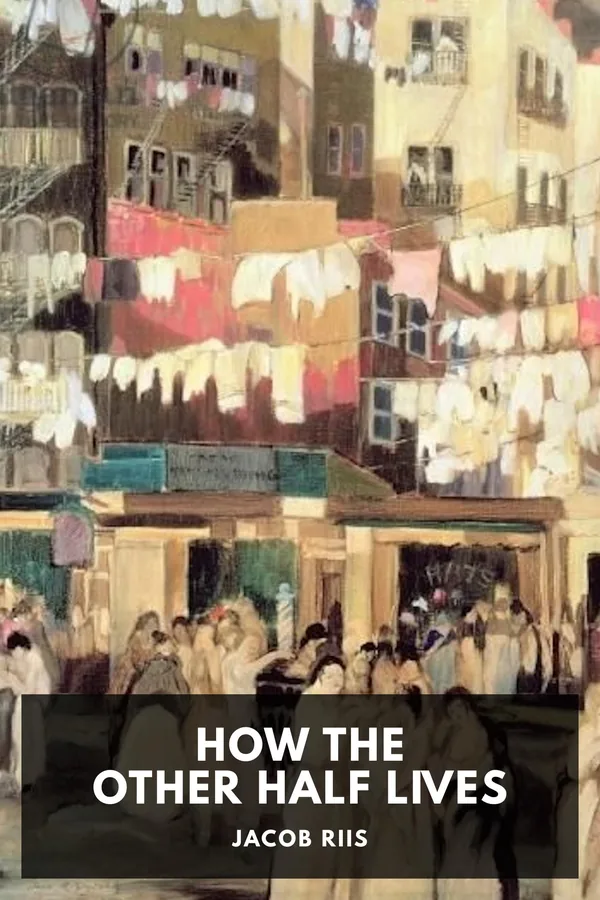
How the Other Half Lives
📖 Click to Read the Opening Pages Online Preview
The opening of Chapter 1
The first tenement New York knew bore the mark of Cain from its birth, though a generation passed before the writing was deciphered. It was the “rear house,” infamous ever after in our city’s history. There had been tenant-houses before, but they were not built for the purpose. Nothing would probably have shocked their original owners more than the idea of their harboring a promiscuous crowd; for they were the decorous homes of the old Knickerbockers, the proud aristocracy of Manhattan in the early days.
It was the stir and bustle of trade, together with the tremendous immigration that followed upon the war of 1812 that dislodged them. In thirty-five years the city of less than a hundred thousand came to harbor half a million souls, for whom homes had to be found. Within the memory of men not yet in their prime, Washington had moved from his house on Cherry Hill as too far out of town to be easily reached. Now the old residents followed his example; but they moved in a different direction and for a different reason. Their comfortable dwellings in the once fashionable streets along the East River front fell into the hands of real-estate agents and boardinghouse keepers; and here, says the report to the Legislature of 1857, when the evils engendered had excited just alarm, “in its beginning, the tenant-house became a real blessing to that class of industrious poor whose small earnings limited their expenses, and whose employment in workshops, stores, or about the warehouses and thoroughfares, render a near residence of much importance.” Not for long, however. As business increased, and the city grew with rapid strides, the necessities of the poor became the opportunity of their wealthier neighbors, and the stamp was set upon the old houses, suddenly become valuable, which the best thought and effort of a later age has vainly struggled to efface. Their “large rooms were partitioned into several smaller ones, without regard to light or ventilation, the rate of rent being lower in proportion to space or height from the street; and they soon became filled from cellar to garret with a class of tenantry living from hand to mouth, loose in morals, improvident in habits, degraded, and squalid as beggary itself.” It was thus the dark bedroom, prolific of untold depravities, came into the world. It was destined to survive the old houses. In their new role, says the old report, eloquent in its indignant denunciation of “evils more destructive than wars,” “they were not intended to last. Rents were fixed high enough to cover damage and abuse from this class, from whom nothing was expected, and the most was made of them while they lasted. Neatness, order, cleanliness, were never dreamed of in connection with the tenant-house system, as it spread its localities from year to year; while reckless slovenliness, discontent, privation, and ignorance were left to work out their invariable results, until the entire premises reached the level of tenant-house dilapidation, containing, but sheltering not, the miserable hordes that crowded beneath smouldering, water-rotted roofs or burrowed among the rats of clammy cellars.” Yet so illogical is human greed that, at a later day, when called to account, “the proprietors frequently urged the filthy habits of the tenants as an excuse for the condition of their property, utterly losing sight of the fact that it was the tolerance of those habits which was the real evil, and that for this they themselves were alone responsible.”
Still the pressure of the crowds did not abate, and in the old garden where the stolid Dutch burgher grew his tulips or early cabbages a rear house was built, generally of wood, two stories high at first. Presently it was carried up another story, and another. Where two families had lived ten moved in. The front house followed suit, if the brick walls were strong enough. The question was not always asked, judging from complaints made by a contemporary witness, that the old buildings were “often carried up to a great height without regard to the strength of the foundation walls.” It was rent the owner was after; nothing was said in the contract about either the safety or the comfort of the tenants. The garden gate no longer swung on its rusty hinges. The shell-paved walk had become an alley; what the rear house had left of the garden, a “court.” Plenty such are yet to be found in the Fourth Ward, with here and there one of the original rear tenements.
The excerpt below quotes the opening three paragraphs of Chapter 1, where Riis traces the first tenement to the “rear house” carried up story by story in a Cherry Hill garden, follows the old Knickerbocker homes as they were partitioned into smaller rooms at lower rents, and ends with the middleman and the 1857 committee’s report on families packed into unventilated rooms. The rear house is the book’s origin story, and the 1857 report is the first document it quotes.
Download Full EPUB1890
~82,000 words (estimated)
Approx. 4.5 hours
Standalone
New York’s Lower East Side tenements, 1880s–1890
Twenty-five chapters grouped into twelve movements
EPUB · AZW3 · KEPUB
22.88 MB (EPUB) · 12.20 MB (AZW3) · 22.90 MB (KEPUB)
Public domain in the United States
Project Gutenberg #45502 · Standard Ebooks
How the Other Half Lives is Jacob Riis’s report on the tenements of New York, published in 1890. Riis worked the police courts and the Fourth Ward as a reporter, and the book turns what he saw into a case: the housing built for the poor was manufacturing vice, disease and poverty faster than charity could repair them. He counts rooms, rents, wages and deaths, names the agents and landlords who profited, and walks the reader block by block through the Bend, Chinatown, Jewtown, the lodging-houses and the model tenements that were supposed to answer all of it. The chapters are reportage, not fiction, and the argument is cumulative.
The book is a document of the 1880s city: its people are crowds, trades and nationalities, and its evidence is the census, the Board of Health and the police returns. What keeps it readable is Riis’s eye for a scene — a keg of doctored beer on a broken chair, a room not thirteen feet either way holding twelve sleepers, a family paying five cents a spot. The writing carries the prejudices of its moment, ranking the nationalities it describes, and a reader should take those judgments as evidence too. As reportage it remains the fullest account of how New York housed its working poor before the tenement laws bit. The text is available via Wikipedia, Project Gutenberg and Standard Ebooks.

How the Other Half Lives by Jacob Riis: Summary, Characters & Themes
This page gives a summary and analysis of How the Other Half Lives, chapter by chapter, with the historical context needed to read it. Riis published the book in 1890, after years of reporting in the police courts and the Fourth Ward, and its most quoted sentence — that one half of the world does not know how the other half lives — describes a city that had stopped looking. He was not a visitor: he knew the station-houses, the agents and the health officers, and he quotes the mortality tables as readily as a tenant’s speech. The twenty-five chapters follow an itinerary through the old Fourth Ward and the Bend, Chinatown and Jewtown, the lodging-houses, the street children, the working girls and the pauper population, and they close with the model tenements and a plea for justice. Riis’s subject, stated at the outset, is a city that had become the tenement.
What Riis describes is a system, not a run of accidents. The first tenement, he writes, was the “rear house” built in a Cherry Hill garden and carried up story by story until it held ten families where two had lived; the middleman followed, taking blocks “at a percentage” and dividing their space into rooms “capable of containing human life within four walls”, and with him came Gotham Court, where cholera killed 195 of every thousand tenants in one visitation. By 1855 the city’s death-rate had risen from one in 41.83, forty years earlier, to one in 27.33. On the East Side the population stood at 290,000 to the square mile, against 175,816 in the worst of old London. A legislative committee had reported the same crowding in 1857, and it took a decade more, and a cholera scare, to produce the first tenement law. The mechanism repeats: a lot covered to the rear, a shaft for a staircase, four families to a floor, and rents a working family could meet only by taking lodgers, who paid five cents for a spot on the floor.
The middle chapters are a catalogue of trades and quarters: the Italian ragpickers of Jersey Street, the sweater’s shop in Ludlow Street where knee-pants are finished at forty-five cents a dozen, the Bohemian cigarmakers rolling cigars in the rooms where they sleep, the seven-cent bunks of Pell Street, the fan-tan rooms of Chinatown, the Talmud schools of the Tenth Ward. His method is cumulative. He gives the rent, the wage, the number of sleepers, the funerals in one house in one year, and lets the figures work. The Bend alone held 4,367 apartments with nine vacant, and its lodgers had to be counted at midnight. The chapter on the sweaters ends with a family’s accounts: seventy-five cents a cloak, seven dollars a week, and rent at nine and a half. The last third turns to the children, the street Arabs of Park Row, the saloons that outnumbered the churches below Fourteenth Street, the women who averaged sixty cents a day, and the paupers who ended in the Potter’s Field or on Blackwell’s Island.
In the last chapters the argument is stated plainly. Charity, Riis says, cannot house the poor; the work must pay. He describes Miss Ellen Collins’s six Water Street houses, where fair rents, plumbing and a janitor turned a haunt of thieves into the most orderly address in the neighborhood, the Improved Dwellings Association’s block in East Seventy-second Street with rooms for 218 families at six to fourteen dollars a month, and A. T. White’s Riverside Buildings in Brooklyn, three hundred homes under one roof around a park. These are his models, and he insists on the rule behind them: a workman has a right to a decent home, and housing him is a business, not a favour. The book ends at the sea, with the population “held in this galling bondage” rising like a tide against a city that has built no barrier but justice.
Riis is a reformer with the assumptions of his class and his decade. He arranges the nationalities of the tenements in an order of promise, gives the Irish and the Italians characteristics rather than conditions, and writes about Black and Chinese New Yorkers in a vocabulary no reader would now accept; those passages are part of the document, and the analysis here marks his judgments as his. The book also keeps its own account of the reform it belonged to, from the Tenement-House Act of 1867 to the model tenements of 1890, and it closes not with a programme but with an image: the sea rising, and one bridge founded upon justice. Jacob Riis’s life is recorded at Wikipedia, the text is at Project Gutenberg and Standard Ebooks, and the next stage of the same argument is in The Jungle, Up from Slavery and The House of Mirth.
Historical Context
The 1890 census was being counted as Riis wrote, and the appendix argues with it: the Health Department put the city’s population at 1,575,073 and its death-rate at 25.19 per thousand, while the census returns gave 1,482,273 and a rate of 26.76. Riis prefers the health officers’ figures and says so. The growth is the argument: 14,872 tenements holding 468,492 people in 1869, 32,390 holding 1,093,701 in 1888, and 37,316 holding more than 1,250,000 when he wrote. That quarrel is a fair introduction to the book’s world, in which the tenement was the subject of a twenty-year campaign of legislation, inspection and statistics: the Tenement-House Act of 1867, the cutting of more than forty-six thousand windows in 1869, the sanitary police and their midnight inspections, and the reports of the Tenement House Commission.
The reform Riis belonged to was divided about method. Charity was suspect because it pauperised; model tenement building was expected to prove that decent housing could return five percent; the law moved slowly and was fought in the courts, which struck down the attempt to prohibit cigarmaking in tenements. Riis’s own answer is the business answer — that it pays to house the poor well — and his evidence is the three experiments he describes in the last chapters. He expects the Mulberry Bend to go the way of the Five Points, and he expects the law to do it, with public opinion behind it. The book was written to hurry that argument along, and its statistics are selected for it.
It is also a book of its moment in other ways. Riis writes about Black New Yorkers, Chinese immigrants, Jews and Italians as types, and his chapter on the color line sets down the city’s racial order as he saw it. The evidence is a reporter’s inventory of rents, wages, cubic feet of air and deaths, gathered on foot, and one of its scenes was, he notes, photographed by flashlight on a midnight inspection. He counts 1,111,082 cases of illness in the city in 1889 and 79,358 people on the sick-list at any moment, and he keeps those figures in his own terms rather than converting them. Readers who want the same city in fiction can set it beside The House of Mirth, and readers who want the same argument carried into the packing-houses can go on to The Jungle.
Key Characters & Literary Archetypes
- The landlord and his agent: Riis’s antagonists are rarely named: they are the owners who let blocks decay, the agents who collect in advance, and the absentee proprietors whose instructions are to collect the rent or eject the tenants. They are the book’s real villains, and they are almost never seen.
- The tenant and the lodger: The family that takes boarders to pay the rent, the lodger who buys a spot on the floor for five cents, and the woman keeping a room going on a dollar and a half a day. The boarder is the difference between the wage and the rent.
- The tramp and the tough: The customers of the stale-beer dives, the sitters who pay for a chair all night in the saloons, and the young men the lodging-houses are said to turn out with the stamp of the institution on them. Riis treats the tramp as a product, not a mystery.
- The street Arab: The newsboy, the bootblack and the waif who says he did not live anywhere, the child Riis treats as the city’s most salvageable material and the one the tenements spoil soonest.
- The sweater and the cigarmaker: The middleman with two sewing-machines and a little English, the woman finishing knee-pants at a dollar and a half, the ironer at three dollars a week, and the Bohemian family rolling cigars in the room where it sleeps.
- The reformer and the model landlord: Miss Collins, the Improved Dwellings Association, A. T. White and the builders of “philanthropy and five percent”, who treat housing as an investment that must pay its way and who keep the rules themselves.
Core Literary Themes
- The rent that eats the wage: Riis keeps returning to the arithmetic of rent: a family’s earnings, the lodgers who make up the difference, and the landlord’s margin, which he argues would survive better under repair than under neglect.
- Disease as evidence: Cholera, smallpox, typhus and the child mortality of the Bend are not background but proof; the death-rate is the book’s most trusted witness and its most quoted figure, and the appendix returns to it.
- Respectability and its limits: The tenement makes cleanliness, privacy and self-respect hard to keep, and Riis argues that a decent room is the precondition of a decent life rather than its reward or its proof.
- The city as a system of blocks: The book moves block by block, treating streets and wards as units of cause and effect, so that one bad house is said to level a whole neighborhood and one good one to raise it.
- Reform as business: The last chapters turn from exposure to investment: model tenements must return five or six percent, and charity that does not pay is said to pauperise the people it means to help.
Why Download Our Custom E-Reader Edition of How the Other Half Lives?
This edition is set from the Standard Ebooks text, which follows the 1890 New York printing and keeps Riis’s chapter divisions and his appendix of statistics. The page adds a chapter-by-chapter summary and the context the book assumes: the tenement laws, the health department’s figures and the model-tenement experiments. If you want to check a passage, the Project Gutenberg transcription is a reliable parallel text.
The book is long and its statistics are of their year, so the chapter groups below are arranged as a route through the argument rather than as a list of titles. Readers who want the housing question can follow chapters 1 to 14; readers who want the children and the street can start at chapter 15; the last two chapters state the case for model tenements. The route is Riis’s own: he wrote the chapters as a sequence of visits, and the summaries keep that order.
Nothing here replaces the book. Riis’s own scenes — a keg on a broken chair, twelve sleepers in a room not thirteen feet either way, a girl sewing in an Elizabeth Street attic — are the reason it is still read, and they are best met in his words, in the order he set them down. The files are made for a reader’s device rather than for a library shelf.
- Based on the Standard Ebooks Edition, via Standard Ebooks, whose text is prepared from the Project Gutenberg transcription and checked against scans of the 1890 New York edition; chapter numbers and the byline follow that edition.
- Chapter summaries, not a substitute Every chapter of the twenty-five is summarized in order, with the rents, wages and mortality figures Riis uses kept in the summary.
- The appendix, not just the prose Riis’s statistical appendix and his quarrel with the 1890 census are treated as part of the book, because the argument depends on them.
- Free files for every reader The EPUB, AZW3 and KEPUB downloads on this page carry the same text and the same chapter divisions, with no registration.
- Upton Sinclair’s 1906 novel carries Riis’s housing argument into the Chicago packing-houses, where the tenement and the wage meet again. — free EPUB, AZW3 & KEPUB
- Booker T. Washington’s 1901 memoir of work and schooling answers, from another city, the question Riis keeps asking about the children of the poor. — free EPUB, AZW3 & KEPUB
- Edith Wharton’s 1905 novel of New York society is the other half of Riis’s city, two streets and one income away. — free EPUB, AZW3 & KEPUB
Chapter summaries
How the Other Half Lives has twenty-five chapters, each on a quarter, a trade or a problem, and Riis moves through them as a reporter walks a beat: the first tenement and the first laws, the Bend and the Italian quarter, the sweaters and the lodging-houses, then the children, the saloons and the model tenements that are his answer. The twelve groups below follow that order and keep his titles. Grouping them is a convenience; Riis’s own divisions are the chapters themselves.
- Chapters 1–2 — Genesis of the Tenement; The Awakening: Riis begins with the “rear house”, the first tenement, carried up in a Cherry Hill garden until ten families lived where two had, and with the middleman who divided blocks into smaller rooms and made the tenement pay. Gotham Court follows with its cholera and its double alley, and then the Tenement-House Act of 1867 and the health board that cut more than forty-six thousand windows in 1869. The point is that reform came late and by fits: the Five Points were cleansed and the Mulberry Bend grew up a stone’s throw away, and the newer tenements were often planned as badly as the old. He notes, too, that the East Side held the most densely packed population in the world, China not excluded.
- Chapters 3–4 — The Mixed Crowd; The Downtown Back-Alleys: The Fourth Ward is a mixture of Irish, Italians and a few Germans, and Riis reads the city’s nationalities off its blocks. Below Chatham Square the back alleys begin: Cherry Hill, Blind Man’s Alley with its blind landlord, and the old Baptist Church on Mulberry Street, whose forty families died at the rate of 75 in 1,000. He describes the alley called the Dirty Spoon, the sewers the Swamp Angels used as a runway, and the tenants of Gotham Court, where a cholera season killed nearly one in five. The blind landlord, worth four hundred thousand dollars, would not pull his alley down; the blind who boarded there drew their relief on the premises.
- Chapters 5–6 — The Italian in New York; The Bend: The Italian arrives under the padrone and the steamship agent, pays a percentage of his wages for the privilege of work, and lives by rag-picking and the ash-barrel. Then the Bend, which Riis calls the foul core of New York’s slums: 4,367 apartments with only nine vacant, a room not thirteen feet either way sleeping twelve men and women, and 155 deaths of children in the block in 1882, when children were 68.28 percent of its mortality against 46.20 percent for the city. In No. 59½, next to Bandits’ Roost, fourteen people died in one year and eleven of them were children.
- Chapters 7–8 — A Raid on the Stale-Beer Dives; The Cheap Lodging-Houses: A midnight raid with the Elizabeth Street squad: a cellar, a keg on a broken chair, thirteen arrests and a woman with a newborn on straw. The dive is the tramp’s club, and Riis follows him to the lodging-houses of Chatham Street and the Bowery, where a bed costs seven, ten, fifteen or twenty-five cents. He counts 4,974,025 lodgers in a year, calls the ten-cent house a nursery of crime, and quotes a police inspector who says that in nine cases out of ten the boy who enters comes out a thief. More than nine thousand homeless young men lodged nightly between the City Hall and Cooper Union, and a fifth of the city’s pawnshops stood in the district.
- Chapters 9–10 — Chinatown; Jewtown: Chinatown is quieter than its reputation: laundries, fan-tan rooms, opium, and a population of men without wives. Jewtown, across the Bowery, is the most crowded ground in the city at 330,000 to the square mile, with a seven-story house holding thirty-six families and a sewing-machine in every room. Riis describes the Pig-market in Hester Street, the Talmud schools, the lawsuits that grow out of business rivalries, and the thrift he treats as both virtue and curse. The Jewish holidays emptied the public schools of the Tenth Ward, and the children could count before they could talk.
- Chapters 11–12 — The Sweaters of Jewtown; The Bohemians: The sweater is the middleman with two or three machines and a little English, and the law that limits factory hours does not reach his shop. Knee-pants are made at forty-five and seventy cents a dozen, and one family working from daybreak to nine at night cleared twenty-five dollars in a good week. A cloak-maker with a wife and two children earned seven dollars a week against nine dollars and a half rent. In the Bohemian quarter the landlord is also the employer: he rents the tenement, sells the tobacco and sets the wage, and the Court of Appeals has struck down the law against cigarmaking in tenements.
- Chapters 13–14 — The Color Line in New York; The Common Herd: Riis turns to Black New Yorkers, pushed out of the old Africa west of Broadway and into uptown blocks, and describes the color line as a fact of the labor market as much as of the street. The Common Herd is the general tenement population: the flat with its locked door and dead bell, the summer roof, the child’s funeral, and the wages that a family of six must divide. Its evidence is domestic: the doorbell as extinct as the dodo below Houston Street, the hall that is a highway for all the world by night and by day, and the flat where a family eats, sleeps and takes a boarder in two rooms. The chapter ends with evictions and the Potter’s Field.
- Chapters 15–17 — The Problem of the Children; Waifs of the City’s Slums; The Street Arab: Children’s Aid Society figures open the section: three hundred thousand sheltered in thirty-seven years and seventy thousand sent to homes in the West. The Foundling Asylum took in twenty-five thousand infants in twenty years, and of 508 babies in one year 333 died. The Society for the Prevention of Cruelty to Children had been called in for 138,891 children in fifteen years. Riis then follows the street Arab to the Newsboys’ Lodging House on Park Row, where six cents buys bed and breakfast, and to the industrial schools that were trying to catch the children the tenements turned out.
- Chapters 18–19 — The Reign of Rum; The Harvest of Tares: Below Fourteenth Street Riis counts 4,065 saloons against 111 churches, and 13,220 of the city’s 32,390 tenements. The saloon is the tenement’s parlour, the growler its errand and the dive its nursery; the chapter follows the boy who runs for beer to the gang that keeps the corner. The Harvest of Tares is the crop: the Whyos and the river thieves, the boy “pinched” at nine, and the police returns that made the tough a familiar figure in the courts. The Eleventh Ward, with 485 saloons in 1889, supplied a third of the homeless lodgers and fourteen percent of the prisoners.
- Chapters 20–21 — The Working Girls of New York; Pauperism in the Tenements: One hundred and fifty thousand women and girls earn their own living, and a saleswoman’s two dollars a week is eaten by fines, including fines for sitting down. Riis follows the shirtmakers and the finishers, gives the sixty cents a day that is the chapter’s refrain, and then turns to the pauper barracks and the almshouse, where the old are “sent to the almshouse to die by their heartless children”, as he puts it. One shirtmaker worked eleven hours in the shop and four at home, and had never made more than six dollars a week.
- Chapters 22–23 — The Wrecks and the Waste; The Man with the Knife: The wrecks are the island’s population: 4,913 insane patients at the end of 1889, 38,600 admissions to the almshouse, and 138,332 through the city’s jails and institutions in the year. Their cost is set against the police and court budgets. Bellevue’s alcoholic cells held 3,694 prisoners, more than a fourth of the hospital’s 13,813 patients that year. Then, at Fifth Avenue and Fourteenth Street, a hungry man with a knife: Riis reads him as the warning that reform must come as justice rather than as violence.
- Chapters 24–25 — What Has Been Done; How the Case Stands: The last two chapters are the argument. The law has done what it could, the rear tenements are coming down, and business has cleared more plague-spots than sanitary science. Miss Collins’s Water Street houses show that fair rents and a janitor can pay; the Improved Dwellings Association’s 218 families had all outside rooms, coal lifts and free baths, and its dividends were limited to five percent. Riis closes with the facts of the case and the sea rising against a city that has built no barrier but justice, and with A. T. White’s three hundred homes under a single roof.
How the Other Half Lives: Frequently Asked Questions
What is How the Other Half Lives about?
Is it fiction or reportage?
How is the book organised?
Which chapters are most quoted?
Does the book describe photographs?
Why does Riis talk so much about rent?
How does the book treat the nationalities it describes?
Where can I read the full text?
Part of: Classic Fiction · 1900s