The Egyptian Book of the Dead by P. Le Page Renouf: Free EPUB, AZW3 & KEPUB Download
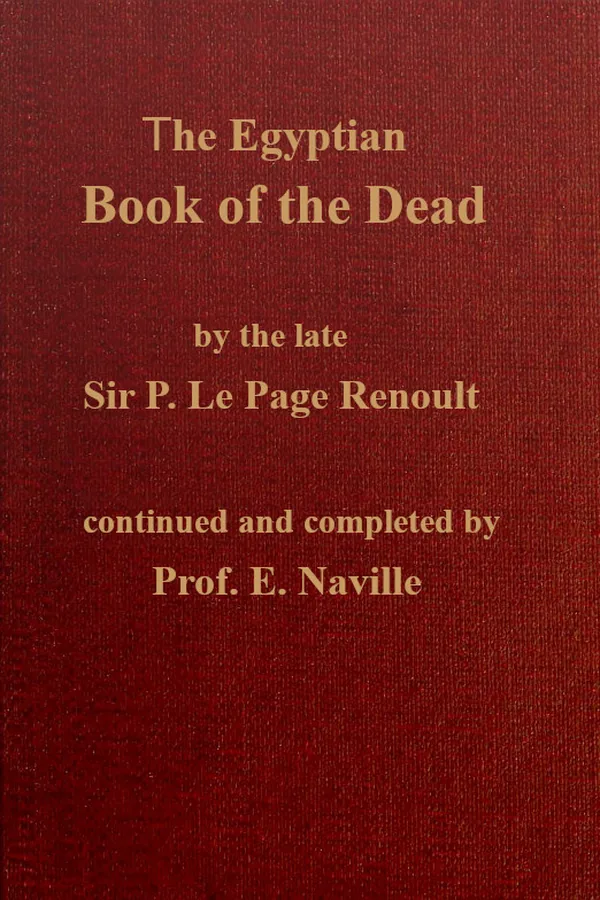
The Egyptian Book of the Dead
📖 Click to Read the Opening Pages Online Preview
The 1904 introduction: how the book came down to us
When, in the year 1892, Sir Peter Le Page Renouf began the publication of his translation of the Book of the Dead, his intention was that the work, once completed, should be preceded by an elaborate Introduction, giving, besides all the information concerning the form and the history of the book, his views as to its sense and its religious value.
As with the unfinished part of the translation,[1] so here, we are left without any notes or any clue whatever as to the form which this introduction was to have taken, and we are obliged to resort to the fifth of the Hibbert lectures, given by Renouf in 1879, in order to know his views about the book.[2]
The excerpt is the first two paragraphs of Edouard Naville’s introduction to the volume, set at the head of the translation Renouf did not live to finish. It opens with Renouf beginning publication of his translation in 1892, with an elaborate introduction planned to explain the form and history of the book and to set out his views on its sense and its religious value. The second paragraph records what happened instead: no notes were left, no plan for the introduction survives, and the editor has to fall back on the fifth of the Hibbert lectures, given in 1879, for Renouf’s views on the book. The excerpt breaks off at the footnote that points to that lecture, and the introduction then turns to the book itself.
Download Full EPUBc. 1550 BCE
Sacred text
~128,000 words (estimated)
Approx. 7.1 hours
Standalone
Egypt, chiefly Thebes and Heliopolis, in the New Kingdom, with the older coffins the spells were copied from and the later copies of the Saite kings, and the other world the spells describe: the Hall of Righteousness, the Fields of Aarru and the pylons of the Tuat.
Twelve groups, from the judgement to the last chapters
EPUB · AZW3 · KEPUB
10.07 MB (EPUB) · 10.41 MB (AZW3) · 10.20 MB (KEPUB)
Public domain in the United States
Project Gutenberg #69566
The Egyptian Book of the Dead is not a book but a collection of spells, hymns and litanies that were copied for the dead of ancient Egypt over more than two thousand years. Each papyrus is a selection, made by a family according to taste and to the price they were willing to pay, and the chapters were numbered only in the nineteenth century, after the great Turin manuscript. What the spells promise is not a reward for a good life but a way out of the tomb, a body kept whole, and a place among the gods. This page follows the complete translation begun by Peter Le Page Renouf in 1892 and finished, after his death, by Edouard Naville.
The collection has no single author and no fixed order. Its oldest chapters were already ancient when they were written on coffins of the Middle Empire, and the revision made under the Saite kings added the last spells, 162 to 165, together with a thick layer of glosses. The judgement scene of chapter 125, with its forty-two assessors and its balance, is one chapter among a hundred and eighty-six. The article on the Book of the Dead covers the wider history of the papyri and the museums they are now scattered through. The text is available via Project Gutenberg #69566.
The Egyptian Book of the Dead by P. Le Page Renouf: Summary, Ideas & Arguments
This page is a summary and analysis of The Egyptian Book of the Dead, the translation and commentary begun by Sir Peter Le Page Renouf and completed after his death by Edouard Naville, published by the Society of Biblical Archaeology in 1904. The title is neither Egyptian nor ancient: Lepsius gave the Turin papyrus the name Todtenbuch in 1842, against Champollion’s Ritual, and the Egyptian heading is better rendered coming forth by day, the phrase Renouf uses throughout. E. A. Wallis Budge’s translation of the Papyrus of Ani, published in 1895, is the earlier and better known version; the notes cite it where the readings differ, and the text printed is the Renouf and Naville volume. The article on Peter Le Page Renouf follows the career of the scholar who began the work. The whole text is held at Project Gutenberg #69566, and the volume takes its place with the other free philosophy classics on this site.
The volume opens by describing what kind of object the book is. It is, in Naville’s phrase, no book at all in the ordinary sense: neither a unity nor a whole, but a collection which grew by degrees at various epochs. Part of it goes back to the Old Empire, the texts of the Middle Empire already show different editions, and some rubrics attribute chapters to a king of the first dynasty. The parts were independent, like the Hebrew Psalms; accepting one chapter did not commit a copyist to the next. Families chose what they wanted from the collection in front of them, and the number of chapters in a papyrus is a rough index of what they were prepared to pay. That is why no two copies agree, and why a manuscript such as the papyrus of Ani has a shape of its own.
The numbering that every edition uses is a nineteenth-century arrangement. Lepsius, publishing the Turin papyrus in 1842, called it the largest piece of Egyptian literature that had been preserved, traced the whole document, and gave each fragment a number following its order in that manuscript. He named the result the Todtenbuch, the Book of the Dead, against Champollion’s Ritual, a name Naville thinks certainly wrong, since no priest speaks in the text and no ceremony is prescribed: the words are put into the mouth of the dead man himself. The numbering is not quite correct, and Naville says as much, but it has been followed ever since. Lepsius counted a hundred and sixty-five chapters; this edition prints on to a hundred and eighty-six, and the chapters after 165 are marked as collected from other papyri. A run of plates at the end reproduces the vignettes, each captioned with the manuscript it was taken from.
The translation is uneven in ways the editors admit. Renouf, lecturing in 1879, described a text that is extremely corrupt: funerary manuscripts were not made to be read by anyone, so a careless scribe had no check on him, and signs that resemble each other in hieratic were confused. Readings were also carried by word of mouth before they were written down, and some chapters were as obscure to Egyptians of the eleventh dynasty as they are to a modern reader. Naville answers that part of the difficulty had been removed by a critical edition of the texts of the XVIIIth and XIXth dynasties, his own of 1886, and that Renouf generally translated from it. He still expects the reader to stumble, and he defends passages that look childish by arguing that they were not so to the people who wrote them, taking the phrase in chapter 112 about a man eating his heart to mean remorse rather than the wrath that Renouf’s version gives.
What the spells are for is set out in Renouf’s account of the beatification of the dead, which Naville summarises in four points. The dead man lives again as upon earth, with the use of his limbs, eating and drinking, in a future whose pleasures are mainly agricultural. He can take any shape he likes, and is not forced through a fixed series of them. He is identified with Osiris, so that his name is written with Osiris before it, and in chapter 42 each limb of his body is assigned to a different god. His body is kept from dismemberment and decay, which Naville calls the origin of mummification. None of this is a reward for virtue; it is a set of techniques for getting through. The two books linked below, Virgil’s Aeneid, which takes a living man down among the dead, and Plato’s Republic, which ends with a judgement of souls, are the nearest company for that journey.
Historical Context
The papyri that carry these spells belong mostly to the New Kingdom. The great copies, the papyrus of Ani among them, were made at Thebes in the XVIIIth dynasty, in the centuries around 1550 BCE, when the formulae were written in hieroglyphic or hieratic on rolls buried with the dead; older chapters survive on coffins of the Middle Empire, which is how some of the oldest material in the collection is known at all. The Saite kings of the XXVIth dynasty had the text revised and put in a definite order, adding chapters 162 to 165, which are never found in the older copies. Copies were still being made under the Ptolemies and in Roman times, though the later the manuscript the more often the text had passed through hands that no longer followed it, which is Naville’s complaint about the Saite revision itself. The papyri are now scattered through the museums of Europe, and the plates of this edition name the collection each vignette comes from.
Modern knowledge of the book begins with the decipherment. Champollion saw the Turin papyrus and used sentences from it in his grammar without making a study of the document; Lepsius, who understood at once what it was, published it in 1842 and gave the collection its modern name. Naville’s collation of the XVIIIth and XIXth dynasty papyri followed in 1886. Renouf had been lecturing on the book since 1879, and in 1892 he began to publish his translation in parts, with an introduction planned for the end of the work. He died before either was finished. Naville, who had been asked to continue and had only scanty notes to go on, translated the chapters from 140 onwards himself, wrote the introduction, and signed it in January 1904; he says plainly that the result cannot be called entirely his own work and that any translation of the book is tentative.
The religion behind the spells is the religion of Heliopolis. Naville holds that the bulk of the book came from the city of Ra Tmu and its priests, with some chapters owing to the priests of Abydos, and that it is the doctrine of that city rather than a popular literature. Its centre is Osiris, whose death and restoration give the dead man the pattern he follows, and its machinery is a geography of the other world, with halls, gates, pylons and domains, each with its guardians and its names. The judgement is not a final sentence on a life but a passage through an examination, and what is weighed in the balance is the man against the law he claims to have kept. What the Egyptians wanted was continuity: a body that stayed whole, a name that was spoken, and a way out into the day.
Key Ideas & Arguments
- No book, but a collection: The first thing to grasp is that there is no authoritative text to summarise. The spells accumulated over centuries, were revised under the Saite kings, and were copied in selections that vary from papyrus to papyrus. Naville compares the parts to the Hebrew Psalms, each independent of the next, and the choice of what to include was made by the family of the dead man, within the limits of what they could spend.
- Coming forth by day: The Egyptian heading of the collection is rendered coming forth by day, and the phrase is the programme of the whole book. The dead man wants to leave the tomb in the morning, to go out and come back, to see the sun and to walk in the world he has left. Because the words are his, spoken in the first person, the collection is not a liturgy performed for him by a priest but a script he takes with him.
- The judgement in the Hall of Righteousness: Chapter 125 is the best known text in the book, and it is built in three parts. The dead man arrives in the hall, addresses the god who presides, and declares that he knows the names of the forty-two who appear there. He then denies wrongdoing in a long series of statements and, in the third part, lists what he has done for other people. The vignette that goes with it shows the hall, the throne and the balance.
- The fields of Aarru: The future the spells describe is not abstract. Chapter 110 puts the dead man in the garden of Hotepit, among canals and barley, where he ploughs, reaps, eats and drinks; chapter 149 lists the domains of the Amenta one by one. The vignettes of chapter 149 are plans of those domains, painted green or light yellow, so that the dead man could find his way around a landscape that was drawn for him before he arrived.
- Knowing the names: A large part of the book’s power lies in names. The dead man must know the name of each of the forty-two assessors, the name of every doorkeeper at every pylon, and the names of the gods he meets; chapter 165 is a list of names of Amon that Naville takes to be Nubian words. To know a name is to have a hold on what bears it, and the spells supply the vocabulary that the journey requires.
- The body kept whole: The last chapters are amulets as much as texts. Chapter 151 is a picture of the funeral chamber rather than a speech, and the chapters that follow describe objects placed on the mummy: the tat of gold in sycamore wood, the carnelian buckle called the blood of Isis, the column of green felspar that cannot be crushed. Underlying them is the fear Naville names as the origin of mummification, that a body divided or decayed cannot live.
Core Arguments & Influence
- A scripture without a canon: The book has no fixed contents, no author and no council behind it, and yet it was copied with remarkable consistency for two thousand years. The Saite revision produced something like an authorised version, made, as Naville sharply observes, by men to whom the book was hardly intelligible, and their glosses were then copied into every later text. The result is a scripture that behaves like a library: authority resides in the single spell, not in the whole, and a copy is judged by what it contains rather than by its fidelity to an original.
- The dead man speaks: Everything in the collection is written in the first person. The dead man is the speaker, and the gods are addressed by him; the priests who compiled and copied the papyri disappear behind his voice. Naville makes this the ground for refusing the name Ritual, and it is also what makes the book readable at a distance: it is a set of claims made by someone who has just died, about what he is and what he has done, and the confidence of the claims is part of their function.
- Justice as a procedure: Chapter 125 has often been read as an Egyptian Last Judgement, but the text is closer to a checklist than to a trial. The forty-two denials are specific and practical: not pressing on the beam of the balance, not taking milk from an infant’s mouth, not stopping the water at its appointed time. The second part then names each judge and the town where he appears, so that the confession doubles as a map of Egypt. What is being tested is knowledge and correctness of speech as much as conduct.
- The body as the argument: The spells assume that a person survives only if the body survives, and much of the book’s apparatus follows from that assumption. The amulets of chapters 155 to 161 are not decorations but instruments, each with a rubric saying where it is placed and what it prevents; the shabti figures answer here am I when the dead man is called to work. Where a modern reader expects consolation, the text offers engineering, and the engineering is directed at keeping a person intact.
- A translation that knows it is provisional: Renouf and Naville are unusually candid about the limits of their work. Renouf calls parts of the text outrageous nonsense and then explains why a scribe would have thought otherwise; Naville prints the sentence that he cannot make sense of and says that only the key to the metaphor is missing. The volume is therefore also a document in the history of Egyptology, showing how a text is edited, conjectured and left open, and why a translation of a funerary corpus can never be treated as final.
Why Download Our Custom E-Reader Edition of The Egyptian Book of the Dead?
The whole volume is here rather than a digest of the famous chapters: Naville’s introduction of 1904, the translation from chapter 1 to chapter 186, the notes that name the papyri collated, and the captions that say which manuscript each vignette was taken from. Nothing has been rewritten for a modern audience, and the chapter numbers are the ones the nineteenth century gave them, so that a reference to chapter 125 means the same thing here as it does in the scholarship.
The page is arranged so that the collection can be read as it actually is. The twelve groups below follow subjects rather than the printed order, because the printed order is an editorial sequence and not a narrative; each group says which chapters it takes and what they do. The summaries are short enough to read before the text and detailed enough to place a passage once you are inside it.
The files are EPUB, AZW3 and KEPUB, with no account, no lock and no expiry. The text is long and repetitive, which is what a collection of spells is; a reader who wants the judgement scene can go to chapter 125, and one who wants the amulets can go to 155 to 161, without reading the spells in between.
- Project Gutenberg transcription, via Project Gutenberg #69566 — the complete Renouf and Naville volume, introduction, chapter notes and plate captions included, with no abridgement and no modernised spelling.
- Naville’s introduction in full The 1904 preface on the form and history of the book, the state of the text, the work of Lepsius and the account of what the spells were believed to do for the dead.
- Every chapter with its notes The notes name the papyri that were collated, explain the vignettes, and record where Renouf’s draft stopped and Naville continued it.
- EPUB, AZW3 and KEPUB Three formats from one text, sized for a phone or a tablet, with the chapter headings kept as headings and the plates described in place.
- Plato’s Republic ends with the myth of Er, a soldier who returns from the dead and describes the judgement of souls and the choice of lives. Set beside chapter 125 it shows how differently two ancient cultures imagined an accounting after death: one as a philosophical argument, the other as a set of words a man had to know. — free EPUB, AZW3 & KEPUB
- Dante’s Comedy is the medieval journey through the other world, guided first by Virgil, and it inherits the Egyptian material at several removes through the classical underworld. Read after the Book of the Dead it makes the Egyptian geography look unexpectedly practical: halls, gates and guardians, each with a name to be answered. — free EPUB, AZW3 & KEPUB
- A collection of the classical myths in which the dead are judged, ferried and transformed. It is the nearest thing on this site to a comparative volume, and the places where the Greek stories diverge from the Egyptian spells are as instructive as the resemblances. — free EPUB, AZW3 & KEPUB
Chapter summaries
The chapters below are spells, not a story, and they are grouped by subject rather than printed in order, because the order is Lepsius’s numbering after the Turin papyrus and not a sequence that anyone read from beginning to end. Twelve groups take the collection from its general title and the unity of the god, through the judgement, the fields of Aarru, the pylons and the amulets, to the last chapters, 166 to 186, which were collected from papyri outside the Turin manuscript.
- Chapter 1 — The chapter of coming forth by day: The general title of the collection, and the spell that opens it: the dead man identifies Osiris as the bull of the Amenta and asks to come forth. The rubric promises that whoever learns the chapter on earth or has it written on his coffin will go out daily and receive bread, beer and flesh on the table of Ra, with a share of the wheat and barley of Aarru.
- Chapter 17 — The One who closeth and openeth: The most interesting chapter in the book for the history of religion: I am he who closeth and he who openeth, and I am but One. Naville dates its material before the XIIth dynasty, and the text survives with a commentary of glosses that explain the speakers line by line. In the papyrus of Ani the chapter is left unfinished, which shows how a copy was assembled.
- Chapter 30 — The heart that must not be taken away: The heart chapters, from 26 to 30B, are among the oldest and the most personal. The dead man addresses his own heart as the heart of his mother and asks that it not be taken from him, not be made to testify against him, and not be parted from his body. Chapter 30B, the amulet version, gives the words to be said over the heart-shaped object placed on the mummy.
- Chapter 42 — Every limb a different god: Here the body is taken apart and reassembled as a pantheon: each limb is assigned to a deity, and the dead man becomes a composite of the gods rather than a single person. The chapter is the clearest statement of the identification with Osiris that runs through the collection, and it is the passage Naville cites when he explains what identification meant.
- Chapter 64 — Yesterday, to-day and to-morrow: The transformation chapters run from 76 to 88, and chapter 64 gives them their formula: I am Yesterday, To-day and To-morrow, a statement about a self that survives the change of days. Chapter 85 adds I am a Soul, I am Ra; chapter 92 opens the tomb to the soul and to the shade, so that the dead man can leave and return without losing either part of himself.
- Chapter 110 — The garden and fields of Aarru: The first full picture of the Egyptian heaven. The dead man takes possession of the garden of Hotepit and arrives at the garden of Aarru, where he ploughs and mows, eats and drinks and loves, and takes his share of the breezes; chapters 108 and 109 lead him there by the hill of Bachau and the eastern gate of heaven. The bliss described is agricultural, and the text is not embarrassed by that.
- Chapter 125 — The judgement in the Hall of Righteousness: The scene everyone knows: the dead man before the lord of Righteousness, the forty-two assessors, the negative confession and then the positive account of what he has done. The vignette that accompanies the chapter, in the papyrus of Ani among others, shows the hall with the throne of Osiris on water, the four children of Horus on a lotus, and the devourer waiting beside the balance.
- Chapter 144 — The pylons and their doorkeepers: Seven gates, each with an occupant, a warden and a herald to be named, and then the twenty-one pylons of chapters 145 and 146, which are two versions of one text. Chapter 147 takes the gates again, and the papyrus of Ani is more complete for it than the Leyden text. The gates are not obstacles but checkpoints, and the names are the passwords.
- Chapter 148 — The seven cows and the four rudders: The celestial cows whose names the dead man must know, with their bull, since they give bread and drink to the glorified soul; with them go the four rudders that steer the sky. Chapter 149 lists the domains of the Amenta one by one, and in the second, the garden of Aarru, the walls are of steel and the wheat stands seven cubits high, its ears two cubits and its stalks five. Chapter 150 is not a text but the plans that go with 149.
- Chapter 151 — The funeral chamber and the amulets: A chapter that is not so much a text as a picture. It describes the four walls of the burial chamber, with their niches, the canopic jars, the figures of Anubis, Isis and Nephthys, and the shabti who answer here am I when called. From 155 to 161 come the objects themselves: the tat of gold in sycamore, the carnelian buckle, the vulture of gold, the column of green felspar, and the spell for unfastening the four winds.
- Chapter 163 — The last spells of the Turin book: Chapters 163 to 165 are marked as brought from another book and added to the coming forth by day, and the editors say plainly that the original collection ended earlier, in old times with 149 and later with 162. Chapter 164 is an amulet against dismemberment, said over a figure of Sekhet or Bast; chapter 165 is a list of the names of Amon, and Naville takes some of them to be Nubian words rather than Egyptian.
- Chapter 166 — The chapters outside the Todtenbuch: With chapter 166 the Turin manuscript is left behind and the remaining chapters are gathered from other papyri, which is why the volume runs to 186. They include the head-rest spell, the eye wounded by Ra and healed by Thoth, and chapter 175, on not dying a second death, which Renouf had translated from the papyrus of Ani. The book ends with hymns to Ra and Osiris and a last chapter that papyri often close with a picture of Hathor of the West.
The Egyptian Book of the Dead: Frequently Asked Questions
What is the Egyptian Book of the Dead?
Who translated the text on this page?
Why are the chapters numbered the way they are?
What happens in the judgement scene?
What is the negative confession?
What are the Fields of Aarru?
Is this a ritual?
How do I read the free downloads?
Part of: Philosophy Classics · P. Le Page Renouf