The Anabasis of Alexander by Arrian: Free EPUB, AZW3 & KEPUB Download
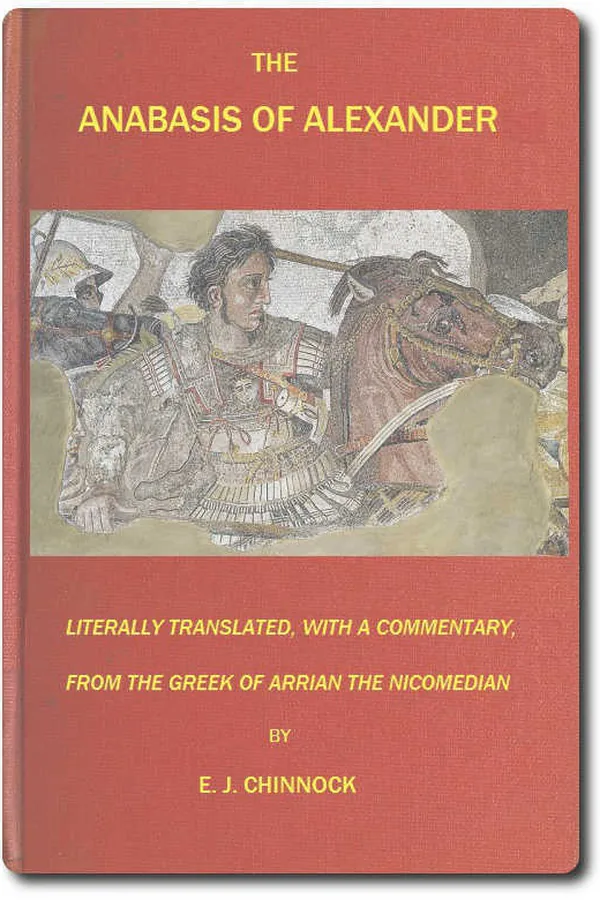
The Anabasis of Alexander
📖 Click to Read the Opening Pages Online Preview
Book I, the Granicus: the king’s spear breaks
Then indeed, Alexander’s spear being broken to shivers in the conflict, he asked Aretis, one of the royal guards, whose duty it was to assist the king to mount his horse, for another spear. But this man’s spear had also been shivered whilst he was in the thickest of the struggle, and he was conspicuous fighting with the half of his broken spear. Showing this to Alexander, he bade him ask some one else for one. Then Demaratus, a man of Corinth, one of his personal Companions, gave him his own spear; which he had no sooner taken than seeing Mithridates, the son-in-law of Darius, riding far in front of the others, and leading with him a body of cavalry arranged like a wedge, he rode on in front of the others, and hitting at the face of Mithridates with his spear, struck him to the ground. But hereupon, Rhoesaces rode up to Alexander and hit him on the head with his scimitar, breaking off a piece of his helmet. But the helmet broke the force of the blow. This man also Alexander struck to the ground, hitting him in the chest through the breastplate with his lance. And now Spithridates from behind had already raised aloft his scimitar against the king, when Clitus, son of Dropidas, anticipated his blow, and hitting him on the arm, cut it off, scimitar and all.132 Meantime the horsemen, as many as were able, kept on securing a landing all down the river, and were joining Alexander’s forces.
The excerpt is a single paragraph from the middle of Book I, in the cavalry fight at the river Granicus. Alexander’s spear has shivered in the melee, and Aretis cannot bring him another before Demaratus of Corinth gives up his own. The king strikes Mithridates, son-in-law of Darius, in the face and fells him; Rhoesaces brings a scimitar down on his helmet; and as Spithridates raises his arm behind the king, Clitus son of Dropidas cuts it off, scimitar and all. The passage ends with the Macedonian horse still securing a landing along the river.
Download Full EPUBc. 2nd century AD
History
148,221 words
8.2 h
Standalone
Macedonia, Thrace, Asia Minor, Phoenicia, Egypt, Mesopotamia, Persia, Bactria, Sogdiana and the Punjab, from the crossing of the Hellespont to the return to Babylon, 334-323 BC.
Seven books, in twelve groups
EPUB · AZW3 · KEPUB
0.47 MB (EPUB) · 0.90 MB (AZW3) · 0.57 MB (KEPUB)
Public domain in the United States
Project Gutenberg #46976
Alexander inherits his father’s plan for Asia and spends the next twelve years carrying it further than anyone had expected. Arrian follows him from the Danube and the destruction of Thebes to the Granicus, Issus, Tyre and Arbela, then through Persia, Bactria and Sogdiana to the Punjab, where the army refuses to cross the Hyphasis. He comes back by the Indus and the Gedrosian desert and dies at Babylon. Arrian writes four centuries later, chiefly from Ptolemy and Aristobulus, and says plainly where his two witnesses disagree.
The history is in seven books, each divided into numbered chapters with a running heading, and this page keeps Arrian’s divisions. The English is E. J. Chinnock’s, published in 1884, and the text follows the Project Gutenberg transcription. The campaign, the persons and the places are set out in the Wikipedia article on the Anabasis of Alexander. The text is available via Project Gutenberg #46976.
The Anabasis of Alexander by Arrian: Summary, Ideas & Arguments
This page is a summary and analysis of The Anabasis of Alexander, the history in seven books that Arrian wrote in the second century AD about the reign of Alexander the Great. It opens with the death of Philip and the settlement of Greece, follows the expedition across the Hellespont, and closes with the king’s death at Babylon and a considered character sketch. The translation is E. J. Chinnock’s, first published in 1884. Arrian was a Greek from Bithynia who governed a Roman province and wrote under the Antonine emperors; the article on Arrian covers the public career that the book’s own preface passes over. The book is late, orderly and explicit about what it owes to its witnesses. The text stands with the other free classics on the site.
Arrian’s preface sets out a rule that governs the whole book. Wherever Ptolemy son of Lagus and Aristobulus son of Aristobulus agree, he records their account as exact; where they differ, he chooses the version he finds more credible and says that he has done so. He explains why he trusts them: Ptolemy served with Alexander and afterwards became a king, and both men wrote after Alexander’s death, when neither compulsion nor reward could buy a false statement. Everything that other writers say he gives, in his own phrase, merely as report. The distinction is not decorative. The book stops again and again to name its two authorities, to set their versions side by side, and to admit that a story cannot be settled. That habit is the reason the book is read as a source as well as a narrative.
The first three books carry the campaign from Europe to the Persian heartland. Alexander settles Greece, marches against the Triballians and crosses the Danube against the Getae, destroys Thebes, and crosses the Hellespont to visit Troy. At the Granicus he fights his first Persian battle and nearly loses his life, and Clitus, whose arm saves him there, will be killed by him years later. Sardis and Ephesus open, Miletus and Halicarnassus have to be besieged, and the coastal provinces are settled through a winter. At Gordium he sees the waggon and its knotted cord. At Issus the Persian line breaks and Darius flees, leaving his mother, his wife and his children in the camp. Tyre is taken by a mole and a fleet, Gaza by assault, and Egypt surrenders without a battle.
The middle books follow him east and north. He lays out Alexandria, crosses the desert to the oracle of Ammon, and returns to fight Darius a second time at Arbela, where the Persian king flees again and is later murdered by Bessus. Babylon and Susa open their gates, the Persian gates are turned by a night march, and Persepolis is taken and its palace burnt. In Bactria and Sogdiana the war becomes a hunt for rebel chiefs and mountain strongholds. Here too the book records the cost of the conquest on Alexander himself: the murder of Clitus at a drinking party, the quarrel over prostration, and the execution of Callisthenes. Then come the rock of Oxyartes, the marriage to Roxana, and the crossing of the Indus.
The last books are the hardest. Beyond the Hydaspes, Porus is defeated and then kept as an ally; at the Hyphasis the army refuses to go further, and Alexander turns back. The fleet sails down the rivers to the Indus and the sea, Alexander is nearly killed by an arrow storming a Mallian wall, and the march home through the Gadrosian desert destroys much of the army. Arrian ends with the death at Babylon, a review of the evidence for poison, a character of Alexander and a defence of the writing itself. The book’s judgement is double: he censures actions and admires the man. It reads well beside Xenophon’s Anabasis, the other famous march through Asia, and beside Meditations, a Roman emperor’s private notebook. The text is available via Project Gutenberg #46976.
Historical Context
Arrian wrote in the second century AD, four hundred years after the events he describes. Almost all that is known of his life comes from Photius, the ninth-century patriarch of Constantinople, and from incidental references in his own works. He was born at Nicomedia in Bithynia near the end of the first century, studied under Epictetus, and was nicknamed the younger Xenophon. At Athens he gained the friendship of Hadrian, went to Rome, received Roman citizenship and the name Flavius, governed Cappadocia from AD 132, and held the consulship under Antoninus Pius. He retired to Nicomedia under Marcus Aurelius and died in that reign. The history belongs to that retirement, written by a soldier and administrator with time to compare his sources.
The book’s authorities are named in its preface. Ptolemy son of Lagus and Aristobulus son of Aristobulus are its backbone, and Arrian says he treats their agreements as exact and chooses between them where they differ. He also used the Royal Diary kept by Eumenes of Cardia and Diodotus of Erythrae, Alexander’s letters, Nearchus’s account of the voyage, and, for the Indian digression, Megasthenes and Eratosthenes. The method shows in the text. On the road to Ammon, Ptolemy’s two serpents are set beside Aristobulus’s two ravens, and Arrian says the details cannot be settled. At Gordium he gives the sword and the pin as alternative accounts of the knot and refuses to choose. At Babylon he reports the poison story only so as not to seem ignorant of it, and then says he does not credit it.
The English text is E. J. Chinnock’s, published in 1884, and it follows the Project Gutenberg transcription of that edition. Chinnock translates literally, aiming at what he calls the very words of the Greek rather than at a paraphrase, and his notes refer continually to Diodorus, Plutarch, Curtius, Justin and Aelian, with the geography taken from Herodotus, Strabo, Pliny and Ammianus. He also notes where Arrian departs from Attic usage. The volume opens with a translator’s preface dated at Dumfries in December 1883 and a life of Arrian, and it closes with an index of proper names in which the vowel quantities are marked, so that the English reader can pronounce what the text names.
Key Ideas & Arguments
- Two witnesses and a rule for using them: Arrian’s preface turns history into a procedure. Ptolemy and Aristobulus are the two authorities he will follow; where they agree he calls the account exact, and where they differ he picks the more credible version and says so. His reason is that both men campaigned with Alexander and wrote after his death, when neither fear nor favour could buy a lie. Everything else is admitted as report. The rule is stated once and then applied for seven books.
- The king who repents: Arrian does not hide what Alexander did. The murder of Clitus at a drunken party and the execution of Callisthenes are set down without excuse. Yet in the seventh book he argues that Alexander was the only ancient king who repented of his errors, and that his faults came from a quick temper, from youth and from unbroken success. The defence is not an acquittal: Arrian censures the acts and says why he still admires the man.
- Command by persuasion: Alexander’s orders are made in speeches. He argues with his officers before the Hyphasis and, when Coenus answers for the army, shuts himself in his tent for three days rather than force the march. At the mutiny of the veterans he dismisses the Macedonians, gives their commands to Persians, and then lets the men weep at his gate until he takes them back. The book treats persuasion, not compulsion, as the instrument of command.
- The army as the limit on the king: The Macedonian army is not a tool that can be aimed. It refuses the Hyphasis, grumbles through the desert march, and demands the honours that Persians are receiving. Arrian shows the king’s power stopping at the endurance of his soldiers, and shows his skill in managing them: the sacrifice, the speech, the refusal to punish, the public banquet where Macedonian and Persian pour the same libation and he prays for harmony between them.
- Sacrifice, omens and the oracle: Decisions begin with sacrifice. Alexander consults Ammon in the desert, reads the signs before battle, and at the Hyphasis offers sacrifice for the crossing; when the victims are unfavourable, according to Ptolemy, he gives the order to turn back. Arrian reports bad signs as reasons, not as decoration, and the practice is part of the portrait: a king who asks the gods before he acts, and is seen to obey them.
- Where the sources cannot be settled: Arrian marks the edge of his knowledge instead of covering it. At Gordium he says he cannot affirm how the cord was loosed, and gives both the sword and the pin. On the road to Ammon he sets the serpents beside the ravens. Of the poison at Babylon he writes that he records the story only to show he has heard it, not because he believes it. The book’s authority rests on those admissions as much as on its detail.
Core Arguments & Influence
- Conquest as a test of character: The campaign is also an experiment on the man who conducts it. Arrian follows Alexander from a young king who shares his men’s thirst to a monarch who has adopted Persian dress and Persian courtiers, and who kills the officer who saved his life. The question the book keeps asking is what unbroken success does to judgement. Arrian’s answer is deliberately divided: the acts that deserve blame are named, and the man is admired for the qualities that made the conquest possible. The reader is left holding both verdicts at once.
- Kingship, Persian dress and the court: The court is where the argument becomes visible. Arrian treats the Persian dress as a political device, adopted so that the king should not appear a foreigner to his Asian subjects, and so that the Macedonians should feel he had a refuge from their temper. He mixes Persian guards with Macedonian and Persian nobles with the Companions. The dispute over prostration, which Callisthenes refuses and Anaxarchus defends, exposes what the Macedonians thought a king was entitled to. The book’s position is that the policy was intelligible and the resentment it caused was real.
- The army’s consent and its limits: No decision in the book is carried by an order alone. The army must be talked into India, out of India, and into the marriage banquet at Opis. Coenus speaks for the soldiers and is applauded; Alexander answers by shutting himself away and offering to let the Macedonians go home, which brings them back as suppliants. Arrian treats this as statecraft rather than weakness, and notes that the king who could not compel the Hyphasis could still call the same men his kinsmen and be believed.
- Geography and the ends of the earth: The book is a map as well as a campaign. The Indian digression sets out the rivers, the climate, the peoples and the elephants, and Arrian argues with Eratosthenes about the old legends of Dionysus and Heracles. Alexander’s ambition is drawn as a geographical idea: to reach the Eastern Sea, to join the Indian Gulf to the Persian, and to sail round from the Persian Gulf to Libya. The Hyphasis is where the idea meets the endurance of the army, and the desert of Gadrosia is where the map turns against him.
- Judgement without partisanship: Arrian claims to write for the benefit of mankind and says he has branded bad actions as bad from a regard for his own veracity. That claim is the book’s intellectual centre. He praises Alexander’s self-control, his speed, his care for his men, and his refusal to be defeated by a wound; he condemns the killings, the flattery he accepted and the Persian manners he adopted to excess. In the life of Arrian the book is called one of the most authentic and accurate of historical works, and its later influence rests on that double stance, admiration held together with censure.
Why Download Our Custom E-Reader Edition of The Anabasis of Alexander?
The download is the whole book, not a selection. All seven books are here in Chinnock’s translation, from the settlement of Greece after Philip’s death to the eulogy of Alexander at the end of Book VII, with the chapter numbers and the running headings of the printed edition kept in place. Nothing has been cut, and no passage has been smoothed over to make the campaign easier to follow than Arrian makes it.
The page is arranged to be read beside the text. The twelve groups below follow Arrian’s own books, and the four books that carry the most ground are each split once so that no group runs much longer than the next. Each summary is short enough to be read before the passage it covers, and the section on the key ideas gathers the arguments that the narrative makes across several books rather than in one place.
The files come in three formats. The EPUB opens in any reader, the AZW3 in a Kindle and the KEPUB in a Kobo, and all three hold the same text with a linked table of contents. There is no account to create, no lock and no expiry; the files work offline once they are on the device, and the book can be copied to another reader without asking anyone for permission.
- Project Gutenberg transcription, via Project Gutenberg #46976 — the complete text of Chinnock’s translation, unabridged, with the translator’s preface, the life of Arrian, the notes and the index of proper names.
- Seven books, twelve groups The summaries follow the edition’s own book divisions. Books I to IV are each split once where the narrative turns, so every group stays inside a single book and none covers ground the book does not contain.
- The whole campaign in one file From the Danube and the Granicus to the death at Babylon, the entire history is in one download, with a linked table of contents and no need for a second file.
- EPUB, AZW3 and KEPUB Three formats for three kinds of reader, all free, all without a lock, and all carrying the same text and the same divisions.
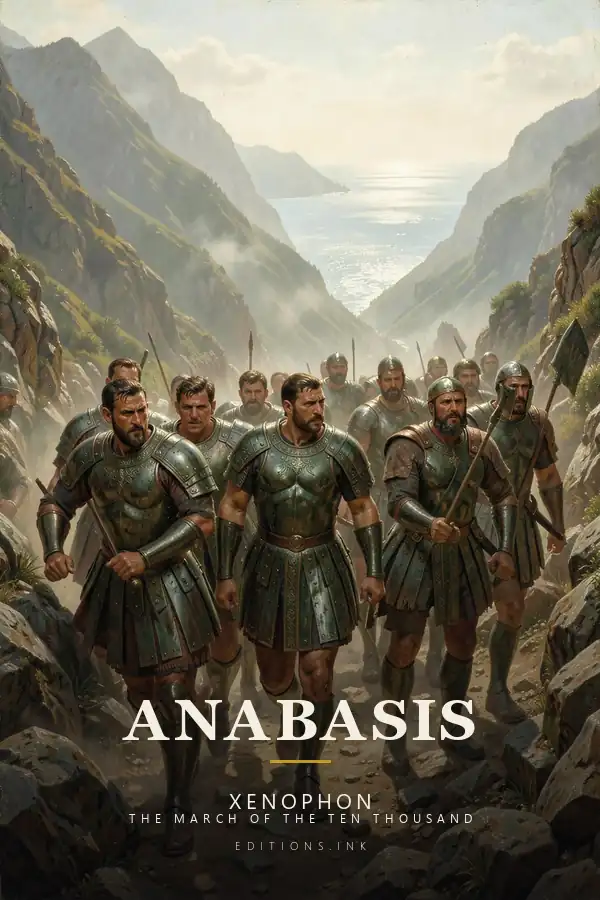
- Xenophon’s Anabasis is the other famous march through Asia, and it runs the other way: a Greek army stranded in the Persian empire, electing its own officers and arguing its way north to the sea. Set beside Arrian, it shows how differently the Greeks wrote about a campaign they had lost. — free EPUB, AZW3 & KEPUB
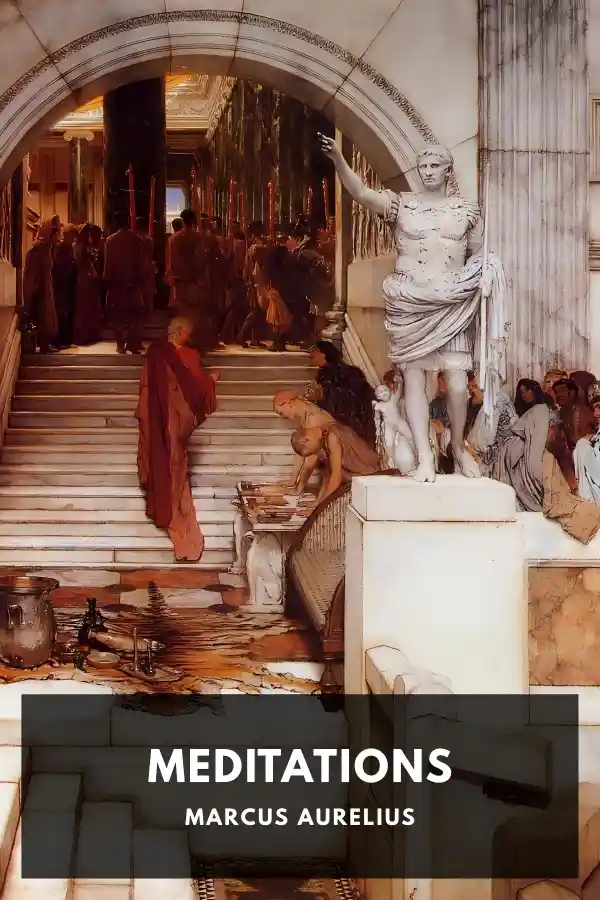
- Marcus Aurelius wrote his notebook while commanding the armies of an empire, and the entries are the private record of a man holding himself to a discipline. Beside Arrian’s account of a king who was flattered, it makes a pair: one ruler explains his conduct to himself, the other is explained by his historian. — free EPUB, AZW3 & KEPUB
- Virgil’s Aeneid is the other great story of a war in Asia that ends in a journey west, and it turns a defeat into a founding. Read beside the Anabasis, it shows how the ancient world made a founding out of a war that was lost, where Arrian makes a history out of one that was won. — free EPUB, AZW3 & KEPUB
Chapter summaries
The twelve groups below follow the book’s own divisions and keep its order. Arrian’s seven books are used as they stand, and the four that carry the most ground, Books I to IV, are each split once where the narrative turns, so that a group never crosses from one book into another. No book has been merged with its neighbour and no group has been given a title the edition does not use.
- Book I — The accession, the Danube and the Granicus: Philip is dead and Alexander, about twenty, is granted the command of the Greeks against Persia. He marches north against the Triballians, crosses the Danube against the Getae, destroys Thebes, crosses the Hellespont to Troy, and fights his first Persian battle at the Granicus, where Clitus saves his life.
- Book I — Sardis, Miletus and Halicarnassus: He takes Sardis and Ephesus, besieges Miletus and occupies the island of Lade, and fights Memnon’s Persian force through the streets of Halicarnassus. Ada of Caria is restored to her province. The march goes on through Lycia, Pamphylia and Pisidia into Phrygia, with the winter spent settling the coast and the interior.
- Book II — Gordium, Tarsus and Issus: At Gordium he sees the waggon of Gordius and the cord that binds its yoke. In Cilicia he falls ill at Tarsus after bathing in the Cydnus and is saved by his physician Philip. Darius comes down behind him and the armies meet at Issus; the Persian line breaks, Darius flees, and his mother, his wife and his children are taken.
- Book II — The mole at Tyre and the fall of Gaza: Tyre refuses him entry, and he builds a mole from the mainland across the strait. The siege is decided at sea by the Phoenician and Cyprian fleets; the city is stormed and its people enslaved. Gaza holds out under its governor and is taken by assault, and Egypt lies open in front of him.
- Book III — Egypt, Ammon and Alexandria: The Persian viceroy surrenders Egypt without a battle. Alexander sacrifices at Memphis, marks out the walls and the agora of Alexandria, and crosses the desert to consult the oracle of Ammon. He settles the country, returns to Syria, and marches to meet Darius on the plain beyond the Tigris.
- Book III — Arbela, Babylon and the Persian gates: He crosses the Euphrates and the Tigris and fights Darius at Arbela, where the Persian line breaks and the king flees again. Babylon and Susa open their gates, the Uxians are subdued, and Ariobarzanes holds the Persian gates until a night march turns the pass. Persepolis is taken and its palace burnt; Bessus murders Darius.
- Book IV — Bactria, Clitus and the Sogdian rock: Bessus is pursued across the Oxus and captured. The Sogdians revolt and are reduced city by city. At a drinking party Alexander kills Clitus, who had saved him at the Granicus. Callisthenes refuses prostration and is later executed. Oxyartes’s rock is stormed, and Alexander marries Roxana, the daughter taken there.
- Book IV — Aornus and the crossing of the Indus: Beyond the river Cabul Alexander fights the Aspasians, besieges Massaga, and takes the rock of Aornus. He reaches the Indus, crosses it, and is met by Taxiles, whose country submits. The campaign now turns east toward Porus, the Hydaspes and the edge of the known world.
- Book V — Nysa, the Hydaspes and the mutiny: He visits Nysa, where the legend of Dionysus is told, and digresses on India, its rivers and its peoples. Porus bars the Hydaspes and is defeated; Alexander spares him and keeps him as an ally. Bucephalas dies. At the Hyphasis the army refuses to go further, and twelve altars are raised to mark the limit.
- Book VI — The Mallians and the wound: The fleet sails down the Hydaspes and the Acesines while the army marches along the banks. Against the Mallians Alexander mounts a ladder at the wall, is struck by an arrow in the chest and nearly dies, and his men break the gate to reach him. He recovers, and the voyage down the rivers continues.
- Book VI — Gedrosia, Carmania and the return: He reaches Patala and the mouths of the Indus, then turns west through the desert of Gadrosia, where heat and thirst destroy much of the army and the guides lose the way. He pours away a helmet of water in front of the troops, finds the sea, and comes out at Pura after sixty days.
- Book VII — Opis, Babylon and the death of Alexander: The Indian sages and the self-sacrifice of Calanus, the mass marriages of Macedonians and Persians, the mutiny of the veterans and the banquet of reconciliation, the death of Hephaestion, and the embassies from Greece. The Chaldaeans warn him not to enter Babylon; there he is taken with fever after drinking with Medius, and dies. Arrian closes with his character and a defence of his career.
The Anabasis of Alexander: Frequently Asked Questions
What is The Anabasis of Alexander about?
Who was Arrian, and why did he write the book?
Is it a primary source for Alexander?
How reliable is Arrian’s account?
What do the seven books cover?
Does this volume include the Indica?
What is this translation, and when was it made?
How do I read the free downloads?
Part of: Classic Fiction · Arrian