A Portrait of the Artist as a Young Man by James Joyce: Free EPUB, AZW3 & KEPUB Download
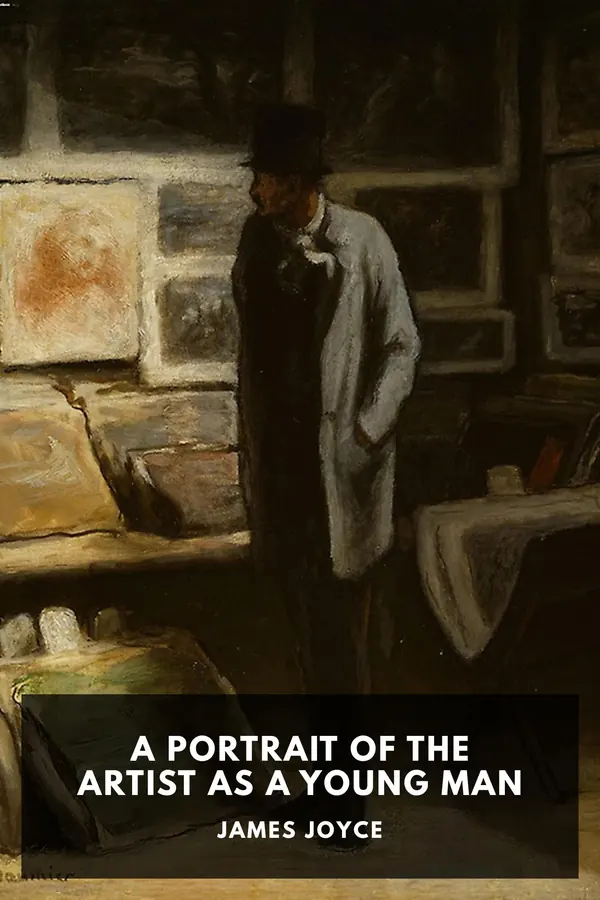
A Portrait of the Artist as a Young Man
📖 Click to Read the Opening Pages Online Preview
The opening of Chapter 1
Once upon a time and a very good time it was there was a moocow coming down along the road and this moocow that was coming down along the road met a nicens little boy named baby tuckoo. …
His father told him that story: his father looked at him through a glass: he had a hairy face.
He was baby tuckoo. The moocow came down the road where Betty Byrne lived: she sold lemon platt.
The preview stops after the first three paragraphs of Chapter 1, quoted from the Standard Ebooks text; the complete novel is in the free download below.
Download Full EPUB1916
~86,000 words (estimated)
Approx. 4.8 hours
Standalone
Ireland, from the 1880s to 1904
Five chapters
EPUB · AZW3 · KEPUB
0.56 MB (EPUB) · 0.61 MB (AZW3) · 0.59 MB (KEPUB)
Public domain in the United States
Project Gutenberg #4217 · Standard Ebooks
A Portrait of the Artist as a Young Man follows Stephen Dedalus from the nursery story of the moocow to the diary he keeps at twenty-two, on the point of leaving Ireland. Joyce writes the book in a prose that grows up with its subject: the child who wets the bed becomes a Clongowes schoolboy, then a Belvedere boy at the Whitsuntide play, then a penitent in a Church Street chapel, then a student who refuses the priesthood and walks out along the strand at the Bull. Family money leaks away, the Church tightens its grip, and language becomes the thing he has to master.
Joyce wrote the novel in Trieste and published it in 1916, the year after Dubliners, and it is the book in which the modern novel learns to think in fragments: a child’s sentences, a Jesuit sermon, a villanelle, a diary. Stephen’s quarrel with Ireland is a quarrel about words as much as about faith or politics, and the great scenes are scenes of language, from the pandybat in the study hall to the tundish in the physics theatre. Read Wikipedia’s article on A Portrait of the Artist as a Young Man for its publication history. The text is available via Project Gutenberg #4217 and Standard Ebooks.
A Portrait of the Artist as a Young Man by James Joyce: Summary, Characters & Themes
This page is a summary and analysis of A Portrait of the Artist as a Young Man, the novel James Joyce published in New York in 1916. Stephen Dedalus is a Dublin boy whose father has money and then does not, whose schooling is in the hands of Jesuits, and whose imagination is fed by the story of the moocow, by The Count of Monte Cristo and by the sound of his own sentences. The book follows him from Clongowes Wood to Belvedere and University College, through the square ditch and the pandybat, a Christmas dinner that ends in a quarrel about Parnell, a retreat sermon on hell, a confession in Church Street and a walk on the strand at the Bull.
Nothing is explained twice. The first chapter is written in a child’s vocabulary, with the world arriving in fragments of song and smell, and the last is a diary kept in short, hard sentences. In between, the prose takes on the rhythms of whatever Stephen is reading or suffering: the liturgical repetition of Father Arnall’s sermon, the scholastic cadences of the argument about beauty, the villanelle that arrives in the middle of the night. There are five chapters and no chapter titles, and the narrative never leaves Stephen’s mind, so that the reader knows only what he knows and feels the pressure of what he refuses to know. The book trusts the reader to keep up.
James Joyce was born in Rathgar in 1882 and educated at Clongowes Wood, Belvedere and University College Dublin, the three schools Stephen attends. He left for Paris in 1902, was called home by his mother’s illness, and in 1904 went abroad with Nora Barnacle, teaching English at the Berlitz school in Pola and then in Trieste, where he rewrote the book that became this novel. Dubliners appeared in 1914, after years of argument with publishers and printers; the Portrait followed in 1916, and Ulysses in 1922. The novel draws on that schooling closely, down to the names of the masters, and the streets are Stephen’s, though the book is a portrait rather than a transcript.
Readers who want the same city in a colder light can turn to Dubliners, the stories Joyce published two years earlier, where the paralysis Stephen complains of is diagnosed inside ordinary lives instead of being escaped. The Picture of Dorian Gray belongs to the same decade and the same argument about the artist and the world, though Wilde’s wit moves in drawing rooms where Stephen’s shame moves in chapels. The Scarlet Letter is the American ancestor of the theme, a novel about sin made public, and Hawthorne’s scaffold scenes carry something of the same pressure as Stephen’s confession. Each has a free edition on this site, and each is a book about a self being made and judged.
The text here follows the Standard Ebooks edition, which was set from the Project Gutenberg #4217 transcription and checked against the 1916 printing. The twelve summaries below follow that text, from the moocow to the last diary entry. Spelling and punctuation are Joyce’s, including the dashes that stand in for quotation marks throughout, and the paragraph breaks are the printing’s rather than an editor’s. Nothing has been modernised, abridged or annotated inside the book. The five chapters are long, and the blank lines inside them mark the places where the printing pauses; the summaries below use those pauses as their divisions. Anyone who wants to check a disputed sentence can compare the file with the Gutenberg transcription, and the two agree throughout, chapter for chapter.
Historical Context
The novel is dated by a death. Charles Stewart Parnell, the Protestant landlord who had led the Irish Parliamentary Party to the edge of Home Rule, died in October 1891, and the Christmas dinner in Chapter 1 is fought over his memory: Dante throws the green velvet brush back into her press, Mr Casey weeps into his plate and calls Parnell his dead king, and the family ends the evening divided by the priests who had denounced him from the altar. The scene is not decoration. It gives Stephen his first lesson in what an argument about politics costs inside a family, and it explains why the Ireland of the book is a place where the Church and the nation pull in different directions.
Stephen’s education is a Catholic education, and the novel takes it seriously. The Jesuits at Clongowes and Belvedere teach him Latin, doctrine and obedience, and the retreat in Chapter 3 shows what the machinery can do when it is aimed at a boy’s conscience: Father Arnall’s sermons on the four last things reduce Stephen to terror, and the confession that follows brings a relief that lasts only a few pages. The same Church that educates him also provides the director who invites him to the priesthood, and the offer is generous, serious and impossible to accept. Schooling in Ireland at the time was largely in clerical hands, and the novel’s argument is with a system that could make a boy feel both chosen and trapped.
Joyce began the material in Dublin in 1904 as a naturalistic sketch called Stephen Hero, and rewrote it in Trieste, where he was teaching English and living on very little. The Egoist, the London magazine edited by Harriet Shaw Weaver, serialised the novel in 1914 and 1915, with Ezra Pound among those who pushed it into print; London publishers had already declined it, and the first book edition appeared in New York, from B. W. Huebsch, in 1916. By then Joyce had been out of Ireland for a decade, and the distance shows: the city in the novel is remembered rather than observed, exact in its street names and its voices and lit by an exile’s attention.
Key Characters & Literary Archetypes
- Stephen Dedalus: The novel’s only centre. He appears as baby tuckoo, able to taste the oilsheet and the lemon platt, and leaves as a young man keeping a diary in clipped, elegant sentences. Between those points he is a weak boy at Clongowes, a proud and filthy adolescent at Belvedere, a terrified penitent, a candidate for the priesthood and a theorist of beauty. His surname points two ways at once, to Daedalus the craftsman and to Icarus the son who falls, and Athy notices that it sounds like Latin.
- Simon Dedalus: Stephen’s father, a Corkman with a good voice, a fund of stories and no money. He tells the moocow story at the start and weeps over Parnell at the Christmas dinner, and later he takes his son to Cork to sell the last of the property, drinks through the afternoon and calls a porter a Dublin jackeen. He is affectionate and unreliable, and the novel never lets Stephen settle whether he is a gentleman or a ruin. ‘A gentleman’ is what Stephen tells Nasty Roche his father is.
- Cranly: Stephen’s closest friend at University College, a medical student with a priestlike face and a heavy black brow. He is the book’s best listener and its most patient antagonist: he eats figs, delivers epitaphs for dead friendships, argues about the eucharist and asks Stephen, in a plain, cold voice, whether he has ever loved anyone. In the last conversation he is the friend Stephen is leaving, and he takes the news without drama, which is what makes the parting hurt. He is the last person to whom Stephen explains himself.
- Emma Clery: The girl Stephen watches and writes about, named Emma in the narrative and reduced to the initials E—C— in the poem he tries to write for her. She appears on the steps of a tram, in a hotel doorway, on the library steps, and finally in the villanelle, where she becomes a temptress in a scarlet gown. Stephen’s feelings about her are mostly about himself, and the novel is honest about the gap between the girl and the figure in his verses, which is the point of the portrait.
- Father Arnall: The Jesuit master at Clongowes who teaches the Latin lesson and is decent about the pandybat, and the same priest who returns in Chapter 3 to preach the retreat at Belvedere. His sermons on hell are the novel’s most sustained performance: the fire that burns without consuming, the worm of conscience, the stench of the damned, delivered in a voice Stephen finds beautiful and unbearable. He is not a villain. The horror is that he means every word kindly, and that the boy in front of him is listening.
- Dante Riordan: The old woman who taught Stephen geography and manners, called Dante throughout the book, with two brushes in her press, maroon for Michael Davitt and green for Parnell. She is a spoiled nun who keeps a religion of rules, and at the Christmas dinner she defends the bishops against Parnell until the family is shouting. She threatens the child with eagles that will pull out his eyes, and she is the first person to teach him that the things he loves can be torn up in front of him.
Core Literary Themes
- Religion and guilt: Stephen’s Catholicism is not a set of opinions he can drop; it is a grammar he thinks in. The retreat sermons work because they are beautiful as well as terrifying, and the confession in Church Street releases him into a piety so exact that it becomes a second penance. Joyce shows guilt operating at the level of the body, in the beaten hands, the nausea after the sermon, the smell of the chapel, and he never lets the reader decide that Stephen has outgrown it. When Stephen refuses the priesthood he is refusing an institution whose language he still uses.
- Language and national identity: The quarrel with the dean of studies over the word tundish is a small colonial scene: an English Jesuit, sent to Ireland to teach, does not know the word for a funnel that every Irish schoolboy knows, and Stephen answers with a joke about Lower Drumcondra speaking the best English. The novel is full of such contests, Latin against English, the Irish language against the language of the marketplace, the rhetoric of Parnell against the rhetoric of the altar. Stephen’s ambition, named at the end, is to forge in the smithy of his soul the uncreated conscience of his race.
- The aesthetics of epiphany: Stephen’s theory, argued out with Lynch on a wet Dublin afternoon, borrows from Aquinas: integritas, consonantia, claritas, or wholeness, harmony and radiance. Art, he says, is static rather than kinetic; it does not tell you to desire or to fear, it holds you still in the moment of apprehension. The novel dramatises the theory instead of illustrating it. The girl standing in the water at the Bull is an epiphany, and so is the sound of the pandybat, and so is the smell of the oilsheet. A single perception is allowed to carry the weight of a whole life, and then the prose moves on.
- Family decline: The Dedalus household loses money in stages, and the novel records the stages without sentiment: the house at Blackrock with its garden and its servant, the move to a bare Dublin terrace, the sale of the property in Cork, the pawn tickets of Chapter 5, the father’s voice on the stairs. Simon Dedalus is charming company and a disaster as a provider, and Stephen’s shame about him is one of the book’s continuous pressures. The decline also means that Stephen has no inheritance to fall back on, which makes his refusal of the priesthood a decision about money as well as about faith.
- Exile: The last chapter is a preparation for departure. Stephen tells Cranly that he will not serve what he no longer believes in, whether it calls itself his home, his fatherland or his church, and the sentence ends with the only arms he allows himself, silence, exile and cunning. The diary that closes the book is already written from outside Ireland, in short entries about weather, girls, friends and words. Joyce left in 1904 and never lived in Ireland again, and the ending is careful not to promise that exile solves anything, only that the artist will keep moving.
Why Download Our Custom E-Reader Edition of A Portrait of the Artist as a Young Man?
A portrait this exact deserves a clean file. The edition offered here follows the Standard Ebooks text, which is set from the Project Gutenberg transcription and checked against the 1916 printing, so the dashes, the italics and the paragraphing are the book’s rather than a converter’s. There are five chapters and no chapter titles, and a table of contents that takes you to the beginning of each one without disturbing the prose.
The novel is dense, and the file is built for rereading as well as for a first pass: proper chapter breaks, working navigation, a cover that survives being sent to a Kindle, and text that reflows on a phone. Nothing has been abridged, modernised or annotated inside the book. The summaries and notes on this page are kept outside the text, where they belong, so the download is the novel as Joyce printed it.
If you want to check a passage against the original transcription, Project Gutenberg #4217 is the place to start, and the two texts agree throughout. Take the EPUB, the AZW3 or the KEPUB and the whole of Stephen’s five chapters is yours, with nothing to sign, nothing to renew and no sample standing in for the book. Every format carries the same five chapters.
- Based on the Standard Ebooks Edition, via Standard Ebooks, whose editors prepared the text from the Project Gutenberg transcription and checked it against the 1916 printing; the five chapters and the paragraph divisions used in the summaries below are theirs, so the page and the file match chapter for chapter.
- Free EPUB, AZW3 and KEPUB files One download per format, with a working table of contents and a cover that survives being sent to a device. EPUB for most readers, AZW3 for Kindle, KEPUB for Kobo, all three carrying the same complete text and none of them locked. Each file stays small enough for an old reader and complete enough for a new one.
- Chapter summaries and a reading guide Twelve summaries follow the five chapters movement by movement, with notes on the historical context, the characters and the themes, and answers to the questions readers ask most often about the book. The page can be read before the novel, used as a map while reading it, or consulted afterwards to see how the parts fit together.
- No sign-up, no paywall No account, no subscription and no sample chapter standing in for the novel. The book is public domain in the United States, and the file is yours to keep, copy between devices and reread, with nothing that expires and nothing hidden inside it.
- Dubliners — free EPUB, AZW3 & KEPUB
- The Picture of Dorian Gray — free EPUB, AZW3 & KEPUB
- The Scarlet Letter — free EPUB, AZW3 & KEPUB
Chapter summaries
Five chapters and no chapter titles, with a prose that changes shape as Stephen grows. These twelve summaries follow the Standard Ebooks text in order, from the moocow story to the last diary entry.
- Chapter 1, part 1 — Baby tuckoo: Once upon a time and a very good time it was there was a moocow coming down along the road. The book opens inside a small boy’s senses: the story his father tells through a glass, the song about the wild rose, the oilsheet that smells queer, the sailor’s hornpipe his mother plays on the piano, Uncle Charles and Dante clapping, the cachou Dante gives him for a piece of tissue paper, the Vances at number seven and Eileen. Then the playgrounds of Clongowes arrive, and the prose begins to harden into a schoolboy’s Latin and a schoolboy’s fear.
- Chapter 1, part 2 — Clongowes Wood: The wide playgrounds swarm with boys, and Stephen keeps to the fringe of the line, too small for the football and too cold in the hands. Nasty Roche asks what kind of a name Dedalus is, Wells shoulders him into the square ditch over a snuffbox, and he lies in the infirmary with Brother Michael and the smell of medicine. Then the news arrives that Parnell is dead, and the school turns the funeral into a rumour of the end of the world. Athy, the little fighter, tells Stephen his name is like Latin.
- Chapter 1, part 3 — The Christmas dinner and the pandybat: The holiday dinner at Bray turns into a fight about Parnell: Dante defends the bishops, Mr Casey weeps into his plate and calls Parnell his dead king, and the child is sent from the table. Back at Clongowes the Latin lesson is interrupted by the prefect of studies, who finds Stephen’s glasses broken and pandies his hands for idleness. The boys carry him to the rector, Father Conmee, and the chapter ends with three groans for Baldyhead Dolan and three cheers for the decentest rector Clongowes ever had.
- Chapter 2, part 1 — Blackrock and the move to Dublin: Summer at Blackrock: Uncle Charles in the outhouse, the garden, the tram into Dublin, the markets, and the paperback of The Count of Monte Cristo that gives Stephen Mercedes and a world of escape. Then the money goes. The family leaves the house with the garden for a bare terrace, and Stephen is enrolled at Belvedere, where the Whitsuntide play makes him briefly visible. He writes a poem to E—C— on the back of a music sheet, and the first stirrings of a shame he cannot name arrive with it.
- Chapter 2, part 2 — Cork and the brothel district: Father and son take the night mail to Cork to sell the last of the property, and Simon Dedalus shows the town to his son in a haze of bars, old friends and remembered stories. The auction is a humiliation, and the porter’s welcome a joke Stephen cannot laugh at. Back in Dublin the money from the sale is spent, the family is poorer again, and Stephen walks the streets behind the quays until a young woman in a long pink gown takes him to a room with a huge doll in it and kisses him.
- Chapter 3, part 1 — The retreat sermons: December, and the school year is running down when the retreat is announced for the feast of St Francis Xavier, three days of sermons and a general confession on the Friday. Father Arnall preaches on the four last things, and on hell he becomes an artist: the fire that burns and does not consume, the worm of conscience that never dies, the stench of the damned, the darkness of the prison. Stephen listens with the fear of a boy who has something to confess, and the terror works on him exactly as intended.
- Chapter 3, part 2 — Confession in Church Street: The sermons leave Stephen unable to eat, pray or sleep, and he cannot bring himself to confess in the college chapel. He walks out through the evening streets instead, asks an old woman with an oilcan where the chapel is, and finds a dark church in Church Street where a capuchin priest listens without surprise. The confession, and the absolution that follows, release him into a fervent fortnight of masses, rosaries and self-denial, until the piety thins into scruple and the ordinary world comes back.
- Chapter 4, part 1 — The refusal of the priesthood: The director of the college sends for Stephen and, in the window of the parlour, speaks of the order, of the robes, of a vocation. He will say mass for the boy in the morning and asks only that Stephen be sure, since the sacrament of orders cannot be repeated. Stephen listens, walks home past the Jesuit house in Gardiner Street, and knows that he will never swing the thurible before the tabernacle. The refusal is not dramatic. It is registered as a fact about his own nature, and the chapter moves on.
- Chapter 4, part 2 — The vision by the water: Stephen walks out along the road to the Bull, crosses the wooden bridge at Dollymount and lets the tide do its work on him. A girl stands wading in midstream, alone and still, and to Stephen she is a seabird, a thing made by magic. Her thighs are bared to the hips and her skirts are kilted about her waist, and the sight is not lust but a vision of life. Heavenly God, his soul cries, and he resolves to live, to err, to fall, to triumph, to recreate life out of life.
- Chapter 5, part 1 — The aesthetic argument: Morning in the shabby house: the box of pawn tickets at his elbow, the mother’s cough, the clock that shows an hour and twenty-five minutes. At the college the dean of studies is lighting the fire and calls a funnel a funnel until Stephen says tundish, and the small colonial comedy lands. Later, walking through the wet streets with Lynch, Stephen sets out his theory of art, wholeness, harmony and radiance, the static and the kinetic, and the difference between the artist who serves and the artist who creates.
- Chapter 5, part 2 — The villanelle: At night, in his room, the verses arrive almost without permission: are you not weary of ardent ways. Stephen writes them on a cigarette packet, revises them, and lets the poem turn Emma into a temptress in a scarlet gown and a fallen seraph. In the morning the joy has curdled into shame and self-disgust, and the episode ends with the old smell of the house, the tattered wallpaper and a weariness that belongs to the poet as much as to the boy.
- Chapter 5, part 3 — The diary: The last movement is the conversation with Cranly, in which Stephen refuses the eucharist, refuses his mother’s prayers and refuses the claims of home, fatherland and church, and names the arms he will use, silence, exile and cunning. Then the diary takes over, short entries from 20 March to 27 April about weather, girls, friends and words, ending with a prayer to the old father, the old artificer, to stand him in good stead. The book stops there, on the edge of departure.
A Portrait of the Artist as a Young Man: Frequently Asked Questions
What is A Portrait of the Artist as a Young Man about?
Is the novel autobiographical?
Does Buck Mulligan appear in this novel?
Why does the prose change so much?
Who is Emma, and why does Stephen treat her so badly?
What happens at the end of the novel?
Is the novel difficult to read?
Where can I download the free EPUB, AZW3 and KEPUB?
Part of: Modern Classics · Early 20th century