The Moonstone by Wilkie Collins: Free EPUB, AZW3 & KEPUB Download
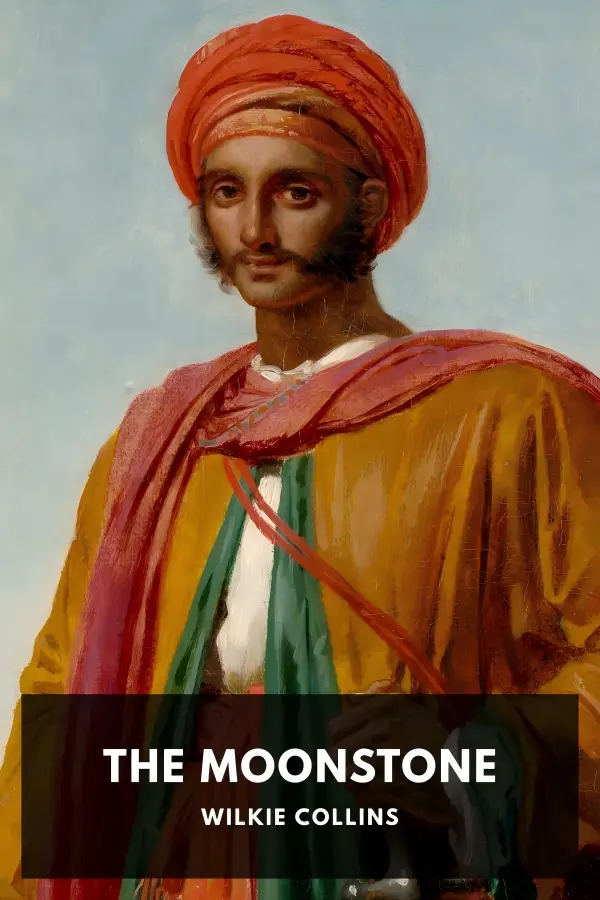
The Moonstone
📖 Click to Read First Period: Chapter I Online Preview
First Period: Chapter I — The Loss of the Diamond (1848)
In the first part of Robinson Crusoe, at page one hundred and twenty-nine, you will find it thus written:
“Now I saw, though too late, the Folly of beginning a Work before we count the Cost, and before we judge rightly of our own Strength to go through with it.”
Only yesterday, I opened my Robinson Crusoe at that place. Only this morning (May twenty-first, Eighteen hundred and fifty), came my lady’s nephew, Mr. Franklin Blake, and held a short conversation with me, as follows:—
“Betteredge,” says Mr. Franklin, “I have been to the lawyer’s about some family matters; and, among other things, we have been talking of the loss of the Indian Diamond, in my aunt’s house in Yorkshire, two years since. Mr. Bruff thinks as I think, that the whole story ought, in the interests of truth, to be placed on record in writing—and the sooner the better.”
Not perceiving his drift yet, and thinking it always desirable for the sake of peace and quietness to be on the lawyer’s side, I said I thought so too. Mr. Franklin went on.
Follow the trail of the cursed diamond and uncover the origins of detective fiction. Download the complete unabridged novel for your e-reader.
Download Full EPUBMasterpieces of Deduction & Victorian Suspense
About Wilkie Collins’s The Moonstone
Serialized in Charles Dickens’s weekly journal All the Year Round and published in three volumes in 1868, The Moonstone is Wilkie Collins’s supreme mystery masterpiece. T. S. Eliot famously celebrated it as “the first, the longest, and the best of modern English detective novels.” It is widely regarded as the first full length detective novel in the English language.
The novel established nearly all the foundational conventions of the modern whodunit genre: an English country-house robbery, a baffling “inside job,” bumbling local constables contrasted with a sharp Scotland Yard detective, red herrings, and a brilliant scientific reenactment.
The plot revolves around the Moonstone, a priceless yellow diamond plundered from a sacred Hindu shrine in Somnath during the 1799 Siege of Seringapatam. Cursed by the three Brahmin priests sworn to guard it, the jewel is bequeathed out of spite by Colonel Herncastle to his niece, Rachel Verinder, on her eighteenth birthday.
That very night, following a festive dinner party at Lady Verinder’s Yorkshire country estate, the gem vanishes without a trace from Rachel’s locked boudoir cabinet. When local police fumble the investigation, the legendary rose-loving detective Sergeant Cuff is summoned from London.
Told through a chorus of distinct, first-person narrative accounts—including the loyal old steward Gabriel Betteredge, religious prude Miss Clack, and medical outcast Ezra Jennings—the investigation uncovers suppressed romantic secrets, drug-induced somnambulism, and societal hypocrisy before the diamond makes its fateful journey back to the East.
Key Characters & Literary Archetypes
- Sergeant Richard Cuff (The Methodical Professional Detective): Based on real-life Scotland Yard detective Jonathan “Jack” Whicher. Gaunt, melancholy, and passionate about breeding roses, Cuff established the archetype of the eccentric, deductive professional detective later popularized by Sherlock Holmes.
- Franklin Blake (The Amateur Sleuth & Unwitting Culprit): Rachel’s cultured cousin who spearheads the investigation into the jewel’s disappearance. In a groundbreaking psychological twist, Blake discovers that he himself took the gem in an opium-induced trance under the influence of laudanum, embodying the split consciousness of Victorian gentlemanhood.
- Rachel Verinder (The Fierce, Self-Determined Heroine): Rachel breaks conventional Victorian female passivity by refusing to cooperate with the police investigation. Believing the man she loves is a dishonorable thief, she endures social suspicion to shield him from exposure and ruin with stubborn moral pride.
- Ezra Jennings (The Excluded Genius & Scientific Outcast): Dr. Candy’s dying assistant, marginalized by his ambiguous colonial origins and unsettling appearance, and burdened by an ambiguous past. His profound medical insights and empathy allow him to design the famous opium reenactment that clears Franklin’s name.
- Rosanna Spearman (The Tragic Reformed Thief): A former reformatory inmate working as a housemaid, whose hopeless, unrequited love for Franklin Blake leads her to hide his stained nightgown, culminating in her heartbreaking suicide in the Shivering Sand.
- Godfrey Ablewhite (The Pious Hypocrite & Secret Cad): Rachel’s philanthropic cousin who poses as a saintly benefactor to orphan societies. Beneath his high moral reputation lies reckless debt, a hidden mistress, and the criminal greed that ultimately leads to his demise.
- Gabriel Betteredge (The Devoted Victorian Domestic): Lady Verinder’s loyal house steward whose warm, humorous narrative opens the inquiry. He treats Daniel Defoe’s Robinson Crusoe as a sacred book of prophecy, representing traditional social order anchored in domestic loyalty.
Core Literary Themes & Historical Significance
- Imperial Guilt and the Return of the Plundered: Collins framed the novel around an explicit critique of British colonial looting, illustrating how the violently stolen sacred artifact inevitably brings moral contamination and domestic discord into the heart of Victorian England. Published in 1868, barely a decade after the Indian Rebellion of 1857, the novel registers contemporary anxieties about empire and its moral costs.
- Multiple Narratives and the Elusive Nature of Truth: By deploying a polyphonic chorus of biased, subjective narrators, Collins pioneered modernist narrative technique, demonstrating that truth is rarely absolute, but reconstructed through piecing together incomplete fragments of human memory. The structure draws on the evidentiary procedures of Victorian legal casebooks and courtroom testimony.
- Unconscious Guilt and Altered States of Mind: Predating Sigmund Freud, Collins explored how narcotics, sleepwalking, and repressed emotional desires expose the hidden fractures lurking beneath Victorian respectability and the rational human ego.
editions.ink Archival Standards
Scans of Victorian multiple-narrator novels commonly suffer from lost subheadings, distorted epistolary datelines, and broken footnote anchors. Our digital edition offers:
- Complete Multi-Narrative Faithfulness: Preserves all distinct periods, narrative logs, medical notes, and epistolary headers without truncation.
- Calibrated E-Ink Display Hierarchy: High-contrast typography optimized for Amazon Kindle, Kobo, and Android e-paper hardware, eliminating eye strain during long reading sessions.
- Triple Format Verification: Verified file integrity across EPUB, AZW3, and KEPUB standards, guaranteeing flawless navigation and native table-of-contents support.