Moby-Dick by Herman Melville – Free Download (EPUB, AZW3, KEPUB)
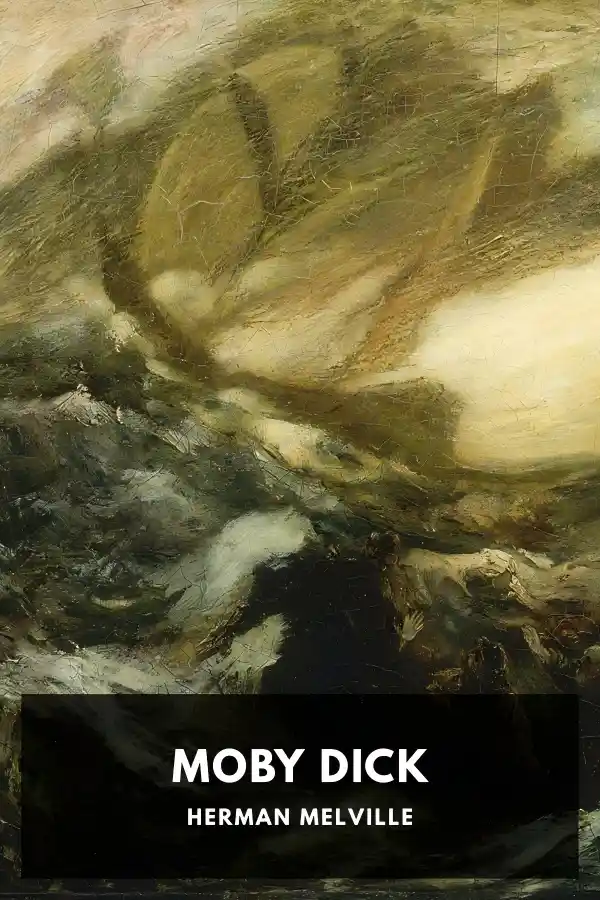
Moby-Dick; or, The Whale
📖 Click to Read Chapter 1 Online Preview
Chapter 1 — Loomings
Call me Ishmael. Some years ago—never mind how long precisely—having little or no money in my purse, and nothing particular to interest me on shore, I thought I would sail about a little and see the watery part of the world. It is a way I have of driving off the spleen and regulating the circulation.
Whenever I find myself growing grim about the mouth; whenever it is a damp, drizzly November in my soul; whenever I find myself involuntarily pausing before coffin warehouses, and bringing up the rear of every funeral I meet; and especially whenever my hypos get such an upper hand of me, that it requires a strong moral principle to prevent me from deliberately stepping into the street, and methodically knocking people’s hats off—then, I account it high time to get to sea as soon as I can. This is my substitute for pistol and ball.
With a philosophical flourish Cato throws himself upon his sword; I quietly take to the ship. There is nothing surprising in this. If they but knew it, almost all men in their degree, some time or other, cherish very nearly the same feelings towards the ocean with me.
Embark aboard the Pequod into Herman Melville’s vast metaphysical deep. Download the complete unabridged epic for your e-reader, including the Moby Dick free epub.
Download Full EPUBGreat American Epics & Whimsical Journeys
About Herman Melville’s Moby-Dick
Published in October 1851 in London as The Whale by Richard Bentley, and in November 1851 in New York by Harper & Brothers under the definitive title Moby-Dick; or, The Whale, Herman Melville’s magnum opus is widely revered as the pinnacle of American Dark Romanticism and modern epic literature.
Dedicated to Nathaniel Hawthorne, the novel blends authentic 19th-century maritime realism—drawn directly from Melville’s own harrowing years aboard the whaling ship Acushnet—with Shakespearean tragic drama, biblical allegory, and encyclopedic cetological discourse. For readers seeking a free Moby-Dick EPUB, this public domain edition offers the complete unabridged text based on a Standard Ebooks transcription from Project Gutenberg eBook #2701.
The story opens with the iconic sentence, “Call me Ishmael.” Seeking to escape a damp, drizzly November in his soul, the philosophical schoolteacher Ishmael travels to Nantucket to sign aboard a whaling vessel, forming an intimate, sacred bond of brotherhood with Queequeg, a heavily tattooed Polynesian harpooner.
They embark on the Pequod, a weathered ship decorated with sperm whale bones. Only after the ship reaches open water does its brooding, peg-legged master, Captain Ahab, reveal the voyage’s true, monomaniacal mission: to hunt and slaughter the legendary White Whale, Moby Dick, who previously severed Ahab’s leg.
Nailing a Spanish gold doubloon to the mainmast as a bounty, Ahab binds his multi-ethnic crew into a blasphemous pact of mutual vengeance. As the Pequod circles the globe through storms, encounters with other whalers, and omens of doom, Ahab systematically silences moral objections, charts, and compasses.
The cosmic confrontation erupts in the Pacific during a three-day chase against the invincible leviathan. Ahab’s harpoon line snags him by the neck, dragging him into the depths as the whale rams and shatters the Pequod, pulling ship and crew into a roaring oceanic vortex. Only Ishmael survives, floating on Queequeg’s buoyant coffin until rescued by the searching ship Rachel.
Key Characters & Literary Archetypes
- Ishmael (The Wandering Outcast & Universal Scribe): Bearing the biblical name of the disinherited wanderer, Ishmael represents the observant, democratic modern consciousness. Unlike Ahab’s fanatical certainty, Ishmael approaches the universe with irony, intellectual curiosity, and philosophical humility, surviving the catastrophe to bear witness.
- Captain Ahab (The Promethean Tyrant & Fatal Monomaniac): A scarred, majestic whaling master whose soul has been scorched by personal tragedy. Viewing the White Whale as the physical wall concealing a malicious or indifferent cosmic creator, Ahab embodies the hubristic rebel who sacrifices his entire community in an apocalyptic war against fate.
- Moby Dick (The Inscrutable Leviathan & Sublime Void): The snow-white sperm whale, scarred with ancient harpoons. Operating far beyond human notions of morality, the beast symbolizes the indifferent grandeur of nature, divine inscrutability, and the terrifying blankness of cosmic reality.
- Queequeg (The Noble Pagan & Sacred Companion): A South Sea prince who leaves his island to study civilized ways, only to find them morally bankrupt. Possessing quiet dignity, generosity, and supreme harpooning courage, Queequeg embodies true moral nobility uncorrupted by Western cultural pretensions; his unused coffin becomes Ishmael’s lifebuoy.
- Starbuck (The Pious Rationalist & Paralyzed Conscience): The Quaker first mate who understands the economic purpose of whaling and opposes Ahab’s insane vengeance. Armed with conservative Christian morality, he lacks the ruthless will required to depose Ahab, illustrating how institutional morality fails before charismatic despotism.
- Stubb & Flask (The Pragmatic Hedonist & Unthinking Destroyer): The second and third mates who normalize horrors through humor and routine. Stubb meets existential absurdity with pipe smoke and joviality, while Flask represents the blind, unreflective violence of industrial exploitation.
- Pip (The Holy Fool & Shattered Soul): A frail African-American cabin boy cast overboard and left drifting in the infinite ocean. Driven mad by peering into the deep abyss of creation, his fractured poetic wisdom becomes the poignant foil to Ahab’s calculated fury.
Core Literary Themes & Historical Significance
- Monomania, Tyranny, and Democratic Peril: Melville presents Ahab’s control over the Pequod as a cautionary allegory for authoritarian politics, showing how a single charismatic demagogue can manipulate collective fear and economic desire to steer an entire society toward mutual annihilation.
- The Limits of Human Epistemology: Through extensive chapters detailing whale anatomy, history, and physiology, Melville shows that empirical science and cataloging fail to grasp the living essence of truth, leaving humanity grasping at shadows.
- Universal Brotherhood vs. Racial Dogmatism: The deep covenant between Ishmael and Queequeg provides an unsparing critique of 19th-century racial prejudices, affirming that genuine human fraternity transcends skin tone, religious dogma, and tribal borders.
Quality, Typography & Legal Compliance Notes
Every digital edition released on editions.ink is individually typeset, audited, and optimized to deliver a museum-grade reading experience across mobile phones, tablets, and dedicated E-Ink e-readers. For readers seeking a free Moby-Dick EPUB, this edition offers the complete unabridged text with endnotes, based on a Standard Ebooks transcription from Project Gutenberg eBook #2701.
Typography & Structural Architecture
- Authentic Master Text: This digital edition is based on a Standard Ebooks transcription from Project Gutenberg, incorporating the complete 135 chapters, together with the “Etymology” and “Extracts” sections and the climactic Epilogue omitted in early British releases.
- E-Ink-Optimized Reading: Engineered for high-contrast e-paper displays, with proportional line leading and balanced margins that reduce eyestrain. Elegant classical drop caps are used in the online preview on editions.ink.
- Cetological Tables & Diagrams: Cetological classifications and whaling tool inventories are presented in clear, structured form that remains legible across screen sizes.
- Multi-Level Digital Table of Contents: Includes a fully validated, deeply linked NCX and EPUB 3 navigation document, allowing readers to jump effortlessly across theoretical treatises, dramatic dialogues, and narrative climaxes.
Editorial Curation & Proofreading Audit
- OCR Error Elimination: Automated OCR artifacts from legacy scans—such as broken em-dashes, merged punctuation, hyphenation errors, and misread archaic nautical spellings (e.g., whale-line, leeway, try-works)—have been audited against physical archival copies.
- Dialect Preservation: Faithfully preserves Queequeg’s and Fleece the cook’s phonetically written speech patterns, Ahab’s Jacobean soliloquies, and Father Mapple’s sermon without anachronistic modern censorship or editorial softening.
- Zero DRM & Clean Metadata: Free of vendor locks, digital rights management (DRM), tracking beacons, or compressed formatting bugs. Ready for immediate import into Apple Books, Kindle, Kobo, Moon+ Reader, or Calibre.
Public Domain Status
Herman Melville was born on August 1, 1819, and passed away in New York City on September 28, 1891. Copyright status depends on the author’s death date and the date of first publication:
- United States: Published in 1851, well before the statutory cutoff of January 1, 1929; the text is in the public domain in the United States.
- Life + 70 Years Jurisdictions (United Kingdom, European Union, Australia): Melville passed away in 1891, far exceeding the 70-year post-mortem threshold.
- Life + 50 / 80 Years Jurisdictions (Canada, Japan, New Zealand): Also well beyond the relevant terms.
Disclaimer: The textual contents of Moby-Dick; or, The Whale presented here are in the public domain in the United States. Users outside the United States should check their local laws before using this ebook, as copyright terms vary by country. The custom typography, structural code formatting, and editorial contributions made for this edition are released under the terms described at the end of the ebook.