Twenty Years After by Alexandre Dumas: Free EPUB, AZW3 & KEPUB Download
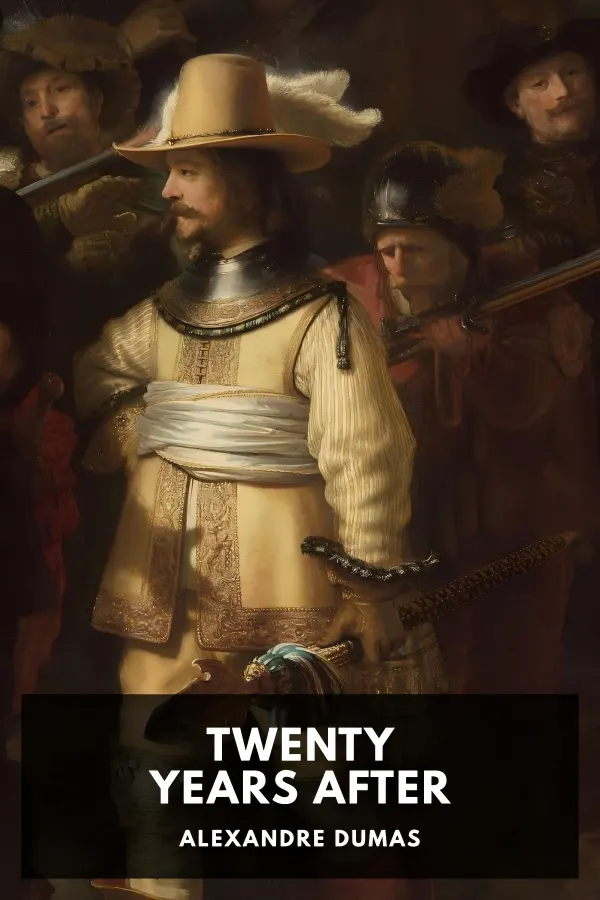
Twenty Years After
📖 Click to Read the Opening Pages Online Preview
Mazarin alone at night in the Palais Royal
In a splendid chamber of the Palais Royal, formerly styled the Palais Cardinal, a man was sitting in deep reverie, his head supported on his hands, leaning over a gilt and inlaid table which was covered with letters and papers. Behind this figure glowed a vast fireplace alive with leaping flames; great logs of oak blazed and crackled on the polished brass andirons whose flicker shone upon the superb habiliments of the lonely tenant of the room, which was illumined grandly by twin candelabra rich with wax-lights.
Any one who happened at that moment to contemplate that red simar—the gorgeous robe of office—and the rich lace, or who gazed on that pale brow, bent in anxious meditation, might, in the solitude of that apartment, combined with the silence of the ante-chambers and the measured paces of the guards upon the landing-place, have fancied that the shade of Cardinal Richelieu lingered still in his accustomed haunt.
It was, alas! the ghost of former greatness. France enfeebled, the authority of her sovereign contemned, her nobles returning to their former turbulence and insolence, her enemies within her frontiers—all proved the great Richelieu no longer in existence.
The preview stops after the opening of Chapter I. The complete text is in the free download below.
Download Full EPUB1845
~242,000 words (estimated)
Approx. 13.5 hours
The d’Artagnan Romances, book 2
France and England, 1648–1649 — Paris, the Palais Royal, the road through Picardy, and the Banqueting House at Whitehall
90 chapters in 12 groups
EPUB · AZW3 · KEPUB
1.08 MB (EPUB) · 1.39 MB (AZW3) · 1.05 MB (KEPUB)
Public domain in the United States
Project Gutenberg #1259
Twenty Years After is Alexandre Dumas’s sequel to The Three Musketeers, published in 1845, and it opens on four men in their forties who have stopped being a legend and become a problem for their employers. d’Artagnan is still a lieutenant of musketeers, Athos has retired to an estate with a son, Porthos is rich and bored in Picardy, Aramis is an abbé with friends among the princes. Cardinal Mazarin, running France for a child king, wants all four in his service. The bargain takes them from the barricades of Paris to the scaffold at Whitehall, where Charles I is waiting for history to finish with him.
Dumas builds the book on two clocks: a Paris where magistrates, princes and a coadjutor are discovering how easy it is to lose a city, and a London where an army has already decided what to do with a king. The four friends serve opposite sides of both quarrels and keep the one oath that matters, sworn in the Place Royale after dark. Twenty Years After was written with Auguste Maquet and printed chapter by chapter while the July Monarchy was still arguing about the Fronde. The text is available via Project Gutenberg #1259.
Twenty Years After by Alexandre Dumas: Summary, Characters & Themes
This is a summary and analysis of Alexandre Dumas’s Twenty Years After, the sequel he published in 1845 to The Three Musketeers: the story it tells, the people who carry it, the France and England behind it, and the reasons it is still read as something more than a second instalment. It opens in the Palais Royal, where Cardinal Mazarin sits up at night over a table of letters and decides that he needs four men he has never met. d’Artagnan is summoned, offered money and sent to find his old friends; the search takes him to a Jesuit house at Noisy, to a château near Blois and to an estate in Picardy where Porthos is dying of comfort. That recruiting is the joke of the first third, and the rest of the book is what it costs.
The novel runs on two clocks. In Paris the Parlement has begun refusing the crown’s taxes, the coadjutor Gondy is organising the poor of the capital, and the arrest of a councillor named Broussel turns a riot into a revolution. In England, Charles I has been sold by the Scots and is being moved from prison to prison by the army that will try him. Dumas ties the two stories with a letter and a mission: Mazarin sends d’Artagnan and Porthos to Cromwell with instructions that are not what they appear to be, while Athos and Aramis travel on the queen of England’s errand. The Three Musketeers ended with four men taking the same risks for one another; this book begins with the four of them old enough to ask what a risk is worth, and to name the price.
Dumas was forty-three in 1845, at the height of a career he ran like an industry: he had the history books, the borrowed memoirs, the collaborators and the newspapers, and he used all of them. He wrote this novel with Auguste Maquet, who supplied much of the historical scaffolding — the Fronde, the trial of Charles I, the flight of the court to Saint-Germain — while Dumas supplied the appetites, the dialogue and the habit of making a serious political point inside a comic scene. Dumas’s Twenty Years After has never had the reputation of its predecessor, and it is the better-built book: it has a plan, an antagonist with a reason to hate, and an ending that refuses to pay its heroes what the reader thinks they have earned. It was written at speed, for a newspaper, and the hurry is part of the pleasure.
What the novel does with its history is unusual for a serial. The Fronde is treated as farce — a rebellion of magistrates who want to be paid and princes who want to be flattered — and the English revolution is treated as tragedy, because Dumas can see that the two are the same argument about who may command a kingdom, argued once with furniture and once with an axe. Mordaunt, the son of Milady, walks between them with a debt of vengeance and a talent for appearing in the right doorway. He is the one character in the book who is never funny, and the change of temperature when he enters a room is the most modern thing in it. Readers who finish this and want the other great French novel of the same crowded century can go on to Les Misérables, or back to Hugo’s Paris of 1482 in The Hunchback of Notre-Dame.
This edition follows the Project Gutenberg #1259 transcription of the nineteenth-century English translation, which keeps Dumas’s ninety chapter headings — “The Shade of Cardinal Richelieu”, “The Man in the Mask”, “The Oubliettes of Cardinal Mazarin” — and prints every chapter in order, numerals included. Nothing is abridged and nothing is smoothed: the dialogue keeps its exclamation marks, the historical asides stay where Dumas put them, and the spelling of proper names is the translator’s. The translation is the nineteenth-century one, and it has the virtues of its period: long sentences, formal address and a straight face. The summaries below walk the book in twelve groups, from Mazarin’s night in the Palais Royal to the last ride out of Paris, and they stop short of the final explanations. Word count, reading time and the file sizes are measured from the files linked on this page, and all three downloads carry the same text.
Historical Context
When the novel opens, Louis XIV is ten years old and his mother, Anne of Austria, governs with Cardinal Mazarin, an Italian who had been Richelieu’s protégé and inherited his desk, his methods and his unpopularity. The war with Spain had been paid for with new taxes and loans, and the Parlement of Paris — a court of law that had acquired the habit of registering the crown’s edicts — refused to register them. In the summer of 1648 the magistrates met in the Chambre Saint-Louis and demanded the abolition of the intendants and the right to approve taxation. Mazarin answered by arresting the most popular of them, Pierre Broussel, on 26 August; Paris had chains across its streets within a day.
The word fronde means a sling, the weapon Paris urchins used to pelt the watch from the ditches; it became the name of the party. The first Fronde, the parliamentary one, ran from the barricades of August 1648 to the peace of Rueil in March 1649, and its set piece is the night of 5–6 January 1649, when the court slipped out of Paris before dawn and took the child king to Saint-Germain. Mazarin’s coach was stopped and searched at the barricades, and the royal family spent the winter in a half-furnished palace while Condé’s army besieged its own capital. Dumas uses that night for one of his best comic scenes, and he uses the larger truth of it — that a government can lose the city it lives in — as the engine of the plot.
Across the Channel the crisis was further along. Charles I had lost the civil war, been sold by the Scots to the English Parliament for four hundred thousand pounds in 1647, and been moved from prison to prison while the army decided what to do with him. His trial began in Westminster Hall on 20 January 1649, and the sentence was carried out on a scaffold outside the Banqueting House at Whitehall on 30 January. Dumas sends his musketeers into that winter as witnesses and would-be rescuers, and he takes the king seriously: Charles is given dignity, patience and a scene with his children. The novel was written in 1845, when France had been changing dynasties for half a century, and its question — by what right does anyone rule — was not academic.
Key Characters & Literary Archetypes
- d’Artagnan: Forty-two when the book opens, still a lieutenant with no company of his own and no richer than he was at twenty. He has kept the Gascon manners and the readiness to fight; what he has lost is the belief that bravery is a career. He does the recruiting, the arguing and most of the arithmetic. He is also the only one of the four who keeps his oath to the letter: hired by Mazarin, he serves Mazarin, even when the man he has been ordered to arrest is a friend.
- Athos: The Comte de La Fère, a few years older than d’Artagnan, retired to Bragelonne near Blois, where he is raising Raoul — the boy he calls his son and presents as the Vicomte de Bragelonne. He has the manners of a great lord, the melancholy of a man who has buried his wife, and a moral seriousness the others tease him for. He refuses to serve Mazarin, which puts him with the princes, and his private errand to England takes him to the scaffold at Whitehall.
- Porthos: Porthos du Vallon, now also de Bracieux de Pierrefonds, has forty thousand livres a year, a lawsuit against the bishop of Noyon, a castle with a moat and nothing to do. He is enormous, good-natured and obsessed with the title he lacks; a barony is the price of his sword, and he says so out loud. He is the most loyal of the four and the least subtle, and Dumas uses him for comedy and then for the heavy work: when something has to be lifted, broken open or stood under fire, Porthos does it.
- Aramis: The Abbé d’Herblay, still fencing, still writing letters, still on the edge of taking orders and never quite over it. He lives at a Jesuit house at Noisy, keeps his friends among the princes, and joins the rebellion for reasons of his own that the novel only half explains. He is the group’s politician: he knows who is sleeping with whom, he negotiates with the coadjutor, and he is the one who produces a plan and then keeps part of it back. He is the most charming and the least trustworthy.
- Mordaunt: Milady’s son, raised in England on his mother’s story of the four men who killed her. He is young, fair, courteous and entirely without scruple; his revenge is the spine of the second half, and he pursues it through three countries with a patience his mother would have admired. He has a letter of protection from Cromwell, the ear of the army, and a talent for arriving at a door before his enemies. Dumas gives him no comic relief at all, which is what makes him frightening.
- Mazarin: First minister of France, running the kingdom and the treasury for a boy of ten. He is Italian, thrifty, timid in the field and coldly patient in a study, and his invariable question is what a service will cost. He hires d’Artagnan, cheats him on the fee, and keeps a second set of letters in his desk. Much of the novel’s comedy depends on him: the great villain of the previous book has been replaced by an accountant in a cardinal’s robes, and the heroes have to work for him.
Core Literary Themes
- Friendship under divided service: The four friends spend most of the novel working for opposite armies. Athos and Aramis go to the princes, d’Artagnan and Porthos to Mazarin, and they meet across barricades, in the Place Royale, and once in the dark on either side of a drawn sword. What holds them together is less sentiment than a formula the novel treats as a treaty: the watchword “Place Royale”, the swords shifted to the left hand, the right hands shaken. Dumas tests the friendship by making each man obey his employer, and the achievement of the book is that duty to a cause and loyalty to a friend are both kept.
- The comedy of forty: Middle age is the novel’s best joke and its real subject. Porthos has grown rich and bored, d’Artagnan has a captain’s ambition and a lieutenant’s pay, Athos has acquired a family and a conscience, Aramis has taken a road that ends in a church. They are heavier, slower, more careful about money and absurdly vain about the past; Porthos wants a barony, d’Artagnan a company, and both are ready to fight for honours a younger man would have taken for granted. Dumas gets his comedy from the gap between the young men of the old book and the substantial householders of this one, and his pathos from the same gap, because the world has stopped needing them.
- Two revolutions, one winter: Dumas sets the Fronde and the English revolution side by side and lets them comment on each other. In Paris a rebellion of magistrates and princes is played as farce: barricades made of furniture, manifestos, and a court that sneaks out of its own capital in the dark. In England the same argument ends on a scaffold. The comparison is deliberate — the French are ridiculous and safe, the English are serious and murderous — and both are asking who has the right to command. The book’s gloom comes from noticing that the farce and the tragedy differ mainly in the quality of the army behind them.
- Money and ingratitude: Almost every plot in the novel turns on payment. Mazarin hires the musketeers, cheats them, pays late and calls it economy; the princes buy colonels; the queen rewards service with a promise she will not keep; Porthos measures himself in livres and titles. Dumas, who was chronically in debt, writes about money with unusual directness, and he makes the reader feel the insult of a bill nobody intends to settle. The state’s ingratitude is treated as a fact of politics rather than a moral failing, and the book ends with arithmetic rather than with justice.
- The past that comes back: Mordaunt is the novel’s argument that deeds are never finished. He is Milady’s child, and he inherits her beauty, her intelligence and her grievance; the four men who condemned her in the previous book are now hunted by someone who was a boy when she died. Dumas uses him to show that a victory can be a debt, and that a state which employs an assassin can be reached by her son. The past is not invoked here as atmosphere or regret; it arrives on horseback, carrying a letter of authority, at the worst possible moment.
Why Download Our Custom E-Reader Edition of Twenty Years After?
Because this is the sequel that improves on its original by growing up. The Three Musketeers is a young man’s book; this one is about men with households, debts and positions, and it is funnier for it — Porthos buying a barony, d’Artagnan haggling with a cardinal, a court sneaking out of its own capital while the musketeers guard the money. Dumas has stopped admiring his heroes and started enjoying them.
Because the two plots are one argument. Dumas keeps the Fronde and the English revolution in the same frame, and the result is a novel that thinks about power while appearing to be about duels and suppers. Read the chapters for the escapes and the fights, and the politics arrive anyway, because the men doing the fighting are on opposite sides of a question the book is honestly unwilling to settle.
Because the guide is built for a road novel. Ninety chapters, three countries and four separate plots: the twelve summaries below are meant to be read beside the chapters, one sitting at a time, and they follow the recruiting, the channel crossing and the winter in London without giving away the last scenes. The EPUB, AZW3 and KEPUB files come from the same transcription, with a working table of contents and nothing locked.
- Project Gutenberg transcription, via Project Gutenberg #1259, the transcription used for this edition: the nineteenth-century English text, all ninety chapters, with Dumas’s headings and the duplicated numerals left as the source prints them.
- Complete ninety-chapter text Nothing abridged and nothing modernised; the Fronde in Paris, the voyage to England and the scaffold at Whitehall as the translation gives them, with the dialogue, the exclamation marks and the period punctuation intact.
- EPUB, AZW3 and KEPUB One download per format, so the book opens on Kindle, Kobo, Apple Books and older readers without conversion, and the table of contents survives a change of font or a new device.
- Free and DRM-free Public domain, with no account, no sample chapter and no lock on the file; download it once and it is yours to keep, to move between readers and to reopen at the Place Royale scene as often as you like.
- The Three Musketeers — free EPUB, AZW3 & KEPUB
- Les Misérables — free EPUB, AZW3 & KEPUB
- The Hunchback of Notre-Dame — free EPUB, AZW3 & KEPUB
Chapter summaries
Ninety short chapters with Dumas’s own headings, written for a newspaper and built to be interrupted: each one ends on a decision, a door opening or a horse leaving. The twelve summaries below follow the book in order, from Mazarin’s night in the Palais Royal to the chapter called Conclusion.
- Chapters I–VII: Mazarin sits up alone in the Palais Royal with a list of men he distrusts and sends for d’Artagnan, who comes expecting a commission and finds a bargain. A patrol through the dark streets, a visit to the Bastille and an interview with Anne of Austria show a city already mutinous and a minister afraid of his own guards. d’Artagnan, forty-two and still a lieutenant, has no money and few illusions; he takes the cardinal’s offer and re-enlists Planchet, now a shopkeeper with a wife and a business, as his servant.
- Chapters VIII–XII: The search for the others. d’Artagnan rides to Noisy, where Aramis receives him in a convent, fences him by lamplight and declines the offer with elaborate courtesy; then to Pierrefonds, where Porthos has grown into a landowner with a lawsuit against the bishop of Noyon, a moat, a drawbridge and an incurable boredom. Porthos will come for a barony; Mousqueton, now calling himself Mouston, will come because he must. Dumas plays both visits as comedy of manners, and both men say yes for reasons that have nothing to do with politics.
- Chapters XIII–XVIII: The road to Blois and the house at Bragelonne: Athos, graver than before, with Raoul, the boy he has raised as his son, and a household that runs on silence. Athos will not serve Mazarin, and the interview ends with the friends agreeing to differ. In Paris the book changes key. The Duc de Beaufort, a prince of the blood, is a prisoner in the donjon of Vincennes, guarded by a governor who prides himself on his penetration, and Grimaud is installed in his service with a plan already half made.
- Chapters XIX–XXIII: Vincennes from the inside: Beaufort amuses his captivity with practical jokes, pâtés smuggled in by the successor of Father Marteau and a rope ladder, while Grimaud counts the guards, the hours and the stones. In Paris, Athos and Raoul are drawn into the salon of the Abbé Scarron, where the coadjutor Gondy can be studied at close range and the wit of the Fronde is on display. Marie Michon’s account of a child left behind years earlier fills in a piece of Athos’s past. The escape is prepared, and Saint-Denis is a parting.
- Chapters XXIV–XXXIII: Beaufort escapes, and the court’s answer is a party of musketeers on the road, a broken-down horse and a night ride that ends in a meeting nobody planned. Back in Paris the four friends drink at the Hôtel de la Chevrette, and Dumas gives them the scene the whole book rests on: in the Place Royale, after dark, they agree that whatever side they serve they will not fight each other. Raoul rides to the army in Flanders with an old tutor, and a skirmish, a ferry crossing and a dying man by the roadside turn a boy’s journey into a lesson.
- Chapters XXXIV–XL: Before Lens, where Condé’s army waits, the novel turns abruptly to England. A letter from Charles I, a letter from Cromwell and a visit from Henrietta Maria to the Palais Royal show Mazarin playing both ends of the English war while refusing the queen of England the loan she asks for. Athos and Aramis take ship on her errand; d’Artagnan and Porthos are sent by Mazarin with a letter meant to fail. In London, Mordaunt presents himself to Lord de Winter, and the novel’s antagonist says aloud who his mother was and what he means to do.
- Chapters XLI–XLVI: Paris in the weeks before the court leaves. Gondy discovers that a mendicant who gives holy water at Saint-Eustache, and a tower by the river where the poor are fed, make as good a machine for a rebellion as an army; the queen and the cardinal answer a riot with a Te Deum for the victory at Lens. Athos and Aramis ride north with money and jewels to buy the king of England’s freedom and are taken for their pains. Dumas runs the two cities side by side: a Paris that talks, and a London that has stopped talking.
- Chapters XLVII–LIII: The riot becomes a revolution. Barricades, a carriage stopped and searched, the court’s flight to Saint-Germain in the dark and a queen who has to be argued into leaving her own palace. d’Artagnan and Porthos, hired men, escort the royal family out of Paris and then learn what an employer’s promise is worth; Gondy’s carriage, a load of straw and four hundred pistoles show what a siege does to prices. Athos and Aramis are out of the city on the princes’ business, and the four friends stand, for the first time, on opposite sides of a barricade.
- Chapters LIV–LXI: The English winter. Letters cross the Channel; Athos and Aramis are prisoners at Newcastle, where the king is held, and the four are reunited in the enemy’s uniform, since d’Artagnan and Porthos have come as Mazarin’s envoys with a letter for Cromwell that is not what it seems. There is a supper in a guarded room, a plan to carry the king off, and an interview with Cromwell that ends any hope of it. Dumas gives Charles the patience of a man who has stopped expecting rescue, and the four men the humiliation of watching a king be humbled.
- Chapters LXII–LXXII: London in the last week of January: the trial in Westminster Hall, the king’s last days in the care of the army, and the workmen hammering up the scaffold outside the Banqueting House at Whitehall. Dumas spends eleven chapters on a single week, and the detail is the point. The four friends attempt rescue after rescue — a house, a boat, a disguise — and each is spoiled by Mordaunt, who carries Cromwell’s authority and knows exactly what they will try. The man in the mask, the skiff called Lightning and the flask of port wine keep the pursuit moving to the last night.
- Chapters LXXIII–LXXIX: The escape at sea: Mordaunt’s felucca, a fight on the water, a corpse with a poniard in its breast, and a small boat from Dunkirk in which hunger makes the servants nervous. Back in France the Fronde has hardened into a war of princes; Athos and Aramis carry the princes’ terms to the court, the crown answers with an army, and the battle of Charenton is fought in the mud outside Paris. The group ends on the road to Picardy, with one account still unsettled: the cardinal has never paid for the services he bought.
- Chapters LXXX–XC: The settlement. The queen’s gratitude turns out to be a promise and the cardinal’s a bill. d’Artagnan and Porthos, unpaid and furious, take Mazarin prisoner in his own orangery at Rueil and hold him for a signature; a hole in a wall, a winding stair and the oubliettes below the château turn a negotiation into a farce, and the farce produces a barony for Porthos and a company for d’Artagnan. The last chapter is called Conclusion, and it sends four friends down four roads, one of them already talking about a marshal’s baton.
Twenty Years After: Frequently Asked Questions
What is Twenty Years After about?
Do I need to read The Three Musketeers first?
How old are the musketeers now?
Who is the antagonist?
How historical is it?
How long does it take to read?
Does it explain the twenty years between the books?
Where can I download the free files?
Part of: Adventure & Sea Stories · The Three Musketeers