The Mystery of the Yellow Room by Gaston Leroux: Free EPUB, AZW3 & KEPUB Download
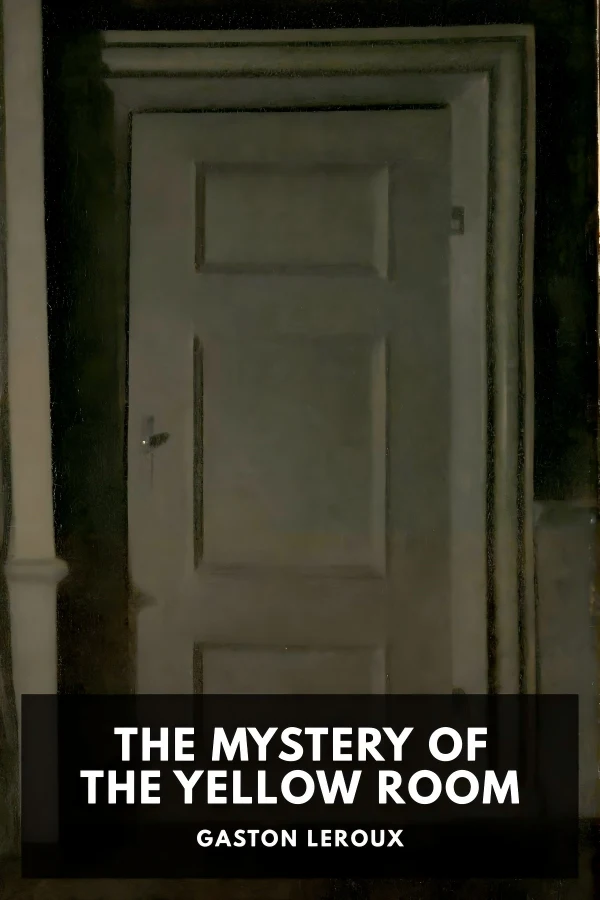
The Mystery of the Yellow Room
📖 Click to Read the Opening Pages Online Preview
Chapter I: In Which We Begin Not to Understand
It is not without a certain emotion that I begin to recount here the extraordinary adventures of Joseph Rouletabille. Down to the present time he had so firmly opposed my doing it that I had come to despair of ever publishing the most curious of police stories of the past fifteen years. I had even imagined that the public would never know the whole truth of the prodigious case known as that of “The Yellow Room,” out of which grew so many mysterious, cruel, and sensational dramas, with which my friend was so closely mixed up, if, apropos of a recent nomination of the illustrious Stangerson to the grade of grand-cross of the Legion of Honour, an evening journal—in an article, miserable for its ignorance, or audacious for its perfidy—had not resuscitated a terrible adventure of which Joseph Rouletabille had told me he wished to be forever forgotten.
“The Yellow Room!” Who now remembers this affair which caused so much ink to flow fifteen years ago? Events are so quickly forgotten in Paris. Has not the very name of the Nayves trial and the tragic history of the death of little Menaldo passed out of mind? And yet the public attention was so deeply interested in the details of the trial that the occurrence of a ministerial crisis was completely unnoticed at the time. Now “The Yellow Room” trial, which preceded that of the Nayves by some years, made far more noise. The entire world hung for months over this obscure problem—the most obscure, it seems to me, that has ever challenged the perspicacity of our police or taxed the conscience of our judges. The solution of the problem baffled everybody who tried to find it. It was like a dramatic rebus with which old Europe and new America alike became fascinated. That is, in truth—I am permitted to say, because there cannot be any author’s vanity in all this, since I do nothing more than transcribe facts on which an exceptional documentation enables me to throw a new light—that is because, in truth, I do not know that, in the domain of reality or imagination, one can discover or recall to mind anything comparable, in its mystery, with the natural mystery of “The Yellow Room.”
That which nobody could find out, Joseph Rouletabille, aged eighteen, then a reporter engaged on a leading journal, succeeded in discovering. But when, at the Assize Court, he brought in the key to the whole case, he did not tell the whole truth. He only allowed so much of it to appear as sufficed to ensure the acquittal of an innocent man. The reasons which he had for his reticence no longer exist. Better still, the time has come for my friend to speak out fully. You are going to know all; and, without further preamble, I am going to place before your eyes the problem of “The Yellow Room” as it was placed before the eyes of the entire world on the day following the enactment of the drama at the Château du Glandier.
A professor’s daughter is found beaten half to death in a room locked from the inside, with no other door, no ladder at the window and no one inside. Download the complete unabridged novel for your e-reader.
Download Full EPUB1907
~74,000 words (estimated)
Approx. 4.1 hours
Joseph Rouletabille #1
The Château du Glandier, outside Paris
29 numbered chapters
EPUB · AZW3 · KEPUB
1.96 MB (EPUB) · 1.86 MB (AZW3) · 1.86 MB (KEPUB)
Public domain in the United States
Standard Ebooks
The Mystery of the Yellow Room is Gaston Leroux’s 1907 locked-room novel, published two years before he began The Phantom of the Opera, and the first book to feature the teenage reporter Joseph Rouletabille.
Mathilde Stangerson is found nearly dead in a room locked from the inside, her father’s laboratory next door, the window barred by an unbroken shutter and the only key in the lock. The police decide the fiance’s guilt is obvious; Rouletabille decides that a room can only be impossible until somebody explains it. This edition follows the Brentano’s English translation, is in the public domain in the United States, and is in the public domain there. The text is available via Standard Ebooks.
The Mystery of the Yellow Room by Gaston Leroux: Summary, Characters & Themes
This summary and analysis treats The Mystery of the Yellow Room as Gaston Leroux’s 1907 novel, the book that made his reputation before The Phantom of the Opera and one of the first detective novels built entirely around a locked room. Leroux was a court reporter and theatre critic who knew how police investigations actually worked, and he uses that knowledge to make the impossible look bureaucratic: the examining magistrate arrives, the witnesses contradict each other, and the impossible room is photographed, measured and filed.
The plot is a duel between two detectives. Frédéric Larsan is the professional, a celebrated policeman who works by motive and arrest; Joseph Rouletabille is eighteen, a reporter, and works by asking what the evidence would look like if the obvious answer were wrong. Mathilde Stangerson, the victim, is the daughter of a scientist researching “the dissociation of matter,” and the novel keeps offering the reader a supernatural explanation for a crime that has an entirely ordinary — and much sadder — one.
The Yellow Room itself is the book’s great invention: a room with one door and one window, locked from the inside, in which a woman is attacked and from which the attacker vanishes. Leroux gives the reader the measurements, the plan, the mud on the sill and the testimony, and then has Larsan explain it all away. The solution, when Rouletabille finally gives it, is not a trick of architecture but a trick of timing, and the novel is honest enough to make the truth less exciting than the mystery.
What has kept the book alive is Rouletabille, who is the first detective in fiction to be younger than the reader expects and to solve cases by refusing to accept a story that everyone else finds satisfying. He reappears in The Perfume of the Lady in Black and The Secret of the Night, and the method — the reporter who out-thinks the police by taking the impossible seriously — is the direct ancestor of a hundred later detectives.
This edition follows the Brentano’s English translation of 1908 and is based on the Standard Ebooks edition, with all twenty-nine chapters intact. The text is in the public domain in the United States; readers elsewhere should check their own law. Both Leroux novels on this site are gathered on the Gaston Leroux author page, and the translation is the work of the New York house of Brentano’s.
Historical Context
The locked-room mystery was already a recognised sub-genre when Leroux wrote this book — Poe’s The Murders in the Rue Morgue had appeared in 1841 and Conan Doyle had been publishing Sherlock Holmes since 1887 — but Leroux was the first to make the impossibility itself the subject. The novel’s long passages of measurement and reconstruction are a parody of the scientific detective and an advertisement for him at the same time.
The book also belongs to the great age of French crime reporting. Leroux covered the courts for Le Matin and knew the difference between what a policeman can prove and what a newspaper can print; Rouletabille’s advantage over Larsan is precisely that he works for a paper and can afford to be wrong in public. The novel’s picture of a château sealed off by reporters, gendarmes and neighbours is drawn from life.
The science in the background is real period science. Professor Stangerson’s researches into the disintegration of matter echo the discoveries of radium and X-rays that had astonished the 1900s, and the novel uses them the way a modern thriller uses genetics: as a respectable explanation for something that turns out to be entirely human.
Key Characters & Literary Archetypes
- Joseph Rouletabille (the detective): An eighteen-year-old reporter with a gift for arithmetic and an allergy to other people’s certainty. His method is to accept the impossible and then ask what made it possible.
- Jean Sainclair (the narrator): A young lawyer and Rouletabille’s friend, who tells the story and is consistently one step behind him. His function is to be the intelligent reader who still gets it wrong.
- Mathilde Stangerson (the victim): The professor’s daughter, forty and unmarried, found nearly dead in the Yellow Room. Her silence about her past is the real mystery of the book, and the one the detective saves for last.
- Professor Stangerson (the scientist): A chemist working on the dissociation of matter, whose laboratory adjoins the Yellow Room. His obsession with his research is what allows the household to keep its secrets.
- Robert Darzac (the fiancé): A colleague of the professor and Mathilde’s intended husband, arrested because he refuses to explain where he was. His chivalry is the most dangerous thing in the novel.
- Frédéric Larsan (the rival): France’s most famous detective, a man of motive and method who solves the case to his own satisfaction and is wrong in the most interesting way possible.
- Ballmeyer (the shadow): A master criminal from Mathilde’s past in America, mentioned long before he appears, and the reason the case has a history nobody in the château wants examined.
- Jacques and the Berniers (the servants): The old servant, the concierges and the gamekeeper who make up the household’s small society. Their evidence is the novel’s comedy and its alibi.
Core Literary Themes
- The impossible room: Leroux gives the reader a plan, a lock and a window, and then shows that the impossibility was never physical. The room is a lesson in how evidence is assembled.
- The reporter as detective: Rouletabille works for a newspaper, not the police, and the novel is interested in the difference: the press can publish a theory the police cannot afford.
- Reputation and secrecy: Every character in the château is protecting a name. The crimes are committed to keep a marriage secret and investigated by men worried about their records.
- Science as alibi: The professor’s research into matter offers the reader a supernatural solution; the novel lets you believe it for two hundred pages before taking it away.
- The past returning: Mathilde’s American marriage is the buried fact that explains everything, and the book is structured as an excavation of a life everybody else has agreed to forget.
- Youth against authority: Rouletabille is a teenager who is right and Larsan is a professional who is wrong, and the novel enjoys the reversal enormously.
Why Download Our Custom E-Reader Edition of The Mystery of the Yellow Room?
The Mystery of the Yellow Room is around 74,000 words and twenty-nine chapters, which makes it a long evening or two comfortable sittings. It is also the founding text of the locked-room mystery as a modern genre: almost every impossible crime written since has been answering Leroux, whether it knows it or not.
The translation matters. Brentano’s published the English text in 1908 while Leroux was still writing sequels, and it keeps the French procedure — the examining magistrate, the confrontation, the depositions — that later adaptations cut. Reading it is the closest an English reader can get to the book Paris actually read.
This edition is DRM-free, unabridged and formatted for a screen rather than a page, with a navigable table of contents and chapter-level navigation, so the Yellow Room’s plan and the final explanation can be checked against each other in a couple of taps.
- Based on the Standard Ebooks Edition, via Standard Ebooks: A corrected text of the Brentano’s translation, checked against scans of the early English printing, with all twenty-nine chapters intact.
- Granular Architectural NCX/Nav Structural Navigation: Every chapter is individually addressable, which matters in a book whose solution is distributed across a hundred small details.
- Calibrated Typographical Layout: Body text in a readable serif face at a comfortable size, generous line spacing, and no page-thrashing layout on small screens.
- Verified Public Domain Sources: The text is in the public domain in the United States and was sourced from Standard Ebooks, which is freely available for anyone who wants to compare the edition.
- The Phantom of the Opera by Gaston Leroux — free EPUB, AZW3 & KEPUB
- The Moonstone by Wilkie Collins — free EPUB, AZW3 & KEPUB
- The Big Four by Agatha Christie — free EPUB, AZW3 & KEPUB
Chapter summaries
Twenty-nine short chapters, merged here into ten movements that follow Rouletabille from a newspaper office to the château at Glandier and into the history nobody wants explained — with nothing given away that the book does not give away itself.
- Chapters I–III: A newspaper office, a telegram and a young reporter who talks his way onto the story: Mathilde Stangerson has been found in the Yellow Room with the door locked from the inside, and by the time Rouletabille reaches Glandier the household has already decided what happened. The chapter title says it plainly: we begin not to understand.
- Chapters IV–VI: Glandier itself: the château, the laboratory, the walled garden and the household of servants and scientists. Rouletabille meets Larsan, who is charming and certain; he meets Darzac, who is silent and therefore guilty; and he begins to measure the Yellow Room, which is the only thing in the case nobody has lied about.
- Chapters VII–IX: The room examined from underneath: the floor, the ceiling, the corridor and the shutters, with Rouletabille crawling about on his hands and knees while the magistrate takes statements. A second attempt on Mathilde’s life is made inside the château, and the attacker again seems to walk through a wall.
- Chapters X–XII: Larsan produces his explanation of how the murderer left the Yellow Room, and the company accepts it because it is clever. Rouletabille refuses it, is mocked for refusing it, and starts collecting the details that do not fit — beginning with a cane that was not there the night before.
- Chapters XIII–XV: The presbytery and the garden, the gamekeeper and the inn: Rouletabille works the small society around the château and finds a man who has been watching the house. A trap is set in the gallery, and the man who is supposed to walk into it is warned in advance.
- Chapters XVI–XVIII: The famous “dissociation of matter” chapters: a figure appears and disappears under the eyes of four witnesses, and the professor’s research is offered as an explanation. Rouletabille draws a circle between the two bumps on his forehead and says nothing, which in this book is a declaration of war.
- Chapters XIX–XXII: Breakfast at the Donjon Inn, an act of Mathilde’s that nobody can explain, and a night watch in which the watchers become the watched. The body that cannot be identified is found, the gamekeeper is murdered, and the case stops being a puzzle about a room and becomes a story about a family.
- Chapters XXIII–XXV: Two scents, two men, one set of footprints: Rouletabille tells the reader that he now knows both halves of the murderer, and then leaves for Paris without saying which halves. Larsan arrests Darzac, and the trial of the fiancé becomes the only clock the story has left.
- Chapters XXVI–XXVIII: The courtroom, the witnesses and the return of the reporter who was supposed to have given up. Rouletabille produces his accusation in open court, and the detective who has been leading the case gets up and walks out of the building — which is the closest the novel comes to an arrest.
- Chapter XXIX: The explanation: the Yellow Room, the timing, the wound that was not a blow, the American marriage and the child nobody in the château knew about. The last chapter is the saddest in the book, and it is the reason the book is still read.
The Mystery of the Yellow Room: Frequently Asked Questions
What genre is The Mystery of the Yellow Room?
What is The Mystery of the Yellow Room about?
Is this the same author as The Phantom of the Opera?
Who is Joseph Rouletabille?
Is The Mystery of the Yellow Room the first locked-room mystery?
How long does it take to read?
Is it suitable for younger readers?
Where can I download The Mystery of the Yellow Room as a free EPUB, AZW3, or KEPUB?
Part of: Detective and mystery classics · Classic books by word count