Three Men in a Boat by Jerome K. Jerome: Free EPUB, AZW3 & KEPUB Download
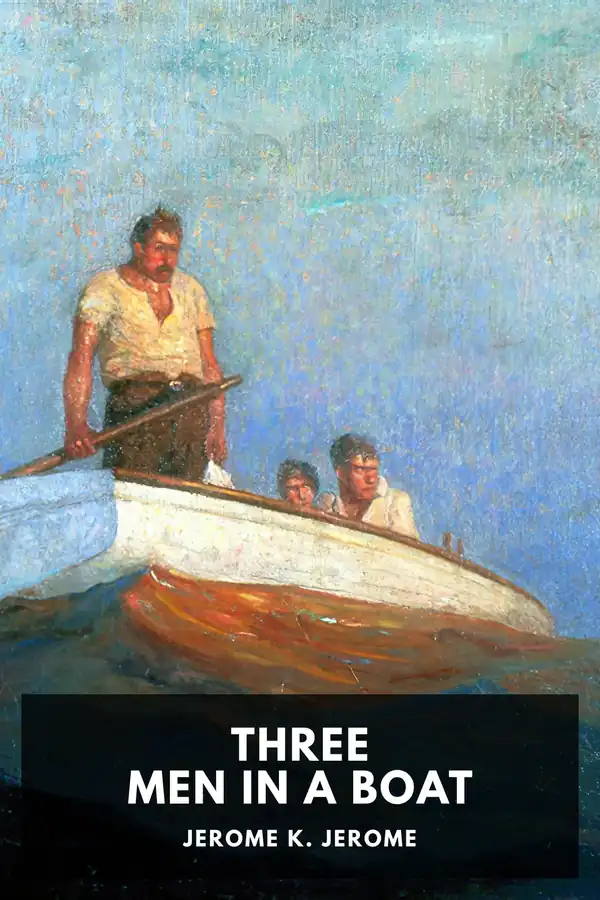
Three Men in a Boat
📖 Click to Read the Opening Pages Online Preview
The opening of Chapter 1
There were four of us—George, and William Samuel Harris, and myself, and Montmorency. We were sitting in my room, smoking, and talking about how bad we were—bad from a medical point of view I mean, of course.
We were all feeling seedy, and we were getting quite nervous about it. Harris said he felt such extraordinary fits of giddiness come over him at times, that he hardly knew what he was doing; and then George said that he had fits of giddiness too, and hardly knew what he was doing. With me, it was my liver that was out of order. I knew it was my liver that was out of order, because I had just been reading a patent liver-pill circular, in which were detailed the various symptoms by which a man could tell when his liver was out of order. I had them all.
It is a most extraordinary thing, but I never read a patent medicine advertisement without being impelled to the conclusion that I am suffering from the particular disease therein dealt with in its most virulent form. The diagnosis seems in every case to correspond exactly with all the sensations that I have ever felt.
The preview stops after the first three paragraphs of Chapter 1, quoted from the Standard Ebooks text; the rest of the journey is in the free download below.
Download Full EPUB1889
~67,000 words (estimated)
Approx. 3.7 hours
Standalone
The Thames between Kingston and Oxford in the late 1880s
Nineteen chapters, one river
EPUB · AZW3 · KEPUB
0.65 MB (EPUB) · 0.69 MB (AZW3) · 0.67 MB (KEPUB)
Public domain in the United States
Project Gutenberg #308 · Standard Ebooks
Three Men in a Boat is Jerome K. Jerome’s account of a fortnight afloat on the Thames, undertaken by three friends who have diagnosed themselves with overwork and a fourth who is a fox-terrier with a low opinion of the plan. J., George and Harris pack a hamper, argue about cheese, lose a toothbrush inside a boot, tow the wrong boat, fail to open a pineapple tin and finally bolt for the train at Pangbourne. Very little of it is really about rowing. The comedy is in the digressions, and so is the odd, sudden shadow that falls across them.
Jerome began the book as a straight guide to the Thames, with a history of every town and a note of the inns, and found that his jokes were better than his itinerary. J. W. Arrowsmith published it in Bristol in 1889, and it has stayed in print ever since, along with a sequel, Three Men on the Bummel, that nobody remembers as fondly. Wikipedia’s article on Three Men in a Boat sets out the publication history. The text is available via Project Gutenberg #308 and Standard Ebooks, whose edition is set from that Gutenberg transcription.
Three Men in a Boat by Jerome K. Jerome: Summary, Characters & Themes
This page is a summary and analysis of Three Men in a Boat, the comic travel book Jerome K. Jerome published in 1889. J., George and Harris decide that their health requires a holiday, hire a boat at Kingston, load it with a hamper, a canvas cover and a dog called Montmorency, and set off up the Thames toward Oxford. What follows is less a plot than a series of disasters with pauses: the packing, the weather forecast, the maze at Hampton Court, the towline, the kettle, the pineapple tin. The journey ends by train from Pangbourne, which is the joke and also, in the book’s own terms, the truth.
The structure is a river with tributaries. Every leg of the journey is interrupted by a story that has nothing to do with the journey and everything to do with the sort of men telling it: Uncle Podger hanging a picture, the cheeses that had to be buried on a beach, the German professor whose tragic song is mistaken for comedy, the old river hand who did everything better last season. Jerome writes in the present tense of a remembered holiday, and the digressions are not padding. They are the method. A chapter of straight travel writing would have been dull, and he knew it before his readers did.
Jerome K. Jerome was born in Walsall in 1859, the son of an ironmonger and lay preacher who moved the family to London and died in debt. He left school at fourteen and worked as a railway clerk, a schoolmaster, a journalist and an actor before turning to journalism and comic writing. The Thames book made his name, and he spent the rest of his life trying to repeat it, in novels, plays, essays and an autobiography. He wrote the sequel, Three Men on the Bummel, in 1900, in which the same men take bicycles to Germany and the joke wears thinner.
Readers who enjoy the riverbank comedy should try The Wind in the Willows, where Kenneth Grahame does something similar with animals in place of clerks and a river that is a good deal kinder. Pride and Prejudice supplies the other half of the English comic tradition, the comedy of manners, where the jokes are made by people who would never admit to making them. The Odyssey is the oldest version of the same story, a journey home interrupted by hospitality, monsters and long digressions, and Jerome’s men would recognise the hospitality at least.
The text here follows the Standard Ebooks edition, which was prepared from the Project Gutenberg #308 transcription and proofed against the early printing. Spelling and punctuation are the book’s, the chapter divisions are the book’s own, and nothing has been abridged or annotated inside the file. The thirteen summaries below follow that text from Kingston to Oxford, with the digressions kept in the order Jerome put them. Anyone who wants to check a passage can compare the file with the Gutenberg transcription, and the two agree chapter for chapter.
Historical Context
By the 1880s the Thames had become a playground. The railway had reached Kingston, Henley and Oxford, the Conservancy had cleaned up a river that was still a working highway, and the Bank Holidays Act of 1871 had given clerks and shop assistants days off in which to enjoy it. Rowing clubs multiplied, pleasure steamers ran from Richmond and Kingston, and a fortnight’s camping on the upper river was cheap enough for men on modest salaries. Guidebooks multiplied with the boats, listing inns, locks, fishing and the charge for a skiff. Three Men in a Boat arrived in the middle of that fashion and made fun of it while using it.
Jerome had already made his name with Idle Thoughts of an Idle Fellow in 1886, and the Thames book began as a guide: a description of the river from Kingston to Oxford, with the history of each town and a note on where to stay. The comic material grew until it swallowed the guide, and what Arrowsmith published in 1889 was a hybrid, part travel book, part memoir, part stage routine, with a preface claiming that the incidents were true and that the author had suffered them. Reviews were mixed and sales were slow at first. Then the book began to sell steadily, and its author discovered that he had written the one thing he would never be allowed to forget.
Its afterlife has been long. Pirated American editions appeared within a year, a stage version came later, and a sequel followed in 1900. It has stayed in print, been translated into many languages, adapted for film and it is one of the few Victorian books that people still pick up for pleasure rather than duty. Part of the reason is that its subject is not really the Thames but the ordinary conviction that everything is somebody else’s fault, which has not dated at all.
Key Characters & Literary Archetypes
- J.: The narrator, a hypochondriac who reads a patent medicine circular and concludes that he has every disease in it: “I was a hospital in myself.” He is the one who remembers the river’s history, delivers the purple passages about moonlight and then punctures them, and keeps the joke running. He is also the one who falls in the water and claims it was pluck. At Goring he stops being funny for two pages, which is the measure of how carefully the comedy has been built.
- George: A bank clerk who sleeps at the bank from ten to four and is therefore the practical one whenever he is awake. He arrives at Weybridge with a banjo, which the others would rather he had not. He is the man left to try the Hampton Court maze on his own, the man who suggests the Irish stew, and the man whose shirt J. ends up wearing after the bathing accident. He is quietly the most competent and the least interested in being funny.
- Harris: Stout, thirsty, and gifted with a comic song that nobody wants to hear twice. He loves tombs and the history in them, which is unfortunate, since J. loathes graves and will go to any length to avoid one. His method of work is to find somebody else to do it, a principle illustrated at length by his uncle Podger. He dives head-first into the hamper while steering, packs the butter into the teapot, and is the character most often found upside down.
- Montmorency: A small fox-terrier with what his owner calls original sin: he has killed a dozen chickens, fought a hundred and fourteen street fights and once helped a gardener win thirty shillings by killing rats against the clock. He objects to the whole expedition, sits on the packing, mistakes lemons for rats, howls whenever George takes out the banjo, and contributes a dead water-rat to the Irish stew. He barks his agreement at the final toast, which is the only sensible thing anyone says all book.
- Uncle Podger: He never comes near the river, and he is still the funniest person in the book. Asked to hang a picture, he sends the girl for nails, the boy after the girl, and half the household for a stepladder, a kitchen chair and a borrowed spirit-level; he drops the picture, loses the nail, loses the mark on the wall, slides off the chair onto the piano and puts the picture up at midnight, crooked. His complaint is that some people would have had a man in to do a little thing like that.
- The woman with the baby: She appears only in the Hampton Court maze, and she gets the better of Harris, which is why she is here. She has been inside since the morning, with a baby on her arm, when Harris collects her into his procession of lost visitors, and when the half of a penny bun on the path gives them all away she tells him plainly that he is an impostor. Harris never recovers his authority in the chapter, and the maze ends with the keeper lost as well.
Core Literary Themes
- Comic incompetence: Nothing in the book is done well. The tent collapses, the towline tangles, the tin will not open, the eggs become a burnt teaspoonful, and the three men who set out to prove their competence spend a fortnight proving the opposite in public. Jerome’s method is to let each man describe his own expertise and then stand back while the river contradicts him. The incompetence is not stupidity; it is the gap between how people talk about themselves and what their hands actually do, which is the oldest engine of English comedy.
- The myth of the holiday: The holiday is promised as a cure and delivered as work. Packing takes until one in the morning, the early start is missed, the boat is heavier than expected, and the rest that was supposed to restore them is spent rowing, cooking badly and looking for lodgings. Jerome is fond of the promise even while he dismantles it: the purple passage about moonlight on the water is beautiful, and the rain that follows is funnier because the passage was beautiful. The book is a catalogue of what holidays are really like, written by someone who kept taking them.
- Victorian leisure and the river: The Thames in the 1880s was a new kind of public space, reachable by train and affordable by clerks, and the book is full of its new users: the fashion-plate ladies at a picnic, the shop boys carrying the marketing, the steam launches whose owners will not look at a rowing boat, the lock keepers, the washers of linen, the professional boatmen. Jerome records the manners of this crowd with affection and a sharp eye, and the comedy is almost always about class meeting class on water that belongs to everybody and to nobody.
- Nostalgia and mortality beneath the farce: Two chapters stop the laughter. At Goring the men find a young woman drowned in the river, and Jerome gives her a life and a child and a penny box of chocolate before he lets the story go, with the sentence that she sinned in living and in dying. Earlier, the night walk and the parable of the dark wood name sorrow plainly. These passages are not interruptions of the comedy; they are what the comedy is protecting against, and the book’s reputation for cheerfulness depends on the reader noticing how close the sadness is.
- Digression as form: The book has almost no plot and does not want one. Its unit is the anecdote, and the anecdotes are triggered by whatever the boat passes: a lock suggests a story about locks, a tomb suggests a story about tombs, a German song suggests a party that ended badly. Jerome had written for magazines, where the column is the form, and he carried the column into a book. The result should be shapeless and is not, because the river supplies the spine and the jokes supply the rhythm, and the ending lands on a train because the river has run out.
Why Download Our Custom E-Reader Edition of Three Men in a Boat?
The book is short, funny and easy to dip into, which makes it a good test of an e-reader file. This edition follows the Standard Ebooks text, set from the Project Gutenberg transcription and proofed against the early printing, so the dashes, the italics and the paragraphing are the book’s rather than a converter’s. The nineteen short chapters are properly divided, and the table of contents takes you to each one without disturbing the prose.
It is also a book people reread, or read aloud, and the file is built for that: working navigation, chapter breaks in the right places, a cover that survives being sent to a Kindle, and text that reflows on a phone. Nothing has been abridged, modernised or annotated inside the book. The summaries and notes on this page are kept outside the text, where they belong, so the download is the holiday as Jerome printed it.
The text follows the Project Gutenberg #308 transcription of the book as Arrowsmith printed it, and the Standard Ebooks edition keeps that reading with its corrections to punctuation and italics. Compare a disputed sentence with the transcription and the two agree chapter for chapter. Take the EPUB, the AZW3 or the KEPUB and the whole of the Thames is yours, from the packing at Kingston to the toast at the end, with nothing to sign and nothing to renew.
- Based on the Standard Ebooks Edition, via Standard Ebooks, whose editors prepared the text from the Project Gutenberg transcription and proofed it against the early printing; the chapter divisions used in the summaries below are theirs, so page and file match chapter for chapter.
- Free EPUB, AZW3 and KEPUB files One download per format, each with a working table of contents and a cover that survives being sent to a device. EPUB for most readers, AZW3 for Kindle, KEPUB for Kobo, all three carrying the same complete text and none of them locked or watermarked. Small enough for an old reader, complete enough for a new one.
- Chapter summaries and a reading guide Thirteen summaries follow the nineteen chapters, grouping the short ones where the journey doubles back, with notes on the historical context, the characters and the themes, and answers to the questions readers ask most often. The page can be read before the book, used as a map while reading, or consulted afterwards to see how the jokes were arranged.
- No sign-up, no paywall No account, no subscription and no sample chapter standing in for the book. The text is public domain in the United States, and the file is yours to keep, copy between devices and reread, with nothing that expires and nothing hidden inside it.
- The Wind in the Willows — free EPUB, AZW3 & KEPUB
- Pride and Prejudice — free EPUB, AZW3 & KEPUB
- The Time Machine — free EPUB, AZW3 & KEPUB
Chapter summaries
Nineteen chapters, most of them interrupted by something. These summaries follow the Standard Ebooks text in order, grouping the short chapters where the trip doubles back on itself, and leaving the digressions where Jerome put them, between the packing at Kingston, the locks and the last train from Pangbourne. Read them as a map of the journey and of the jokes, which arrive in the order a fortnight on the water would produce them.
- Chapter 1 — A hospital in himself: Three friends sit in a room discussing their ailments, and J. reads a patent medicine circular until he is sure he has every disease listed except housemaid’s knee, which he expects by post. A doctor prescribes beefsteak, bitter beer, a ten-mile walk and an early bed, and diagnoses overwork. Harris proposes a sea voyage and is dismantled; George suggests the river, and Montmorency, who objects, is outvoted three to one.
- Chapter 2 — Camping out and the question of rain: Plans are laid: Harris and J. take the boat from Kingston to Chertsey on Saturday, and George joins them after work. They dream aloud about sleeping under the stars until Harris asks what happens when it rains, then answers himself with a long farce about a tent collapsing on three men in the dark. They compromise, camping when it is fine and taking rooms when it is wet, and Montmorency’s criminal record is entered in evidence.
- Chapter 3 — Uncle Podger and the lumber of life: Harris says his way of working is to find someone else to do it, and offers his uncle Podger hanging a picture as proof: nails, hammer, stepladder, a borrowed spirit-level, a cut finger, a lost coat, a fall onto the piano and a picture up at midnight, crooked. George’s rule is to take only what cannot be done without, and they settle on a boat with a canvas cover.
- Chapter 4 — Cheese, packing and the three lemons: No paraffin oil, because it oozes, and no cheese, because of a story about two Liverpool cheeses that emptied a railway carriage, bolted with the cab horse and ended up buried on a beach. Then the packing: J. forgets his boots and finds his toothbrush inside a boot. George and Harris break a cup, squash a tomato with the jam, tread the butter into the teapot and salt everything, while Montmorency kills three lemons he takes for rats.
- Chapter 5 — The forecast, the crowd and the wrong train: Mrs Poppets wakes them at nine, George falls into the bath, and the toothbrushes are fished out of the packed bag. A weather forecast predicts everything at once, which sets off a digression on forecasting and the Oxford barometer that reads very dry while the town floods. The luggage draws a street crowd, nobody at Waterloo knows the platform, and half a crown persuades the driver to be the eleven five for Kingston, which is really the Exeter mail.
- Chapter 6 — Kingston and the Hampton Court maze: Kingston gives J. a page of Saxon kings, Caesar and Elizabeth, and a shopman who has papered over a carved oak room. He is so busy remembering history that he forgets to steer and runs into the towpath. Harris then tells how he studied the map of the Hampton Court maze, took a cousin inside, collected twenty followers including a woman with a baby, and was called an impostor when a half-penny bun on the path gave them away.
- Chapters 7–8 — Sunday dress and a comic song: At Moulsey Lock on a Sunday the river is a flower show. J. describes the correct boating costume and the dreadful approximations worn by his friends, then the two fashion-plate ladies made to wash up at a picnic. Harris insists on seeing a tomb and the sexton offers him skulls. On Sunday afternoon Harris sings badly, and a German professor’s tragic song is laughed at by a whole party, who are cursed for it.
- Chapter 9 — George is introduced to work: George is put to towing and the towline immediately tangles itself, two men blaming each other while the boat drifts toward the weir. A courting couple tow the wrong boat for miles, a barge horse flings five loungers onto the bank, and three girls take the rope with more success than any of the men. J. remembers hunting for Wallingford lock, abolished a year earlier, and being rescued by a concertina in the dark.
- Chapters 10–11 — The first night and the cussedness of things: They camp at Picnic Point and fight the canvas cover, which has iron hoops and a temper. The kettle boils only when ignored, supper produces four separate sighs, and talk turns to desert islands, drains and two men in one bed. J. cannot sleep, walks out and tells a parable about a dark wood called Sorrow. Morning brings the bathing dare, George’s shirt, and six eggs reduced to a teaspoonful of burnt regret.
- Chapters 12–13 — Datchet, the pineapple tin and Marlow: Between the chores and the history is the night at Datchet, when every lodging in town is full and Harris prepares to die on the hamper until a boy with a beer can leads them to his mother’s cottage. Then the pineapple tin with no opener, which defeats a knife, scissors, the mast and a hitcher before it goes in the river. At Marlow, Montmorency is stared down by a black cat.
- Chapters 14–15 — Irish stew and the old river hand: The potatoes defeat them, so everything goes into the pot unpeeled and Montmorency adds a dead water-rat. George’s banjo is discussed and the dog howls. Harris loses the party in the rain, the whisky disappears and the swans multiply overnight. Then J. explains that he loves work and can sit and look at it for hours, and the old river hand begins the comedy of men who did everything better last season.
- Chapter 16 — The woman in the river at Goring: A friend’s steam launch tows them most of the way to Streatley, and then the book changes key. Near Goring they find a young woman drowned in the river, and Jerome gives her a history: seduced, turned out, twelve shillings a week, a child, a last appeal refused, a ticket and the water. The men lift her out and go on to lunch at the Bull, and the holiday is never quite the same.
- Chapters 17–19 — The plaster trout, the locks and the train home: Washing day at Streatley, and a fishing chapter in which nobody catches anything and a glass-case trout of legendary weight turns out, when George drops it, to be plaster of Paris. At Hampton Court a photographer says look at your nose, meaning the boat’s nose under the lock, and the photograph is ruined. Two days at Oxford and a change in the weather end it: they see a train at Pangbourne and take it.
Three Men in a Boat: Frequently Asked Questions
What is Three Men in a Boat about?
Is it a novel or a travel book?
Is the book autobiographical?
Who is Montmorency?
Why does so little happen?
Is it suitable for children?
How long does it take to read?
Where can I download the free EPUB, AZW3 and KEPUB?
Part of: Classic Fiction · Jerome K. Jerome