The Innocents Abroad by Mark Twain: Free EPUB, AZW3 & KEPUB Download
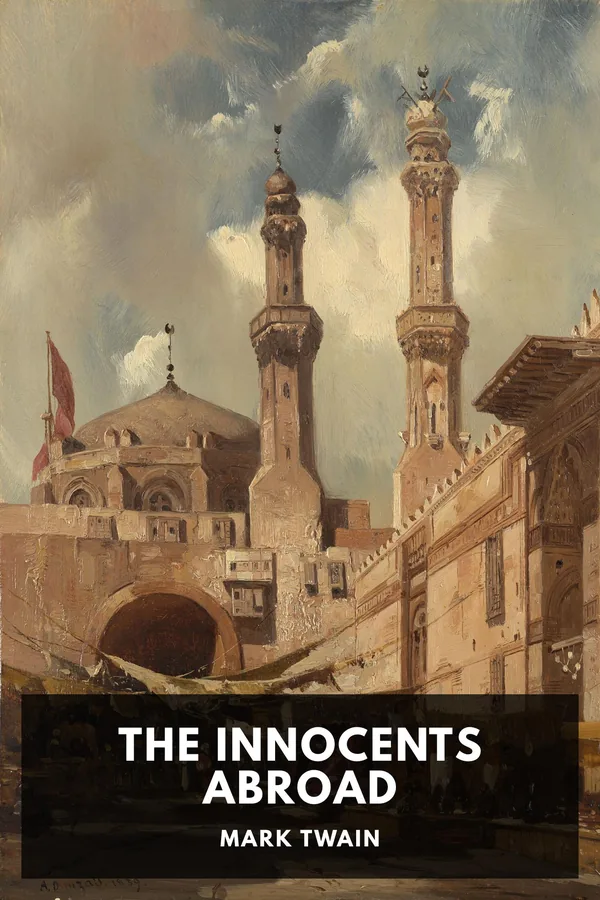
The Innocents Abroad
📖 Click to Read the Opening Pages Online Preview
The opening of Chapter 1
Occasionally, during the following month, I dropped in at 117 Wall Street to inquire how the repairing and refurnishing of the vessel was coming on, how additions to the passenger list were averaging, how many people the committee were decreeing not “select” every day and banishing in sorrow and tribulation. I was glad to know that we were to have a little printing press on board and issue a daily newspaper of our own. I was glad to learn that our piano, our parlor organ, and our melodeon were to be the best instruments of the kind that could be had in the market. I was proud to observe that among our excursionists were three ministers of the gospel, eight doctors, sixteen or eighteen ladies, several military and naval chieftains with sounding titles, an ample crop of “Professors” of various kinds, and a gentleman who had “Commissioner of the United States of America to Europe, Asia, and Africa” thundering after his name in one awful blast! I had carefully prepared myself to take rather a back seat in that ship because of the uncommonly select material that would alone be permitted to pass through the camel’s eye of that committee on credentials; I had schooled myself to expect an imposing array of military and naval heroes and to have to set that back seat still further back in consequence of it maybe; but I state frankly that I was all unprepared for this crusher.
I fell under that titular avalanche a torn and blighted thing. I said that if that potentate must go over in our ship, why, I supposed he must—but that to my thinking, when the United States considered it necessary to send a dignitary of that tonnage across the ocean, it would be in better taste, and safer, to take him apart and cart him over in sections in several ships.
Ah, if I had only known then that he was only a common mortal, and that his mission had nothing more overpowering about it than the collecting of seeds and uncommon yams and extraordinary cabbages and peculiar bullfrogs for that poor, useless, innocent, mildewed old fossil the Smithsonian Institute, I would have felt so much relieved.
The excerpt below quotes the opening of Chapter 1, where the narrator describes the great pleasure excursion talked of in every newspaper in America, prints the prospectus of the Holy Land trip with its price, route and committee on applications, and explains how he paid his ten percent and was accepted as one of the select party.
Download Full EPUB1869
Travel writing
193,000 words
10.7 h
Standalone
Europe and the Levant in 1867, from the Azores, Gibraltar and Paris to Rome, Constantinople, the Crimea, Jerusalem and the pyramids of Egypt.
Sixty-one chapters and a Conclusion, grouped into fourteen parts
EPUB · AZW3 · KEPUB
1.23 MB (EPUB) · 1.26 MB (AZW3) · 1.29 MB (KEPUB)
Public domain in the United States
Project Gutenberg #3176 · Standard Ebooks
The Innocents Abroad is Mark Twain’s account of the Quaker City excursion of 1867, a chartered side-wheel steamer that carried sixty-five passengers from New York to the Azores, Gibraltar, France, Italy, Greece, Turkey, the Crimea, the Holy Land and Egypt. Twain was one of the party, and he writes as a tourist among tourists: he prints the prospectus, reports the fares, hotels, guides, relics and ruins, and records what the pilgrims said and did. The book is a record of a pleasure trip that keeps turning into a comedy of expectation, and its narrator never pretends to be neutral. He is the joke as often as he is the judge.
The book is travel writing with the report and the performance kept apart. Twain describes the route and the sights, then tells the reader what he made of them, and the laughter usually falls on the pilgrims, the guides and the guidebooks rather than on the places themselves. The tone hardens as the ship moves east: Palestine is smaller, drier and poorer than the Bible pictures, and the narrator says so in plain words. Wikipedia’s entry on the book covers its writing and its reception. — The text is available via Project Gutenberg #3176 and Standard Ebooks.
The Innocents Abroad by Mark Twain: Summary, People & Places
This page offers a summary and analysis of The Innocents Abroad, the book Mark Twain made out of the Quaker City excursion of 1867: sixty-one chapters and a Conclusion, set out here in reading order, with the party, the places and the arguments that run through them. Mark Twain sailed as one of sixty-five passengers, and what he wrote is not a guide but a report on tourists, himself included. It keeps apart two things that travel books usually blend: what the party actually did, and what the narrator made of it. The distinction matters, because the narrator is a humourist with a grudge against guidebooks, and his victims are as often the people beside him as the places they came to see. The chapter groups below follow the book’s own order.
The excursion was advertised in February 1867 by Charles C. Duncan of 117 Wall Street at twelve hundred and fifty dollars a passage, on a chartered side-wheel steamer, the Quaker City, which was to leave New York on 8 June for the Azores, Gibraltar, France, Italy, Greece, Turkey, the Crimea, the Holy Land and Egypt. A committee on applications chose the passengers, and the party that assembled numbered sixty-five, drawn from fifteen or sixteen states, with three ministers, eight doctors and a newspaper of its own printed on board. The first chapter prints the prospectus, and the document is worth having: it shows what was promised, which is the measure by which the narrator quietly judges what was delivered. The complete text is at Project Gutenberg #3176.
The comedy is social before it is geographical. The pilgrims are prosperous, earnest and sure of themselves, and they move through Europe in a straggling procession of green spectacles, blue umbrellas and costumes bought on the way; they are lectured at by guides, overcharged in shops and asked for baksheesh at every turn. Twain gives them types rather than names: the Oracle, who never uses a one-syllable word and invents authorities; the poet, who presses his verses on consuls; the boy Jack, with the journal his father told him to keep. He is fond of them and merciless about them at once, and the fondness keeps the satire from becoming contempt. The famous passages are nearly all of this kind, a scene of collective vanity reported without comment, then one line that fixes it.
Eastern travel changes the weather of the book. In France and Italy the joke is at the expense of the tourists; in Palestine it is at the expense of the pictures in the Bible and the books they had read at home. The country is small, bare and poor, the sacred sites are crowded with rival claims, and the narrator says so in the flat tone of a man comparing a place with its advertisement. He is not consistent, and does not try to be: he mocks the relics and then stands moved in the Church of the Holy Sepulchre. Two later American books sit usefully beside this one, Roughing It, Twain’s own account of the West, and Typee, Melville’s Polynesian narrative, which gave American travel writing its first bestseller.
The book appeared in 1869, and its manner, the first-person reporter who is also the butt of the joke, the deadpan inventory, the sudden drop into seriousness, became one of the templates of American comic prose. It is also a document of its moment: a party of Americans abroad in the 1860s, carrying letters from their government and a sturdy conviction of national superiority, and finding that the world does not arrange itself for their convenience. The text used here is the Standard Ebooks edition, set from the Project Gutenberg transcription, with the chapter numbers as the edition prints them. More books of the same kind are on the Classic Fiction shelf.
Historical Context
The excursion belonged to a decade of American travel. The prospectus is dated Brooklyn, 1 February 1867, and promises a first-class steamer, an experienced physician, a library and a select company; the price was twelve hundred and fifty dollars, with five dollars a day allowed for expenses ashore. The ship was the Quaker City, a side-wheel steamer chartered for the season, and she sailed on 8 June with sixty-five passengers, among them three ministers and eight doctors. Twain notes that the steamship lines were carrying Americans out of the ports at four or five thousand a week, and that everyone he met seemed to be going to Europe, most of them to the International Exposition in Paris. The party was a specimen of that traffic, and the book is a report on what the traffic looked like from inside.
The map the ship crossed was still an old one. Gibraltar was a garrison, Tangier a walled city under the Emperor of Morocco, Italy a kingdom less than a decade old with Rome still outside it, and Constantinople the capital of an Ottoman empire whose Sultan the party saw reviewing troops in Paris. In the Crimea they walked over the Malakoff and the Redan twelve years after the siege, and at Yalta they were received by the Russian Emperor. Palestine was a province of the Ottoman Empire, travelled on horseback with dragomans and tents, and the party carried revolvers against Bedouins it never met. Quarantine governed the ports: the ship was held at Naples, refused entry at Athens, and the party ran the blockade by night to see the Acropolis.
Twain’s raw material was journalism. The preface says that portions of the book were written first as letters for the Daily Alta California, whose proprietors waived their rights, and for the New York Tribune and the New York Herald; the last chapter prints, with an apology, the valedictory article he wrote for the Herald the night the ship reached New York. The book came out in 1869, and it made his name as a writer of travel. Its purpose, as the preface states it, is to suggest how a reader would be likely to see Europe and the East if he looked at them with his own eyes instead of the eyes of those who had travelled there before him. That sentence is the programme of the whole book, and the narrator keeps it.
People & Places
- The pilgrims: The sixty-five passengers of the Quaker City, drawn from fifteen or sixteen states and chosen by a committee on applications. Twain calls them pilgrims, and they behave like a tribe: they buy costumes, wear green spectacles, carry blue umbrellas and quarrel over seats and prices. They are the book’s collective hero and its standing joke.
- The Oracle: An old passenger who eats for four and looks wiser than the whole Academy of France, never uses a one-syllable word when a longer one will do, and cannot define the long words he uses. He invents authorities to win arguments, and in the ship’s story he mistakes Scylla and Charybdis for Sodom and Gomorrah. The party tolerates him and rather likes him.
- Ferguson: Not one man but a name. The party calls every guide Ferguson, whatever his real name, and the custom exasperates them all; even the celebrated Turkish guide Faraway Moses, famous from Murray’s handbooks, is renamed on the spot. Ferguson is the book’s type of the professional explainer: fluent, tireless, inaccurate, and convinced that the tourists want to buy silk rather than see the Louvre.
- Captain Duncan: Chief of the expedition, and the man who tells the narrator to stop smoking abaft the wheel. He makes the only good speech of the Fourth of July dinner, a short toast and an order for another basket of champagne. When a passenger challenges the coffee, Duncan tastes it and says it is inferior for coffee but pretty fair tea.
- Jack: One of the younger passengers, travelling with Dan and Moult, and keeping a journal because his father told him to. He writes down everything, including how many lies Moult has told, and is assured it will be worth more than a thousand dollars when it is done. His father’s parting advice, quoted in full, is a small comic masterpiece of American ambition and politeness.
- Blucher: A confiding young man from the Far West on his first voyage, booked for the excursion, and innocent of Europe to a degree the narrator finds restful. He buys a handkerchief on Broadway and tells the clerk he will hand him the change in Paris, though the clerk is not going. His new watch will not keep ship time.
Core Themes
- Seeing with your own eyes: The preface states the programme: to suggest how a reader would see Europe and the East if he looked with his own eyes rather than through the eyes of earlier travellers. The book tests that idea everywhere, and the test is usually comic. The pilgrims recognise Notre-Dame because it is like the pictures, and are disappointed when the pictures turn out to be better than the place. Twain’s method is to describe what is actually in front of him, dust, beggars, fees, bad coffee, and then to measure it against the engraving in the guidebook. The result is not a defence of the real against the ideal; it is a demonstration that most of what travellers see is what they came prepared to see.
- The pleasure excursion as a business: The trip is a commodity from the first page. There is a prospectus, a price, a committee on applications, a treasurer, a contract, and a printed programme that the party treats as a bond. The book keeps the accounts: fares, tips, guide fees, baksheesh, quarantine, the cost of a horse, the price of a kiss for a franc. Twain is amused by the advertising language of the prospectus and quietly uses it as a standard, so that a bad dinner or a closed church becomes a failure of the enterprise rather than an accident of travel. The pilgrims are consumers, and their disappointments are consumer complaints.
- Relics, frauds and belief: From the Azores to Jerusalem the party is shown relics: a piece of the true cross, nails, thorns, the stone of unction, the column of the centre of the earth, the grave of Adam. Twain reports the claims in a deadpan list and lets the repetition do the work. He is not a simple sceptic. He calls the Church of the Holy Sepulchre the most illustrious edifice in Christendom, and says it is still grand and venerable even with its claptrap and impostures, because a god died there. The book’s target is not faith but the trade in evidence, the guides and monks who manufacture proof for people who have come a long way to be convinced.
- The Holy Land in the present tense: The eastern chapters are the book’s second half and its real subject. Jerusalem is small enough to walk around in an hour, the country is bare, stony and poor, and the sacred places are villages of mud and stone. Twain refuses to pretend otherwise, and the refusal is the most argued part of the book: readers who wanted a devotional travelogue found a joke about a country rather than a pilgrimage. The description is not uniformly hostile. He is moved by Galilee, by the Sea of Tiberias at dawn, by the plain of the Shepherds, and the final verdict on the country is delivered as a list of what it gave the world rather than as a sneer.
- The innocent as narrator: Twain’s persona is a man who does not know the language, cannot manage the customs, and is confidently wrong about what he sees, and that persona is the engine of the comedy. He is the innocent abroad as much as the pilgrims are. He mispronounces French, misunderstands quarantine rules, is cheated by boatmen and barbers, and reports each failure with the same gravity he gives to St Peter’s. The pose allows him to say sharp things without claiming authority for them, and it lets the book end in affection rather than in satire: the Conclusion says travel is fatal to prejudice and that he would sail the same cruise again.
Why Download Our Custom E-Reader Edition of The Innocents Abroad?
The download is the whole book, sixty-one chapters and the Conclusion, from the prospectus in the first chapter to the Herald article and the farewell in San Francisco, with the chapter numbers the edition prints and nothing abridged. The text is the Standard Ebooks edition, set from the Project Gutenberg transcription, and the spelling, punctuation and chapter divisions are the edition’s own.
Around the text the page supplies what a long itinerary needs: fourteen grouped summaries that stop where their chapters stop, six character notes, five themes, and a note on the 1867 excursion, the ports and the quarantine that shaped the route. The groups are ours; the chapters and their numbering are not. A reader can follow the voyage city by city, or look up a single chapter without losing the thread of the tour.
The files come in three formats with the same text and the same chapter breaks. The EPUB opens in Apple Books, Calibre and most Android readers; the AZW3 is the file for a Kindle, by USB or through Send to Kindle; the KEPUB is the one Kobo devices read best. No account is needed for any of them, and nothing in the downloads is locked, watermarked or time limited.
- Based on the Standard Ebooks Edition, via Standard Ebooks, whose text of The Innocents Abroad is set from the Project Gutenberg transcription, with the chapter numbers and divisions the edition prints.
- Complete text in sixty-one chapters Every chapter from the prospectus of 1867 to the Herald article, plus the Conclusion, numbered as the edition numbers them, with no chapter text abridged.
- Chapter summaries in reading order Fourteen grouped summaries from New York harbour to the pyramids and the voyage home, each keyed to the chapters it covers and stopping at their end.
- EPUB, AZW3 and KEPUB files The same text in three formats, for Apple Books, Kindle and Kobo, with the chapter breaks and the chapter numbers intact.
- Twain’s 1872 account of the West, written after the Holy Land tour, and the nearest of his books to this one in method: the reporter, the tall tale and the flat refusal to be impressed. — free EPUB, AZW3 & KEPUB
- Melville’s 1846 Polynesian narrative, the first American travel book to become a bestseller, and a useful contrast in tone: the same voyage outward, a very different view of the people at the other end. — free EPUB, AZW3 & KEPUB
- The shelf of classic fiction and travel on this site, where the nineteenth-century novels and narratives are gathered, including the American books usually read beside this one. — free EPUB, AZW3 & KEPUB
Chapter summaries
The book has sixty-one chapters and prints no titles, and the edition closes with a short afterword headed Conclusion. The chapter numbers here are the edition’s; the fourteen group names are ours, added to make a long itinerary easy to follow. Each group begins where its first chapter begins and stops where its last chapter stops. The chapters are cited by number throughout, and the numbering is the same in all three downloads.
- Chapters 1–3 — The advertised excursion: The prospectus of the Holy Land excursion is printed in full, with its price of twelve hundred and fifty dollars, its route and its committee. The narrator pays his deposit and is accepted, learns that Beecher and General Sherman will not sail, and boards the Quaker City on a wet Saturday in June.
- Chapters 4–7 — At sea, the Azores and Gibraltar: Shipboard life settles into bells, dominoes, horse-billiards and a ship’s newspaper. The party reaches the Azores after ten days, inspects a Jesuit relic and the local agriculture, and Blucher’s new watch fails to keep ship time. A week of storm carries them to Gibraltar, where the narrator is unimpressed by the famous rock and the party crosses to Tangier.
- Chapters 8–10 — Tangier, the Fourth of July and France: Tangier is the first wholly foreign place, and the party rides mules under a guide, hears how the Moors mended a mosque clock, and is warned off sacred ground. They rejoin the ship for a Fourth of July of cannon and champagne, then land at Marseilles, where their French is of no use and a café waitress answers them in English.
- Chapters 11–14 — Paris and its guide: A five-hundred-mile run through France brings them to Paris and the International Exposition. The hotel supplies a guide whom the party renames Billfinger and then Ferguson, and who takes them to silk shops instead of the Louvre. They see the military review, a glimpse of the Emperor Napoleon and the Sultan of Turkey, Notre-Dame, the Morgue and the cancan.
- Chapters 15–18 — Tombs, Versailles and Genoa: The party visits Père Lachaise and the church of St Denis, where the effigies of thirty generations of kings lie on their tombs, and spends a day at Versailles, where the scale of the park and the cost of the waterworks impress the narrator against his will. They sail for Genoa, walk its palaces, and go on to Milan and its cathedral.
- Chapters 19–22 — Milan, Como and Venice: At La Scala the party inspects the largest theatre in the world, and in Milan they see the Last Supper and are told how much it has been damaged. The Italian bath and the soap shortage become running jokes, as does the local billiards. They take the lakes, compare Como unfavourably with Tahoe, and come at last to Venice by night.
- Chapters 23–26 — Venice, Florence and Rome: The gondola, St Mark’s and the Winged Lion are inspected, and the narrator tilts at the old masters and at the snobbery of tourists. The party passes through Florence and Pisa, visits Garibaldi, and reaches Rome, where St Peter’s defeats every comparison and the Coliseum draws the book’s most sustained set piece.
- Chapters 27–31 — Roman horrors, Naples and Vesuvius: The catacombs, the Capuchin vaults with their walls of bones and the Vatican Museum follow in a sequence of horrors and masterpieces. The ship is quarantined at Naples, and the party climbs Vesuvius by night, visits the Blue Grotto, and walks through Pompeii, where the skeletons are still in the ashes.
- Chapters 32–34 — Athens and Constantinople: Quarantine refuses the ship entry at Athens, so the party runs the blockade by night, spends a few hours on the Acropolis and is escorted back to the harbour by guards. Constantinople follows: St Sophia, the Grand Bazaar, the trade in Circassian girls, the dogs in the streets, the Turkish bath and the coffee, each tested and found wanting.
- Chapters 35–38 — The Black Sea and the Crimea: The ship goes up the Bosporus into the Black Sea, leaving a dozen passengers with the guide Faraway Moses, and anchors off Sebastopol, where the party walks the Malakoff and the Redan and hunts relics. They are received by the Russian Emperor at Yalta, breakfast with a Grand Duke, and return by way of Odessa to Constantinople and Smyrna.
- Chapters 39–42 — Ephesus and the road to Syria: At Smyrna the party visits the tomb of Polycarp and the ruins of the ancient city, then takes a special train to Ephesus, where the donkeys are bad and their collected marbles are confiscated by a government officer. They sail for Beirut and camp in the mountains of Lebanon, at a place the party renames Jacksonville.
- Chapters 43–48 — Baalbec, Damascus and Galilee: The overland route runs through Baalbec, whose temples stand in a Syrian village, and on to Damascus, where the narrator is prostrated by cholera. They ride to Dan and the sources of the Jordan, swim in the Sea of Galilee, and come to Magdala and Tiberias, where the beggars and filth are worse than anything in Italy.
- Chapters 49–56 — Nazareth, Jerusalem and the Dead Sea: The pilgrims climb Tabor, ride to Nazareth, and visit the grotto of the Annunciation and Joseph’s workshop. They pass Shechem and Jacob’s well, see Jerusalem from the hill, and tour the Church of the Holy Sepulchre and the Via Dolorosa. Then come Jericho, the Dead Sea, the monastery of Mars Saba, Bethlehem and the departure from Joppa.
- Chapters 57–61 — Egypt, the voyage home and the Conclusion: Alexandria and Cairo lead to the pyramids, which the party climbs amid a chorus of baksheesh, and to the Sphinx. The ship turns home by Cadiz, Madeira and Bermuda. The last chapter prints the Herald article, and the Conclusion, written in San Francisco a year later, takes back the satire.
The Innocents Abroad: Frequently Asked Questions
What is The Innocents Abroad about?
Who was on the Quaker City?
How many chapters does the book have?
Is The Innocents Abroad a novel?
What does Twain say about the Holy Land?
Who are the Oracle and Ferguson?
How does the book end?
How do I read the free downloads?
Part of: Classic Fiction · 1860s