Nature by Ralph Waldo Emerson: Free EPUB, AZW3 & KEPUB Download
Nature
📖 Click to Read the Opening Pages Online Preview
The opening of Chapter I
TO go into solitude, a man needs to retire as much from his chamber as from society. I am not solitary whilst I read and write, though nobody is with me. But if a man would be alone, let him look at the stars. The rays that come from those heavenly worlds, will separate between him and what he touches. One might think the atmosphere was made transparent with this design, to give man, in the heavenly bodies, the perpetual presence of the sublime. Seen in the streets of cities, how great they are! If the stars should appear one night in a thousand years, how would men believe and adore; and preserve for many generations the remembrance of the city of God which had been shown! But every night come out these envoys of beauty, and light the universe with their admonishing smile.
The stars awaken a certain reverence, because though always present, they are inaccessible; but all natural objects make a kindred impression, when the mind is open to their influence. Nature never wears a mean appearance. Neither does the wisest man extort her secret, and lose his curiosity by finding out all her perfection. Nature never became a toy to a wise spirit. The flowers, the animals, the mountains, reflected the wisdom of his best hour, as much as they had delighted the simplicity of his childhood.
When we speak of nature in this manner, we have a distinct but most poetical sense in the mind. We mean the integrity of impression made by manifold natural objects. It is this which distinguishes the stick of timber of the wood-cutter, from the tree of the poet. The charming landscape which I saw this morning, is indubitably made up of some twenty or thirty farms. Miller owns this field, Locke that, and Manning the woodland beyond. But none of them owns the landscape. There is a property in the horizon which no man has but he whose eye can integrate all the parts, that is, the poet. This is the best part of these men’s farms, yet to this their warranty-deeds give no title.
The excerpt below is the first three paragraphs of Chapter I. Emerson begins by saying that to go into solitude a man must retire as much from his chamber as from society, and that the stars will do the work, being always present and always inaccessible. The third paragraph turns to the landscape he saw that morning, made up of farms that Miller, Locke and Manning own, though the part a man can own is not the part the poet sees.
Download Full EPUB1836
Essay
~15,000 words (estimated)
Approx. 50 minutes
Standalone
Concord, Massachusetts, in 1836, and the ground the essay keeps returning to: the bare common crossed at twilight, the woods, the hill-top over against the house, and a January sunset.
Introduction and eight chapters, in nine groups
EPUB · AZW3 · KEPUB
0.10 MB (EPUB) · 0.14 MB (AZW3) · 0.11 MB (KEPUB)
Public domain in the United States
Project Gutenberg #29433
Nature asks why one age should live on the religion and poetry of another, and answers that the world is still available to anyone who will look at it. Emerson divides the essay by the uses nature serves, commodity, beauty, language and discipline, and shows each one educating the mind that meets it. The last of the uses leads him to ask whether nature exists outside us at all; he answers that it is a phenomenon rather than a substance, and that behind it stands spirit. The essay closes with a call to build your own world.
After the Introduction the essay runs in eight chapters, four for the uses it names, from Commodity and Beauty to Language and Discipline, then Idealism, Spirit and Prospects. The argument is carried in short paragraphs rather than in a system, and its best known page is the one in Chapter I where Emerson becomes a transparent eye-ball in the woods. The Wikipedia article on Nature sets out the essay’s publication and the argument it has prompted. The text is available via Project Gutenberg #29433.
Nature by Ralph Waldo Emerson: Summary, Ideas & Arguments
This page offers a summary and analysis of Nature, with the Introduction and the eight chapters set out in reading order, the argument of each one described, and the terms it turns on explained as they come up. Ralph Waldo Emerson published the essay in 1836, and the text followed here is the later Boston edition of 1849, which James Munroe and Company called a new edition. Emerson writes in short paragraphs rather than in a continuous treatise, and the book belongs with the rest of the Philosophy Classics on this site.
The Introduction sets the question. The age is retrospective, it builds the sepulchres of the fathers, and Emerson asks why the living generation should not enjoy an original relation to the universe. Philosophy divides the universe into Nature and the Soul, and everything that is not me, art and other men and my own body included, is ranked under the name nature. He then names the uses he will treat, and says that in inquiries so general as this one the inaccuracy of using the word in two senses is not material.
Chapter III distributes beauty three ways: the simple perception of natural forms, the beauty that comes with a noble action, and beauty as an object of the intellect. Beauty is the mark God sets upon virtue, and a work of art is nature passed through the alembic of man. Chapter IV makes language the third use, in three degrees: words are signs of natural facts, particular natural facts are symbols of spiritual facts, and nature is the symbol of spirit. Right means straight and wrong means twisted, and the world is emblematic.
Chapter V argues that nature is a discipline, a school for the understanding and the reason, and that space, time, society, labor and climate give lessons whose meaning is unlimited. Debt is a preceptor whose lessons cannot be forgone, property is compared to snow, and the moral law is said to lie at the centre of nature. Chapter VI raises the doubt whether nature exists outwardly at all, and answers that it does not matter, since the world is ideal to a man who cannot test the report of his senses.
Chapter VII adds what idealism leaves out, since a theory that only denies matter leaves God out of me, and spirit is what puts nature forth through us. Chapter VIII turns to prospects, quotes George Herbert’s poem on man, and ends with the words of a poet who calls man a god in ruins and tells him to build his own world. The Project Gutenberg #29433 text is the one this page follows. Readers who want more of the same argument can go on to Emerson’s Essays: First and Second Series, and to Thoreau’s Walden.
Historical Context
Nature was published in 1836, and it opens by accusing its own age of living on the past. The complaint is not that the age is ignorant but that it is derivative: it beholds God and nature through the eyes of the foregoing generations. Emerson demands a poetry of insight rather than of tradition, and a religion by revelation rather than by history. The essay appeared without its author’s name, and the text printed here is the new edition that James Munroe and Company brought out in Boston in 1849, with Thurston, Torry and Company named as the printers.
The essay’s learning is wide and lightly worn. Plato, Bacon, Leibnitz and Swedenborg are named together as the geniuses who have studied the standing problem of how spirit manifests itself in matter. Shakespeare is the poet who subordinates nature to expression, George Herbert is the psalmist quoted at the end, and De Stael, Goethe and Coleridge supply phrases that the argument takes up. Emerson also cites Turgot on doubting the existence of matter, and Euler on a law of arches that will be found contrary to all experience and yet is true.
The world the essay addresses is already industrial. Steam carries the thirty-two winds in the boiler of a boat, iron rails cross the country, and the private poor man has cities, ships and canals built for him. Emerson sets that power beside another kind: the traditions of miracles, the abolition of the slave trade, the miracles reported of Swedenborg and Hohenlohe, and the facts gathered under the name of Animal Magnetism. The question the last chapter keeps asking is what man might do with his whole force rather than with his understanding alone.
Key Ideas & Arguments
- Nature and the NOT ME: The Introduction’s definition. The universe is composed of Nature and the Soul, and whatever is not me, art and other men and my own body included, is ranked under the name nature. In the common sense the word means essences unchanged by man, space, air, river, leaf; art is the mixture of his will with them.
- The transparent eye-ball: The best known page of Chapter I. Standing on the bare ground, Emerson says that all mean egotism vanishes and he becomes a transparent eye-ball, nothing and seeing all, part or particle of God, while the currents of the Universal Being circulate through him. The image keeps the eye as the organ that takes nature in and takes the self out.
- The four uses: Commodity, Beauty, Language and Discipline, the classes into which Chapter II throws every use of nature. Commodity is the benefit the senses owe to nature, and the others are the uses of the soul. The order runs from the lowest and most obvious to the highest, and each later use is said to include the earlier ones.
- The emblem: Chapter IV’s argument that words are signs of natural facts, that particular natural facts are symbols of particular spiritual facts, and that nature is the symbol of spirit. Right means straight, wrong means twisted, spirit means wind. Because the whole of nature is a metaphor of the human mind, parts of speech are metaphors, and proverbs keep the force of parables.
- Discipline: Chapter V’s name for nature as a course of training. Space, time, society, labor, climate, food and the animals give lessons day by day, and every property of matter is a school: solidity, inertia, extension, figure, divisibility. Property and debt belong to the same school, and every natural process is a version of a moral sentence.
- Phenomenon, not substance: The idealist conclusion of Chapters VI and VII. Nature is a phenomenon, an accident and an effect, while necessary existence belongs to spirit. The senses believe in the world’s absolute existence and culture loosens that belief. Idealism answers only the first of the three questions, what matter is, and leaves whence and whereto to spirit.
Core Arguments & Influence
- An original relation to the universe: The Introduction states the wager of the whole essay. If the order of things can satisfy every curiosity it awakens, the living generation has no reason to grope among the dry bones of the past. Emerson’s test of a true theory is that it explains all phenomena, including the ones thought inexplicable, language, sleep, madness, dreams, beasts and sex. The essay is written in that confidence rather than as a defence of it.
- Beauty as the mark of virtue: Chapter III will not rest in the merely pretty. The simple delight of the eye is called the least part of beauty; the higher kind is found in combination with the human will, and beauty is the mark God sets upon virtue. A heroic act makes the place and the bystanders shine, and the beauty of the scene is added to the beauty of the deed. Art gathers the same radiance into works, since beauty in nature is a herald and not the end.
- The uses of nature as education: Commodity, beauty, language and discipline are not four separate topics but four stages of one schooling. Even the lowest use is an education in the doctrine of use, that a thing is good only so far as it serves, and discipline names the training in which the others are taken up. The world is a school for the understanding, and the reason reads the same lesson again in its own terms, since every property of matter answers to a law of mind.
- Idealism and its limit: Emerson grants that he cannot test whether his impressions answer to outlying objects, and concludes that it makes no difference: nature is ideal to him. Idealism is a useful introductory hypothesis rather than the last word, because a theory that only denies matter leaves God out of me and balks the affections. Chapter VII therefore passes from what matter is to whence it comes and whereto it goes.
- Build your own world: The last chapter is a prospect rather than a summary. Empirical science clouds the sight, and a guess may be more fruitful than an indisputable affirmation. The essay closes on the poet’s words: man is a god in ruins, nature is not fixed but fluid, every spirit builds itself a house, and beyond the house a world. Emerson tells the reader to build his own.
Why Download Our Custom E-Reader Edition of Nature?
The download is the whole essay: the Introduction, the eight chapters from Nature to Prospects, the quotations from Shakespeare and Herbert as the text prints them, and the poet’s closing discourse in full. Nothing is abridged and no chapter is summarised in place of itself.
The page is arranged to be read beside the text. Nine groups follow the essay’s own divisions and stop where each chapter stops; six notes explain the ideas the argument turns on; five themes follow the demand for an original relation, the argument about beauty, the schooling of the uses, the ideal theory and the closing call. A short historical section gives the age the essay accuses.
The files come in three formats with the same text and the same divisions. The EPUB opens in Apple Books, Calibre and most Android readers, the AZW3 is the file for a Kindle, and the KEPUB is the one Kobo devices read best. No account is needed, and the text can be looked up in any printing of the essay.
- Project Gutenberg transcription, via Project Gutenberg #29433 — the complete essay, with the Introduction, the eight chapters and the closing discourse, unabridged.
- Nine groups, one for each division Every division of the essay has its own summary, from the Introduction to Prospects, and each one stops at the end of the chapter it covers rather than running ahead of it.
- The text as the edition prints it Paragraphs are given whole and the quotations stay inside the argument where the text puts them, so the verses Shakespeare and Herbert contribute are read as Emerson uses them and not cut out as decoration.
- EPUB, AZW3 and KEPUB files The same text in three formats, for Apple Books, Kindle and Kobo, with the chapter divisions intact and nothing to install beyond the reading app you already use.
- Emerson’s Essays: First and Second Series, the two collections that followed this essay and made the essay his form. Free in EPUB, AZW3 and KEPUB. — free EPUB, AZW3 & KEPUB
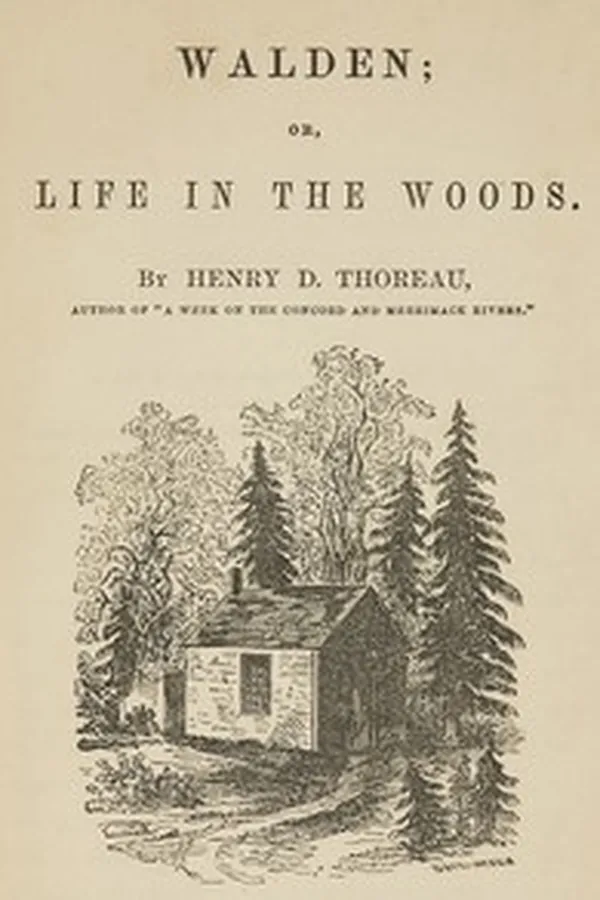
- Thoreau’s Walden, the book the younger friend wrote out of the same experiment in living close to nature, and the natural place to go after Prospects. — free EPUB, AZW3 & KEPUB
- The shelf where this edition sits, with the rest of our free philosophy and nature writing in EPUB, AZW3 and KEPUB. — free EPUB, AZW3 & KEPUB
Chapter summaries
The nine groups below follow the essay’s own divisions in the order the text prints them: the Introduction, then Chapters I to VIII, which are Nature, Commodity, Beauty, Language, Discipline, Idealism, Spirit and Prospects. Nothing has been merged or renamed, and each summary stops where its chapter stops.
- Part 1 — Introduction and the retrospective age: The essay opens on a complaint. The age builds the sepulchres of the fathers and beholds God and nature through the eyes of an earlier generation. Emerson asks for an original relation, a poetry of insight and a religion of revelation, and defines nature as the NOT ME, which takes in other men and his own body.
- Chapter I — Nature: Solitude is not a matter of leaving company. A man must retire from his chamber as much as from society, and the stars, always present and always inaccessible, teach the reverence that natural objects teach. Few adults can see nature, and the woods give a perpetual youth. On the bare ground Emerson becomes a transparent eye-ball.
- Chapter II — Commodity: Every use of nature falls under commodity, beauty, language or discipline, and this chapter takes the lowest. The senses owe nature their advantages, the wind sows and the rain feeds the plant, and the useful arts only repeat what nature has done. Steam and iron roads have changed the world, but a man is fed that he may work.
- Chapter III — Beauty: Beauty is a nobler want than commodity, and it is taken in three ways: the delight of the eye in natural forms, the beauty that attends a noble action, and beauty as an object of the intellect. Beauty is the mark God sets upon virtue, and art is nature passed through the alembic of man.
- Chapter IV — Language: Nature is the vehicle of language in three degrees: words are signs of natural facts, particular natural facts are symbols of spiritual facts, and nature is the symbol of spirit. Right means straight and wrong means twisted, and spirit means wind. The corruption of man is followed by the corruption of language.
- Chapter V — Discipline: Nature is a discipline, and its lessons are given by space, time, society, labor, climate, food and the animals. Property with its debts is a preceptor whose lessons cannot be forgone, and even the hated training in wants teaches the doctrine of use. Every natural process is a version of a moral sentence.
- Chapter VI — Idealism: The doubt is whether nature outwardly exists. Emerson cannot test the report of his senses, and so the world is ideal to him, though the permanence of laws is not shaken by that. Culture works the same way, since a change of position turns the street into a puppet-show, and the poet makes things fluid. Idealism is a hypothesis.
- Chapter VII — Spirit: Three questions are put to the mind: what is matter, whence is it, and whereto. Idealism answers only the first. The rest is spirit, which does not build up nature around us but puts it forth through us, as the life of a tree puts forth leaves. Nature is a remoter incarnation of God.
- Chapter VIII — Prospects: The best naturalist knows that much remains to be learned, and that it is not learned by adding to known quantities. Emerson quotes George Herbert’s poem on man, and ends with a poet’s discourse: man is a god in ruins and the dwarf of himself, nature is not fixed but fluid, and every spirit builds itself a house. Build, therefore, your own world.
Nature: Frequently Asked Questions
What is Nature about?
What does the transparent eye-ball mean?
What are the four uses of nature?
What is Emerson’s idealism?
How does the essay treat religion?
Is Nature one argument or a series of chapters?
Which edition is this text?
How do I read the free downloads?
Part of: Philosophy Classics · Ralph Waldo Emerson