The Consolation of Philosophy by Boethius: Free EPUB, AZW3 & KEPUB Download
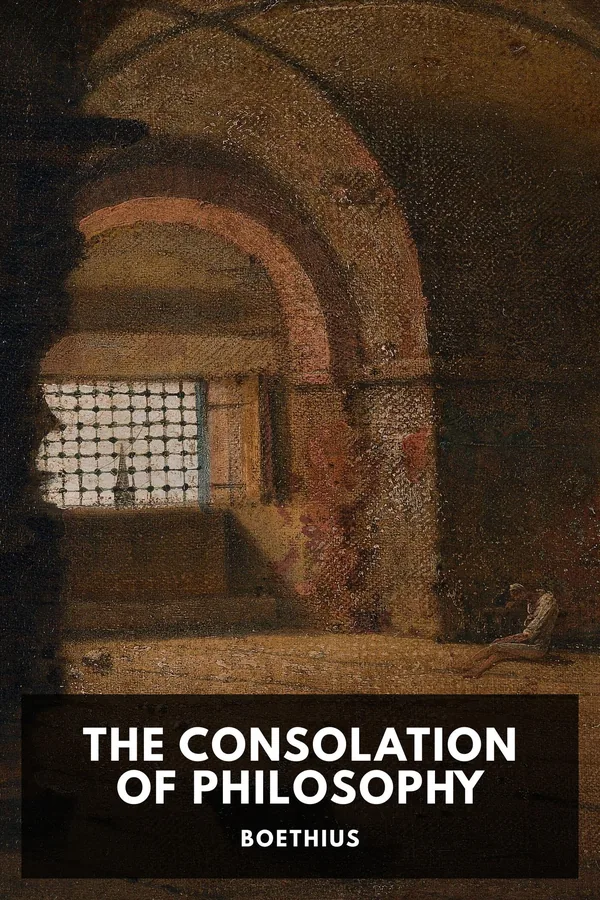
The Consolation of Philosophy
📖 Click to Read the Opening Pages Online Preview
Lady Philosophy appears
While I was thus mutely pondering within myself, and recording my sorrowful complainings with my pen, it seemed to me that there appeared above my head a woman of a countenance exceeding venerable. Her eyes were bright as fire, and of a more than human keenness; her complexion was lively, her vigour showed no trace of enfeeblement; and yet her years were right full, and she plainly seemed not of our age and time. Her stature was difficult to judge. At one moment it exceeded not the common height, at another her forehead seemed to strike the sky; and whenever she raised her head higher, she began to pierce within the very heavens, and to baffle the eyes of them that looked upon her. Her garments were of an imperishable fabric, wrought with the finest threads and of the most delicate workmanship; and these, as her own lips afterwards assured me, she had herself woven with her own hands. The beauty of this vesture had been somewhat tarnished by age and neglect, and wore that dingy look which marble contracts from exposure. On the lowermost edge was inwoven the Greek letter Π, on the topmost the letter θ,1 and between the two were to be seen steps, like a staircase, from the lower to the upper letter. This robe, moreover, had been torn by the hands of violent persons, who had each snatched away what he could clutch.2 Her right hand held a notebook; in her left she bore a staff. And when she saw the Muses of Poesy standing by my bedside, dictating the words of my lamentations, she was moved awhile to wrath, and her eyes flashed sternly. “Who,” said she, “has allowed yon playacting wantons to approach this sick man—these who, so far from giving medicine to heal his malady, even feed it with sweet poison? These it is who kill the rich crop of reason with the barren thorns of passion, who accustom men’s minds to disease, instead of setting them free. Now, were it some common man whom your allurements were seducing, as is usually your way, I should be less indignant. On such a one I should not have spent my pains for naught. But this is one nurtured in the Eleatic and Academic philosophies. Nay, get ye gone, ye sirens, whose sweetness lasteth not; leave him for my muses to tend and heal!” At these words of upbraiding, the whole band, in deepened sadness, with downcast eyes, and blushes that confessed their shame, dolefully left the chamber.
But I, because my sight was dimmed with much weeping, and I could not tell who was this woman of authority so commanding—I was dumbfounded, and, with my gaze fastened on the earth, continued silently to await what she might do next. Then she drew near me and sat on the edge of my couch, and, looking into my face all heavy with grief and fixed in sadness on the ground, she bewailed in these words the disorder of my mind:
The excerpt covers the first two paragraphs of the prose in Book I. Boethius is writing verses of complaint in his prison when a woman of venerable countenance appears above his head; the first paragraph describes her eyes, her changing stature, her imperishable robe torn by violent hands, the Greek letters Π and θ with the steps between, the notebook in her right hand and the staff in her left, and the angry speech that drives the Muses of Poesy from his bedside. The second gives his dumbfounded silence as she sits on the edge of his couch and begins to bewail the disorder of his mind.
Download Full EPUB524 AD
Prosimetrum
42,748 words
2.4 h
Standalone
A prison cell at Pavia, 523-524 AD
Five books in ten groups
EPUB · AZW3 · KEPUB
1.07 MB (EPUB) · 1.07 MB (AZW3) · 1.10 MB (KEPUB)
Public domain in the United States
Project Gutenberg #14328 · Standard Ebooks
The Consolation of Philosophy is Boethius’s last work, written in a prison cell at Pavia while he waited for the sentence of Theodoric the Ostrogoth to be carried out. It is a prosimetrum, five Books in which prose chapters alternate with songs, and its argument is conducted as a dialogue between the condemned man and Lady Philosophy. She drives away the Muses of Poesy, dries his tears, and leads him from self-pity and the wheel of Fortune to the question of what happiness is, why the wicked prosper, and how human freedom can survive God’s foreknowledge. The ending leaves him composed, but not acquitted.
The book has a clear shape: Book I finds the prisoner and brings Philosophy to his bedside; Book II puts Fortune on trial and weighs her gifts; Book III looks for the one good that cannot be taken away; Book IV asks why the good suffer and the wicked rule; Book V takes up chance, free will and the divine present. The edition also prints the translator’s preface and a short life of Boethius. The Wikipedia article on the Consolation follows its reception. — The text is available via Project Gutenberg #14328 and Standard Ebooks.
The Consolation of Philosophy by Boethius: Summary, Ideas & Arguments
This page gives a summary and analysis of The Consolation of Philosophy, with the five Books in reading order and the ideas the dialogue turns on: the wheel of Fortune, the highest good, providence and fate, eternity and free will. The terms are explained as they come up, and each Book is followed through its argument. Boethius wrote it in prison at Pavia while he awaited the sentence of Theodoric; the edition’s Proem says that within a year of seeing his two sons made joint consuls in 522 he was a solitary prisoner, stripped of honours, wealth and friends. The work is a prosimetrum, prose chapters alternating with songs, and Lady Philosophy conducts the argument. This is the Standard Ebooks text of H. R. James’s translation of 1897, and the page is meant for readers coming to the book for the first time.
Book I begins with complaint and ends with diagnosis. Philosophy appears above the prisoner’s head, drives off the Muses of Poesy as playacting wantons who feed his sickness with sweet poison, dries his tears, and is recognised as his nurse. He tells his story: the charge of hindering an informer from giving evidence against the senate, forged letters alleging that he hoped for the freedom of Rome, the charge of sacrilege, and the names of his accusers, Basil, Opilio and Gaudentius. He had been condemned unheard, and the charge he answers is that he wished to save the senate. She finds three causes of his sickness: he has forgotten his own nature, the end of the universe, and its government. Book II puts Fortune on trial; she speaks in her own name, ‘I turn the wheel that spins’, and Book II ends by saying that Ill Fortune is more useful than Good because she shows the hearts of friends.
Book III asks what happiness is. All beings seek one end, but pursue it in wealth, rank, sovereignty, glory or pleasure, and each fails because it gives only a part of what it promises. The error is to separate what is one: contentment, power, reverence, renown and joy must be had together, and their seat is God. Unity is another aspect of goodness, and all things desire it. The distinction between what Fortune gives and what belongs to the mind is the hinge of the whole work. Book IV turns to the problem of evil: only the good have power, the wicked are most unhappy when they get what they want, and the wrongdoer is more wretched than the man he injures. The argument is meant to be paradoxical, and it is left so. Providence and fate are distinguished, and all fortune is called good fortune. Book III closes with the song of Orpheus, who looked back and lost what he had won.
Book V asks whether chance exists, whether man is free, and how freedom can survive God’s foreknowledge. Philosophy answers that chance is relative to human purpose, that freedom of choice belongs to reason, and that knowledge follows the faculty of the knower rather than the thing known. God is eternal, and eternity is ‘the possession of endless life whole and perfect at a single moment’; he sees all time in one present, so his foreseeing is seeing and imposes only a conditional necessity. The book ends with the will unshaken and the laws not unjust. An epilogue says that he died soon after, by one account before Theodoric’s judgment seat, by another with a cord round his forehead and a club; it gives the manner of death only as a report, and the book’s last word is an exhortation, not a proof.
The translation is H. R. James’s, first published in 1897, and the preface says it follows Peiper’s Leipzig text of 1874. That preface also makes the book’s claim on later readers: it was the scholar’s familiar companion throughout the Middle Ages and down to the sixteenth century, translated into every European tongue and into English nearly a dozen times. It adds only that the book ought not to be forgotten, and that those who can go to the original will find their reward. Readers who come to it from Augustine can compare the Confessions, which turns the same prison of the self into prayer; the Meditations of Marcus Aurelius offer Stoic consolation from the edge of power; and the rest of the Philosophy Classics shelf is free here. The full text is at Project Gutenberg #14328, and this edition follows Standard Ebooks.
Historical Context
Boethius lived in the last quarter of the fifth century AD and the first quarter of the sixth, as the edition’s Proem says. The Proem is the translator’s account rather than a contemporary chronicle, and it is the fullest account of his life in the volume. Theodoric the Ostrogoth crossed the Alps and made himself master of Italy while Boethius was growing to manhood. Born into an ancient family, orphaned early, brought up by Symmachus and later his son-in-law, he became sole consul in 510 and was raised by Theodoric to Magister Officiorum, head of the whole civil administration. In 522 his two sons were created joint consuls, and he delivered the public speech in the king’s honour; within a year he was a solitary prisoner at Pavia.
The fall is told in Book I rather than by a historian, and the trial itself is not described, so the reader has only the prisoner’s version of it. Boethius says he blocked Conigastus and Trigguilla, protected Paulinus and Albinus, and at Verona resisted the attempt to implicate the whole senate in the treason charge against Albinus. It is the one political scene in the book that he fixes by place. His accusers were Basil, Opilio and Gaudentius; the charges were hindering an informer from giving evidence against the senate, forged letters alleging that he hoped for the freedom of Rome, and sacrilege. He was condemned unheard, at a distance of near five hundred miles, as he says, and the Proem adds that the prison was at Pavia.
The edition’s preface is the best evidence for the book’s later life. It calls the Consolation the scholar’s familiar companion throughout the Middle Ages and down to the beginning of the modern epoch in the sixteenth century, translated into every European tongue and into English nearly a dozen times, from King Alfred’s paraphrase to Preston, Causton, Ridpath and Duncan. It compares the alternation of prose and verse to dialogue and chorus in a Greek play, and names Peiper’s Leipzig text of 1874 as the base. It also thanks the translator’s brother for correcting the proofs, a small sign of how the work was done. The epilogue is more cautious about the death: it gives two accounts and chooses neither.
Key Ideas & Arguments
- Lady Philosophy: Philosophy appears at the prisoner’s bedside as a woman of venerable countenance, eyes bright as fire, her stature at one moment common height, at another striking the sky. Her imperishable robe is torn, with Π on the lower edge, θ on the upper, and steps between. She drives off the Muses of Poesy and conducts the cure by argument and song.
- The wheel of Fortune: Fortune’s image for her own rule. In Book II she speaks in her own name: wealth and honour are under her control, they come and go with her, and ‘I turn the wheel that spins’. The argument does not deny her power; it denies that her gifts can be owned, and finds one use for her, the discovery of true friends.
- The highest good: The end all beings seek, and the subject of Book III. Men pursue it as wealth, rank, sovereignty, glory or pleasure, but each gives only a part of what the whole requires. The good is one and indivisible, so it cannot be assembled from pieces; it exists, its seat is God, and the happy man partakes of the divine nature.
- Providence and fate: Book IV’s distinction between the whole and its unfolding. Providence is the order of all things unified in the divine mind; fate is that same order unfolded in time. The book compares them to reasoning and pure intelligence, time and eternity, a circle and its centre, and concludes that all fortune is good fortune.
- Eternity: Book V’s definition of God’s life: ‘the possession of endless life whole and perfect at a single moment’. Eternity is not endless duration but the whole of time held in one present, from which nothing future is absent and nothing past has escaped. God’s knowledge is therefore not foreknowledge of a future but knowledge of a present that never passes.
- Free will: The power of choice that Philosophy treats as a necessary attribute of reason. Man has a measure of it, less than the freedom of divine natures, but real enough for merit, law and punishment to mean something. Book V saves it by distinguishing absolute from conditional necessity: what God sees will happen, but the seeing does not compel.
Core Arguments & Influence
- Philosophy as medicine: The cure is the plot. Book I hardly argues yet; it diagnoses, and the diagnosis is that Boethius has forgotten his own nature, the end of the universe and the means by which it is governed. Each later Book treats one of the three. The method is dialectic, question and answer, with songs between the steps, and the songs are not decoration: they restate the argument in another register, as a chorus does in a Greek play. The preface’s comparison is exact, and it explains why the book can be read as a drama of a mind recovering rather than as a treatise.
- Fortune and the critique of worldly goods: Book II and Book III are a long answer to the question of what can be lost. Fortune’s gifts are external, so they cannot be owned, and the more anxious the owner, the less he possesses them. The argument is not ascetic: it does not say that wealth, rank or pleasure are evil in themselves, only that they cannot give what they promise, because they are parts of a whole that men insist on taking separately. The one good that cannot be taken away is not a thing among them, and Book III locates it in God. The wheel is the image of the whole position.
- The problem of evil: Book IV is the hardest stretch. If God governs, why do the wicked prosper? Philosophy’s answer is a set of paradoxes: only the good have power, the wicked are powerless because they cannot reach the good they seek; punishment is medicine, so the unpunished wrongdoer is worse off than the punished one; and what looks like chance is our ignorance of a government whose key we do not hold. The distinction of providence and fate is the ground of the answer, and the conclusion, that all fortune is good fortune, is a claim about use rather than about pleasantness.
- Eternity and freedom: Book V turns to the hardest question, and its argument is compact. Chance is not a cause but a name for events whose causes we do not see. Freedom is real, but measured: man has a share of it, less than divine natures. Foreknowledge does not compel, because knowledge is shaped by the knower’s faculty, and God’s knowledge is not a prediction from the past but the whole of time held in an eternal present. The distinction between absolute and conditional necessity saves both sides, and the book ends not with a proof but with an exhortation to prayer and virtue.
- A book between worlds: Boethius wrote as a Roman senator and consul, and the Proem presents him as orator, poet, musician and philosopher. It credits him with handing on Greek philosophy to the Middle Ages by his Latin translations of Aristotle, and the preface says the Consolation was the scholar’s familiar companion from the Middle Ages to the sixteenth century. Yet its consolation comes from philosophy rather than from revelation, and its figures are Fortune, Providence and the Muses. That reticence about revelation is part of its power, and it explains the book’s long series of translators, from King Alfred’s paraphrase to the eighteenth-century versions the preface names.
Why Download Our Custom E-Reader Edition of The Consolation of Philosophy?
The download is the whole work: the translator’s preface, the Proem, all five Books with their songs, and the epilogue. Nothing is cut, and the prose and verse keep the alternation the edition prints, with the songs set as verse rather than run into the prose. The text is James’s 1897 translation, and the same text can be checked at Project Gutenberg #14328 if you want to compare a passage. The text has not been modernised, so its wording can be matched to the 1897 volume.
Around the text the page supplies what a dialogue of this density needs: ten summaries that follow the five Books and split the long ones where the argument turns, six notes on the ideas, five on the larger claims, and a short account of the fall of Boethius. The groups are editorial, but the Books, chapters and songs are the edition’s own. The summaries are a map, not a substitute for the text. They are short enough to read before the Book they summarise.
The files come in three formats with the same text and the same breaks. The EPUB opens in Apple Books, Calibre and most Android readers; the AZW3 is the file for a Kindle; the KEPUB is the one Kobo devices handle best. No account is needed, and nothing is locked or watermarked, so the same download can be read on more than one device. The same file can be kept and reopened without a connection.
- Based on the Standard Ebooks Edition, via Standard Ebooks, whose edition prints the preface, the Proem, the five Books and the epilogue in the James translation.
- Complete text of the five Books Every chapter and song from Book I to Book V, with the translator’s preface, the Proem and the epilogue, nothing abridged.
- Ten groups in the edition’s order Ten summaries following the five Books, with the long Books split where their argument turns.
- EPUB, AZW3 and KEPUB files The same text in three formats, for Apple Books, Kindle and Kobo, with the chapter and song divisions intact and no account needed.
- Augustine’s Confessions, the other book through which the Latin Middle Ages thought, and the nearest thing to a companion volume: a life told as a search, and a conversion. — free EPUB, AZW3 & KEPUB
- Marcus Aurelius’s notes to himself, Stoic consolation written from the edge of power four centuries before Boethius, and the closest ancient analogue to the prison dialogue. — free EPUB, AZW3 & KEPUB
- The shelf where this edition sits, with the rest of our free philosophy in the same format. — free EPUB, AZW3 & KEPUB
Chapter summaries
This edition prints the translator’s preface, a Proem on the life of Boethius, the five Books with their alternating prose chapters and songs, and a short epilogue. The ten groups below follow the Books, splitting the longer ones where the argument turns. The labels are editorial; the Book divisions, chapter numbers and song numbers are the edition’s own.
- Book I, part 1 — The prisoner and the Muses: Boethius writes verses of complaint in his prison; Philosophy appears above his head, drives off the Muses of Poesy as playacting wantons who feed his sickness with sweet poison, and sits on the edge of his couch. He is dumbfounded, and she begins to bewail the disorder of his mind in Song II.
- Book I, part 2 — The accusation and the three causes: He recognises his nurse Philosophy, who recalls the persecutions of Socrates, Anaxagoras, Zeno, Arrius, Seneca and Soranus. He tells of the charge that he wished to save the senate and hindered an informer, of the forged letters and his accusers Basil, Opilio and Gaudentius. She finds three causes of his sickness: he has forgotten his nature, the world’s end, and its government.
- Book II, part 1 — Fortune’s wheel and her defence: Philosophy reproves his complaints, then speaks in Fortune’s own name: her gifts are hers to give and take, and ‘I turn the wheel that spins’. He answers that memory of past happiness is the bitterest part of misery; she counts what remains, Symmachus, his wife and sons, and says no lot is complete.
- Book II, part 2 — The gifts weighed: Riches, high place, power, fame and pleasure are examined and found external, anxious and empty; fame shrinks against the size of the universe and the length of time. The one service Fortune can do is to reveal herself and show which friends are true, so that Ill Fortune is more useful than Good.
- Book III, part 1 — The false goods: Philosophy promises to lead him to true happiness. All beings seek one end, but pursue it in wealth, rank, sovereignty, glory or pleasure; each is tested and fails, because riches increase want, titles command no reverence, power brings no safety, fame crowns the unworthy, and pleasure ends in repentance. The list is the book’s map of false happiness.
- Book III, part 2 — The one good: The error is to separate what is one: contentment, power, reverence, renown and joy must be had together. Happiness exists, and its seat is God; unity is another name for goodness, and all things desire it. Boethius says he is recollecting what he knew, and the problem of evil returns. The argument takes it up again in Book IV.
- Book IV, part 1 — The good alone have power: The old puzzle: why do the wicked rule and the good suffer? Philosophy argues that only the good have power, that the righteous never lack reward nor the wicked punishment, that the wicked are most unhappy when they get what they want, and that the wrongdoer is more wretched than the man he injures.
- Book IV, part 2 — Providence and fate: The seeming confusion is our ignorance of God’s government. Providence is the whole order seen in the divine mind; fate is the same order unfolded in time, ‘as a circle to its centre’. Hence all fortune is good fortune, since it rewards, disciplines, amends or punishes, and adversity is the soldier’s trumpet.
- Book V, part 1 — Chance and freedom: Is there chance? Only relative to human purpose, as Aristotle says in the Physics; what looks fortuitous rests on a subtler causation. Is man free? Freedom of choice belongs to reason, and man has a measure of it. Then how can God’s certain foreknowledge leave room for free will, merit and prayer? The three questions are answered in order.
- Book V, part 2 — Eternity and the timeless present: Knowledge follows the knower’s faculty, not the thing known. God is eternal, and eternity is ‘the possession of endless life whole and perfect at a single moment’; he sees all time in one present, so his foreseeing is seeing, not causing. Only a conditional necessity follows, and the will stands unshaken. The book ends with an exhortation to prayer and virtue.
The Consolation of Philosophy: Frequently Asked Questions
What is The Consolation of Philosophy about?
Who was Boethius, and why was he in prison?
What is a prosimetrum?
What is the wheel of Fortune?
Why does Philosophy drive away the Muses?
What are the false goods of Book III?
What is the difference between providence and fate?
Where can I read the text online?
Part of: Philosophy Classics · Boethius