The House of Mirth by Edith Wharton: Free EPUB, AZW3 & KEPUB Download
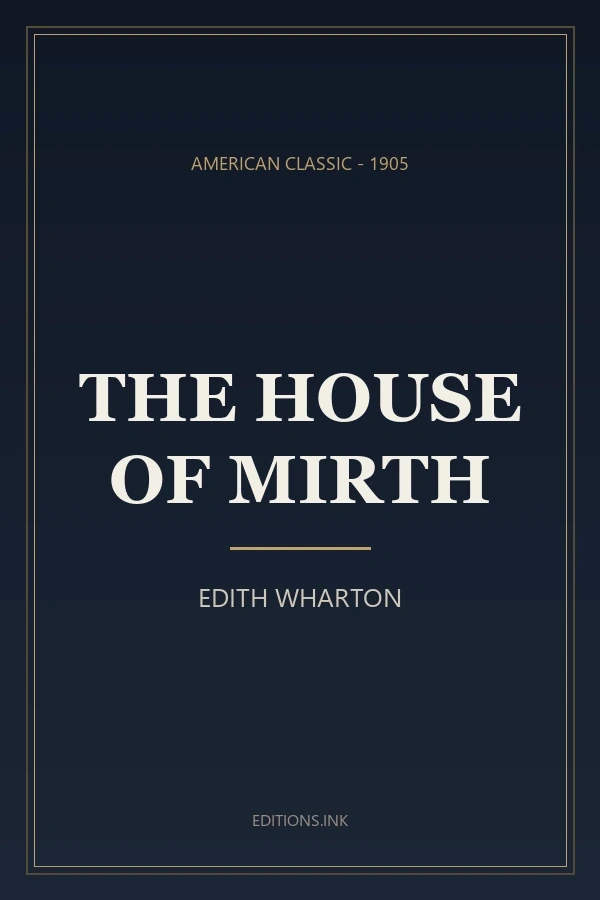
The House of Mirth
📖 Click to Read the Opening Pages Online Preview
The story begins
Selden paused in surprise. In the afternoon rush of the Grand Central Station his eyes had been refreshed by the sight of Miss Lily Bart.
It was a Monday in early September, and he was returning to his work from a hurried dip into the country; but what was Miss Bart doing in town at that season? If she had appeared to be catching a train, he might have inferred that he had come on her in the act of transition between one and another of the country houses which disputed her presence after the close of the Newport season; but her desultory air perplexed him. She stood apart from the crowd, letting it drift by her to the platform or the street, and wearing an air of irresolution which might, as he surmised, be the mask of a very definite purpose. It struck him at once that she was waiting for some one, but he hardly knew why the idea arrested him. There was nothing new about Lily Bart, yet he could never see her without a faint movement of interest: it was characteristic of her that she always roused speculation, that her simplest acts seemed the result of far-reaching intentions.
An impulse of curiosity made him turn out of his direct line to the door, and stroll past her. He knew that if she did not wish to be seen she would contrive to elude him; and it amused him to think of putting her skill to the test.
The afternoon at the Benedick — the tea, the risk and the walk down the stairs — ends here. The whole novel, from the station to the rented room, is in the free EPUB below.
Download Full EPUB1905
~129,000 words (estimated)
Approx. 7.2 hours
Standalone
New York, Bellomont, and Monte Carlo
Chapter summaries
EPUB · AZW3 · KEPUB
0.54 MB (EPUB) · 0.71 MB (AZW3) · 0.58 MB (KEPUB)
Public domain in the United States
Project Gutenberg
The House of Mirth is Edith Wharton’s novel of Gilded Age New York and of a woman with no money, a famous face and a closing market. Lily Bart is twenty-nine, beautiful and poor, trained for nothing but marriage and running out of time. Wharton follows her through ten months: a Monday in September at Grand Central, weekends at Bellomont, a fortune made by speculation, a public cut at Monte Carlo and a debt of nine thousand dollars she cannot pay. Around her: Lawrence Selden, who loves her and watches; Simon Rosedale, who can afford her; Bertha Dorset, who needs her and destroys her.
The novel appeared in 1905, when Wharton was forty-three, and it made her famous; its portrait of a society that prices women and then discards them has not dated. It is also a book about money — dressmakers’ bills, bridge losses, a legacy of ten thousand dollars that arrives a season too late — and Wharton keeps the arithmetic on the page. The House of Mirth was her first novel of the city she was born into. This page offers the complete novel as a free epub, with summary, characters and analysis below. The text is available via Project Gutenberg #284.

The House of Mirth by Edith Wharton: Summary, Characters & Themes
The House of Mirth is a summary and analysis of Edith Wharton’s 1905 novel, published by Charles Scribner’s Sons after a serial run in Scribner’s Magazine. It is a drawing-room book in which nearly all the violence is done with good manners. Lily Bart is a poor relation in a rich tribe: her father lost the money and died, her mother died of the humiliation, and her aunt, Mrs. Peniston, keeps her on a small allowance and a thinner patience. What Lily owns is her beauty and her social skill, and both are wasting assets. Wharton wrote it with a coldness its first readers found scandalous.
The plot has the shape of a market falling. In September Lily is at Bellomont, working on Percy Gryce, an heir who collects Americana; by November she has lost him and borrowed money she cannot repay. A speculation arranged by her host’s husband turns a few hundred dollars into nine thousand, and the nine thousand is not a gift. The rest is the calling in of that debt: a scene in an empty house, a will that leaves her ten thousand dollars and her cousin four hundred thousand, a winter of small humiliations, and a rented room with a lace cover on a chest of drawers.
Wharton tells it in two books and twenty-nine chapters, with a discipline that is almost cruel: no scene runs longer than it must, and every conversation is also a transaction. Its set pieces are public by design: the tableaux vivants at the Wellington Brys’, where Lily poses as Reynolds’s Mrs. Lloyd and the room goes silent; the quarrel on a bench above the bay at Monte Carlo, where a woman is dismissed in one sentence.
Around her Wharton sets four kinds of power. Selden has taste, irony and no money; his republic of the spirit is a country he can visit but not live in. Rosedale has money and wants entrance. Bertha Dorset has position and uses Lily as a screen for her affair with Ned Silverton, then destroys her when the screen becomes inconvenient. The ending refuses both marriage and rescue: Lily dies of an overdose of chloral, and Selden arrives to find her bills receipted and almost all of her legacy gone in one cheque to Trenor.
The book sold well and was read as a scandal, and Wharton’s own circle found itself in it. She went on to write The Custom of the Country, The Age of Innocence, which won the Pulitzer Prize in 1921, and a memoir, A Backward Glance. Born in New York in 1862, divorced in 1913, she died in France in 1937. It remains the book that made her name. For the author’s life and other work, see Edith Wharton. The full text is available from Project Gutenberg #284.
Historical Context
Wharton’s New York was a closed society of a few hundred families who knew one another’s houses, incomes and cousins. In the 1890s new fortunes arrived from railways, stores and finance, and the old families defended themselves with a list — Mrs. Astor’s Four Hundred — and a calendar of dinners, opera boxes and country-house weekends. The novel is exact about that calendar: Bellomont is a machine for entertaining, the Brys’ evening is new money buying a place at the table, and Lily’s life is a sequence of invitations repaid in dress and charm.
Wharton wrote it in 1904 and 1905, much of it at The Mount, the house she built at Lenox in 1902, and it ran in Scribner’s Magazine before Scribner’s published it in October 1905. Her marriage to Edward Wharton had become long, childless and unhappy; they divorced in 1913, and the novel’s picture of a woman with no financial standing of her own was written by someone who knew how little a wife’s position depended on affection. Its working title was A Moment’s Ornament.
The sums are precise: a dressmaker’s bill, a bridge loss of three hundred dollars, nine thousand dollars of investments — roughly a decade’s wages for a clerk — and a legacy of ten thousand against four hundred thousand. Wharton separates money that is earned, and therefore slightly shameful, from position that is inherited, and shows how completely a woman of Lily’s class is excluded from the first and dependent on the second. Marriage is the only profession open to her. The novel treats the marriage market as a market, with prices, timing and a crash.
Key Characters & Literary Archetypes
- Lily Bart: Twenty-nine, beautiful, well dressed and penniless, daughter of a ruined father and an ambitious mother who taught her that her face was her fortune. She has no profession, no income and no home; she lives on her aunt’s charity and other people’s invitations, and understands her situation with a clarity that never quite saves her.
- Lawrence Selden: A lawyer with a small income, a flat in the Benedick and a habit of watching. He loves Lily in the way that costs him nothing: at a distance, in the intervals of his own comfort. His republic of the spirit is the novel’s standard of value, and his failure to act on it is the novel’s judgement on him; he arrives too late at every crisis.
- Simon Rosedale: A financier of the new school, risen from nothing, rich, shrewd and socially hungry. Introduced as a man Lily snubs, he becomes the most honest person in the book: he tells her exactly what he wants and what he can pay. His scheme with Bertha’s letters hands her the only weapon she has ever had, and she refuses it.
- Bertha Dorset: Small, thin, restless and without scruple, a woman who runs her life as a campaign and her marriage as a convenience. She takes Lily up because a poor, beautiful friend is useful as a screen for her affair with Ned Silverton, and drops her the moment Lily becomes a liability. It is Bertha who spreads the story of Lily’s gambling.
Core Literary Themes
- Beauty as capital: Lily’s face is her fortune, and Wharton keeps the accounts: a season costs more than she has, every invitation is an advance. Beauty depreciates on a schedule the market knows by heart.
- Debt: The nine thousand is the plot, but debt runs through everything: dressmakers’ bills, bridge losses, the obligation of hospitality, the letters Lily buys and cannot use. It is collected in a room, by a man, at an hour she cannot choose.
- The spectator’s cowardice: Selden is the novel’s intelligence and its conscience, and he is also its coward. He can analyse Lily’s situation better than anyone and never intervenes in time. The judgement on detached observation, delivered through a man Wharton likes, is the most modern thing in the book.
- The tribe: Society here is an organism with an immune system: gossip is how it expels a member, and Lily’s expulsion is gradual, polite and total. A person can be destroyed without anyone doing anything illegal.
Why Download Our Custom E-Reader Edition of The House of Mirth?
This is the complete novel, not an abridgement: both books, all twenty-nine chapters, from the station in September to the last morning in a rented room. The text is the Project Gutenberg transcription, checked and reset, so Wharton’s long sentences and her exact sums survive intact.
It is built for e-readers rather than for scans: real paragraphs, working navigation, no broken hyphenation, a cover made for a modern shelf, and a file small enough to open instantly.
Roughly a hundred and twenty-nine thousand words, seven hours at an ordinary pace. If you want the shape of it first, the summaries, characters and context on this page will take ten minutes.
- Project Gutenberg transcription, via Project Gutenberg #284 — the source text used for this edition.
- Complete 1905 text Both books, all twenty-nine chapters, unabridged, with the original chapter divisions.
- EPUB, AZW3 and KEPUB Apple Books and Kobo take the EPUB or KEPUB, Kindles take the AZW3.
- Summary and analysis Movements, characters, themes and context on this page, if you want the reading first.
- The Picture of Dorian Gray — free EPUB, AZW3 & KEPUB
- The Time Machine — free EPUB, AZW3 & KEPUB
- A Modest Proposal — free EPUB, AZW3 & KEPUB
Chapter summaries
The novel runs in two books and twenty-nine chapters. This guide follows its ten movements in order, from the Monday in September to the last morning in a rented room.
- Book I, chapters 1-2: the Benedick: On a Monday in September Selden finds Lily Bart in the rush at Grand Central, waits with her and takes her up to his flat in the Benedick for tea. She tells him she is horribly poor and very expensive; the visit is a risk, and a char-woman on the stairs sees her go. Outside, Simon Rosedale offers her a lift and acquires a hold on her. On the train to Bellomont she begins work on Percy Gryce, an heir who collects Americana.
- Book I, chapters 3-5: Bellomont: Bridge has cost Lily three hundred dollars she cannot pay. Wharton supplies the history: a father ruined and dead, a mother who taught her that beauty was her capital. Judy Trenor advises her to go slowly with Gryce. Then Selden arrives unannounced, and on Sunday, when the house goes to church, he asks her to walk with him before he leaves.
- Book I, chapters 6-7: the republic of the spirit: From a ledge above the valley Selden describes his republic of the spirit, where the only rank is personal worth, and Lily asks whether he would marry her: no, he says, but perhaps he would if she did. The afternoon ends with a passing motor and Lily pretending to be ill. Within days Bertha Dorset tells Gryce a version of Lily’s gambling debts, and driving her to the station Gus Trenor offers to put her on to a good thing.
- Book I, chapters 8-10: the first cheque: Trenor’s tip pays a thousand dollars, then more, and Lily spends money she is sure she will earn. A char-woman brings her a parcel of Bertha Dorset’s letters to Selden and Lily buys them, not knowing why except that they are power. She has also lost Gryce, who is engaged to Evie Van Osburgh, and must congratulate her at the wedding.
- Book I, chapters 11-12: the tableaux vivants: At the Wellington Brys’ evening Lily poses as Reynolds’s Mrs. Lloyd, a painted figure stepping out of a frame, and the room goes quiet. Selden sees what the audience sees: the more she is admired, the less she will be married. In the rose garden he tells her he loves her and can do nothing; she answers, love me, love me, but do not tell me so. The gossip hardens into a sentence: Lily Bart, who has no money, is seen everywhere.
- Book I, chapters 13-15: nine thousand dollars: Two notes arrive: Judy Trenor is out of town, and Gus Trenor wants Lily at the house that evening. She finds a man with a grievance and a bill: he has paid nine thousand dollars into her account and now wants his money’s worth. The evening ends with her escape and the walk to Gerty Farish’s flat at midnight. Rosedale proposes and is put off; Selden sails for Havana; Bertha invites her to the Mediterranean.
- Book II, chapters 1-3: the Sabrina: At Monte Carlo in April Selden watches the Dorsets’ yacht steam into harbour and hears from Carry Fisher what Lily’s success costs: she is Bertha’s decoy, keeping George Dorset amused while Bertha reads Verlaine with Ned Silverton. In the gardens Dorset collapses: Bertha did not come back until seven in the morning. Lily sends for Selden, who advises silence. At dinner Bertha says clearly that Miss Bart is not going back to the yacht.
- Book II, chapters 4-6: the will, the Gormers, the lane: In June the Peniston relatives gather for the will: ten thousand dollars for Lily, four hundred thousand and the house for Grace Stepney. The Gormers, new money, take her up, and Carry Fisher carries her off to Alaska until the gossip cools. Back in town she is dropped again, and in a lane on Long Island George Dorset, half mad, asks her help in getting a divorce.
- Book II, chapters 7-9: Rosedale’s bargain: In a glen above the lake Lily tells Rosedale she will marry him, and he does not take her: a wife with a reputation would ruin him. Then he shows why he came: he owns the Benedick, he knows about the letters, and he proposes a campaign using them to force Bertha to take her back. Lily refuses, and the refusal costs her the last opening. Selden goes to find her and is given the Emporium Hotel address.
- Book II, chapters 10-14: the word which made all clear: Lily’s last employments, the Emporium Hotel and Madame Regina’s work-room, both end badly. She takes a boarding-house room and lives on tea, chloral. On the last evening she walks to Selden’s flat, tells him the truth about the letters and drops them into his fire; they part with a kiss on the forehead. The next morning she is found dead of chloral, and Selden reads the cheque-book.
The House of Mirth: Frequently Asked Questions
What is The House of Mirth about?
How does the novel end?
Where does the title come from?
How long is it?
Is it autobiographical?
Why does Lily refuse Selden and Rosedale?
What are the tableaux vivants?
Where can I read the original text?
Part of: Classic Books by Length and Reading Time · Authors