Common Sense by Thomas Paine: Free EPUB, AZW3 & KEPUB Download
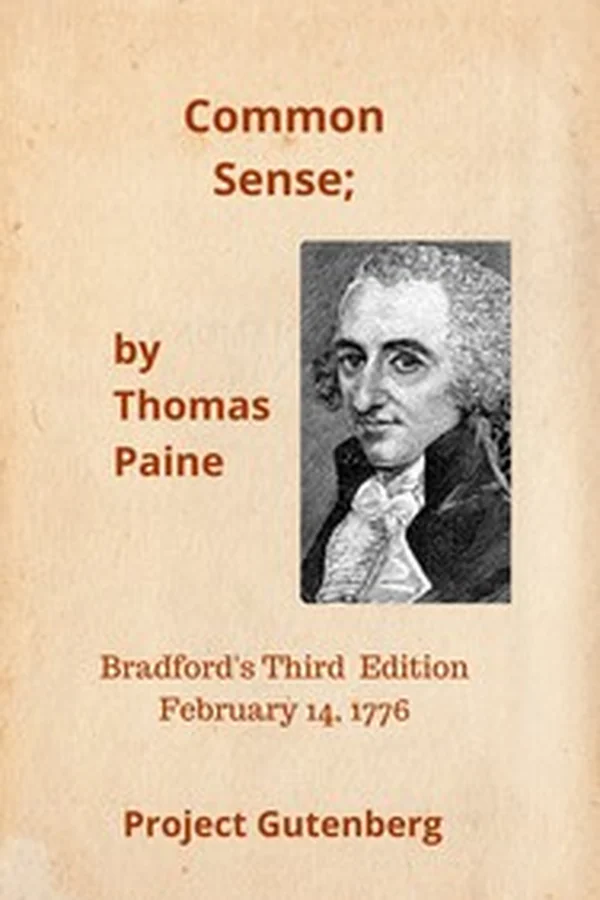
Common Sense
📖 Click to Read the Opening Pages Online Preview
Introduction
Perhaps the sentiments contained in the following pages, are not yet sufficiently fashionable to procure them general favor; a long habit of not thinking a thing wrong, gives it a superficial appearance of being right, and raises at first a formidable outcry in defense of custom. But the tumult soon subsides. Time makes more converts than reason.
As a long and violent abuse of power, is generally the Means of calling the right of it in question (and in Matters too which might never have been thought of, had not the Sufferers been aggravated into the inquiry) and as the King of England hath undertaken in his own Right, to support the Parliament in what he calls Theirs, and as the good people of this country are grievously oppressed by the combination, they have an undoubted privilege to inquire into the pretensions of both, and equally to reject the usurpation of either.
In the following sheets, the author hath studiously avoided every thing which is personal among ourselves. Compliments as well as censure to individuals make no part thereof. The wise, and the worthy, need not the triumph of a pamphlet; and those whose sentiments are injudicious, or unfriendly, will cease of themselves unless too much pains are bestowed upon their conversion.
The introduction breaks off here. The complete pamphlet — the case against monarchy, the appendix, and the address to the Quakers — is in the free edition.
Download Full EPUB1776
~22,000 words (estimated)
Approx. 1.2 hours
Standalone
Philadelphia and the thirteen colonies, 1776
7 sections
EPUB · AZW3 · KEPUB
0.30 MB (EPUB) · 0.36 MB (AZW3) · 0.31 MB (KEPUB)
Public domain in the United States
Project Gutenberg #147
Common Sense is a pamphlet Thomas Paine first published in Philadelphia in January 1776, and its argument is that the colonies should stop petitioning George III and declare independence. The text here is the enlarged edition of 14 February 1776, which added an appendix and an address to the Quakers. There is no plot and no cast of characters. The book is one continuous case, carried forward by short declarative sentences, by scripture turned against kings, and by arithmetic about ships, sailors and debt. Its voice is why it still lands: Paine writes as a man talking to neighbours in a tavern, not as a lawyer addressing a court, and he assumes his reader can be won by evidence rather than ordered by authority.
The frame is a choice between two futures rather than a list of grievances. Reconciliation, Paine argues, can only produce a crippled dependency, its trade regulated and its laws subject to a distant veto; independence he presents as the cheaper and safer course. The tension is that he must argue for separation while claiming the argument is already over. “The period of debate is closed”, he writes, and then spends a hundred pages debating. He resolves the difficulty by moving the question from right to prudence, from whether Britain has injured America to whether a continent can be governed by an island, and a war paid for without a state. See Wikipedia’s article on Common Sense for its publication history. The text is available via Project Gutenberg #147.
Common Sense by Thomas Paine: Summary, Characters & Themes
This page is a summary and analysis of Common Sense by Thomas Paine, with the historical context, the characters and the themes, followed by chapter summaries and the free download links. The pamphlet works by accumulation rather than by formal proof. It separates society from government—society is produced by our wants, government by our wickedness—and then uses the distinction as a measuring rod, first on the British constitution, then on monarchy, then on the American case. Each step is made to look obvious: a few families could govern themselves under a convenient tree, so simplicity is safe; kings arrive in history from the heathens, so monarchy is neither ancient nor divine; a continent is not an island, so it cannot be governed from one. Nothing in the book depends on legal precedent or on the authority of a single writer; the appeal is always to something the reader can check, a text of scripture, a distance on a map, a figure for a debt.
The author is Thomas Paine, and the text of Common Sense itself has a long critical history. Paine’s plainness is a rhetorical performance, not an absence of art. The sentences are short and the vocabulary is ordinary, but the effects are calculated: the run of antitheses that opens the introduction, the direct address to “ye that love mankind”, the willingness to call a monarch a worm or “the Royal Brute of Britain”. The pronoun is almost always the reader’s, and the argument is made to seem like something you have just thought of yourself. He also builds authority by refusing to claim any. The postscript insists that “Who the Author of this Production is, is wholly unnecessary to the Public, as the Object for Attention is the Doctrine itself, not the Man”, and describes the writer as “unconnected with any Party”. A pamphlet that hides its author can speak for nobody in particular, which is exactly the voice a continental cause needed.
The long middle of the book is a demolition of hereditary right, and it goes further than the constitutional argument around it. Paine begins from equality—“Mankind being originally equals in the order of creation”—and asks how one family came to be exalted above the rest. Scripture is then used as evidence against kings: Gideon refuses a crown, Samuel tells Israel that in demanding a king they have rejected God rather than the prophet, and the Jews who were told to render unto Cæsar had no king of their own and were vassals of Rome. Hereditary succession is “an insult and an imposition on posterity”, and the plea that it prevents civil wars is “the most barefaced falsity ever imposed upon mankind”. Since the Conquest he counts thirty kings and two minors, eight civil wars and nineteen rebellions. The point is not the accuracy of the count but the absurdity of calling such a record a divine appointment.
What Paine proposes in Section III is a working constitution, not a slogan. Each colony would send at least thirty delegates to a Congress of at least 390; the president would be chosen by lot from one colony and then by ballot of the whole house, with the privilege rotating; a Continental Conference of congressmen, assemblymen and five representatives of the people at large would draft a charter securing “freedom and property to all men, and above all things, the free exercise of religion”. The ceremony he invents for it ends with a crown placed on the charter and then “demolished, and scattered among the people”, because “in America the law is king”. He also warns that if the founding is left to chance, “some Massanello may hereafter arise”, a Naples fisherman who made himself king in a day. The warning is aimed at his own side: a founding left to improvisation can end in a dictator.
The book’s afterlife is documented in the file itself. The transcriber’s page of notices catches both reactions at once: one reports that it “makes a great noise”, another that its “effects were sudden and extensive upon the American mind”, and a third that its author wrote with unmatched “ease and familiarity of style”. The argument’s machinery has aged better than its examples. Its arithmetic is dated, but its test of legitimacy is not: can a government show that it serves the governed? Readers who want the sources can follow it back to Two Treatises of Government and sideways to The Republic, which asks the oldest version of Paine’s question, who should rule; A Modest Proposal shows what a pamphlet could do with the same plain style a generation later. The text used here is the Project Gutenberg transcription (#147), which is in the public domain in the United States.
Historical Context
The pamphlet dates itself exactly: the title page reads “Printed and sold by W. & T. Bradford, February 14, 1776”, and the introduction is signed from Philadelphia on the same day. It was written after the fighting that began on “the nineteenth of April”, and it says so, since plans made before that date now look “like the almanacks of the last year”. Paine’s postscript explains that this new edition was held back in the hope that someone would answer “the Doctrine of Independance”, and that no answer came, so the doctrine stands unanswered. The delay also explains the appendix, since the book grew while its case was being tested in public. The urgency is dated too: a nation forms its government only once, and the pamphlet insists that the chance is now.
Reception is documented inside the file, and the evidence is unusually direct. The page of quotations the transcriber added at the back records the noise the pamphlet made: one notice reports that “a pamphlet called ‘Commonsense’ makes a great noise”, a reader writes “I never saw such a masterful performance”, and a hostile one calls it “One of the vilest things that ever was published to the world”. The appendix treats the absence of any refutation as proof of the doctrine, and the postscript reasons the same way. Paine also says the first and second editions appeared “without the following calculations”, so the naval and financial material in Section IV was added later, and the address to the Quakers joined the volume after that. None of this is outside testimony; every scrap of it is inside the book.
This text is a transcription of the Bradford edition, and the transcriber states what that involves: it “retains the original characteristics of the document”, meaning the author’s capitalization, spelling and italics. The page numbers are his own invention and are really paragraph numbers, matched to the National Humanities Center’s edited text; Paine’s reference to “page forty” is kept, with a modern link. The Quaker reply is printed after the main text, followed by the collected quotations and the notes. The 1776 title page describes the volume as “a new edition, with several additions in the body of the work”, with “an appendix” and “an address to the people called Quakers”. Nothing has been modernised, which matters for a book whose most quoted sentences depend on their eighteenth-century punctuation.
Key Characters & Literary Archetypes
- The Hereditary Monarch: Paine never names George III in the main argument; he anatomises the office instead. A king, he writes, has little to do but “make war and give away places”, a trade paid at “eight hundred thousand sterling a year”. The throne is a machine for converting flattery into power: “How impious is the title of sacred majesty applied to a worm”. The appendix then names the occupant, calling the speech from the throne “a piece of finished villainy” and the King “the Royal Brute of Britain”.
- The House of Lords: The peers carry the aristocratic third of Paine’s three-part analysis. He calls the English constitution “the base remains of two ancient tyrannies, compounded with some new republican materials”, with the king monarchical, the peers aristocratical and the commons republican. Because the lords are hereditary, he argues, they are “independent of the people” and therefore contribute nothing to the freedom of the state; their independence is the defect of the arrangement, not its safeguard. The argument is structural rather than personal: no individual lord need be corrupt for the bench to be useless.
- The American Colonist: The reader Paine constructs is a farmer or shopkeeper with property, sense and no taste for martyrdom. He is addressed as a juror: “I offer nothing more than simple facts, plain arguments, and common sense”. Paine flatters his competence while warning against his caution, and he measures the cost of waiting in the colonist’s own currency, burnt towns, occupied ports, taxes paid to a parliament that will not listen. The same reader is told that reconciliation is not a compromise but a delay that makes the eventual settlement worse.
- The Quaker Meeting: The epistle is addressed to a body, not a person: “To the Representatives of the Religious Society of the People called Quakers”. Paine grants their piety and denies their standing, arguing that the testimony was published by men who had “put yourselves in the place of the whole body of the Quakers” without authority, and that as a political act it was not so much religious as political. The meeting is the one audience in the book he cannot convert, only rebuke. He asks them only to stop speaking for a whole society.
- The Author Persona: The nameless author is a character in his own pamphlet. The postscript refuses to identify him, saying that “Who the Author of this Production is, is wholly unnecessary to the Public”, and supplies a character reference instead: he is “unconnected with any Party, and under no sort of Influence public or private, but the influence of reason and principle”. This is a rhetorical device as much as a precaution, since an author with no party, no office and no name can claim to speak for the continent rather than for a faction in Philadelphia.
- The Tory: The loyalist is the pamphlet’s internal opponent, and Paine treats him less as an enemy than as a bad calculator. In the appendix he addresses the Tories directly: if they cannot be Whigs by conviction, they should at least want independence, because it is the only settlement that protects them. They should have “prudence enough to wish for Independance”. The sentence is typical of the book’s method, since it argues from interest when virtue is unavailable and assumes the reader’s self-respect is a lever that can be pulled.
Core Literary Themes
- Government as a necessary evil: Paine’s first principle is deflationary: government is not the source of human goods but a remedy for human faults. “Society is produced by our wants, and government by our wickedness”, he writes, and “government even in its best state is but a necessary evil”. The image that carries the argument is clothing: “Government, like dress, is the badge of lost innocence”. Once government is understood as a remedy, its legitimacy depends on performance, and the test he applies is security, the “true design and end of government”. A constitution that fails the test is not venerable, however old it is. The test is not antiquity but performance: does it keep the peace and protect property?
- Hereditary right as an insult to posterity: The attack on succession is the book’s most radical move, because it denies that time can create right. If all men are “originally equals in the order of creation”, then no family can be born to rule, and a crown inherited is a claim on the future made by the dead. Hereditary succession is therefore “an insult and an imposition on posterity”. Paine also denies its supposed benefit: the plea that it prevents civil wars is “the most barefaced falsity ever imposed upon mankind”, and he counts the wars of York and Lancaster, “Twelve pitched battles”, as its fruit. He also notices that succession rewards the accident of birth over the evidence of conduct.
- Separation argued as prudence: Paine keeps the case for independence on the ground of interest rather than glory. Commerce is the engine: “Our plan is commerce”, and a free America would be “a free port” for Europe. He denies that Britain’s protection was ever disinterested, since her motive was “interest not attachment”, and he turns geography into an argument: “there is something very absurd, in supposing a continent to be perpetually governed by an island”. The rhetorical effect is to make separation sound like the conservative choice, the one that preserves what the colonies already have. The same move disarms the objection that independence is a leap in the dark, since the dark is reconciliation, whose terms nobody can now predict.
- Scripture turned against kings: Paine reads the Old Testament as a republican archive. Gideon refuses a crown, Samuel tells Israel that in demanding a king they have rejected God, and the Jews who were told to render unto Cæsar had, Paine notes, no king of their own. The effect is to take the most conservative text in the culture and make it testify against monarchy, and to suggest that the divine right of kings is a pagan import: “Government by kings was first introduced into the world by the Heathens”. The reply to the Quakers extends the manoeuvre, turning a testimony about God’s prerogative over kings into an argument for staying out of politics.
- A break in time: The last pages give the pamphlet its scale. Independence is presented not as a repair but as a founding: “We have it in our power to begin the world over again”, and “The birthday of a new world is at hand”. Paine compares the moment to the deluge, since no situation “similar to the present” has occurred “since the days of Noah”, and he warns that the chance is a one-off, because a nation forms its government only once. The rhetoric is secular millenarianism: the future is open, but only briefly, and the failure to act is moral rather than merely political. He promises no wisdom to the new state, only that the moment will not come again.
Why Download Our Custom E-Reader Edition of Common Sense?
This edition is built for reading rather than for reference. The text is set in three formats, EPUB for phones and tablets, AZW3 for Kindle, KEPUB for Kobo, and each carries real chapter marks for the seven sections, so the appendix and the Quaker letter are separate destinations instead of one long scroll. The typography is quiet, the paragraphs are indented, and the preview above is the opening of the text itself, not a summary of it. The file is small enough to keep on a phone and opens without a plugin.
The file includes what most modern reprints cut. The Bradford volume printed Paine’s reply to the Quakers after the appendix, and this edition keeps it there, in sequence, so that the argument and its aftermath read as one document. The transcriber’s page of contemporary notices is left in place too, which means you can watch the pamphlet being praised and denounced in the same breath by readers who had only just met it. Read in sequence, the reply shows how quickly a pamphlet became a political event.
Nothing is abridged and nothing is modernised. Paine’s capitalisation and italics are the printer’s, the section headings are the author’s, and the only editorial additions are the transcriber’s paragraph numbers and his collection of early notices. If you want to quote the book, the wording will match the 1776 printing rather than a twentieth-century school edition, which matters, since the most famous phrases are precisely the ones later editors tidy up. Nothing here depends on a modern editor’s judgement about what Paine meant.
- Project Gutenberg transcription, via Project Gutenberg #147 — the complete text, unabridged, with the chapter headings the author set.
- Seven marked sections the introduction, four numbered sections, the appendix and the Quaker reply, each a separate chapter mark in every format.
- The Bradford text, not a modernised one original spelling, capitalisation and italics, so Independance and æra stay as Paine’s printer set them.
- Three formats, one text EPUB, AZW3 and KEPUB, DRM-free, with no abridgement and no added preface.
- Two Treatises of Government — free EPUB, AZW3 & KEPUB
- The Republic — free EPUB, AZW3 & KEPUB
- A Modest Proposal — free EPUB, AZW3 & KEPUB
Chapter summaries
Seven sections, in the order the Bradford volume printed them. The introduction and four numbered sections are the argument; the appendix and the Quaker reply answer its critics.
- Introduction: Four pages of preface rather than argument. Paine says why he is writing at all, concedes that the doctrine of independence is not yet fashionable, and warns that custom will defend itself loudly before it yields: “the tumult soon subsides. Time makes more converts than reason.” The postscript adds two things the book needs, that the new edition was delayed waiting for a refutation which never came, and that the author’s identity is irrelevant to the truth of the doctrine.
- I. Of the Origin and Design of Government in General: The most abstract section, and the one that supplies the vocabulary for everything after it. Paine separates society from government, derives government from wickedness, describes the small colony that needs only a tree for a state-house, and then applies the test to the English constitution, which he finds a mixture of “two ancient tyrannies” with republican materials, its checks “farcical” and its crown the dominant part. It ends with the simile of the man attached to a prostitute, unfitted to choose or judge a wife.
- II. Of Monarchy and Hereditary Succession: The scriptural case against monarchy, followed by the historical one. Paine asks how kings began and gives three answers, lot, election and usurpation, none of which supports inheritance. He assembles the Hebrew kings as a warning, separates “Render unto Cæsar” from any duty to a king, and turns to the Norman conquest: “A French bastard landing with an armed banditti”. The section ends with the arithmetic of misrule, thirty kings, two minors, eight civil wars and nineteen rebellions.
- III. Thoughts on the Present State of American Affairs: The pivot from principle to programme. Paine argues that the period of debate has closed, answers the reconciliation case point by point, and asks what single advantage the connection has produced. Then he builds: annual assemblies, a Congress of at least 390, a president chosen by lot and ballot in rotation, and a Continental Conference to draft a charter guaranteeing “freedom and property to all men, and above all things, the free exercise of religion”. The crown is placed on the charter and then scattered among the people.
- IV. Of the Present Ability of America: The section that answers the objection that America cannot afford a war. Paine counts population, armed men and shipbuilding materials, “Tar, timber, iron, and cordage”, and treats a public debt as a bond rather than a burden. He adds hard figures for the British navy, warns that a thin representation lets two counties govern a province, and lists four reasons why a declaration of independence would strengthen America’s position with foreign courts. He also warns that the colonies’ own assemblies are too small to be safe.
- Appendix: Written after the pamphlet was in print, and answering what had appeared since: the King’s speech, which reached Philadelphia the same day, and Sir John Dalrymple’s address to the Americans. Paine divides the question in two, whether separation is in America’s interest and whether it is easier than reconciliation, rejects any return to “the footing we were on in sixty-three”, proposes selling back lands to sink the debt, and ends by imagining independence arriving by Congress, by army or by mob.
- Paine’s Reply to the Quakers: A separate epistle, printed after the appendix, answering the Quaker meeting’s testimony against the war and against independence. Paine accepts their pacifism and denies their jurisdiction: they have spoken for a whole society without authority, mixed religion with politics, and quoted Proverbs to no purpose. If arms are sinful, he says, the sin belongs to those who began the war; he invites them to preach at St James’s and to the commanders at Boston, and closes by wishing them their civil and religious rights.
Common Sense: Frequently Asked Questions
What does Common Sense actually argue?
Is Common Sense a religious tract?
How long does Common Sense take to read?
Which edition is this, and does it include the appendix?
Why is it called Common Sense?
What have the Quakers to do with it?
Is it still readable today?
Where does the free text come from?
Part of: Philosophy classics · Public domain, explained