Notes from the Underground by Fyodor Dostoevsky: Free EPUB, AZW3 & KEPUB Download
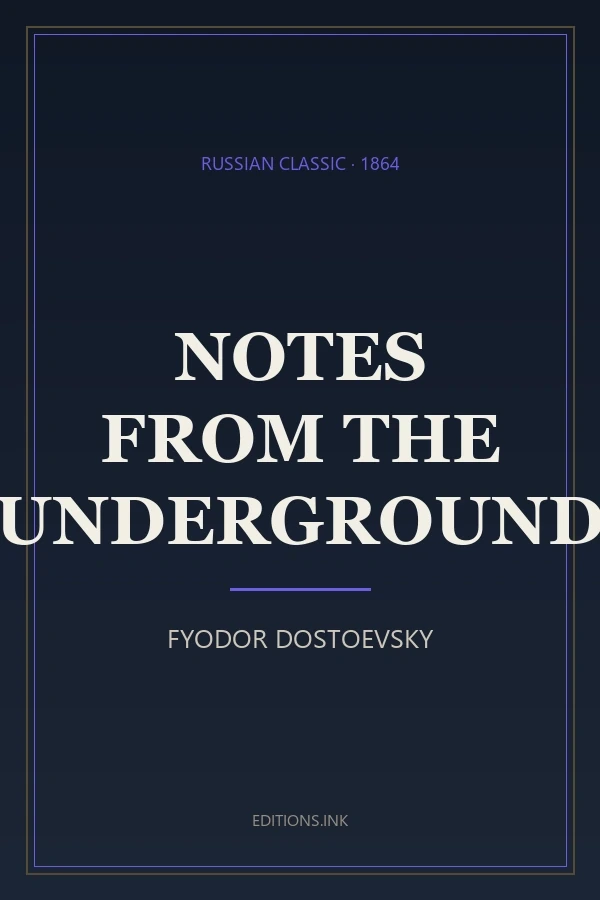
Notes from the Underground
📖 Click to Read the Opening Pages Online Preview
Part I, section I: “I am a sick man”
I am a sick man…. I am a spiteful man. I am an unattractive man. I believe my liver is diseased. However, I know nothing at all about my disease, and do not know for certain what ails me. I don’t consult a doctor for it, and never have, though I have a respect for medicine and doctors. Besides, I am extremely superstitious, sufficiently so to respect medicine, anyway (I am well-educated enough not to be superstitious, but I am superstitious). No, I refuse to consult a doctor from spite. That you probably will not understand. Well, I understand it, though. Of course, I can’t explain who it is precisely that I am mortifying in this case by my spite: I am perfectly well aware that I cannot “pay out” the doctors by not consulting them; I know better than anyone that by all this I am only injuring myself and no one else. But still, if I don’t consult a doctor it is from spite. My liver is bad, well—let it get worse!
I have been going on like that for a long time—twenty years. Now I am forty. I used to be in the government service, but am no longer. I was a spiteful official. I was rude and took pleasure in being so. I did not take bribes, you see, so I was bound to find a recompense in that, at least. (A poor jest, but I will not scratch it out. I wrote it thinking it would sound very witty; but now that I have seen myself that I only wanted to show off in a despicable way, I will not scratch it out on purpose!)
When petitioners used to come for information to the table at which I sat, I used to grind my teeth at them, and felt intense enjoyment when I succeeded in making anybody unhappy. I almost did succeed. For the most part they were all timid people—of course, they were petitioners. But of the uppish ones there was one officer in particular I could not endure. He simply would not be humble, and clanked his sword in a disgusting way. I carried on a feud with him for eighteen months over that sword. At last I got the better of him. He left off clanking it. That happened in my youth, though.
The preview breaks off three paragraphs in. The argument, the dinner and the wet snow continue in the full text below.
Download Full EPUB1864
~44,000 words (estimated)
Approx. 2.5 hours
Standalone
St Petersburg: a rented room on the outskirts, the Nevsky Prospect, and a brothel behind a milliner’s window
21 sections in 12 summaries
EPUB · AZW3 · KEPUB
0.37 MB (EPUB) · 0.44 MB (AZW3) · 0.39 MB (KEPUB)
Public domain in the United States
Project Gutenberg #600
Notes from the Underground is a short novel in two unequal parts, and the first of them is not a story at all. A retired clerk of forty, alone in a bad room on the edge of St Petersburg, explains at length why he is spiteful, ill and unable to become anything — not a hero, not even an insect. He argues with imagined readers about consciousness, toothache, the laws of nature and twice two makes four. The second part remembers a dinner, a humiliation, and a night that ends with a young woman named Liza.
The second part, “À Propos of the Wet Snow”, covers a few days when he was twenty-four: a farewell dinner for a schoolfellow he despised, a speech that wrecks it, three hours of pacing by the stove, and then a brothel where he lectures a girl on the ruin of her life and is, for one hour, taken at his word. The book closes with him alone again in the snow, and with a note from the author that the diary does not end so much as stop. See Wikipedia’s article on Notes from the Underground for its publication history. The text is available via Project Gutenberg #600.

Notes from the Underground by Fyodor Dostoevsky: Summary, Characters & Themes
Notes from the Underground is a summary and analysis of Dostoevsky’s 1864 novella, with the historical context, the characters, the themes, section-by-section chapter summaries and the free download links. The book is built as a confession without a plot. Its speaker, a former official of forty, has retired on a small inheritance, lives in a bad room on the edge of the city, and uses the first eleven sections to tell the reader what kind of man he is: ill, spiteful, over-conscious and unable to act. Only in the second part does anything happen, and what happens is small — a dinner he was not wanted at, and a young woman who comes to his flat the following evening. The two halves are printed as “Underground” and “À Propos of the Wet Snow”.
The author is Fyodor Dostoevsky, and the text of Notes from the Underground itself has a long critical history. Dostoevsky was born in Moscow in 1821, trained as a military engineer, and was arrested in 1849 with the Petrashevsky circle, sentenced to death, reprieved at the scaffold and sent to four years of hard labour in Siberia followed by service as a soldier. He returned to Petersburg in 1859 and wrote his major novels in the fifteen years that remained. This one came in 1864, the year in which both his wife and his brother died, and it is the first book in which the voice of his later narrators is fully audible: a man arguing with himself in public, at cross-purposes with his own argument.
The form is deliberately awkward. An author’s note at the front insists that the diarist is imaginary, then adds that people like him “not only may, but positively must, exist in our society”. There is no plot in the ordinary sense and no chapter titles beyond numerals; the narrator has no name and is only “I”, while the reader is addressed as “you” and accused of the same cowardice. Much of Part I is not narrative but argument — with the reader, with a wall, with arithmetic — and it keeps doubling back to call itself a lie. Part II changes register completely: dated, concrete, full of streets, gloves, a stained trouser knee and a borrowed six roubles. The transition between the two is abrupt on purpose, and it is one of the book’s inventions.
The argument of Part I is aimed at the optimistic rationalism of the 1860s, the belief that once people see their true interest they will act on it and that history is a matter of enlightened calculation. The narrator answers with the wall, the pleasure of toothache and twice two makes four — the arithmetic of a world where the answer is settled in advance and nothing is left to want. His counter-claim is that a man may choose what is stupid and harmful simply to prove that the choice was his own, “twice two makes five is sometimes a very charming thing too” included. The crystal palace of the reformers, when it arrives, would be a place no one could put his tongue out at.
The text in this edition is the Project Gutenberg transcription (#600), complete and in the public domain: the author’s note, both parts, all twenty-one sections, the Nekrasov epigraph that opens Part II and the bracketed sentence that closes it. The novella is given without editorial apparatus, no introduction and no notes, and without modernised spelling; the section numbers are as the transcription has them and no paragraph has been cut or moved. If the narrator’s argument gets under the skin, it is worth seeing it turn into plot: Crime and Punishment is the same city with a story attached, The Brothers Karamazov takes the questions into a courtroom, and The Idiot is the next book about a good man among worse ones.
Historical Context
Notes from the Underground appeared in the first issues of 1864 in Epoch, the short-lived monthly edited by Dostoevsky and his brother Mikhail, which was chronically short of money. He wrote fast and to a deadline, in the middle of debts and a household in crisis. Russian readers of that year had spent a decade arguing about the “new men” — the ascetics of science and self-interest whose portraits Chernyshevsky had drawn the year before in What Is to Be Done? — and the narrator’s jeering at rational egoism, at the crystal palace and at the arithmetic of progress is part of that argument rather than a meditation on it.
By 1864 a whole vocabulary of progress was in circulation in Russia: the natural sciences were taken to have settled human behaviour, crime was a miscalculation, and history was a matter of engineering. Dostoevsky had spent the early 1860s writing against that vocabulary in his own journalism; here he lets his narrator do it by mockery instead of argument. The wall made of “the laws of nature, the deductions of natural science, mathematics” is what a man runs his head against; the crystal palace is what the engineers promise to build once everyone has agreed that the wall cannot be moved. The refusal to be reconciled to a wall, even a wall that cannot be broken, is the book’s whole subject.
St Petersburg in the 1860s was a city of clerks, cheap lodgings and long straight prospects. The narrator is a collegiate assessor, a rank in the table of ranks, and nearly all of his social life in Part II is conducted through rank: the officer who moves him aside, the general he makes way for on the Nevsky, the schoolfellows who now have incomes and expectations. Behind them stands the Petersburg of the emancipation and the swelling bureaucracy, with a large population of young women arrived from the provinces with no trade but one. Liza says she is from Riga, and the narrator’s lecture on her future is a piece of local sociology as well as a piece of cruelty.
Key Characters & Literary Archetypes
- The Underground Man: The narrator, never named: forty years old, a collegiate assessor who retired after twenty years’ service on a legacy of six thousand roubles and lives in a wretched room on the outskirts with one disagreeable servant. He is ill and refuses doctors out of spite, clever and unable to use it, and honest to the point of exhibitionism about his own cowardice. Everything he does in Part II is done to restore a dignity he has already decided he does not possess.
- Liza: A young woman of twenty or so, “from Riga”, with straight dark eyebrows and grave, wondering eyes, whom the narrator meets in a house behind a milliner’s window. She listens to his sermon on her ruin and weeps, then comes to his flat the next evening because he gave her his address. She is the one person in the book who takes him at his word, and she throws his five-rouble note back on the table.
- Apollon: The narrator’s servant, a man of the old school with a taste for pedantry and a lisping drawl, paid seven roubles a month and determined to be the equal of any argument. He cleans the boots once a day and not twice, stands in the doorway with one hand behind his back and simply stares, and drives his master into shouting for the police. The wages owed to him are the exact measure of the narrator’s poverty, and his announcement that a woman is waiting is the hinge of Part II.
- Zverkov: A schoolfellow of the narrator’s, now an officer about to leave Petersburg for a distant province, for whom the farewell dinner of Part II is given. At school he was a pretty, playful boy whom everybody liked, bad at lessons and good at being liked; he has since come into an estate of two hundred serfs and acquired a manner of condescending good nature. He is not a villain, he is immune: when the narrator begs his pardon, he answers that he could not possibly be insulted.
- Simonov: A quiet, equable old schoolfellow whom the narrator visits on a Thursday and had not seen for a year. He is arranging Zverkov’s dinner, keeps the accounts of it, and is the only person in the book who does the narrator a kindness — he pushes over six roubles with the words “Take it, if you have no sense of shame!” The letter the narrator writes him the next morning, returning the money with an account of his own good breeding, is one of the funniest and most painful pages in the book.
- The officer on the Nevsky: A tall officer of over six feet who once, at a billiard table, took the narrator by the shoulders and moved him aside without a word, and so gave him a grievance to live on for years. The narrator follows him about, learns his surname from a shout in the street, writes a satire that no journal prints, and finally arranges a collision on the Nevsky Prospect in which neither man yields a step. He calls the result a victory and remembers it for the rest of his life.
Core Literary Themes
- Consciousness as an illness: The book opens by diagnosing itself: to be too conscious is a disease, and the narrator has it badly. The mouse of section III is the type — a creature that sees every side of its own resentment and so can neither act on it nor abandon it. Even toothache becomes a demonstration: a month of it yields an audience, and the educated moan of the nineteenth century is a complaint about progress as much as about a nerve. His conclusion is deliberately perverse and hard to shake: suffering is the sole origin of consciousness, and a contented man would feel nothing at all.
- The wall and twice two makes four: The wall stands for everything that cannot be argued with — the laws of nature, the deductions of natural science, mathematics. A man may beat his head against it, and the wall will not care. The narrator’s grievance is not that the wall exists but that he is expected to be reconciled to it, and the arithmetic is the same grievance in a purer form: twice two makes four whether or not he wills it, and a will that cannot alter the answer is not free. He would rather keep the freedom to want something stupid than be correct.
- The crystal palace: The glass exhibition building of the 1850s had become, by 1864, shorthand for the perfected society the radicals expected: rational, planned, comfortable and finished. The narrator’s objection is not that the plan would fail but that it would succeed, and that a man inside it would have nothing left to desire. He would crawl into a hen-house to get out of the wet, he says, but he will not be fobbed off with a hen-house that calls itself a mansion. He would rather see his hand wither than lay one brick of the real thing.
- Spite, or the freedom to want what harms you: The most scandalous claim in Part I is that a man may knowingly choose what is injurious to himself, not from ignorance but to prove that the choice was his. Against the utilitarians, who explain error as a miscalculation, the narrator insists that spite is a form of freedom: it cannot be tabulated, predicted or spent. The underground is where that freedom is finally kept — conscious inertia, a refusal to do anything at all, which he celebrates as a position rather than admitting it is a defeat. The book never settles whether this is courage or a tantrum.
- Humiliation and love as tyranny: Part II turns the argument into behaviour. He invites himself to a dinner where he is not wanted, insults the company, and then begs forgiveness; he follows a girl home and improves her, then cannot bear being comforted by her. His own analysis is exact: with him, loving meant tyrannising and demonstrating moral superiority, and love was the right, freely granted by the beloved, to tyrannise in return. The five-rouble note he presses on Liza is the whole thesis in one gesture — a kindness offered as an insult, refused as an insult, and remembered for fifteen years.
Why Download Our Custom E-Reader Edition of Notes from the Underground?
This edition is the whole book — the author’s note, both parts, all twenty-one sections, the Nekrasov epigraph and the closing bracket — and it is free. The text is the Project Gutenberg transcription, complete and in the public domain, with nothing abridged and no spelling modernised. None of the argument has been simplified for the reader, which in this particular book would be a kind of betrayal.
Three formats, one download each: EPUB for phones and tablets, AZW3 for Kindle, KEPUB for Kobo. The files carry no DRM, no account is needed, and the section breaks are real chapter breaks, so the eleven sections of Part I and the ten of Part II open where Dostoevsky put them rather than in the middle of a paragraph. Each file keeps the author’s note and the epigraph in their places.
It is a short book and a slow one: about 44,000 words, roughly two and a half hours of reading, most of it spent inside one man’s head. The summaries below follow the numbered sections, so you can see where the argument stops and the story starts before you begin, or find the passage about the wall and twice two again after you have finished. The table of contents takes you straight to any section by its number.
- Project Gutenberg transcription, via Project Gutenberg #600 — the complete text, unabridged, with all twenty-one numbered sections and the author’s note where they belong.
- Formats EPUB for phones and tablets, AZW3 for Kindle, KEPUB for Kobo — one download each, free, with no account and no DRM to strip.
- Navigation every numbered section is its own chapter break, so Part I reads as the argument it is and Part II as the separate story it pretends to be.
- Text unabridged and unmodernised, with the original punctuation and the closing bracket kept, so nothing of the book’s awkwardness has been tidied away.
- Crime and Punishment — free EPUB, AZW3 & KEPUB
- The Brothers Karamazov — free EPUB, AZW3 & KEPUB
- The Idiot — free EPUB, AZW3 & KEPUB
Chapter summaries
The novella runs to twenty-one numbered sections in two parts: eleven in “Underground”, ten in “À Propos of the Wet Snow”. The summaries below keep the original numbering, so the two halves can be read as the argument and the story they were built to be.
- Part I, section I: “I am a sick man”: He opens with the three sentences everyone quotes — sick, spiteful, unattractive — and then refuses to see a doctor out of pure spite. Twenty years of it; he is forty; he has left the service on a small legacy and lives in a wretched room on the outskirts with one disagreeable servant. The important thing, he says, is not that he is spiteful but that he is ashamed of not being spiteful enough: bring him a cup of tea with sugar in it and he would be appeased.
- Part I, sections II–III: the mouse and the wall: Consciousness, he says, is a disease, and Petersburg is the most theoretical and intentional town on earth. Against men of action, who revenge themselves like a bull and stop only at a wall, he sets the mouse: the man who doubts, revises and despises his own revenge even while taking it. The wall is the laws of nature, the deductions of natural science, mathematics. He cannot break it with his head and he will not be reconciled to it, and the refusal is presented not as heroism but as grinding impotence.
- Part I, sections IV–V: the toothache and the pleasure of degradation: Two short sections on pain and self-disgust. A toothache sustained for a month is shown to have its enjoyments: the moaning is done for an audience, and the educated moan of the nineteenth century differs from a peasant’s howl because it complains about progress and civilisation. From there he moves to degradation — a man who knows he is behaving badly can still take a voluptuous pleasure in the knowing — and to the sham penitence of a child promising not to do it again.
- Part I, sections VI–VII: laziness, and the gentleman who knows his Lafitte: He wishes he had done nothing simply from laziness, and treats the sluggard as a positive identity rather than a failure. Then a portrait: the gentleman who prides himself on being a connoisseur of Lafitte, who drinks to “the sublime and beautiful”, and who has acquired a good round belly, a treble chin and a ruby nose. The joke is at his own expense as much as anyone’s — he is describing the sort of person an intelligent man becomes once he stops arguing and starts enjoying himself.
- Part I, sections VIII–IX: the organ-stop and twice two: If a formula for every human desire were ever found, he says, men would turn into organ-stops: the tables of rules would arrive and the will would have nothing left to do. Reason is only one faculty, and a man wants to live his whole life, not simply extract square roots. Then the arithmetic: it is fixed in advance, twice two makes four whether he wills it or not, and a will that cannot alter the answer is not a free will. He would rather keep the right to want something stupid.
- Part I, sections X–XI: the crystal palace, and the lie: The crystal palace of the reformers is the target: he could creep into a hen-house to get out of the wet, but he will not take a hen-house for a mansion, and while he lives he would rather his hand were withered than bring one brick to such a building. The last section turns on himself: he believes none of it, he writes for readers only because that is easier, and he has spent forty years listening to them through a crack under the floor. The snow outside is what reminds him of the incident he is going to tell.
- Part II, section I: the officer at the billiard table: He is twenty-four again, a clerk with a bad temper and no money, and the sorest memory of that year is an officer who once took him by the shoulders and moved him aside without a word. He could have forgiven blows; he cannot forgive being moved without being noticed. He follows the man for years, learns his name from a shout in the street, writes a satire that no journal prints, and finally stages a collision on the Nevsky in which neither of them yields a step.
- Part II, sections II–III: the visit, and the dinner arranged: Boredom drives him to Anton Antonitch’s Tuesday at-home, where he sits four hours in silence among the excise duty and the daughters’ snub noses. He then calls on Simonov and walks into the arrangements for a farewell dinner to Zverkov: seven roubles a head, the Hôtel de Paris, five o’clock. He invites himself, though the others plainly do not want him, and treats the invitation as a debt they owe him. He has nine roubles, owes seven to his servant, and tells himself that he will go and will not pay the wages.
- Part II, section IV: the dinner, the speech, the three hours: He arrives at twenty-five past five for a dinner ordered for six, and waits an hour with the table not even laid while waiters watch him; nobody had told him the hour had changed. Zverkov is courteous in the manner of a general, Ferfitchkin sniggers, and the questions about his salary are not friendly. Drunk on sherry and Lafitte, he makes a speech about phrasemongers and true comradeship that ends by recommending the seduction of Circassian girls and the shooting of the enemies of the fatherland. Then he walks up and down by the stove from eight till eleven.
- Part II, section V: the wet snow, and the milliner’s shop: He runs out into a warm wet snow, takes a sledge, and works himself up to a slap in the face, only to recognise his own fantasy as something out of Pushkin’s Silvio and Lermontov’s Masquerade. He gets out in the street, stands in the snow, gets back in and hits the driver on the neck. The address is a millinery shop by day; by night the drawing-room holds one candle and nobody, because the party has already separated. The madam smiles, and a minute later Liza comes in.
- Part II, sections VI–VII: the sermon, and the address: Alone with her, he delivers a long lecture on the fate of a young woman in her trade: the houses she will descend to, the consumption, the coffin carried through the Haymarket, the water a foot deep at Volkovo Cemetery. He invents details as he goes and enjoys the power of it, and does not notice until too late that she has broken down and is biting the pillow. Then he is ashamed, apologises and gives her his address. She says she will come, and presses on him an old letter from a medical student.
- Part II, sections VIII–X: Apollon, the note, and the end: Next morning he has already forgotten her: he borrows fifteen roubles, repays Simonov, and goes to war with Apollon over seven roubles of wages. The quarrel is at its worst, with the servant guffawing and his master shouting for the police, when Liza walks in. He humiliates her, then sobs on the sofa for a quarter of an hour while she holds him, then watches her through the crack of the screen. She leaves with a crumpled blue five-rouble note pushed into her hand, throws it down, and he never sees her again.
Notes from the Underground: Frequently Asked Questions
What is Notes from the Underground about?
Is the Underground Man Dostoevsky?
Why does he keep returning to twice two makes four?
What is the crystal palace in the book?
Do I have to read Part I before Part II?
What happens to Liza?
Which translation is this edition?
Where can I read the whole text online?
Part of: Philosophy · Classic Fiction