The Food of the Gods by H. G. Wells: Free EPUB, AZW3 & KEPUB Download
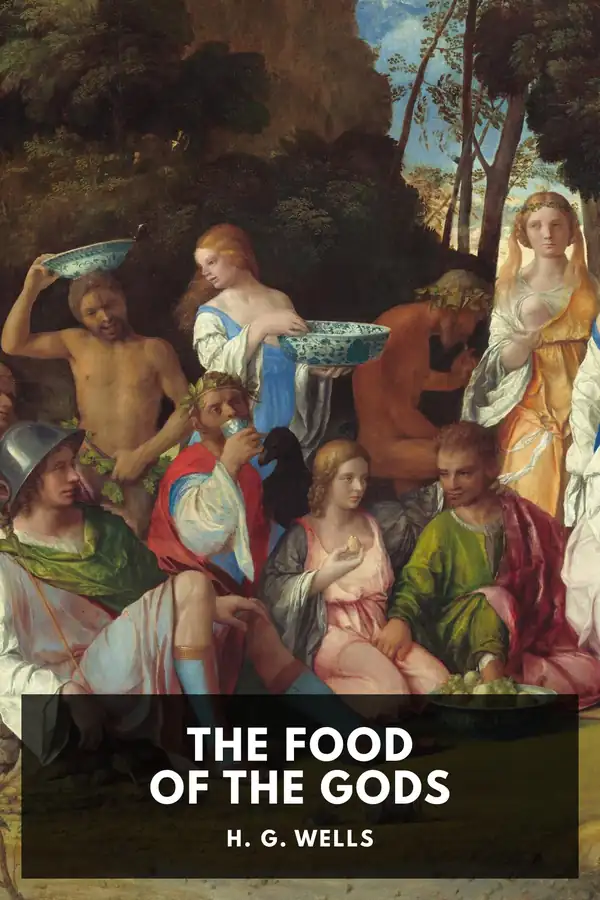
The Food of the Gods
📖 Click to Read the Opening Pages Online Preview
Two scientists, a Sloane Street flat and a theory of growth
In the middle years of the nineteenth century there first became abundant in this strange world of ours a class of men, men tending for the most part to become elderly, who are called, and who are very properly called, but who dislike extremely to be called—“scientists.” They dislike that word so much that from the columns of Nature, which was from the first their distinctive and characteristic paper, it is as carefully excluded as if it were—that other word which is the basis of all really bad language in this country. But the Great Public and its Press know better, and “scientists” they are, and when they emerge to any sort of publicity, “distinguished scientists” and “eminent scientists” and “well-known scientists” is the very least we call them.
Certainly both Mr. Bensington and Professor Redwood quite merited any of these terms long before they came upon the marvellous discovery of which this story tells. Mr. Bensington was a Fellow of the Royal Society and a former president of the Chemical Society, and Professor Redwood was Professor of Physiology in the Bond Street College of the London University, and he had been grossly libelled by the anti-vivisectionists time after time. And they had led lives of academic distinction from their very earliest youth.
They were of course quite undistinguished looking men, as indeed all true scientists are. There is more personal distinction about the mildest-mannered actor alive than there is about the entire Royal Society. Mr. Bensington was short and very, very bald, and he stooped slightly; he wore gold-rimmed spectacles and cloth boots that were abundantly cut open because of his numerous corns, and Professor Redwood was entirely ordinary in his appearance. Until they happened upon the Food of the Gods (as I must insist upon calling it) they led lives of such eminent and studious obscurity that it is hard to find anything whatever to tell the reader about them.
The preview stops inside Book I. All twelve chapters are in the free download below.
Download Full EPUB1904
~74,000 words (estimated)
Approx. 4.1 hours
Standalone
Southern England in the early twentieth century
12 chapters in three books
EPUB · AZW3 · KEPUB
0.70 MB (EPUB) · 0.76 MB (AZW3) · 0.73 MB (KEPUB)
Public domain in the United States
Project Gutenberg #11696 · Standard Ebooks
Two very different scientists, the cautious Mr. Bensington and the physiologist Professor Redwood, work out that growth is a chemical process which can be switched on from outside the body. Their compound, Herakleophorbia IV, turns chicks, wasps and rats into monsters, escapes from a farm at Hickleybrow in Kent and reaches a village baby named Albert Caddles. Twenty years later England is a country of giant vegetation and a handful of giant young people, while the politician Caterham campaigns to stamp the Food out. Wells mixes farce, social satire and a genuinely troubling question about who gets to decide how large the future should be.
The Food of the Gods is one of Wells’s most ambitious scientific romances: a comedy of Edwardian science that becomes a prophecy about a species refusing to stay small. It appeared in 1904, and its central invention — a growth formula that makes chickens, wasps and children enormous — carries a serious argument about progress, responsibility and the survival of the fittest. The novel is described in the Wikipedia article on The Food of the Gods and How It Came to Earth. The text is available via Project Gutenberg #11696 and Standard Ebooks.
The Food of the Gods by H. G. Wells: Summary, Characters & Themes
This page is a summary and analysis of The Food of the Gods and How It Came to Earth, the scientific romance H. G. Wells published in 1904, between The Time Machine and The War in the Air. Wells, whose life and opinions are part of the book’s argument, had spent the 1890s turning scientific speculation into narrative, and here he takes a single premise — that growth is a chemical process which can be supplied from outside the body — and follows it through two decades of imagined history. Mr. Bensington, a bald, fussy authority on toxic alkaloids, and Professor Redwood, a physiologist, isolate the substance they call Herakleophorbia IV. Their first trials, on a farm at Hickleybrow in Kent, produce chickens six times their normal size, wasps with three-inch stings and rats that kill a horse. The tone is comic; the implications are not.
Wells makes the science absurd and the consequences logical. The Food must be given continuously through childhood or the growing child sickens; adults who stop taking it keep their size; the stuff leaks, blows about as dust and gets into ponds, streams and bakeries. What begins as a laboratory joke becomes an ecological accident and then a political crisis. Readers who know The War of the Worlds will recognize the method: one impossible change, traced through institutions, habits and ordinary people until the world looks different. The difference is that the change is not an invasion from outside but something humans made and cannot recall. Bensington wants to pour the Food into the earth and watch the world swell; Redwood dreams of lecturing cosmic forces on the new growth. Neither imagines a farm labourer’s wife carrying two stolen tins across the downs to her daughter’s village.
The middle of the novel is its sharpest social comedy. At Cheasing Eyebright, a Kentish village under the Hanger, the baby Albert Edward Caddles is fed the stolen Food and grows into a gentle, hungry, unemployable giant. Lady Wondershoot, the village tyrant, sends flannel and charity, then sets him to work in her chalk quarry; the Vicar teaches him that his strength is “not for use”. Wells uses the village to show how English society manages anything it cannot classify: with patronage, boundary boards and good advice. The scientists’ own giant children fare better, educated in a purpose-built nursery and a fortified camp, but they too are confined, watched and finally legislated against. The Princess, fed the Food as a royal infant, is kept ignorant of the other giants until she meets Redwood’s son; their love affair turns a species question into a family quarrel.
The book is built in three movements. Book I, The Dawn of the Food, is laboratory farce and monster hunt; Book II, The Food in the Village, is provincial satire; Book III, The Harvest of the Food, is political thriller and open-ended myth. That structure lets Wells age his characters and his world without losing the comic thread: the same Bensington who once fretted about tadpoles ends as a timid celebrity in Tunbridge Wells, while the giant children become a standing challenge to every institution that tried to keep them small. As in The Invisible Man, the speculation is less about machines than about the rules a society will bend to protect itself. Caterham’s campaign gives the reaction a plausible, popular voice: prohibition, licensing, a cordon around the giants and a promise that the little people will remain the measure of all things.
The first edition was published by Macmillan in London in 1904, and the book has been reprinted constantly since. This page follows the Standard Ebooks edition, prepared from the Project Gutenberg transcription available at Project Gutenberg #11696; the Standard Ebooks edition of The Food of the Gods supplies the clean text used for this free download. Wells never revised the ending: the novel closes not with a battle but with a speech, as the giants refuse Caterham’s terms and promise to scatter the Food across the world. Whether that is triumph or catastrophe is left to the reader, which is why the book remains more unsettling than its monster-movie reputation suggests.
Historical Context
Wells wrote the novel in the aftermath of the Boer War, when British confidence was being audited. The conflict had exposed the poor physical condition of recruits, and a committee on physical deterioration would report in 1904 on hunger, overcrowding and the health of the urban poor. Growth, nutrition and national efficiency were public themes, not laboratory ones. The Food of the Gods takes that anxious conversation and makes it literal: if the state could feed its children better, what kind of citizens would result, and who would control them? Wells had joined the Fabian Society in 1903, and the novel’s impatience with committees, lawyers and building regulations is the impatience of a reformer who has watched institutions defend themselves.
The book belongs to the great age of the scientific romance, the decade of Wells’s The Time Machine, The Island of Doctor Moreau, The Invisible Man and The War of the Worlds. Those books took a single scientific or evolutionary idea and pushed it through ordinary English life; this novel does the same with growth, and it does so at greater length, with a cast that ages across twenty years. Wells was also writing as a socialist and prophet, and his contemporaries debated heredity, degeneration and the possibility of breeding a better human being. The novel does not endorse that programme. Its giants are not a master race but a handful of very large young people who want to be left alone, and their creators are two middle-aged men who never agree on what they have done.
Food itself was a political subject in 1904. Milk was routinely watered, preservatives were unregulated, and the quality of the national diet had become a question for doctors and civil servants. Wells turns that concern into a substance that can be spilled, stolen, sold and dumped: the Food enters the world through a cracked pipe, a carelessly opened tin and a dust-laden flour sack, not through a government programme. The result is a satire on pollution and on the impossibility of containment. Caterham’s movement, with its posters, mass meetings and promise to “grasp the nettle”, also catches the new style of popular politics in an age of mass newspapers; the mob that marches on Bensington’s flat is both frightening and recognizably modern.
Key Characters & Literary Archetypes
- Mr. Bensington: A small, bald, stooping Fellow of the Royal Society, expert on toxic alkaloids, who keeps his boots slit for corns and shares a Sloane Street flat with a disapproving cousin. He conceives the Food as a way to abolish the body’s resting phase and dreams of pouring it into the earth. Fame frightens him, the mob hunts him, and he ends in Tunbridge Wells, taking the waters and avoiding the subject. Wells makes him ridiculous without making him contemptible; his vanity is the ordinary vanity of a clever man never asked to imagine consequences.
- Professor Redwood: A physiologist at Bond Street College who reaches the Food through growth curves on kittens, puppies, sunflowers and, briefly, his own baby. He is quieter and more stubborn than Bensington, and he secretly doses his infant son before telling anyone. The novel follows him from the laboratory to the fortified camp where his grown son waits with the other giants; he is the parent who must negotiate with the future he made. His final position, staying with the giants while their answer goes to Caterham, is the book’s closest approach to a moral choice.
- Cossar: A civil engineer, large, practical and impatient, who takes charge when the farm at Hickleybrow becomes dangerous. He buys guns, organizes the burning of the wasps’ nest, crawls into the rat tunnels and later builds the giant nursery and the Cossars’ fortified camp. He feeds the Food to all three of his sons and refuses to apologize for it. Where Bensington theorizes and Redwood worries, Cossar acts; he is Wells’s tribute to the engineering temperament, and also a warning about how easily competence becomes coercion.
- Caterham: The politician who turns public fear into a programme. A cousin of the Prime Minister and a rising orator, he demands Boomfood’s total suppression, campaigns to grasp the nettle and, by the third book, governs by decree. He is not a simple villain: Wells gives him exhaustion, magnetism and a belief that the little people must remain the measure of the world. His proposal to the giants, a reservation with no more Food and no children, is reasonable the way a prison is reasonable, and the novel lets him make his case.
- The Princess: Fed the Food as an infant by Dr Winkles, the Princess of Weser Dreiburg has grown up isolated, royal and ignorant of the other giants. Her visit to England is a dynastic arrangement until she meets young Redwood in the Great Park and discovers what she is. Their fourteen meetings, the court scandal and her refusal to give him up make Book III’s second chapter the novel’s love story. She is also the first giant woman, and her presence turns the Food from a public problem into a question about who may have a future.
- Albert Edward Caddles: The village child who receives the stolen Food at Cheasing Eyebright. He grows into a shy, hungry giant, kept out of school and church, taught that his strength is “not for use”, and set to work in Lady Wondershoot’s chalk quarry. His bewildered questions become a London catchword, “Wot’s it all for?”, before he is shot by police in a Highgate garden. He is the book’s most sympathetic creation and its clearest victim: a person made by science and then punished for the size it gave him.
Core Literary Themes
- Growth as an uncontrollable force: The novel’s central image is growth that will not stop at the size its makers intended. Chicks become horses, wasps become birds of prey, children become forty-foot strangers, and the Food keeps leaking into ponds and bakeries. Wells treats growth as both promise and pollution: it is life itself, and it is also the thing that ruins a neighbourhood. The giant children are not monsters, but the vegetation, rats and insects around them are, and the difference is partly a matter of scale and partly a matter of who can be reasoned with. The book’s most disturbing suggestion is that the process cannot be reversed, only managed.
- Science without responsibility: Bensington and Redwood are careful men by temperament, and the disaster still happens. They test on animals, keep records and argue about publication, but they never ask who will clean up after them. The Food escapes through a cracked pipe, a stolen tin and a dusty sack; the scientists’ own children are the first experiments they cannot control. Wells, trained as a biologist, knew how easily a laboratory result becomes a public fact. The novel is less an attack on knowledge than on the habit of treating consequences as somebody else’s department. Its repeated image is the official inquiry that concludes nothing can go wrong while, outside, the nettles grow.
- Class, patronage and the village: Cheasing Eyebright is a small study in English hierarchy. Lady Wondershoot owns the village, the Vicar interprets it, and the parish decides what to do with a child who does not fit. Caddles is fed, clothed and pitied, then put to work and told his strength is “not for use”. Wells’s satire targets kindness that cannot imagine a different order. The giant children of the scientists escape the village but not the pattern: they are given a nursery, a camp and finally a reservation. The novel asks who has the right to decide how large a person may be, and answers, uncomfortably, that the decision is usually made by those who are frightened.
- Reaction, progress and the popular voice: Caterham’s campaign is the novel’s political engine. He speaks to mass meetings, prints posters, promises to grasp the nettle and gives the frightened a language for their fear. Wells refuses to make him a fool: his diagnosis of the danger is accurate, and his solution is a prison. Against him stand the giants, who ask only to be left alone and to grow. The debate is not between science and superstition but between two kinds of future, one small and safe and administered, the other large, risky and unknown. The novel’s open ending declines to settle the argument, which is why the political chapters still read like a warning rather than an allegory.
- Love and the coming race: The Princess and young Redwood are the first giants to meet as equals, and their courtship is also a species negotiating with itself. Their love is presented without irony: they are young, lonely and physically magnificent, and the court’s horror is both comic and credible. Wells uses the romance to test his own idea of progress, because a new race that cannot love is only a bigger machine. The pair’s flight to the Cossar camp turns private feeling into public defiance. At the end, the giants’ answer to Caterham is delivered by a young man who has chosen a woman and a future over the safety of the little world that raised him.
Why Download Our Custom E-Reader Edition of The Food of the Gods?
This edition is built for reading rather than for a shelf. The text is the Standard Ebooks text of Wells’s 1904 novel, with the three books and twelve chapters in their original order and the chapter titles left as he wrote them. There is no editorial apparatus interrupting the story, no modernized spelling and no abridgement. What you download is the whole story, set cleanly, with a table of contents that works on an e-reader.
The download includes every chapter, including the long middle book that film adaptations usually cut. You can follow the Food from the Sloane Street flat to Hickleybrow, from the village of Cheasing Eyebright to the fortified pit at Chislehurst, and judge the ending for yourself. The Project Gutenberg transcription at Project Gutenberg #11696 is the source of the text; the chapter summaries above are here to help you keep the large cast straight.
Wells is a brisk, argumentative writer, and this is one of his most readable long romances. The comedy is broad, the politics are sharp and the giant children are treated with more sympathy than their creators. If you have read The War of the Worlds for the invasion and The Time Machine for the far future, this is the book where Wells turns the same imagination on the near future of everyday England. It is also, quietly, a book about parenting.
- Based on the Standard Ebooks Edition, via Standard Ebooks, whose editors prepared this text from the Project Gutenberg transcription, keeping the novel’s three books and twelve chapters in their published order; the divisions used in the summaries below match the edition you download.
- Complete twelve-chapter text All of Book I, Book II and Book III, including the political chapters that adaptations tend to compress, in the order Wells published them.
- EPUB, AZW3 and KEPUB downloads Three formats for phones, tablets, Kindle and Kobo, each with a working table of contents and no account required.
- Free and DRM-free No payment, no registration and no copy protection; the novel is public domain in the United States, so you can keep and share the files.
- The War of the Worlds — free EPUB, AZW3 & KEPUB
- The Invisible Man — free EPUB, AZW3 & KEPUB
- The Time Machine — free EPUB, AZW3 & KEPUB
Chapter summaries
Book I opens with the discovery; the twelve chapters below follow the Food from a Sloane Street flat to the last stand of the giants at Chislehurst.
- Book I, chapter 1 — The discovery of the food: Wells introduces his two scientists with affectionate mockery: Mr. Bensington, a small, bald expert on toxic alkaloids, and Professor Redwood, a physiologist who has been measuring growth in kittens, puppies and his own baby. Redwood’s curves show that growth comes in bursts, and Bensington sees how to supply the missing substance in food. They name it Herakleophorbia, test three versions and arrive at Herakleophorbia IV, the Food of the Gods. The chapter is a comedy of pedantry, and it ends with the two men dreaming of an enormous future.
- Book I, chapter 2 — The experimental farm: Bensington’s plan to test the Food on tadpoles is vetoed by his cousin Jane, so he rents a farm at Hickleybrow in Kent and hires the Skinners to raise chickens. The first three formulae fail; the fourth produces chicks six times their proper size, wasps as big as hens and rats that will soon be a menace. Redwood confesses that he has already fed the Food to his baby son. Mrs. Skinner steals two tins and releases the giant hens on the village, and her husband vanishes up the hill.
- Book I, chapter 3 — The giant rats: A country doctor is attacked by three giant rats, and the news reaches London. Cossar, the engineer, takes command, buys guns and powder and leads a small expedition to Hickleybrow, where the farm is buried in giant vegetation and the wasps are as large as hens. The party smokes out the wasps, shoots the rats and burns the farm to avoid a scandal. Bensington remembers Latimer’s words about the candle lit in England. Nine miles away, Mrs. Skinner opens a tin and feeds the Caddles baby.
- Book I, chapter 4 — The giant children: Bensington becomes famous, Punch christens the substance Boomfood, and the public mood turns from amusement to alarm. Caterham, a rising politician, demands suppression; a Royal Commission is promised and a bill threatened. Dr Winkles, the loudest popular authority on the Food, treats a royal baby with it. Redwood’s own son grows at several times the normal rate, and Cossar builds a giant nursery next to Redwood’s house. The chapter sets out the rules of the Food and the shape of the coming conflict.
- Book I, chapter 5 — The minimificence of Mr. Bensington: Winkles secretly tries to analyse the Food in a garden laboratory at Keston, and the residue drains into a pool. Beetle larvae grow to a foot long, a science teacher is attacked, and the common becomes a centre of giant life. Similar leaks appear at Ealing and Sunbury, but the public blames Bensington alone. A mob marches on his flat; Cossar disguises him as an old woman and walks him out. Bensington retires to Tunbridge Wells, a small man who has launched a large world.
- Book II, chapter 1 — The coming of the food: The Food spreads across the world through dust, flour and leaking pipes, while the giant children grow quietly. Wells narrows his lens to Cheasing Eyebright, a Kentish village ruled by Lady Wondershoot and explained by its Vicar. Mrs. Skinner arrives with her stolen tins, and the Caddles baby is fed. He grows so fast that the parish calls it hypertrophy and the christening becomes a spectacle. Redwood tracks the baby down and insists the Food must continue. The chapter ends with the parish deciding that the mischief is done, though it is only beginning.
- Book II, chapter 2 — The brat gigantic: Albert Caddles grows into a shy, hungry giant, kept out of school and church and taught that his strength is “not for use”. He floods Lady Wondershoot’s icehouse, is set to work in her chalk quarry and runs it single-handed. The stream he drinks from carries the Food into the valley, and giant weeds, fish and insects follow. Caddles begins to ask why he must work and why the gentlefolk own everything; the Vicar has no answer. The chapter closes with the Vicar’s death and the giant grass hiding his tombstone.
- Book III, chapter 1 — The altered world: Twenty years on, a released convict travels to London and finds an England of giant thistles, buried railway stations and election posters. The three Cossar boys, now forty feet tall at least, keep a fortified camp near Sevenoaks and are kept out of bounds. Caterham speaks at the People’s Palace, promising to grasp the nettle, and the crowd roars. The chapter sketches the political world of the Food: a frightened majority, a handful of giant young people and a government preparing to act. Young Redwood is in love and no longer listening.
- Book III, chapter 2 — The giant lovers: The Princess of Weser Dreiburg, fed the Food as a baby, comes to England for a dynastic marriage and knows nothing of the other giants. In the Great Park she meets young Redwood, and over fourteen meetings they fall in love. The court, the Bishop and the press are scandalized; a courtier urges her to give him up as a matter of loyalty. Redwood has been making Food for the Cossars in his workshop, and the police close the roads. The chapter ends with the lovers running toward the Cossar camp under gunfire.
- Book III, chapter 3 — Young Caddles in London: Caddles wrecks the chalk quarry and walks to London, where Caterham’s emergency rules forbid any person over eight feet to travel more than five miles from home. He wanders the city asking what the swarming little people are for; the question becomes a music-hall catchword, and he cannot buy food because he has no money. Hunger drives him to raid bakers’ shops; the police corner him in Highgate. He pulls down a great electric standard to defend himself and is shot twice. The chapter is the book’s coldest scene and its clearest indictment of the little world’s fear.
- Book III, chapter 4 — Redwood’s two days: Caterham’s government arrests Cossar and places Redwood under house arrest while its forces surround the giants’ camp. For thirty-six hours Redwood hears gunfire, sees searchlights and fears a massacre, until Caterham’s secretary brings him news: thirteen giants are dead, his son is wounded, and the camp has shelled London with the Food, a poison to little people. Caterham, worn out and keeping himself up with drugs, offers a reservation and a ban on children. Redwood agrees to carry the terms to the camp, knowing he is now a messenger between two species.
- Book III, chapter 5 — The giant leaguer: Redwood reaches the fortified pit at Chislehurst and finds his son, bandaged, beside the Princess. He presents Caterham’s terms to the assembled giants: disperse, make no more Food, have no children. The giants refuse. Young Redwood argues that the little people will take the Food whether they wish to or not, and the giants resolve to scatter it across the world. Redwood stays with them; their answer goes to Caterham at dawn. The novel ends with Cossar’s son outlined against the stars, arm raised.
The Food of the Gods: Frequently Asked Questions
What is The Food of the Gods about?
Is it a sequel to The War of the Worlds?
Do I need to read the three books in order?
Is the giant child Albert Caddles or Albert Cossar?
What is Herakleophorbia IV?
How does the novel end?
Is the book suitable for younger readers?
Where can I download the free EPUB, AZW3 and KEPUB?
Part of: Science Fiction Classics · Early 20th Century