The White Company by Arthur Conan Doyle: Free EPUB, AZW3 & KEPUB Download
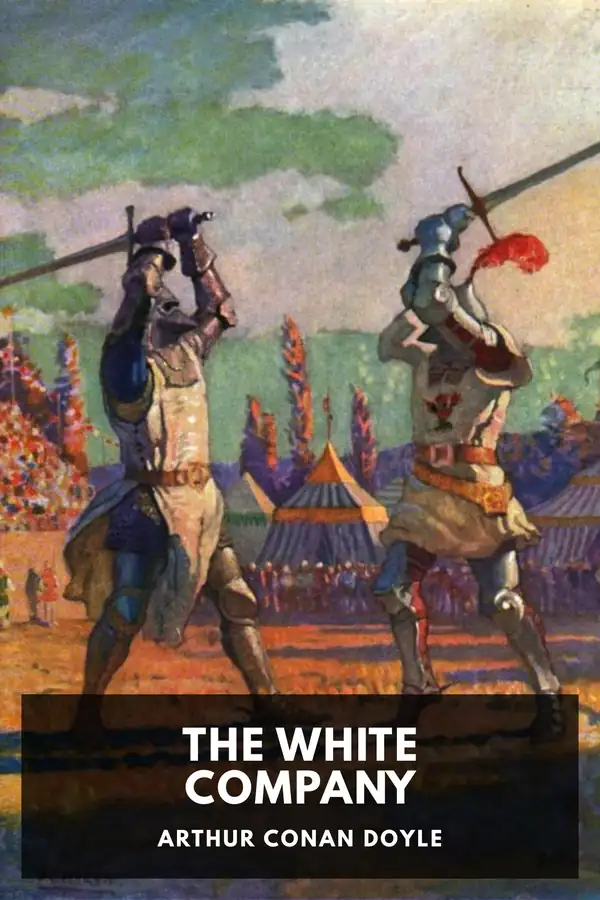
The White Company
📖 Click to Read the Opening Pages Online Preview
Beaulieu Abbey, a great bell, and a novice who breaks the peace
The great bell of Beaulieu was ringing. Far away through the forest might be heard its musical clangor and swell. Peat-cutters on Blackdown and fishers upon the Exe heard the distant throbbing rising and falling upon the sultry summer air. It was a common sound in those parts—as common as the chatter of the jays and the booming of the bittern. Yet the fishers and the peasants raised their heads and looked questions at each other, for the angelus had already gone and vespers was still far off. Why should the great bell of Beaulieu toll when the shadows were neither short nor long?
All round the Abbey the monks were trooping in. Under the long green-paved avenues of gnarled oaks and of lichened beeches the white-robed brothers gathered to the sound. From the vineyard and the vine-press, from the bouvary or ox-farm, from the marl-pits and salterns, even from the distant ironworks of Sowley and the outlying grange of St. Leonard’s, they had all turned their steps homewards. It had been no sudden call. A swift messenger had the night before sped round to the outlying dependencies of the Abbey, and had left the summons for every monk to be back in the cloisters by the third hour after noontide. So urgent a message had not been issued within the memory of old lay-brother Athanasius, who had cleaned the Abbey knocker since the year after the Battle of Bannockburn.
A stranger who knew nothing either of the Abbey or of its immense resources might have gathered from the appearance of the brothers some conception of the varied duties which they were called upon to perform, and of the busy, widespread life which centred in the old monastery. As they swept gravely in by twos and by threes, with bended heads and muttering lips there were few who did not bear upon them some signs of their daily toil. Here were two with wrists and sleeves all spotted with the ruddy grape juice. There again was a bearded brother with a broad-headed axe and a bundle of faggots upon his shoulders, while beside him walked another with the shears under his arm and the white wool still clinging to his whiter gown. A long, straggling troop bore spades and mattocks while the two rearmost of all staggered along under a huge basket o’ fresh-caught carp, for the morrow was Friday, and there were fifty platters to be filled and as many sturdy trenchermen behind them. Of all the throng there was scarce one who was not labor-stained and weary, for Abbot Berghersh was a hard man to himself and to others.
The preview stops inside Chapter 1. All thirty-eight chapters are in the free download below.
Download Full EPUB1891
~151,000 words (estimated)
Approx. 8.4 hours
Standalone
England, France and Spain, in the 1360s
38 chapters
EPUB · AZW3 · KEPUB
0.75 MB (EPUB) · 0.88 MB (AZW3) · 0.80 MB (KEPUB)
Public domain in the United States
Project Gutenberg #903 · Standard Ebooks
Alleyne Edricson has lived twenty years inside Beaulieu Abbey, and on the day the great bell rings he is sent out into a world he has never seen. A novice called Hordle John is expelled on the same morning, and on the road the two fall in with Samkin Aylward, a bowman with a song for every occasion. The three ride for Christchurch, where Sir Nigel Loring, a small, courteous, one-eyed knight, is mustering the White Company for the wars in France. Alleyne becomes his squire, learns to love his master’s daughter Maude, and follows the white jerkins across the sea to Bordeaux, Gascony and the snowy passes of Spain.
Conan Doyle published The White Company in 1891, between the first Sherlock Holmes stories, and it belongs to the historical romances he cared about more than the detective. It follows Alleyne from cloister to battlefield, but its real subject is a company: archers in white jerkins, knights who keep their vows, and free companions who sell their swords to whoever pays. Its set pieces are a sea fight in the Channel, a tournament at Bordeaux, a burning castle and a last stand in a Spanish ravine. The text is available via Project Gutenberg #903 and Standard Ebooks.
The White Company by Arthur Conan Doyle: Summary, Characters & Themes
This page is a summary and analysis of The White Company, Arthur Conan Doyle’s 1891 romance of a company of English archers in the Hundred Years’ War. It opens in the cloister of Beaulieu Abbey in Hampshire, where Alleyne Edricson has been raised since infancy, and where, on the morning the great bell rings, the abbot tells him that his father’s twenty-year bargain is done and he must go out into the world. On the same day the novice Hordle John, a giant with a giant’s appetite, tears up a prie-dieu and is expelled. On the Lyndhurst road the two fall in with Samkin Aylward, an archer who has served in France and can sing a whole song about the bow. Within a week Alleyne is a squire in the household of Sir Nigel Loring, and the White Company has begun to muster.
The novel then does what a romance of 1891 was expected to do and takes its people to the wars. The company sails from Lepe in the Yellow Cog, beats off two rover galleys in the Channel, crosses the bar of the Gironde and comes to Bordeaux, where the Black Prince holds his court and where Sir Nigel binds a black patch over his eye until he has done a deed of arms in Spain. From Bordeaux the road runs south through Gascony and over the Pyrenees into Castile, where Pedro the Cruel is trying to win back his throne from Henry of Trastamara. Alleyne grows from a clerk who has never seen a battle into a duellist, a knight and the Socman of Minstead, and the book ends in Hampshire with a wedding, a rescued heiress and a giant with five thousand crowns in his saddlebag.
Doyle builds the book out of set pieces rather than a single plot: the night at the Pied Merlin, the wrestling match over a featherbed, the murderer in sanctuary whom Sir Nigel cannot fight, the tournament on the plain at Bordeaux, the burning castle of Villefranche, the cold passage of Roncesvalles. Around Sir Nigel he gathers a small comedy of types — the courteous knight who apologises before he kills, the archer who wagers his bed, the novice who can lift a door off its hinges — and lets their loyalty do the work of a plot. Readers who enjoy this kind of thing will find the same pleasure in The Black Arrow, Stevenson’s Wars of the Roses romance, which is also the story of a young man learning what a bow and a promise are worth.
Arthur Conan Doyle was born in Edinburgh in 1859 and trained as a doctor, and he wrote The White Company while Sherlock Holmes was making him famous and, by his own account, keeping him from the books he wanted to write. The historical novel was his first love: he had read Scott as a boy and he researched armour, archery and the French of the period with the enthusiasm of a man who has found a use for his hobbies. The result is a book that is accurate about how a longbow is drawn and cheerful about how a knight behaves. The same appetite for a journey with a companion runs through Kidnapped, and the same pleasure in a strong, strange expedition through The Lost World, where Doyle sent an older professor and a younger reporter into a country that should not exist.
The White Company was published in London by Smith, Elder & Co. in 1891, and it has stayed in print ever since. Doyle later wrote a prequel, Sir Nigel (1906), about his hero’s own youth, so the two books can be read in either order. This page follows the thirty-eight chapters of the text in the order Doyle gave them, and the summaries below gather the chapters into twelve groups where the action runs straight on. The text is available from Project Gutenberg #903, and the Standard Ebooks edition has been proofed from that transcription. The download links at the top of this page carry the same text, chapter for chapter.
Historical Context
The novel is set in the 1360s, in the uneasy peace that followed the Treaty of Brétigny in 1360. England had won the first phase of the Hundred Years’ War, and the Black Prince ruled Aquitaine from Bordeaux as a prince with his own court, his own taxes and his own war. Peace left thousands of soldiers with nothing to do, and the free companies, bands who fought for wages and plunder, became a plague across France. When Pedro the Cruel was driven from the Castilian throne by his half-brother Henry of Trastamara, the prince took his side, and in 1367 an English army crossed the Pyrenees to restore him. Doyle moves his company into that campaign, and the novel’s last third is fought in the passes and ravines of northern Spain.
The title is older than the book. A company of English mercenaries in fourteenth-century Italy, famous under Sir John Hawkwood, was known as the White Company, and Doyle borrowed the name for his own archers in white jerkins. The book is a romance in the old sense, an adventure with knights and vows at its centre, and the campaigns of the Black Prince are its frame rather than its subject. Historical fiction was enjoying a revival in the 1880s and 1890s, when Stevenson, Weyman and Doyle all tried to bring the Middle Ages back without the costume drama of the earlier century. Doyle’s advantage was his appetite for technical detail: the draw of a bow, the weight of a mail shirt, the way a castle is held by five tired men.
The 1360s were a good decade for the longbow. English armies had learned at Crécy that a few thousand archers could break a charge of French knights, and the weapon became a national institution: villages trained, statutes required practice, and a bowman could earn more in France than a labourer at home. Doyle gives the bow its due. The archers in the novel are not scenery: they win the sea fight, they hold the keep, and their songs and wagers carry much of the book’s humour. Behind the romance sits a harder economy of ransoms, plunder and unpaid wages, which the novel acknowledges whenever a prisoner is worth more alive than dead.
Key Characters & Literary Archetypes
- Alleyne Edricson: Twenty years old when the novel opens, raised by the Cistercians of Beaulieu and educated in Latin, logic and the stars. He leaves the abbey with ten silver crowns and no idea how to use a sword. His education is the book’s running joke and its moral engine: he is brave because he does not know what danger looks like, honest because he was taught to be, and stubborn in a way that survives contact with the world. He ends the book knighted, married and landed.
- Sir Nigel Loring: The constable of Twynham Castle, a small, thin, courteous knight with one eye and a black patch, who apologises to the men he is about to fight and keeps every vow he makes, however absurd. He is a comic figure and an honourable one at the same time, and Doyle never lets the joke turn into contempt. His vow to wear the patch until he has done a deed of arms in Spain gives the middle of the novel its clock.
- Samkin Aylward: A free archer who has campaigned in France, sung in every inn from Southampton to Bordeaux and learned his bow in the wars. He is cheerful, boastful, superstitious and practical, and his wager of a featherbed against Hordle John’s strength is the first of the book’s many small comedies. Aylward is the novel’s professional: he knows the price of a horse, a ransom and a good night’s sleep. In the end he marries the widow who keeps the Pied Merlin and settles down with his stories.
- Hordle John: The black sheep of the opening chapter, a novice of Beaulieu who weighs two hundred and seventy pounds and is expelled for tearing up a prie-dieu in the chapter house. He is not clever and knows it, but he is loyal, good-humoured and almost unbelievably strong, and the novel’s best physical comedy comes from watching other men try to move him. He follows Alleyne out of affection rather than need, and the five thousand crowns he carries out of Spain make him, in the end, a prosperous householder at Lyndhurst.
- Maude Loring: Sir Nigel’s daughter, wilful, quick and easily bored, who meets Alleyne in Minstead Wood when he drives off a furious stranger with a staff. She becomes his pupil in the castle schoolroom, where he tries to teach her the almagest and she teaches him something else entirely. She is not a passive prize: she teases, tests and quarrels with him, and when he comes back from Spain she is on the point of taking vows at Romsey. His rescue of her is the last and least warlike of his adventures.
- Bertrand du Guesclin: The famous French captain, who fights Sir Nigel as an unknown knight at the Bordeaux lists and then appears at Villefranche, where his two-headed eagle is a passport through a hostile countryside and where he helps Sir Nigel’s five men hold the keep. Later, in Spain, he is on the other side: the double eagle of Du Guesclin is the device on the host that comes down against the White Company. Doyle uses him as a mirror for Sir Nigel, a professional soldier with the same courage and none of the same illusions.
Core Literary Themes
- Chivalry and its comedy: Doyle loves the vocabulary of chivalry, vows and pennons and deeds of arms, and keeps testing it against the world. Sir Nigel seeks a wayside venture and finds a murderer eating bread and cheese under a sanctuary cross; he binds a patch over his eye and cannot take it off until Spain. The comedy does not destroy the ideal; it makes the ideal look like a choice rather than a costume. That double vision, affectionate and ironical at once, is the book’s most modern quality.
- Vows and the price of keeping them: Every major character is bound by something he has said. Aylward loses a wager and must go to the wars; Sir Nigel vows to wear a patch until he has done a deed in Spain; Alleyne promises to serve, and later to return for Maude. Doyle treats vows as a form of currency: they cost something, they can be kept or broken, and the plot turns on which is which. The novel is unusually interested in what it takes to keep a promise when nobody is watching.
- The cloister and the world: Alleyne’s education is the spine of the book. He knows the trivium and the stars but not the price of a horse, and the comedy of the early chapters comes from a scholar meeting a world that will not be argued with. By Spain he has learned the soldier’s trade without quite losing the clerk’s conscience. Doyle, a doctor who wrote romances, seems to have enjoyed the contrast: the abbey and the camp are two ways of training a man, and neither is sufficient alone.
- Fellowship and the company: The White Company is not an army but a household. Its archers sing together, quarrel together, wager their bedding and carry an old Italian glass-painter home through the streets of Bordeaux. Doyle gives the company a shared humour and a shared code, and the battles matter less than the fact that these men have chosen each other. It is a book about a group before it is a book about a hero, and the last stand in the barranca is moving because by then the reader knows the songs, the nicknames and the debts.
- War as a trade: For all its talk of honour, the novel is candid about money. Ransoms are the real spoils of war, and a robber-knight’s death is a piece of news rather than a tragedy. Sir Nigel is poor and knows it; Sir Claude Latour, who captains the company, sends money and archers from France. The romance sits on top of an economy, and Doyle, who had known poverty as a young doctor, does not pretend otherwise. The result is a war story in which the accounts are almost as important as the archery.
Why Download Our Custom E-Reader Edition of The White Company?
This edition is the complete novel, all thirty-eight chapters, set for reading on a screen rather than for a shelf. There are no notes in the margin, no modernised spelling and no abridgement. The chapter divisions follow the text’s own numbering, and the summaries on this page take their cue from the titles Doyle gave them. What you download is the book, with a table of contents that works on an e-reader and a cover that survives being copied to a device.
The text descends from the Project Gutenberg transcription, checked against the proofed edition prepared from it, so the two can be compared line by line if you want to. Project Gutenberg #903 holds the plain transcription and the chapter numbering that this page follows. Both preserve Doyle’s archaic spellings, his Gascon oaths and his French, which are part of the book’s pleasure rather than obstacles to it.
Three formats, one download each: EPUB for most readers, AZW3 for Kindle, KEPUB for Kobo. All three carry the same text and the same navigation, and none is locked. There is no account, no sample chapter posing as the book and no expiry date. Download it once and it stays on your device, ready to move to a phone, a tablet or another reader without asking anyone’s permission.
- Based on the Standard Ebooks Edition, via Standard Ebooks, whose editors prepared and proofed this text; their text is the one behind every summary below, chapter for chapter, so the page and the download agree. The numbering is the book’s own, and the text is the full novel rather than an abridgement.
- Complete thirty-eight-chapter text Every chapter is here, from the bell of Beaulieu to the last ride into Hampshire, with no cuts for length, no modernised spelling and no editorial summary standing in for a scene. The short chapters are kept short, and the long ones are kept whole.
- EPUB, AZW3 and KEPUB One file per format, so the novel opens on Kindle, Kobo, Apple Books and most other readers without conversion, with working navigation, chapter breaks and a cover that survives being sent to a device.
- Free and DRM-free Public domain in the United States, with no account, no subscription and no lock on the file; download once and keep it, copy it between devices and reread it whenever you like, with nothing to renew.
- The Black Arrow — free EPUB, AZW3 & KEPUB
- Kidnapped — free EPUB, AZW3 & KEPUB
- The Lost World — free EPUB, AZW3 & KEPUB
Chapter summaries
Thirty-eight chapters, from the bell of Beaulieu to the last ride into Hampshire. The twelve summaries below keep the novel’s order, group the chapters where the action runs straight on, and take their cue from the titles Doyle gave them.
- Chapters 1–3 — The black sheep of Beaulieu; Alleyne leaves the Abbey: Beaulieu Abbey rings its great bell, and the monks gather to judge a novice who has broken the peace: Hordle John, huge and unrepentant, tears up a prie-dieu and is turned out. That morning the abbot tells Alleyne that his father’s bargain has run its twenty years and that he must leave the only home he knows, with ten silver crowns in a lettuce leaf. On the Lyndhurst road the two meet, and John cozens the fuller of Lymington with a sham indulgence.
- Chapters 4–6 — Justice at Southampton; the Pied Merlin; Aylward wagers his featherbed: On the road to Southampton Alleyne watches the king’s justice when the bailiff and his archers shoot down two masterless men. That night the travellers shelter at the Pied Merlin, a forest inn hung with painted shields, where archers and retainers drink and talk of the war in France. Samkin Aylward, a bowman with a song for every occasion, wagers a French featherbed from the sack of Issodun that he can throw Hordle John; John throws him instead, and the wager sends Aylward to the wars.
- Chapters 7–9 — A murdered courier; the king’s hunt; a rescue in Minstead Wood: In the woodlands the three comrades find a murdered courier with a letter from Sir Claude Latour, captain of the White Company, to Sir Nigel Loring. In Minstead Wood Alleyne meets a poacher, then the king’s hunting party, and then a girl set upon by a furious stranger; he drives the man off with his staff and learns that the stranger is his own brother, the Socman of Minstead, and the girl is Maude Loring, who laughs when she hears where he is bound.
- Chapters 10–12 — Sir Nigel at Twynham; Alleyne learns more than he can teach: At Christchurch Sir Nigel Loring receives his visitors in a bare room, small, courteous and one-eyed, and Hordle John and Aylward take service with him, while Alleyne is given a place in the household. Maude teases him as her shepherd, and in the castle schoolroom he tries to teach her the almagest while she teaches him something less bookish. Word comes that the White Company is mustered, and Alleyne, in love and without lands, prepares to leave.
- Chapters 13–15 — The company musters; a wayside venture; the Yellow Cog sails from Lepe: The White Company sets out from Christchurch, archers in white jerkins with their bows, and Sir Nigel riding before his squires Ford, Terlake and Alleyne. He is looking for a deed of arms to open the campaign, but the only adventure on the road is a squalid quarrel over a murderer in sanctuary, and chivalry has to wait. At Lepe the company boards the Yellow Cog, a merchant ship bound for Bordeaux, with Lady Loring’s glove in Sir Nigel’s cap.
- Chapters 16–18 — Two rover galleys; the bar of Gironde; the patch on Sir Nigel’s eye: Off the Channel coast two rover galleys close in, and the Yellow Cog’s archers answer crossbow bolts with the longbow and win before the pirates board. The cog crosses the dangerous bar of the Gironde and comes to Bordeaux, where the Black Prince keeps his court at the Abbey of St Andrew’s among Gascon lords and English knights. Sir Nigel binds a black patch over his left eye and vows not to remove it until he has done a deed in Spain.
- Chapters 19–21 — Don Pedro at St Andrew’s; a duel in the water; the glass-painter of Bordeaux: At St Andrew’s the prince’s council hears Don Pedro of Castile, driven from his throne by his half-brother, and the Spanish campaign is agreed over wine and garlic jokes. Alleyne, insulted by a burly squire called Tranter, fights him with sword and dagger until they end in the water, and wins both an apology and a place among the squires. That night he and Ford escort an old Italian glass-painter, Agostino Pisano, and his daughter Tita home through the revels of Bordeaux.
- Chapters 22–24 — Wassail at the Rose de Guienne; the lists; a champion from the East: The bowmen hold wassail at the Rose de Guienne, and the talk turns to the tournament, where five English knights will hold the lists against all comers. Sir Nigel is one of them. The day belongs to a nameless French knight in a plain white surcoat and black shield who comes from the East and asks to fight on foot. Sir Nigel wounds him in the shoulder, the prince stops the fight, and the Frenchman speaks bitterly before he goes.
- Chapters 25–27 — A letter to Twynham; relics on the road; Roger Clubfoot is hanged: Sir Nigel writes a long letter home to Twynham, and Alleyne, who has neither lands nor title, confesses his love for Maude to his master. The three comrades ride south from Bordeaux with sumpter mules, and on the road an old palmer sells them relics so holy that every abbey in Christendom would bid for them. At Aiguillon they hear how Roger Clubfoot, the robber-knight of Quercy, was hanged, and how a man on a white mule rode on about his business.
- Chapters 28–30 — The marches of France; the second sight of the Lady Tiphaine; the brushwood men: The company comes over the marches of France through a wasted country of burned farms and free companions, and at a wayside inn falls in with Du Guesclin, who leads them to Villefranche, where the Seneschal of Auvergne keeps a harsh hall and where the captain’s wife, the Lady Tiphaine, has second sight. His two-headed eagle is a passport through the gate. At supper the Lady Tiphaine cries out that danger is close upon them, and before dawn the brushwood men, a peasant rising, fire the castle and drive the English into the keep.
- Chapters 31–34 — Five men hold the keep; the passage of Roncesvalles; sport at Pampeluna: Five men hold the keep, Sir Nigel, Alleyne, Aylward, Hordle John and Du Guesclin, while the castle burns around them. At dawn the company’s archers shoot a cord over the wall, and the Lady Tiphaine is lowered to safety before the others slide down. The army then makes the passage of Roncesvalles in winter snow, with Gascons, English and the Duke of Lancaster’s knights strung along the pass, and the company recovers its spirits with archery and wrestling in the vale of Pampeluna.
- Chapters 35–38 — The eagle at Logroño; the patch removed; the barranca; the homecoming to Hampshire: Sir Nigel raids a Spanish camp by night and takes a supposed king who turns out to be a body-squire, and afterwards takes the patch from his eye. Then comes the barranca, where the White Company makes its last stand and is broken; Hordle John and a handful of bowmen cut their way out. The survivors go home; Alleyne is knighted by the Black Prince and carries Maude from Romsey, and Sir Nigel and Aylward come back from Barbary alive.
The White Company: Frequently Asked Questions
What is The White Company about?
Who are the main characters?
Is The White Company a Sherlock Holmes story?
Should I read Sir Nigel first?
Where and when is the novel set?
Is the history accurate?
How long is The White Company?
Where can I download the free EPUB, AZW3 and KEPUB?
Part of: Adventure & Sea Stories · Victorian Literature