Dead Souls by Nikolai Gogol: Free EPUB, AZW3 & KEPUB Download
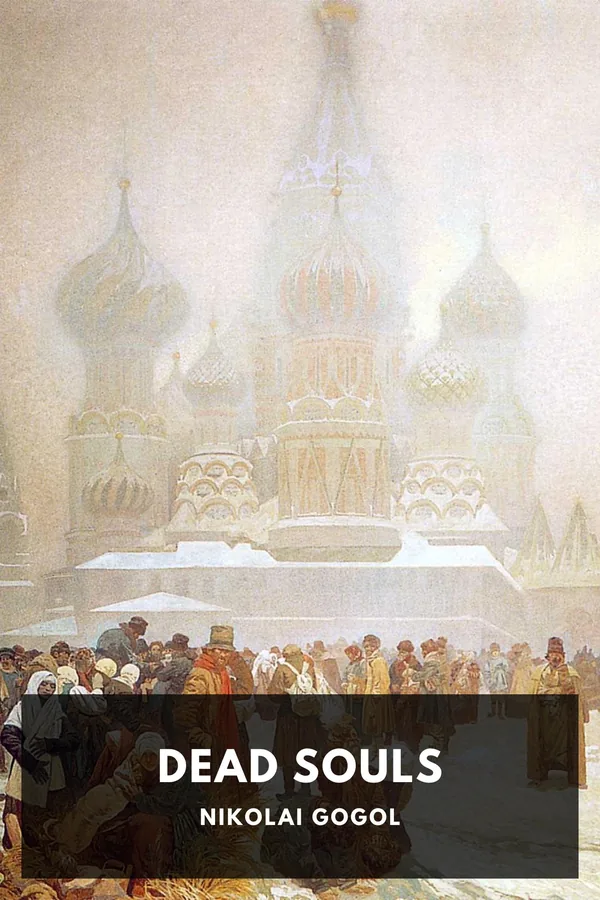
Dead Souls
📖 Click to Read the Opening Pages Online Preview
The opening of the novel
To the door of an inn in the provincial town of N. there drew up a smart britchka—a light spring-carriage of the sort affected by bachelors, retired lieutenant-colonels, staff-captains, landowners possessed of about a hundred souls, and, in short, all persons who rank as gentlemen of the intermediate category. In the britchka was seated such a gentleman—a man who, though not handsome, was not ill-favoured, not over-fat, and not over-thin. Also, though not over-elderly, he was not over-young. His arrival produced no stir in the town, and was accompanied by no particular incident, beyond that a couple of peasants who happened to be standing at the door of a dramshop exchanged a few comments with reference to the equipage rather than to the individual who was seated in it. “Look at that carriage,” one of them said to the other. “Think you it will be going as far as Moscow?” “I think it will,” replied his companion. “But not as far as Kazan, eh?” “No, not as far as Kazan.” With that the conversation ended. Presently, as the britchka was approaching the inn, it was met by a young man in a pair of very short, very tight breeches of white dimity, a quasi-fashionable frockcoat, and a dickey fastened with a pistol-shaped bronze tiepin. The young man turned his head as he passed the britchka and eyed it attentively; after which he clapped his hand to his cap (which was in danger of being removed by the wind) and resumed his way. On the vehicle reaching the inn door, its occupant found standing there to welcome him the polevoi, or waiter, of the establishment—an individual of such nimble and brisk movement that even to distinguish the character of his face was impossible. Running out with a napkin in one hand and his lanky form clad in a tailcoat, reaching almost to the nape of his neck, he tossed back his locks, and escorted the gentleman upstairs, along a wooden gallery, and so to the bedchamber which God had prepared for the gentleman’s reception. The said bedchamber was of quite ordinary appearance, since the inn belonged to the species to be found in all provincial towns—the species wherein, for two roubles a day, travellers may obtain a room swarming with black-beetles, and communicating by a doorway with the apartment adjoining. True, the doorway may be blocked up with a wardrobe; yet behind it, in all probability, there will be standing a silent, motionless neighbour whose ears are burning to learn every possible detail concerning the latest arrival. The inn’s exterior corresponded with its interior. Long, and consisting only of two storeys, the building had its lower half destitute of stucco; with the result that the dark-red bricks, originally more or less dingy, had grown yet dingier under the influence of atmospheric changes. As for the upper half of the building, it was, of course, painted the usual tint of unfading yellow. Within, on the ground floor, there stood a number of benches heaped with horse-collars, rope, and sheepskins; while the window-seat accommodated a sbitentshik,4 cheek by jowl with a samovar5—the latter so closely resembling the former in appearance that, but for the fact of the samovar possessing a pitch-black lip, the samovar and the sbitentshik might have been two of a pair.
During the traveller’s inspection of his room his luggage was brought into the apartment. First came a portmanteau of white leather whose raggedness indicated that the receptacle had made several previous journeys. The bearers of the same were the gentleman’s coachman, Selifan (a little man in a large overcoat), and the gentleman’s valet, Petrushka—the latter a fellow of about thirty, clad in a worn, over-ample jacket which formerly had graced his master’s shoulders, and possessed of a nose and a pair of lips whose coarseness communicated to his face rather a sullen expression. Behind the portmanteau came a small dispatch-box of redwood, lined with birch bark, a boot-case, and (wrapped in blue paper) a roast fowl; all of which having been deposited, the coachman departed to look after his horses, and the valet to establish himself in the little dark anteroom or kennel where already he had stored a cloak, a bagful of livery, and his own peculiar smell. Pressing the narrow bedstead back against the wall, he covered it with the tiny remnant of mattress—a remnant as thin and flat (perhaps also as greasy) as a pancake—which he had managed to beg of the landlord of the establishment.
While the attendants had been thus setting things straight the gentleman had repaired to the common parlour. The appearance of common parlours of the kind is known to everyone who travels. Always they have varnished walls which, grown black in their upper portions with tobacco smoke, are, in their lower, grown shiny with the friction of customers’ backs—more especially with that of the backs of such local tradesmen as, on market-days, make it their regular practice to resort to the local hostelry for a glass of tea. Also, parlours of this kind invariably contain smutty ceilings, an equally smutty chandelier, a number of pendent shades which jump and rattle whenever the waiter scurries across the shabby oilcloth with a trayful of glasses (the glasses looking like a flock of birds roosting by the seashore), and a selection of oil paintings. In short, there are certain objects which one sees in every inn. In the present case the only outstanding feature of the room was the fact that in one of the paintings a nymph was portrayed as possessing breasts of a size such as the reader can never in his life have beheld. A similar caricaturing of nature is to be noted in the historical pictures (of unknown origin, period, and creation) which reach us—sometimes through the instrumentality of Russian magnates who profess to be connoisseurs of art—from Italy; owing to the said magnates having made such purchases solely on the advice of the couriers who have escorted them.
It begins with the first three paragraphs, as a britchka draws up at the door of an inn in the provincial town of N.:
Download Full EPUB1842
~141,000 words (estimated)
Approx. 7.8 hours
Standalone
Provincial Russia in the 1830s, from town N. to the estates around it
Eleven chapters in Part One, then the four fragments of Part Two
EPUB · AZW3 · KEPUB
0.80 MB (EPUB) · 0.93 MB (AZW3) · 0.85 MB (KEPUB)
Public domain in the United States
Standard Ebooks · Project Gutenberg #1081
Dead Souls is Nikolai Gogol’s comic novel of 1842, and its hero is a well-dressed nobody named Chichikov who arrives in a provincial town and pays calls on every landowner within reach. He has come to buy serfs, not living ones, but the names of men who have died since the last census and still stand on their owners’ tax rolls. Since serfs are counted as “souls”, he is buying dead souls, and he means to mortgage the list for a fortune. The book Gogol published is Part One; Part Two survives only as fragments.
It is also a poem about Russia, and the joke is never only a joke. Dead Souls appeared in Moscow in 1842, passed by a censor who disliked the title, and Gogol meant it as the first part of a trilogy on the model of Dante: a descent, a purgation, a paradise. The purgation was never finished. He burned the manuscript of Part Two in 1852, days before he died, and what this edition prints after Part One is the surviving wreck of it. The text is available via Project Gutenberg #1081 and Standard Ebooks.
Dead Souls by Nikolai Gogol: Summary, Characters & Themes
Dead Souls is Nikolai Gogol’s novel of 1842, and this summary and analysis follows it chapter by chapter, from the inn at town N. to the troika on the road out. Pavel Ivanovitch Chichikov is a man of no visible fortune and considerable charm who arrives in a provincial capital, calls on every official worth calling on, and then tours the estates of the neighbourhood. He is not buying land, grain or furniture. He is buying the names of dead serfs, and the comedy comes from watching a whole society help him do it without asking why.
The book appeared in Moscow in 1842 under a title the censor had already tried to change, and it was meant to be only the first third of a work on the model of Dante: hell, purgatory, paradise, with Chichikov descending through provincial life and rising towards a redeemed Russia. Gogol spent the next ten years on the second part, wrote it, disliked it, and burned the manuscript in a fit of religious despair nine days before his death in 1852. What survives of Part Two is a set of drafts and fair copies, printed after his death and breaking off in the middle of the Governor-General’s speech. His life and the cult that grew around him are set out at Wikipedia’s article on Gogol.
The scheme is a piece of accounting, and the accounting is real. Russian serfs were registered by name on revision lists and taxed by the soul, whether or not the soul was still breathing; a landowner went on paying for a dead man until the next revision, ten or twenty years away. Chichikov offers to take the dead names off their hands, cheap, and to pay the transfer fees. He then has himself registered as the owner of several hundred peasants in the province of Kherson, where nobody will look for them, and plans to mortgage the list to a bank at the going rate for a living serf. Every landowner he visits understands the arithmetic at once; not one of them asks what he intends to do with the ghosts.
The satire works by object. Manilov’s book is open at page fourteen in a room nobody reads in; Korobotchka’s clock hisses before it strikes; Nozdrev’s dogs are named after their owner’s tastes; Sobakevitch’s furniture and his soul are made of the same wood; Plushkin’s heaps are sorted into piles of things that were once useful. The five estates are five ways of being dead while alive, and the officials of the town are a sixth. Gogol’s narrator interrupts to scold his readers, to praise the road and to promise that better people are coming, and the promise is the book’s most painful joke. Readers who want the next stage of the Russian novel can go on to Fathers and Children, where the argument has moved from estates to ideas.
For the wider question behind the joke, two books on this site take the ownership of persons seriously: Uncle Tom’s Cabin, published ten years later in another empire, and The Souls of Black Folk, which asks what a soul is worth once the law has stopped counting it. The text on this page follows the Standard Ebooks edition of C. J. Hogarth’s 1915 translation, with the Introduction and the author’s preface included; the same public-domain text is at Project Gutenberg #1081.
Historical Context
Serfdom was the ground of the book’s economy. Peter the Great replaced household taxation with a poll tax on every male soul in 1718–24, and the revisions that followed, roughly every decade or two, fixed each owner’s bill until the next count. Between revisions a dead serf remained a taxable asset, and a serf could be sold, given, gambled or mortgaged like any other property; the state bank lent against souls as readily as against land. The word carried both meanings at once, the legal unit and the immortal thing, and Gogol’s title depends on the collision. Emancipation came in 1861, nineteen years after the novel.
The Russia that read the book was Nicholas I’s: a police state with a large censorship, a Third Section and a deep suspicion of anything that made the bureaucracy look ridiculous. The censor passed Dead Souls in 1842 only after the title was softened to The Adventures of Chichikov, or Dead Souls, and the tale of Captain Kopeikin, the wounded officer who takes his grievance to St. Petersburg and becomes a bandit, was cut from the first printing and did not appear until 1855. Gogol was in Rome when the book came out, and the reception split the literary world: Westernisers read it as an indictment, Slavophiles as a celebration of Russian vitality, and both were partly right.
The ten years after 1842 are the saddest part of the story. Gogol published Selected Passages from Correspondence with Friends in 1847, a book of conservative moralising that infuriated his friends and drew Belinsky’s famous open letter; he made a pilgrimage to Jerusalem, returned, and fell under the influence of a priest who urged him to destroy his secular work. On the night of 11–12 February 1852 he burned the manuscript of Part Two, and he died on 21 February, aged forty-two. The surviving fragments were printed in 1855 from his papers. The novel therefore ends twice: once with a troika on the road and once with a sentence that stops.
Key Characters & Literary Archetypes
- Chichikov: Pavel Ivanovitch Chichikov, called Pavlushka as a boy, is a collegiate councillor with no estate, no family and no visible income, who lives by pleasing people and remembering what they like. His father’s advice to save a kopeck, and a school career of selling cakes to hungry classmates, made him a patient swindler rather than a bold one. He is not handsome, not fat and not thin, and he can talk about horses, dogs, whist or the excise with equal fluency. He wants a fortune, a wife and children to inherit it; he has a talent for making other people feel generous. The last pages find him stripped of everything except the habit of starting again.
- Manilov: Manilov is the first landowner and the softest: a fair-haired, blue-eyed man whose smile is sugar and whose conversation never lands on a fact. His estate has an arbour called the Temple of Solitary Reflection, a pond, a bridge, and a study where the same book has lain open at page fourteen for two years. His sons are Themistocleus and Alcides, and his wife speaks in the same sentimental key. He gives Chichikov his dead souls for nothing, is moved by the transaction and cannot quite understand what has happened. Gogol’s joke is that his kindness is real and worthless at once: he would help anyone and has never helped anyone.
- Korobotchka: Korobotchka is a small widow with a large estate, a suspicious mind and a good head for prices. Her house smells of apples and carpets, her clock hisses before it strikes, and her guest’s bed is shared with the bugs. She cannot grasp a trade in dead men, thinks it must be worth something if a man from the town wants it, and is afraid of selling too cheap; fifteen roubles a soul ends the argument, and she adds a request that Chichikov sign a contract for her flour. Her real function is the plot’s: she drives to town to ask what dead souls fetch, and the question starts the rumour that destroys him.
- Nozdrev: Nozdrev is thirty, red-faced, loud, and unable to tell a lie he does not immediately believe. He has dogs, horses, a barrel organ, a pond with an improbable fish, and a wife and children he never mentions; he loses money at cards and comes back the same. He refuses to sell his dead souls and offers to give them: all Chichikov has to do is buy a stallion for ten thousand roubles, or a barrel organ, or beat him at chess. The chess game is the best scene in the chapter, because Nozdrev cheats in the open and is genuinely indignant when he is caught. He is also the town’s loudest witness against Chichikov.
- Sobakevitch: Sobakevitch is a bear in a tailcoat: heavy, deliberate, and made, like his furniture, of one solid piece. He eats a side of mutton and a cheesecake the size of a cartwheel, keeps portraits of Greek generals on his walls, and calls every other landowner a fool, a swindler or a pig. His dead serfs, he says, were the best men he had, and he wants a hundred roubles a soul before settling at two and a half. The list he writes out is the chapter’s triumph: names, trades and nicknames, a whole vanished workforce in a clerk’s hand. He is the only landowner who understands exactly what Chichikov is buying, and he does not care.
- Plushkin: Plushkin is the novel’s most famous ruin: a thin, grey figure in a patched coat whom Chichikov takes for the steward, shuffling through a village of broken fences and dead bees. Once a careful householder, he lost his wife, quarrelled with his children and turned his grief into a general suspicion that has eaten his estate. He keeps a heap of rubbish sorted by type, a broken clock, a daughter’s unopened tea set, and a biscuit from a cake baked years ago, which he offers his guest. His serfs die and run away; seventy-eight souls go for thirty kopecks each. Gogol calls him the hole in humanity, and the phrase is a diagnosis, not an insult.
Core Literary Themes
- Souls, living and dead: The title is a legal pun that turns into a moral one. A soul is a taxable unit, a name on a revision list, a thing that can be bought, mortgaged and moved to Kherson; it is also the part of a man that cannot be owned at all. Chichikov’s trade works only because everyone, from the officials to the sellers, agrees to treat the first meaning as the only one. The novel lets the dead names become more vivid than the living people who sell them: the list Chichikov copies out is full of trades and faces, while the landowners he meets are mostly hollow. The comedy is that the accountancy is accurate.
- The gallery of landowners: Five estates, five diagnoses. Manilov is sentimentality with nothing behind it; Korobotchka is petty cunning that cannot see past the price of flour; Nozdrev is violence and lies without memory; Sobakevitch is appetite and solid contempt; Plushkin is grief turned into accumulation. Each is given a house, a smell, a manner of eating and a way of talking, and each is a different answer to the same question: what is a man for? Gogol refused to make any of them villains in the ordinary sense, which is why they are unbearable. They are not exceptions. They are the class.
- Paper and power: The province runs on documents. Purchase deeds, powers of attorney, receipts, revision lists, petitions and, in Part Two, a forged will decide what happens to people, and the officials who handle them are described with a care that is almost affectionate. Ivan Antonovitch’s hand closes over a banknote; the President reads out a list of dead peasants and proposes a toast; the Governor-General’s office is a room full of portfolios and ledgers. The satire is not that the bureaucracy is cruel but that it is a machine for converting persons into paper, and that everyone, including the victim, has learned to speak its language.
- Russia and the road: The novel is built on movement: the britchka, the koliaska, the inn, the next estate, the road at night. The journeys give Gogol his structure and his best prose, the panoramic paragraphs where a village, a field and a line of cranes are held for a moment and then lost. At the end the carriage becomes a troika and the driver a nation, and the narrator asks where it is going. The answer is not given. That open question, asked of a country rushing forward with no one able to say to what, is the book’s most modern gesture, and the reason the ending survives a century of quotation.
- Laughter with tears behind it: Pushkin said that behind Gogol’s laughter the reader feels unseen tears, and the phrase has stuck because it describes the technique exactly. The surface is farce: a man buys dead peasants, a dog steals a dinner, a clerk’s jowl trembles over a bribe. Behind it is a moralist who believes the comic writer is a doctor and Russia is the patient. The author’s preface, printed with Part One, asks readers to send him corrections and promises virtuous characters in the volumes to come. Those volumes never came; the tears, in the end, are for the promise.
Why Download Our Custom E-Reader Edition of Dead Souls?
The file on this page is built from the Standard Ebooks text of C. J. Hogarth’s 1915 translation, the same public-domain text that is at Project Gutenberg #1081. It is complete: eleven chapters of Part One, the author’s preface and the four fragments of Part Two, with the point where the manuscript breaks off left visible rather than tidied away. The Introduction by John Cournos is included, and the spelling of names follows the translation, so Chichikov, Korobotchka, Nozdrev, Sobakevitch and Plushkin appear as Hogarth left them.
The guide is written for a first reading and for a second. It summarises every chapter in order, marks the border between the 1842 book and the posthumous fragments, and keeps the scheme at the centre rather than treating it as a curiosity. There are notes on the six principal figures, five themes, the serf census that makes the plot possible, and the history of the manuscript Gogol burned. The summaries are short enough to read before a chapter and detailed enough to check a memory afterwards.
Dead Souls is funnier than its reputation and sadder than its jokes. It reads quickly, the way satires read quickly, and then it does not leave: the troika, the list of names, the Prosecutor’s funeral, the last unfinished sentence. This edition is for readers who want the whole thing in one file, with a map of where they are, and no account to create before they start.
- Based on the Standard Ebooks Edition, via Standard Ebooks — Hogarth’s 1915 translation of the 1842 Russian text, with the Introduction by John Cournos and Gogol’s own preface. The text is complete and unabridged.
- Part One complete, and what survives of Part Two Eleven chapters, then the four fragments printed after Gogol’s death, still bearing the gaps and the break-off. Nothing is invented to fill them.
- EPUB, AZW3 and KEPUB files One download for each reader: EPUB for most devices, AZW3 for Kindle, KEPUB for Kobo, with a working table of contents and the chapter breaks intact.
- Free, with no account and no DRM Direct download from this page, no email, no sign-up, no software to install. The book is in the public domain in the United States.
- Uncle Tom’s Cabin — free EPUB, AZW3 & KEPUB
- The Souls of Black Folk — free EPUB, AZW3 & KEPUB
- Fathers and Children — free EPUB, AZW3 & KEPUB
Chapter summaries
Dead Souls is not one continuous narrative. Part One, published in 1842, has eleven chapters and ends with the troika. Part Two survives as four fragments, printed after Gogol’s death, which stop in the middle of a sentence. The guide follows that order and names the seam, so that a reader can tell the finished book from the wreck of its sequel.
- Arrival in town N.: A britchka with a smart pair of horses brings a gentleman to the inn of a provincial town, and within a week Chichikov has called on the Governor, the Vice-Governor, the prosecutor, the tax commissioner and the Chief of Police. He is modest about himself and fluent about everything else: horses, dogs, whist, the tariff. The one thing he wants to know is which landowners live near the town and how many souls each of them owns. Nobody yet asks why. The chapter ends with him setting out for the country, Selifan on the box and Petrushka left to mind the portmanteau.
- Manilov: The first estate belongs to Manilov, a landowner so sweetly vague that his garden has a summer-house called the Temple of Solitary Reflection and his study holds the same book at page fourteen. There are two sons, Themistocleus and Alcides, and a wife who speaks in the same key. Chichikov, at dinner, explains that he has long wanted to buy a few peasants; Manilov, who had assumed the talk was of land, hands his dead souls over for nothing and asks nothing in return. The deal is made, and the visit is a lesson in what politeness costs when it has no bottom.
- Korobotchka: A storm, a lost road and an overturned carriage bring Chichikov to the estate of an elderly widow, Korobotchka, who feeds him, gives him a bed with bugs, and in the morning listens to his offer with mounting suspicion. Dead men cannot be sold, she says, and if they could she would want to know the current price. She has never heard of such a trade and is afraid of being cheated by a man from the town. Fifteen roubles a soul settles it; she also makes him sign a power of attorney for flour and buckwheat, and keeps the receipts.
- Nozdrev: Chichikov stops at a tavern and meets Nozdrev, who is coming from a fair, out of money and out of sorts. His estate is a chaos of dogs, horses, a barrel organ and a pond in which he claims to have caught a sturgeon of enormous size. He will not sell dead souls, but he will give them: let Chichikov buy a stallion for ten thousand roubles, or a barrel organ, or play him at chess for the lot. Chichikov, who sees the cheat and then catches him moving a piece, ends the visit by leaving in the night with Nozdrev’s servants threatening him.
- Sobakevitch: Sobakevitch, in a bear-coloured coat and boots that look like two bears’ paws, is a man built out of solid matter: his chairs, his table, his wife and even the portraits of Greek generals on his walls seem cut from the same timber. Dinner is a side of mutton and a cheesecake the size of a wheel. He knows the exact number of his dead, complains that they were the best men he had, and asks a hundred roubles a soul before settling at two and a half. The list he writes out is a poem of trades and nicknames, and he hands it over as if he were doing Chichikov a favour.
- Plushkin: The sixth estate is already dead: a village with broken fences, a manor with cracked walls, and an owner so thin and grey that Chichikov takes him for the steward. Plushkin, once a careful householder, has become a miser who counts every crust and suspects every visitor. His daughter’s gift, a tea set, stands unopened; his serfs are dying or running away; his heaps of rubbish are sorted by category. He sells seventy-eight souls at thirty kopecks each, and cannot decide whether to offer Chichikov a glass of vodka or a mouldy biscuit, and does both.
- The town officials: Back in town, Chichikov goes to the courthouse to register the purchase and finds the whole machine of the province waiting in one room: the President, the prosecutor, the inspector of medicine, the architect, and the clerk Ivan Antonovitch, whose hand closes over a note like a trap. The deeds are copied, the witnesses assemble, and Chichikov explains that his estate lies in the province of Kherson: he is now, in the eyes of the town, a landowner of four hundred souls. The officials drink his health. Nobody asks to see the land.
- The ball and the rumours: The town gives itself up to Chichikov: dinners, whist, a ball at the Governor’s, where he is graceful to every lady and fatal to the Governor’s daughter. Then Korobotchka arrives to ask what dead souls are fetching, Nozdrev tells the ballroom that his friend buys the dead, and the two ladies who are pleasant in every respect take the story apart in the drawing room: an abduction, a forgery, a Napoleon escaped from St. Helena. The officials meet at the Chief of Police’s to decide whether Chichikov is a spy, a counterfeiter or Captain Kopeikin, and the prosecutor goes home and dies of the shock.
- Chichikov’s flight: Part One closes with the biography the novel has been withholding: the boy Pavlushka, the father’s advice to save a kopeck, the school where he sold cakes to his hungry classmates, the treasury office, the customs house, the smuggling, the ruin, the fresh start, the plan of the dead souls. In the town the story is now public; Nozdrev confirms it, Korobotchka supplies the price of a soul, and the officials cannot decide whether to arrest him or ask him to stay. Chichikov wakes, packs and drives out past the prosecutor’s funeral, and the chapter ends with the troika and the question: whither, Russia?
- Part Two, Tientietnikov and the General: The fragments begin with a landscape and a man who does not use it: Andrei Ivanovitch Tientietnikov, thirty, a stargazer who has drifted through the service, dabbled in a philanthropic society, and now plans a history of the Russian generals of 1812 while his estate runs itself into the ground. Chichikov examines the house, the peasants and the accounts, and finds a landowner too absent to be robbed. The next fragment is short and funny: an old General is told about a decrepit uncle and a purchase, laughs until the tears come, and offers Chichikov the whole graveyard for the joke.
- The unfinished end: Chichikov moves on to Petukh, a fisherman and gourmand, then to Kostanzhoglo, the one landowner in the book who works, and who tells him plainly that buying dead souls is theft. He plans to buy the estate of Khlobuev, a ruined man with a hole in his boot, and the scheme grows into a forged will; a clerk offers to sell him his freedom in prison for thirty thousand roubles, the Governor-General rages, and the old tax-farmer Murazov argues mercy and tells him to leave town. He leaves, poorer and shaken. The last fragment is the Governor-General’s speech to the officials of the province, breaking off mid-sentence.
Dead Souls: Frequently Asked Questions
What is Dead Souls about?
Is Dead Souls unfinished?
What does “dead souls” mean?
Who is Chichikov?
Why did Gogol burn Part Two?
Is it a novel or a poem?
Which translation is this?
Where can I download Dead Souls?
Part of: Classic Fiction · Victorian era