The Big Four by Agatha Christie: Free EPUB, AZW3 & KEPUB Download
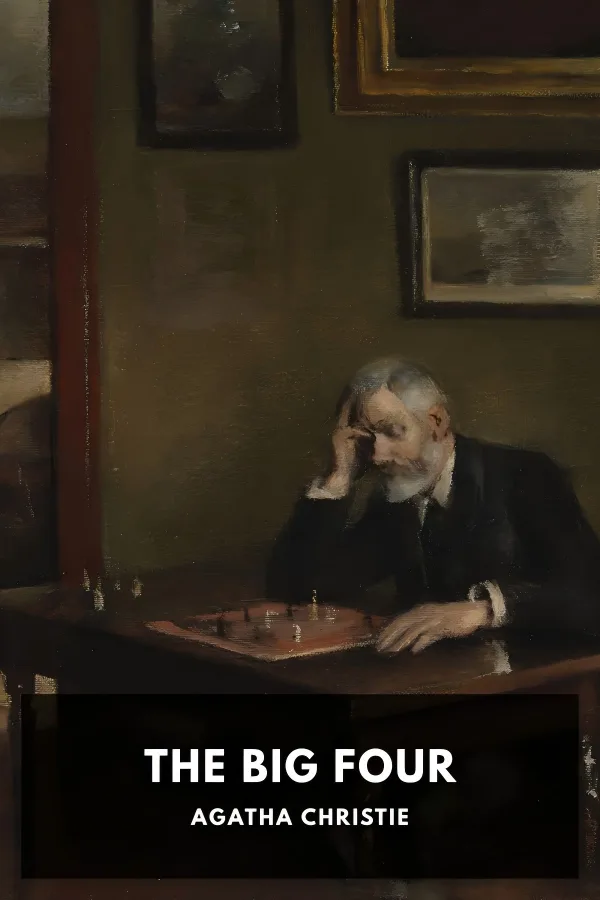
The Big Four
📖 Click to Read the Opening Pages Online Preview
The ferry to Dover, and a visitor at Farraway Street
I have met people who enjoy a channel crossing; men who can sit calmly in their deck-chairs and, on arrival, wait until the boat is moored, then gather their belongings together without fuss and disembark. Personally, I can never manage this. From the moment I get on board I feel that the time is too short to settle down to anything. I move my suit-cases from one spot to another, and if I go down to the saloon for a meal, I bolt my food with an uneasy feeling that the boat may arrive unexpectedly whilst I am below. Perhaps all this is merely a legacy from one’s short leaves in the war, when it seemed a matter of such importance to secure a place near the gangway, and to be amongst the first to disembark lest one should waste precious minutes of one’s three or five days’ leave.
On this particular July morning, as I stood by the rail and watched the white cliffs of Dover drawing nearer, I marvelled at the passengers who could sit calmly in their chairs and never even raise their eyes for the first sight of their native land. Yet perhaps their case was different from mine. Doubtless many of them had only crossed to Paris for the week-end, whereas I had spent the last year and a half on a ranch in the Argentine. I had prospered there, and my wife and I had both enjoyed the free and easy life of the South American continent, nevertheless it was with a lump in my throat that I watched the familiar shore draw nearer and nearer.
I had landed in France two days before, transacted some necessary business, and was now en route for London.
Download Full EPUB1927
~56,000 words (estimated)
Approx. 3.1 hours
Hercule Poirot, book 5
London, Paris, Dartmoor and the Italian Dolomites
18 scenes in 12 groups
EPUB · AZW3 · KEPUB
0.21 MB (EPUB) · 0.30 MB (AZW3) · 0.24 MB (KEPUB)
Public domain in the United States
Project Gutenberg #70114
The Big Four is Agatha Christie’s 1927 Poirot novel, and the one where the detective is handed a conspiracy instead of a body in a library. Hastings comes back from a ranch in the Argentine to find his friend packing for Rio, and before the trunks are closed a stranger collapses in the flat at 14 Farraway Street with four names, four kinds of power, and the figure four written over and over on a sheet of paper. What follows is a campaign rather than an enquiry: a dead man on Dartmoor, a scientist who vanishes in Paris, radium in a lead case, a chess match in Westminster, a cellar in Limehouse, and at last a mountain in the Dolomites.
No single murder holds the book together. What holds it is an organisation with a division of labour: a brain in China, money in America, science in France and a killer who can wear any face. Christie wrote it between The Murder of Roger Ackroyd and The Mystery of the Blue Train, and the strain shows in a story that keeps changing its clothes. The Big Four reads as a sequence of linked episodes rather than one case, and the Dell edition printed here makes that plain. The text is available via Project Gutenberg #70114.
The Big Four by Agatha Christie: Summary, Characters & Themes
This is a summary and analysis of Agatha Christie’s The Big Four, a Poirot novel of 1927 that opens with a homecoming. Captain Hastings, back after eighteen months on a ranch in the Argentine, crosses to Dover on a July morning and goes straight to 14 Farraway Street, where he finds Hercule Poirot packing a trunk of prehistoric size for Rio de Janeiro, at the invitation of Abe Ryland, the American soap magnate. Before the trunks are closed a man collapses in the inner room, grey with dust and thin to the bone, repeating the address and covering a sheet of paper with the figure four. He has come to warn Poirot about four people, and he dies before he can say much more.
The four are described by function before they are described by name. Number One is a Chinese political chief who pulls wires in Peking; Number Two is American money; Number Three is French science; Number Four is the hand, a man who can be anyone and who signs his work with a stopped clock. Poirot treats the warning as a declaration of war, and the rest of the book is a campaign fought at a disadvantage, with Japp of Scotland Yard, a retired civil servant called John Ingles, and a Russian countess who keeps appearing on the wrong side of the table. Each episode is a separate job: a bungalow on Dartmoor, a laboratory at Passy, a country house full of blue letters, a chess table wired to the mains.
Agatha Christie was in her late thirties when the book appeared, with six Poirot titles behind her and The Murder of Roger Ackroyd, the novel that made her reputation, published the year before. The Big Four grew out of a series of linked stories she wrote for The Sketch in 1924, and the joins are still visible: the scenes are set pieces, each with its own trick and its own trap, rather than stages of one continuous investigation, and she never revised the habit out. Collins published it in London in January 1927; the text used here is the Dell paperback of June 1972, which keeps the eighteen numbered scenes and invents no chapter headings.
The method is disguise and substitution. Number Four is a professional actor, so any face in the book may be a mask, and Christie uses that freedom to end several episodes twice: the arrest that turns out to be a wager in the servants’ hall, the corpse that was dead before the fire was lit, the chess champion who may never have existed. The effect is a book that keeps offering a solution and then withdrawing it, which is enjoyable at the length of an episode and less so at the length of a novel. The plotting is brisk and sometimes careless, and the book has never had the standing of the Ackroyd year. It belongs with The Mystery of the Blue Train as the work of a writer running a series at speed; readers who like the conspiracy frame better than the drawing room can go on to The Seven Dials Mystery, which puts a secret society in an English country house and lets the same taste for ritual and disguise run.
This edition follows the Project Gutenberg #70114 transcription of the Dell printing. The scene headings are kept as the book prints them, the list of four names at the front is not tidied into a table of contents, and the dialogue, including Poirot’s French and the countess’s stage Russian, stands as it was set. The scene divisions are the paperback’s own, and the twelve groups below follow the order of the text rather than a scheme imposed on it. The summary walks through the book and stops short of the final explanations, so the last pages are left to the reader.
Historical Context
By 1924 the thriller had a settled vocabulary and Christie borrowed from it. Sax Rohmer’s Fu Manchu novels had made the sinister Chinese mastermind a fixture of the cheap novel, John Buchan’s The Thirty-Nine Steps had made the hunted man a hero, and G. K. Chesterton’s The Man Who Was Thursday had turned a council of anarchists into a joke with a serious floor under it. Li Chang Yen, the unseen Number One with a palace in Peking and agents in every capital, belongs to that shelf rather than to the realistic detective story, and Christie keeps him off the page for almost the whole book, so that his absence does the work of a presence. The type was familiar enough by then that she could use it without a single scene of explanation.
The serial origin explains the shape. The stories ran in The Sketch in 1924, when Christie was writing at a pace that few of her contemporaries matched, and when the novel was assembled the episodes were stitched rather than rebuilt. The year of publication followed her own disappearance and the collapse of her first marriage, and there is a restlessness in the book that fits the period: governments are useless, the police are one step behind, and the only defence is a private detective with a filing system. The pace shows in the minor characters, who arrive, announce themselves and are gone within a page. Collins printed it in January 1927; Dodd, Mead had it in America a few weeks later.
The 1920s also supply the props. Radium was a luxury in the decade after the Curies, kept in lead and measured in francs; wireless was a mystery that could be sold as a weapon; a chess champion from Russia was a plausible celebrity in London, where emigres gave lessons and played exhibition matches. Limehouse had been a byword for opium and secrecy in fiction since Sherlock Holmes, and the Dolomites were the newest fashion in summer travel, four thousand feet up and reached by motor road. Christie uses all of it the way she uses a hotel: as a stage that needs no explanation. A reader in 1927 would have recognized every one of these properties as a newspaper item.
Key Characters & Literary Archetypes
- Hercule Poirot: Short, neat and sixty, with an egg-shaped head and a moustache that takes two minutes of waxing each morning. He works by order and method, keeps a filing system of index cards, and says that the little grey cells do the work while other detectives run about measuring footprints. In this book he is out of his depth more than once, and the plot turns on his pride as much as on his intelligence. He is also, for long stretches, frightened, and the book is honest about how much of his confidence is performance.
- Captain Arthur Hastings: The narrator, back from a ranch in the Argentine with a wife called Cinderella and a talent for being in the wrong room at the right time. He believes what he is told, trusts a good face, and supplies the book with its accidents: he answers a stranger’s note, takes a secretary’s post under a false name, and lets a woman in a mourning veil walk past him. Poirot’s affection for him is real, and so is his usefulness to the other side.
- Number Four: The hand of the organisation, a middle-sized Englishman of thirty-five or so whose own face is never seen twice. He works in costume and voice, from an asylum attendant to a Paris doctor to a chess champion, and he kills with what the room provides: a gas fire, a hypodermic, a car in the street. He signs his work with the number four, and his one fixed habit is a piece of bread pressed on the tablecloth to catch the crumbs.
- Madame Olivier: The French scientist of the group, tall and white-robed, with a scar on one cheek and the face of a nun in a bad painting. Her husband died in an explosion in her own laboratory three years before the book opens, and she has gone on from his work into atomic energy and the focusing of wireless beams. She receives visitors in a villa at Passy, keeps her radium in a lead case, and is the only member of the four who works with her hands as well as her brain. Her scenes are the shortest in the book and the coldest, and she never raises her voice.
Core Literary Themes
- A conspiracy run like a business: The four are not a gang but a firm, and Christie lays out the departments: a brain to plan, capital to pay for it, a laboratory to invent the weapons, and a hand to do the work that needs a face. The horror is administrative rather than gothic. Poirot’s answer is equally bureaucratic, a card index and a list of names, and the book suggests that the modern criminal and the modern detective are both managers.
- Disguise and the unstable face: Number Four is an actor, and the novel keeps asking whether anyone is what he appears to be. A servant is a convict, a doctor is an impostor, a chess champion is a stand-in, and the narrator himself spends weeks as Arthur Neville. Christie enjoys the theatricality and distrusts it at the same time: the book’s most reliable clue is not a face but a habit, a hand moving bread across a tablecloth. The actor’s trade is the novel’s model for crime: a costume, a voice, a prepared story and a quick exit before anyone can ask questions.
- Fours, clocks and arithmetic: The book counts. The number four is written on paper, stopped on a clock, scattered as four books and four lumps of coal, stacked as four heaps of salt, and hidden in a letter read every fourth word. Christie uses arithmetic as a signature and as a puzzle, and the repetitions give an otherwise loose narrative a spine: the reader learns to look for fours the way Poirot does.
- The detective out of his depth: Poirot spends most of the novel being late. He is decoyed onto a train, tricked by a note, given a false lead, and told by a dying man that he is already beaten; he needs the Home Office, foreign governments and a good deal of luck. That helplessness is the book’s real subject, and it is why the ending, when it comes, is less a triumph of deduction than the closing of a trap that other people helped to build. Christie would not let her detective lose often, and the pleasure here is watching her find reasons why he might.
Why Download Our Custom E-Reader Edition of The Big Four?
Because the book is usually read in a hurry and repaid by a slower look. This edition gives the complete eighteen scenes in order, with the Dell printing’s headings, the four-name list at the front and the dialogue untouched, so the small machinery works: the stopped clock in the flat, the frozen leg of mutton in the larder, the four heaps of salt on a restaurant cloth, and the letter that can be read two ways if you count the words. The fours are all in place: four names, four warnings, four suspects, four ways of dying. Nothing has been cut to make the story tidier than Christie left it, and nothing has been added to explain what she preferred to leave half said.
The file is built for e-readers rather than for scans: a working table of contents, scene breaks that survive a change of font, no page images and no optical character debris from the 1972 paperback. Sentences end where the book ends them, quotes open and close, and the French and Russian phrases keep their accents. It is the same text on a phone, a Kindle or a Kobo and on the oldest e-ink screen you own, and it is DRM-free, so it can be moved between devices, lent to a friend and kept for as long as the reader lasts.
Read it as a serial, one episode at a time, and the joins stop mattering; read it as a Poirot book and the shortage of detection becomes the interesting part, because a detective who is late is a different kind of detective from one who is merely clever. The summary, characters and context on this page are meant to be read beside the novel, not instead of it, and they stop where the book’s own explanations begin, in a tunnel under a mountain.
- Project Gutenberg transcription, via Project Gutenberg #70114, the source text used for this edition, transcribed from the Dell paperback of June 1972 and checked against the printing’s own scene headings, its list of four names at the front and its chapterless layout, so that the page follows the book rather than a later editor’s idea of it.
- Complete eighteen-scene text No abridgement, no invented chapter titles, no modernised spelling and no silent corrections; the book as Dell set it in June 1972, with the eighteen numbered scenes, the epigraph of four names and Poirot’s French left in French. The countess’s Russian stays stage Russian.
- EPUB, AZW3 and KEPUB One download per format, so the book opens properly on Kindle, Kobo, Apple Books and every other reader without conversion, and the table of contents works on all of them, including the older devices that dislike nested navigation. No app and no account are needed.
- Free and DRM-free Public domain in the United States, with no account, no sample chapter, no email address and no lock on the file; download it once and it is yours to keep, move between devices and reread, with nothing to renew and nothing to lose.
- The Murder of Roger Ackroyd — free EPUB, AZW3 & KEPUB
- The Mystery of the Blue Train — free EPUB, AZW3 & KEPUB
- The Seven Dials Mystery — free EPUB, AZW3 & KEPUB
Chapter summaries
The Dell edition prints eighteen numbered scenes and no chapter headings. These twelve summaries follow the book in order, from the Channel crossing to the mountain.
- Hastings comes home: A July crossing to Dover, then 14 Farraway Street, where Poirot is packing a prehistoric trunk for Rio at the invitation of Abe Ryland. Hastings has been away eighteen months on an Argentine ranch and has told nobody he is coming. The reunion is interrupted by a stranger who stumbles into the flat grey with dust, repeats the address, and covers a sheet of paper with the figure four, each one larger than the last. He speaks of four people, of a brain and money and science, and of a destroyer, then collapses.
- The Dartmoor bungalow: Poirot is called out of London by train and, when the train stops at a signal outside Woking, jumps from the carriage and takes another back: the journey was arranged to keep him away from his own door. The visitor is dead, poisoned with prussic acid and left with the windows open and a clock stopped at four. Then John Ingles, retired from the Civil Service and surrounded by Chinese porcelain, tells of four opponents of Li Chang Yen who died in four different ways, and produces a begging letter from a bungalow on Dartmoor, where the sender has been found with his throat cut and his jade missing.
- A scientist vanishes in Paris: Captain Kent of the American secret service brings Poirot a story of torpedo boats lost off the coast, and of a laboratory that can focus a beam of wireless energy on a chosen spot. The English scientist Halliday, who read a paper to the British Association, disappeared in Paris two months earlier; his wife keeps a house at Chetwynd Lodge in Surrey. In a villa at Passy, Madame Olivier receives them in a white overall and a nun’s coif, a scar on one cheek, and on the stairs a woman in deep mourning hurries past them, after which a tree falls where they had been standing.
- The radium in the lead case: A visitor in an overcoat buttoned to the chin offers Poirot ten thousand-franc notes to drop the case and, when that fails, tries to throw Hastings with a Japanese trick. The man who runs out of the room turns out to be a waiter with a tray; the pocket-book left behind carries the name Felix Laon and a note about a council meeting at 34 Rue des Echelles. Poirot calls the note bait and does nothing. Then Madame Olivier writes that her laboratory has been burgled and her papers taken, and that the safe was not opened: inside it is a lead case of radium, worth millions of francs, which she can keep for only two more days.
- Secretary at Hatton Chase: Poirot suspects Abe Ryland and sends Hastings into the house as Arthur Neville, English secretary, with special shoes, padded cheeks, a gold tooth and his moustache shaved. At Hatton Chase the stenographer Miss Martin describes the blue letters with a small four on the flap that Ryland forbids anyone to open; one she opened by mistake was about a quarry and read, every fourth word, as a date and an hour. Hastings keeps the appointment at the quarry, is held at gunpoint, and is rescued when Poirot arrives with a whistle and a story about a cordon of police.
- The yellow jasmine: At Croftlands in Worcestershire, a rich traveller called Paynter is found dead in a locked room with his face burned in the gas fire and the words Yellow Jasmine written on the floor in ink. The curry at dinner carried enough opium to kill two men, the hypodermic was strychnine, and the manuscript of a book about China is missing. The Chinese servant Ah Ling says the curry never left his hands, and the young doctor attending the case wears pince-nez and admires Poirot’s methods. Poirot buys a small book on toxicology and learns that yellow jasmine paralyses the nerve endings and stops the breath.
- The chess problem: In a Soho restaurant Japp describes the death of Gilmour Wilson, the young American player, in the middle of a match against the Russian champion Savaronoff: he pitched forward at the third or fourth move and died with a carved white bishop in his hand and a small burn on his left palm. The board was a gift, inlaid with silver and black squares; the chess table has since been replaced by a copy, and there are nail holes in the Persian carpet where its feet had stood. Poirot weighs a bishop from the box against the one from the dead man’s hand and finds a difference.
- The baited trap: A telegram says that Hastings’ wife has been kidnapped by a gang calling itself the Big Four, and a Chinese messenger brings a note ordering him to come at once and leave no word for his friend. Hastings scatters four books on the floor and throws four lumps of coal into the fire as a signal, then follows the man to a Limehouse cellar and a silk-hung room whose floor opens on black water. There he is made to write the letter that will bring Poirot to the house, and Poirot comes, with a smoke bomb in his pocket and Japp’s men behind him.
- The peroxide blonde: From the ruins of the Limehouse rooms Poirot takes a file of notes on himself and on Hastings, written for the man in charge: Hastings is impulsive and can be led by a red-haired woman, Poirot is vain and fussy. The only person who can identify Number Four is Flossie Monro, a music-hall actress with yellow hair, who remembers a young actor of medium height and blue-grey eyes who always pressed a piece of bread on the table to catch the crumbs. She promises a photograph and is knocked down by a car in the street within twenty minutes; the frame at her flat is empty and priced at four shillings.
- The terrible catastrophe: Poirot takes Hastings to the Home Secretary and lays out the four and what each of them supplies: a brain, a fortune, a laboratory and a man who can wear any face. He leaves a key and a sealed envelope in case he is killed. A nurse from the Lark Sisterhood brings a bowl of soup from a Hertfordshire house where the master is dying of what the doctor calls gastritis; the residue is antimony. At Elmstead, Poirot recognizes a small habit at the dinner table and leaves by the ivy, and that night, back in London, a box of matches in his own flat goes up in blue flame.
- The dying Chinaman: Hastings is told that Poirot died in the fire and goes to the funeral, then to the Home Office, where he is politely sent away. In a Soho restaurant a stranger stacks the salt in four little heaps on the cloth and advises him to leave England; in Hyde Park the Countess Rossakoff delivers a second warning from her car. A dying Chinese servant in St Giles’s Hospital says three words that sound like music, a carriage and a woman’s name, and a letter left by Poirot sends Hastings to a villa in the Ardennes, where the dead man is waiting for him.
- The Felsenlabyrinth: The trail leads to Karersee in the Dolomites, where quarries and a labyrinth of boulders hide the headquarters of the four, and where the hotels are full of guests who are not guests. On the terrace after dinner the lights go out, and Hastings wakes in a tunnel with a gag in his mouth; the four are waiting in a rock chamber, one chair empty and draped with a mandarin’s cape. What follows is a race through the mountain and a bargain with a woman who wants her child back, and the book’s last hour is spent settling accounts it opened in the first.
The Big Four: Frequently Asked Questions
What is The Big Four about?
Is The Big Four a novel or a set of linked stories?
Do I need to read the earlier Poirot books first?
Who are the Big Four?
Where is The Big Four set?
Is The Big Four one of Christie’s best novels?
How long does The Big Four take to read?
Where can I read the full text online?
Part of: Classic Books by Length and Reading Time · Authors