Democracy and Education by John Dewey: Free EPUB, AZW3 & KEPUB Download
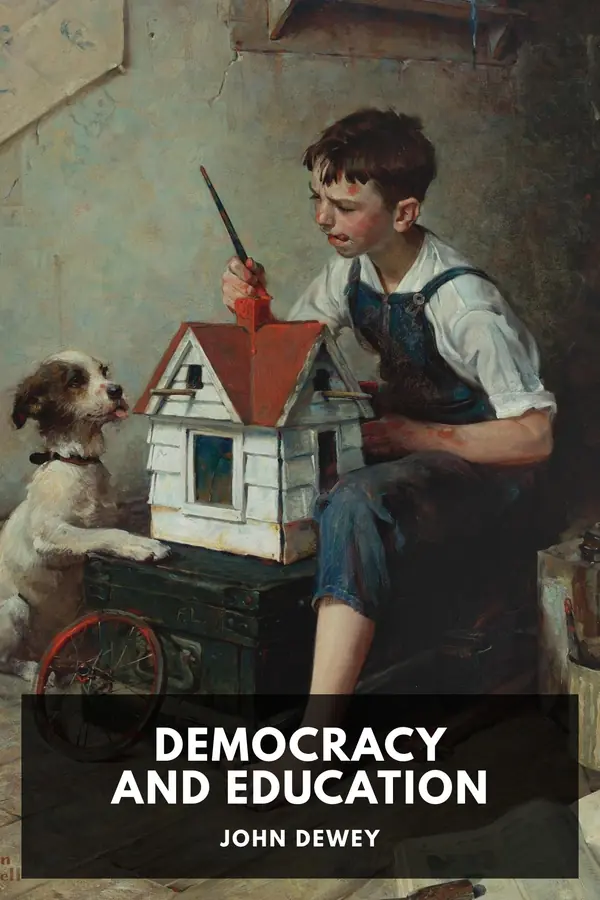
Democracy and Education
📖 Click to Read the Opening Pages Online Preview
The opening of Chapter One
The most notable distinction between living and inanimate things is that the former maintain themselves by renewal. A stone when struck resists. If its resistance is greater than the force of the blow struck, it remains outwardly unchanged. Otherwise, it is shattered into smaller bits. Never does the stone attempt to react in such a way that it may maintain itself against the blow, much less so as to render the blow a contributing factor to its own continued action. While the living thing may easily be crushed by superior force, it none the less tries to turn the energies which act upon it into means of its own further existence. If it cannot do so, it does not just split into smaller pieces (at least in the higher forms of life), but loses its identity as a living thing.
As long as it endures, it struggles to use surrounding energies in its own behalf. It uses light, air, moisture, and the material of soil. To say that it uses them is to say that it turns them into means of its own conservation. As long as it is growing, the energy it expends in thus turning the environment to account is more than compensated for by the return it gets: it grows. Understanding the word “control” in this sense, it may be said that a living being is one that subjugates and controls for its own continued activity the energies that would otherwise use it up. Life is a self-renewing process through action upon the environment.
In all the higher forms this process cannot be kept up indefinitely. After a while they succumb; they die. The creature is not equal to the task of indefinite self-renewal. But continuity of the life process is not dependent upon the prolongation of the existence of any one individual. Reproduction of other forms of life goes on in continuous sequence. And though, as the geological record shows, not merely individuals but also species die out, the life process continues in increasingly complex forms. As some species die out, forms better adapted to utilize the obstacles against which they struggled in vain come into being. Continuity of life means continual readaptation of the environment to the needs of living organisms.
It begins with the first three paragraphs of Chapter One, where Dewey sets living things against a stone:
Download Full EPUB1916
~135,000 words (estimated)
Approx. 7.5 hours
Standalone
American schools and civic life in the Progressive Era
26 chapters, grouped into twelve movements for this guide
EPUB · AZW3 · KEPUB
0.78 MB (EPUB) · 0.91 MB (AZW3) · 0.82 MB (KEPUB)
Public domain in the United States
Project Gutenberg #852 · Standard Ebooks
Democracy and Education is John Dewey’s 1916 argument that education is not preparation for life but the process by which a society keeps itself alive. Growing up, he says, means learning to share in the meanings and purposes of a group, and a democracy, which needs its members to think for themselves, has to educate for continued growth rather than for fixed ends. The book works through habit and interest, thinking and method, subject matter and play, the split between liberal and industrial study, and ends by calling philosophy the general theory of education. It is less a doctrine than a way of testing any doctrine against what it does to a pupil.
Dewey wrote it while American schooling was being rebuilt around industry, immigration and compulsory attendance, and it makes the case, at book length, that a school exists to keep a society learning. Democracy and Education runs to 26 chapters, from the transmission of culture to a closing theory of morals, and argues throughout that a democracy must educate for growth instead of for a finished product. Its subject is the whole of schooling, from the first habit a child forms to the civics of the last chapter. The text is available via Project Gutenberg #852 and Standard Ebooks.
Democracy and Education by John Dewey: Summary, Characters & Themes
This is a summary and analysis of John Dewey’s Democracy and Education, the book of 1916 in which he asks what education is for and answers that it is the process by which a society renews itself. Dewey starts from a plain fact: a group cannot outlive its members, so the young have to be brought into its interests and skills or the group dies. Schools are a late arrangement for doing deliberately what living together does by accident, and once schooling is cut off from life it begins to look like a stock of information to be handed over. The business of the book is to put the two together again. Dewey writes as a teacher of teachers, and the argument keeps returning to what happens in a room with children in it. It runs to 26 chapters, and every one of them closes with a summary of its own.
The argument moves in three movements. The first describes education as transmission and as growth: a habit is not a rut but a skill at using conditions, immaturity is not a lack but the power to keep learning, and the educational process therefore has no end beyond more of itself. The second asks what a democratic society needs, and finds the answer in two measures of a community: how many of its interests are consciously shared, and how freely it deals with other groups. The third follows those measures into the curriculum, where interest and effort, method and subject matter, play and work, science and history, and the old division between liberal and industrial study all turn out to be arguments about the same thing. Nothing is settled by definition; every term is tested against the practice it is meant to explain.
John Dewey was born in Burlington, Vermont, in 1859 and died in New York in 1952. He taught at Michigan and Minnesota, went to Chicago in 1894, and there worked with a school attached to the university in which the ideas behind this book were tried out; from 1904 he taught at Columbia, and the preface is signed from Columbia University in August 1915. He wrote on psychology, logic, ethics, art and politics as well as on education, and the range shows here, in a book that moves from the habits of a child to the theory of knowledge. His earlier books had worked out a philosophy of experience and its consequences for logic and for the school. This is the book in which the two halves of his work, the philosophical and the pedagogical, are carried on at once, and it is still the shortest way into the whole of his thinking.
The book is not a manual and offers no scheme of lessons. Its method is to take a current theory of the school and show the social arrangement underneath it: faculty psychology rests on the notion of a stock of powers; Herbart’s formation rests on the mind as furniture; Froebel’s unfolding, Hegel’s state and Rousseau’s nature all make growth travel towards a finished end. Dewey’s examples are ordinary — a flame, a bicycle, a game of ball, a toy boat, the counting house, the garden, the laboratory — and the prose is plain and largely free of jargon. Two earlier books stand behind this one: On Liberty, which argues for the free mind Dewey assumes a school must produce, and Plato’s The Republic, the first systematic philosophy of education, written against democracy rather than for it. The philosophy classics shelf gathers the rest.
The text here is complete and unabridged: a short preface dated Columbia University, August 1915, and 26 chapters, each chapter closing with the author’s own summary and the argument carried through to the moral theory of the last. It follows the Standard Ebooks edition, whose text is based on the transcription at Project Gutenberg, numbered 852. There is no translator, the book being English from the first; no editorial introduction has been added, and no apparatus interrupts the argument. The spelling and italics follow the Standard Ebooks text, and the chapter titles, the paragraph breaks and the author’s summaries are kept as that edition gives them. There is no index and no editor’s notes; the only apparatus is the author’s own, and it is kept.
Historical Context
Democracy and Education came out of a particular experiment as well as out of a philosophy. Dewey had gone to Chicago in 1894 and worked there with a school attached to the university, where children cooked, wove, worked in wood and kept gardens, and where the standing question was what an activity was teaching. The philosophy that grew alongside it, pragmatism, treats ideas as instruments: a belief is worth what it can do in directing action, and knowledge is what has been tested by its consequences. Readers who know that tradition will hear it in the book’s language about experiment, method and the reconstruction of experience; readers who do not can still follow the argument, because Dewey builds it out of the schoolroom rather than out of a system.
The year matters. American schools were being rebuilt to hold a population that had arrived in millions from Europe, and Dewey remarks in these pages on the diversity of races and religions in the United States and on the public school as the force that mixes them. Industry had changed what work was, and a movement for vocational education wanted the school to train for trades. Dewey gives two chapters to the division between labour and leisure and one to vocational aims, and his warning is precise: training for a narrow trade turns the school into an instrument for keeping the existing order unchanged. Occupations belong in the school as studies, he argues, not as jobs. Parents, employers and school boards all had a stake in the answer, and it is over that answer that this book argues.
The book is also a review of the educational theories that had reached American teachers. Rousseau’s nature, Pestalozzi’s object lessons, Froebel’s kindergarten, Herbart’s five formal steps and Hegel’s state all appear by name, each given its service and then its defect, and the criticisms are made with patience rather than contempt. Behind them stand two larger changes: the Darwinian idea that living things are continuous with their surroundings, which Dewey uses against every mind-and-world dualism, and the rise of experimental science, which he treats as the method the school has not yet learned to use. Plato’s republic is discussed at length, and the judgement on it is the argument of the whole book in miniature. The list of names is not decoration; Dewey is placing his own account of experience against theirs.
Key Characters & Literary Archetypes
- The child: The child is where every argument in the book starts. Dewey’s child is not a small adult waiting to be filled but an active creature reaching for a flame, talking while being dressed, making a toy boat, asking outside school the questions the schoolroom suppresses. Immaturity is treated as a power: helplessness forces the child into communication, and plasticity is the ability to learn from what happens.
- The teacher: The teacher appears as the one who arranges conditions rather than dictates conclusions. What the teacher can do, Dewey says, is modify stimuli so that the right responses form, and the art lies in making a problem large enough to challenge thought and small enough to be worked. The teacher is also a learner; when pupils respond in unexpected ways, teaching that refuses the surprise stops being education.
- The older generation: The mature stand for the interests, purposes and skills that a group cannot let die with its members. They are not authorities to be obeyed so much as the carriers of a common life into which the young are initiated, and the book holds them responsible for the society they hand on, since in directing the young a society determines its own future.
- The school: The school is a special environment, built because the ordinary one has become too complex and too mixed to educate by itself. Its three tasks are to simplify and order the material, to purify it of what the group would rather not transmit, and to balance it so that a child can escape the limits of the family and the street he was born into.
- The democratic citizen: The citizen is the figure against whom the argument is tested. Democracy here is not a form of government but a mode of associated living, and its citizen is someone with many interests consciously shared, who mixes freely with groups unlike his own, and who can readjust as conditions change instead of waiting to be told what to do.
- The scientist and the practical man: Dewey refuses to keep them apart. Science is method made deliberate, and the practical man’s rule of thumb is method left unexamined; the laboratory is the place where labour becomes intellectually fruitful. The pair also carries the book’s social point, since a worker who sees the relations of his work is a scientist in the only sense that matters.
Core Literary Themes
- Growth as the only end: The book’s foundation is that living is growing, and that growth is measured by the capacity for further growth rather than by arrival at a goal. Immaturity is a positive power, dependence is a social asset, and habit at its best is executive skill, an ability to use conditions as means. From this Dewey draws the criterion he applies to every school practice: does it create a desire for continued growth and supply the means of satisfying it? Preparation, unfolding and faculty training fail the test because each sets a finished end outside the process and makes present work mechanical. That is why immaturity, dependence and plasticity are treated as assets rather than as stages to be got through.
- Interest, effort and the will: Interest is not a sweetener added to dull material; it is what lies between a present power and a remote end, the middle conditions that connect the two. When a subject has to be made interesting by prizes or threats, the connection is missing and the abuse of the doctrine has begun. Discipline is not its opposite: it means power at command, and a strong will is one that thinks consequences through with firmness and fullness. Effort without interest Dewey calls one-sided, and the two are shown to be correlative aspects of activity that has an aim. The test of a lesson is therefore whether the pupil can see the end it serves.
- Thinking as method: Thinking is the deliberate connection of what we do with what follows, and it begins in a genuine perplexity rather than in a lesson. Dewey sets out five steps: a situation of experience, a real problem arising in it, the information and observation the problem requires, suggested solutions developed in order, and the testing of those suggestions by application. The sequence is not a recipe to be recited; it is the shape any inquiry takes, which is why method and subject matter cannot be separated, and why a method taught as a set of steps becomes the routine it was meant to cure. The teacher’s part is to keep the difficulty real and the data near enough to be used.
- Occupation, play and the industrial question: Occupations enter the curriculum as things to do that typify social situations, and the sciences grew out of them: mechanics from tools and machines, chemistry from dyeing, bleaching and metalwork, geometry from measuring land. Play and work differ in the time-span of the result aimed at, not in seriousness, and both pass into drudgery when the consequences lie outside the activity. This is also where the book’s politics are sharpest: a society that trains the many for a narrow trade while keeping culture for the few reproduces a class division it pretends to have abolished. The occupations are defended as studies, not as training for a job.
- Democracy as conjoint communicated experience: Democracy in this book is a mode of associated living, and two questions measure any community: how numerous and varied are the interests consciously shared, and how free is the interplay with other forms of association? A band of thieves fails both tests; a despotism fails the second and perverts the capacities it rules. The educational consequence is that a mobile society must educate its members for personal initiative and adaptability, and that the school, if it is to teach democracy, has to be a place where meanings are shared and work is done together. That is also the book’s answer to the charge of vagueness: the test is institutional, not personal.
Why Download Our Custom E-Reader Edition of Democracy and Education?
Because the test the book sets for theory is a practical one: if a theory makes no difference in the classroom it is artificial. The argument is cumulative, so habit in Chapter Four returns as method in Chapter Thirteen and as morals in Chapter Twenty-Six, and a reader who has the shape of it can carry the detail. The files here are complete and unabridged, 26 chapters with the author’s own summaries, set from the same text that is held at Project Gutenberg. Read the summaries first or ignore them; either way the order of the chapters is the argument.
Because it is a long book that does not have to be read in one run. The chapters are short enough to take one at a time, every chapter ends with a summary in Dewey’s own words, and the table of contents names every chapter, so a reader can enter at the question that interests him. The sentences are plain and the examples are ordinary objects: a flame, a bicycle, a game of ball, a garden. This is philosophy written for teachers, and it reads like a teacher talking to teachers.
Because the page is built to be read beside the book. The twelve movements in the guide give the argument of each group of chapters, the key figures and themes collect the terms that recur, and the questions answer what readers usually ask first. Nothing in the guide replaces the text; it is a map for the first reading and an index for the second, and it keeps Dewey’s order rather than substituting a scheme of its own.
- Based on the Standard Ebooks Edition, via Standard Ebooks, whose text is based on the transcription at Project Gutenberg, so the wording, the chapter titles and the author’s summaries are that edition’s.
- Complete text, preface and 26 chapters Nothing is cut and nothing is rewritten: the preface dated Columbia University, August 1915, all 26 chapters, and the summary Dewey wrote to close each chapter.
- Twelve movements that follow Dewey’s order The chapter guide groups the 26 chapters where the book itself pauses, so an argument you have heard of can be found in the place where it is made.
- No account, no app, no cost EPUB, AZW3 and KEPUB files, clean text and a plain table of contents, readable on any e-reader and free to download and pass on.
- On Liberty — free EPUB, AZW3 & KEPUB
- The Republic — free EPUB, AZW3 & KEPUB
- Philosophy Classics — free EPUB, AZW3 & KEPUB
Chapter summaries
Democracy and Education has 26 chapters. Each one closes with a summary of the author’s own, so the book can be read chapter by chapter and checked against Dewey’s own statement of where the argument stands. The twelve movements below follow his order and group the chapters where the book itself pauses; they are a reader’s convenience, not a scheme imposed on the text. Read them in sequence, or use them to find the place where an argument you have heard of is actually made.
- Chapters 1–2 — education as a necessity of life and as a social function: Living things renew themselves through action on their surroundings, and a group renews itself by transmitting its interests and skills to the young; without that transmission a civilised society relapses into barbarism. Communication is the means, and it is not pouring in but sharing a situation until meanings are common. The school then appears as a special environment that simplifies, purifies and balances.
- Chapters 3–4 — direction, imitation and growth: Direction is not coercion: it turns impulses already in motion towards a course, which is why the deepest control is the way adults use things rather than the orders they give. Imitation, as usually explained, puts the cart before the horse. Growth then supplies the ground of the book: immaturity is power, plasticity is the ability to learn from experience, and habit is executive skill rather than routine.
- Chapters 5–6 — preparation, unfolding, formal discipline and reconstruction: Three popular theories are examined and found to set a finished end outside the process: preparation for a remote future, the unfolding of latent powers, and the training of faculties that do not exist. Herbart’s formation comes closer, but leaves out the living energy that uses subject matter. Education is then defined as the reconstruction of experience that adds to its meaning and the power to direct what follows.
- Chapter 7 — the democratic conception in education: Two measures decide the worth of a community: how many interests are consciously shared, and how freely it deals with other groups. A band of thieves fails both; a despotism fails the second and perverts the capacities it rules, while Plato saw the problem and made the class, not the individual, the unit. Democracy is a mode of associated living, and that is what the school has to practise.
- Chapters 8–9 — aims, natural development and social efficiency: An aim is foresight of consequences used to direct what is being done, so it must grow out of present conditions, stay flexible, and free activity rather than arrest it; imposed aims make pupil and teacher mechanical. The rival aims of nature, social efficiency and culture are shown to be partial: native powers supply the start and the limit but not the end, and culture is the capacity to keep finding meanings.
- Chapters 10–12 — interest, discipline and thinking: Interest is what lies between a present power and a remote end, not a sweetener added to dull material; discipline is power at command, and a strong will is one that thinks its consequences through with firmness and fullness. Thinking is the deliberate connection of what we do with what follows, and its five steps, from perplexity to hypothesis, survey, elaboration and test, set the pattern of method in the classroom.
- Chapters 13–14 — method and subject matter: Method is not a set of tricks applied to material from outside; it is the arrangement of material that makes it effective, and the traits of good method are directness, open-mindedness, single-mindedness and responsibility. Subject matter runs through three stages, from the knowledge of how to do a thing, through information, to the organised knowledge of the expert, and the teacher’s task is to keep the pupil moving along that road.
- Chapters 15–17 — occupations, geography, history and science: Occupations enter the school as things to do that typify social situations, and the sciences grew out of them: mechanics from tools, chemistry from dyeing, geometry from measuring land. Geography and history widen a local activity into its setting in space and time. Science is knowing brought to its perfected form, which is why it must be taught as method and not as a vocabulary, or it arrives as inert information.
- Chapters 18–20 — values, labour and leisure: Educational values are either intrinsic or instrumental, and the curriculum is a confusion because it treats them as separate domains to be balanced. The liberal and the useful were divided when one class worked and another did not, and the split survives in schools that drill the three R’s and call the drill liberal. Experience itself is practical before it is cognitive, and experiment is what joins knowing to doing.
- Chapters 21–22 — nature, humanism and the individual: Naturalism and humanism are two halves of one failure to see that man’s home is nature, and science taught apart from human use produces a smattering. The isolated mind of modern philosophy is then traced to a real struggle for freedom that was misdescribed as separation; the individual is formed in a social medium, and a democratic society counts individual variation as the means of its own growth.
- Chapter 23 — the vocational aspects of education: A vocation is any continuous activity that is significant to the one engaged in it and useful to others, and its opposite is aimlessness rather than leisure. The danger is trade training: schools that prepare for a narrow calling keep the existing order unchanged, while a vocational education worth the name teaches the science, history and civics that let a worker change with the work.
- Chapters 24–26 — philosophy, knowledge and morals: Philosophy is defined as the general theory of education, since it thinks about the conflicts of a society and education is where those conflicts are settled in dispositions. The dualisms of the earlier chapters are traced to the walls between social classes and replaced by continuity; knowledge is what makes one experience available in another. Morals follow: character is conduct, and the school is a community or it teaches nothing.
Democracy and Education: Frequently Asked Questions
What is Democracy and Education about?
Is it a practical guide to teaching?
Why does Dewey say education has no end beyond itself?
What does Dewey mean by interest, and why is it not a soft option?
Does he reject subject matter in favour of activities?
What does the book argue about vocational education?
How does Dewey define democracy, and what follows for schools?
Where can I get the text, and what edition is this page based on?
Part of: Philosophy Classics · Classic Fiction